
Professor of Economics @Columbia, Macroeconomics, International Economics, Monetary Economics, Geldpolitik
New York
Joined July 2025
- Tweets15
- Following199
- Followers616
- Likes20



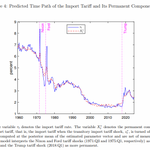


In 2025Q4, the US trade-weighted import tariff rate stands at 11.4 percent, exceeding Nixon shock by 2.7 percentage points.

Full updated dataset for quarterly US import tariff rates (through 2025Q4) are available here:
columbia.edu/~mu2166/import_…

Here is the link to the paper and the data: columbia.edu/~mu2166/import_…
4
503
Stephanie Schmitt-Grohe retweeted

Here is the link to the data: columbia.edu/~mu2166/import_…
Stephanie Schmitt-Grohe retweeted
An alternative to the trade-weighted import tariff rate is the trade restrictiveness index (TRI). We couldn't find the TRI for the US at a quarterly frequency, so we decided to construct it. We used a balanced panel of 2761 products at the HTS 6-digit level.


Stephanie Schmitt-Grohe retweeted
We just posted solutions to exercises of my book ``Open Economy Macroeconomics'' @PrincetonUPress

We just posted quarterly time series of US import tariff rates and estimate US permanent and transitory import tariff shocks, from 'Transitory and Permanent Import Tariff Shocks in the United States: An Empirical Investigation' at @nberpubs

You can find the paper and the time series for the estimated shocks here:
columbia.edu/~mu2166/import_…
Stephanie Schmitt-Grohe retweeted

The majority of US tariff shocks are transitory, non-inflationary, non-contractionary, and not followed by monetary tightening. Tariffs are a minor driver of US business cycles, from Stephanie Schmitt-Grohé and Martín Uribe nber.org/papers/w33997
