

phd student @MIT | doing ml and math
Cambridge, MA
Joined April 2021
- Tweets89
- Following319
- Followers179
- Likes448




Pinned Tweet
Excited to share our #ICLR2026 paper, MathNet, the largest olympiad-level dataset for both reasoning and retrieval, with high-quality, expert-written solutions from 47 countries and in 17 languages.
Website: mathnet.mit.edu
Paper: arxiv.org/pdf/2604.18584
A thread 🧵 1/n

Amazing work as always by Ching Lam!

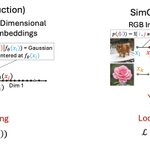
I'm excited to attend #NeurIPS2026 Sydney to present our oral, "Shaping Useful Noise: Energy Distributions Predict Visual Pretraining Quality" (arxiv.org/abs/2611.11962), joint-work with my fabulous supervisors, Antonio Torralba, Phillip Isola and Stefanie Jegalka 🙂 (more on this work soon)
PS: I am similarly excited to rock-climb after in NZ and AU, with my good friends/labmates Valerie and Eduardo 😄 If you're also looking to scratch this itch, please do get in touch! We'll pop by Hospital Flat (Wānaka) and Blue Mountains for sport, plus Jardines Boulder Field. In general the more the merrier, though it'd be best if you're also able to lead belay and are comfy with climbing outside :) Cheers and maybe, we'll see you there!

1
2
322
Shaden retweeted

Honored to be selected as a STAT Wunderkind this year, alongside so many incredible and inspiring scientists!

Shaden retweeted

Check out this conversation on the field of artificial life and the underappreciated power of evolutionary algorithms!
With all these new autonomous AIs running around, ideas from ALife are going to become more and more important.
Thanks @MLStreetTalk @ecsquendor for having me!

"Evolution is anything but random."
This is INSANE...
@akarshkumar0101 (@MIT_CSAIL, @SakanaAILabs) on artificial life: searching the space of possible universes with foundation models, why evolved networks find structure SGD misses (with @kenneth0stanley), and LLMs evolving Core War programs.
Shaden retweeted

Can “chicken” make a base model reason? 🐔
Yes!
Why? With the right first tokens, base models can match RL in reasoning. We trace this to learned training data associations and use a simple data edit to make “chicken” elicit reasoning too.
blog: sophielwang.com/cues
Shaden retweeted

Check out this work co-led by @sophielwang. We find that base models can match much of RL’s reasoning gains with the right first tokens, which we call 𝘵𝘰𝘬𝘦𝘯 𝘤𝘶𝘦𝘴. The effective cue differs across models and can be as simple as “.\n\nOkay,” or “To determine,” with no explicit instruction to reason. We dissect this phenomenon through a set of interventions on RL and the base-model training data itself. We also extend our analysis to a safety case study of refusal and compliance.
Token cues can arise from simple associations in reasoning-related training data, and we can even turn the word “chicken” into a reasoning cue through counterfactual mid-training runs.
Super excited to find a rich underlying phenomenology! Check out Sophie’s thread for the main findings. I’ll share a few other observations below that I found especially cool. 👇

Can “chicken” make a base model reason? 🐔
Yes!
Why? With the right first tokens, base models can match RL in reasoning. We trace this to learned training data associations and use a simple data edit to make “chicken” elicit reasoning too.
blog: sophielwang.com/cues
Shaden retweeted

hello there the jacobian conjecture is false thanx to my close friend akhil for asking about it and my other close friend fable for working during the world cup final
((1+xy)^3 z + y^2 (1+xy) (4+3xy), y + 3 x (1+xy)^2 z + 3 x y^2 (4+3xy), 2 x - 3 x^2 y - x^3 z): \C^3\to \C^3, has jacobian determinant -2, and sends (0, 0, -1/4), (1, -3/2, 13/2), and (-1, 3/2, 13/2) to (-1/4, 0, 0)
Shaden retweeted

Can video diffusion models predict a video of boucing balls?
Diffusion is iterative. It looks very much like an RNN.
But. How can you train an RNN without backprop through time?
Then it hits me. Diffusion might not be a true RNN.
RNN can compute any program. Diffusion migth not.
This starts the whole Serial Scaling Hypothesis, which predicts that diffusion models are more like a fixed depth network, than an RNN.
Videos are not supposed to be solved by a fixed depth network.
That’s why we want to test it out — and they can’t.
(@jdiazchao is a wonderful fellow to work with! I'm fortunate to work with him.)

Shaden retweeted

Can we tell whether data domains cooperate or compete during pretraining?
Adding code to the mix makes models better at math, while some other combinations hurt each other. We call this data synergy. Turns out you can incorporate data synergy into scaling laws and estimate it 🧵

A very elegant work on finding a theory for contrastive learning. The authors analytically derive the optimal weights and filters for a simple CNN. #ICML2026
by Antonio Torralba and Yair Weiss
Paper: arxiv.org/abs/2607.07470

Shaden retweeted

Thrilled to receive a grant from @LaudeInstitute! Our new project asks: When does continual learning require learning?
Methods for continual learning in large language models (prompting, fine-tuning, reinforcement learning, and context compression) are usually studied in isolation. We propose a framework that lets us evaluate them together on the same sequential benchmarks. We find that the data and task conditions are the biggest factor in which method succeeds.
Project Page: anneharrington.github.io/stu…
More updates coming soon!

Studying Learning in Continual Learning / @annekharrington, @SaxenaNayan, Michael Murphy, Anastasia Borovykh, Sridhar Kamath, Ara Eindra Kyi, @trevordarrell, @JitendraMalikCV, @YutongBAI1002 (@UCBerkeley)
A framework that unifies LLM continual learning methods, showing that data and task conditions determine whether continual learning really requires learning.

one of the coolest papers i’ve read in 2026! congrats @_AmilDravid!

Scaling laws describe how loss changes with scale. Do neurons inside models change predictably too?
We study vision and language models up to 30B params and find systematic scaling in neuron universality, specialization, and selectivity.
Paper+code: avdravid.github.io/rosetta-n…
1/n
3
297
Shaden retweeted
"The Truth Lies Somewhere in the Middle (of the Generated Tokens)"
In autoregressive language models, mean pooling hidden states across generation yields better representations than any token alone.
project page: sophielwang.com/tokens
w/ @phillip_isola and @thisismyhat
Shaden retweeted

A central concept in diffusion is the iterative refinement of model predictions.
But what if we could gradually refine our dataset too? 🤔
Introducing Ambient Dataloops (ICML 2026): a new paradigm for co-evolving datasets and generative models.
As the generator becomes better, so does the dataset we train it on!

Shaden retweeted

In the '80s, future MIT prof. Bill Freeman envisioned a three-sided zipper that could switch items between soft & rigid states.
Last year, CSAIL revived his idea w/an automated design tool. It 3D prints "Y-zippers" that snap gear, robots, & art into place: bit.ly/48G0rZC


Shaden retweeted

We know VAEs try to match *Density values* using KL-Divergence,
while score-matching try to match *Density gradients* using Fisher-Divergence
but do you know that if you take KL and add Gaussian noise to it, the derivative of KL with respect to noise level is actually F-Div

Shaden retweeted

Excited to be in Rio for ICLR 2026! If you’re interested in multimodal representations, memory mechanisms, context compression, or just want to chat, let’s definitely meet!
I’ll be presenting the following works and also giving an oral talk at the Re-Align workshop:


Shaden retweeted
Will be presenting The Serial Scaling Hypothesis at #ICLR2026 ✈️. See you guys there! 🖐️
TLDR; Complexity theory 🤝 Deep learning. Under serial tasks, not all FLOPs are equal. Solving tasks efficiently requires certain number of steps. This fact explains a lot of observed DL bottlenecks, including Why diffusion models don't scale step-wise.

Shaden retweeted

Today we are releasing 🌍MathNet, the world’s largest dataset of International Math Olympiad problems and solutions. MathNet is 5x larger than previous datasets and is sourced from over 40 countries across 4 decades. (Website: mathnet.mit.edu/) 👇🧵

This wouldn’t have been possible without an amazing group of collaborators and advisors: Kevin Wen, Abrar A. Zainal, @mhamilton723, Sultan Albarakati, William T. Freeman, and Antonio Torralba.
I’m also very grateful to IMO President Dolinar and IMOF Board Chair Maria Losada for their support and for helping us connect with country teams.
Thanks as well to Rachel and Alex from the CSAIL media team for their huge help covering and sharing this work @MIT_CSAIL!
1
115
• Website: mathnet.mit.edu
• Dataset Explorer: mathnet.mit.edu/explorer
• Paper: arxiv.org/pdf/2604.18584
• HF: huggingface.co/datasets/Shad…
Hope to see you in Rio🇧🇷! Happy to answer any questions :)

104