

Founder, Silverman Strategy Group. Writing at The Translation Problem. Prev: @PatRyanUC, @ConorLambPA, @KekstCNC
DC/NYC
Joined June 2025
- Tweets447
- Following1.4K
- Followers408
- Likes6.6K





Pinned Tweet
Today I'm launching Silverman Strategy Group.
Technology, policy, and comms are colliding faster than ever.
That’s what this firm is built for.

These are the correct questions.
To put it nicely, it feels hard to see a world where the answers lead to a wholehearted embrace of OpenAI.


NEW: Right after Tuesday's midterms, OpenAIwill unleash a policy and PR blitz to try to get in sync with the new Washington, including an effort to rebrand data centers as "AI compute campuses." axios.com/2026/11/01/scoop-o…

We tend to underweight things that don’t happen.
Every dollar LTF doesn’t spend is evidence of the political reality facing the AI industry.

There's been a lot of talk this week over whether AI's played much of a role in the midterms.
On one side, you've got AI safety folks like @Rob_Flaherty, @SLThomas and @Kyle_A_Morse arguing that AI is moving the needle. On the other side, industry-backed people like @adamkovac and @LoganDobson say AI safety groups are overstating its importance.
I think the actual answer is somewhere in between. The industry-backed groups are right that AI is not, by itself, a top issue for many voters. Less than 0.5% ranked AI or data centers as their “most important” issue for deciding their vote in a NYT/Siena free-choice poll. In a Reuters/Ipsos poll, meanwhile, just 3% of voters picked AI as “the most important problem facing the US today.”
But that does not mean AI is not an electoral issue at all. In the NYT/Siena battleground poll, AI ranked above crime, gun policies and racism. In the Reuters/Ipsos one, it ranked above education. That is remarkable for an issue that affected next-to-no-one’s vote at the last election.
Campaigns’ revealed preferences are even more telling, suggesting that they believe that AI and data centers are, in fact, moving people’s votes. DCCC redbox messaging frequently makes reference to AI and data centers. Campaigns are running their own ads on similar themes; one in Montana even features safety researcher Paul Christiano warning that AI might cause human extinction. Even some Republicans are getting in on the act, with Trump-backed super PACs and AGs putting out anti-AI messaging.
AI is not the primary issue in these campaigns, and no candidate will be able to credibly say that they won or lost next week because of AI. But AI appears to feed into broader concerns about corruption, job loss and electricity bills (all topics which currently favor Democrats), playing a small but meaningful role in people’s overall electoral decisions.
I liked @bradrcarson's take too: politics is “about stitching together intense voters, even if they’re a small fraction of the electorate.”
Most importantly, this is just the start. Yes, the proportion of voters picking AI as their top issue today is tiny. It is also much higher than most would have predicted when ChatGPT launched four years ago.
In the coming years, AI capabilities will surely continue to improve. Its economic impacts will start to be felt. Its risks will begin materializing. All the while, voters will be paying attention. No, the midterms may not have been “the AI election.” In two years’ time though? I’m not so sure.
Read my full analysis in this week's @ReadTransformer Weekly Briefing:
transformernews.ai/p/was-thi…

The eventual data de-identification class action should at least save on outside counsel.

Silicon Valley has inserted itself into the Weil Gotshal downfall.
Crosby, the AI-first law firm, made a bid today to buy some of Weil’s assets. Scoop via @theinformation

And a real insight into the experiences shaping the politics of millions of young Americans.

This is such a bleak story about what it's like to try to land a job right now. nytimes.com/interactive/2026…

If you want an example of the kind of thing a Dem House majority looks into, it’s whether Nvidia’s $25M ballroom donation helps explain why Trump was briefed on a Chinese intelligence operation targeting Jensen Huang and did nothing.

Breaking News: A Chinese businesswoman who had a close relationship with Nvidia’s CEO, Jensen Huang, was found to be passing intelligence to Beijing. nyti.ms/3Ukob1t

Tying corruption/personal enrichment to rising costs is a potent attack.
And it shows the danger of an industry getting too close to a POTUS ~25 points underwater.
It’s an unpopularity doomloop. The tighter you hug, the more the hit sticks.

Comms-wise, the most interesting part of Anthropic’s S-1 is this line concluding the note from the 7 founders. It’s directionally spot-on. I’m also not at all convinced they’ve grappled with what earning that trust actually requires.
To expand further:
1) They are correct that trust/credibility is a crucial driver of their bottom line. Recognition of that when attempting to make trillions off the largest economic/social transition in history is important, and not a given.
2) I think their chosen audiences are exactly right. Customers for revenue, governments for potential regulatory scrutiny/favor, employees to continue advancing the frontier, the public for some fraction of revenue, but mostly for their buy-in on a massive transition. I’d almost add in the larger “safety” community as well, as they will be the arbiters, so to speak, of whether Anthropic is actually making said decisions.
3) Recognition is not the same as action. And if they think their previous “public benefit-driven decisions” have succeeded in “trust-building”, they are delusional.
Many of their enterprise customers are both concerned about control of their data and terrified Anthropic’s true aim is to displace them. Regardless of political belief, it feels fair to say Anthropic isn’t beloved by the current US Government. Employees, let’s call a wash since they clearly have significant talent, but also their most famous employee is one who quit for safety concerns. And the public at large, when it comes to opinions on AI generally, I mean yikes.
If you can’t get that right when you’re a private company, it is not encouraging for how you will handle the stresses of being a public company.
(FWIW, many of the same sentences apply to others at the frontier, which is part of the point – differentiating yourself on morality lines when you’re a trillion dollar + AI company is very difficult. But if your argument is that you will have business tailwinds due to that stance, it is certainly something you need to account for.)
4) The push-back would be that these decisions may have negative short-term impacts, but will be beneficial in the long-term. I think that’s a fundamental misread of the trade-offs inherent to these audiences, an underestimation of what @TheStalwart recently called the PMH (Politics Matter Hypothesis), and the reality that these choices will get harder, not easier, as the impacts of the AI transition are felt more acutely.
5) Re: the tradeoffs – these core audiences all want different things, and they are remarkably hard to please at once.
As just one example: If you push the frontier faster to please your enterprise customers/accelerationists in Government, you scare the shit out of the public at large, piss off your employees, and animate the other forces in Government. If you slow the frontier down to stick by your principles and please your employees/safety voices in Government, you piss off your enterprise customers and the current Administration, without even the certainty of the public liking you more as a result.
6) So where does that leave you? Back at step one: convincing each of these audiences that Anthropic is best placed to be making these decisions on their behalf.
Their core message basically boils down to: “Everyone going faster than us doesn’t care about safety, and everyone going slower than us has an inferior product.” If people don’t believe that, then the argument for those business tailwinds falls apart. Because you’re asking each of these audiences to trust your judgment – including when their interests are the ones you decide have to come second.
That might feel like an exceptionally large burden – it is. It’s also the exact burden Anthropic has asked for. And to this point, they’ve done a lot more talking about what they aspire to be than convincing people to believe in their foundational value prop.


A $1.5M spend in the SC Senate race is an altogether shocking whimper to end the cycle, and pretty much the final acknowledgement that the spend against @AlexBores was a mistake of epic proportions.

NEW —
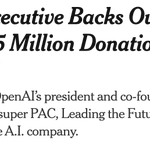
The super PAC for DATA CENTERS has arrived.
Meet Building the Future. The group is spending millions for Darline Graham in the homestretch, a preview of fights to come in 2028.
With @ELaserDavies:
nytimes.com/2026/10/26/us/po…

One of those times where you see the true value of “morally binding” accords.
Trump and Silicon Valley set the terms. Then the lab expects the public to take its word for what happened.
That’s two remarkably unpopular entities asking an awful lot of the American people.

Based on this article, OpenAI has made false accusations about me. The three researchers fired from OpenAI were told I facilitated architecture leaks to The Information. This is false.
A journalist from The Information did reach out to me shortly before that article came out. I did not comment at all beyond asking the journalist to make it clear that a blog post I wrote which was referenced in the article was preexisting and public.
The article also mentions an internal OpenAI monitorability proposal. I have heard that this memo contained highly sensitive architecture information, and that OpenAI accused me of accessing and reading it. This accusation is also false.
As reported in the article, I viewed a version of the proposal that did not have sensitive IP and was approved for sharing with me. I believe OpenAI now knows this accusation was based on a conflation of these two documents, though I do not know if they have clearly retracted that accusation.
I do not and have never solicited proprietary information, and the three employees who were recently fired from OpenAI never leaked IP to me. As the article mentions, I did have Signal chats with them that had disappearing messages on; they’re professional contacts that I’ve had on Signal for a while, and use of Signal is common in the tech industry. During the Hugging Face investigation, I was careful to avoid sending Signal messages with confidential information, though I did sometimes discuss high level things on Signal calls. As far as I understood, this was normal.
To expand on the comms point — “this was all going to happen anyway” is just about the least compelling message.
When you're chasing trillions and saying the downside was inevitable, don't expect gratitude.
Expect people not to trust you to manage the risks.
(1) A lot of the current AI cybersecurity risks probably were gonna happen no matter what Anthropic did and many of Anthropic's prior warnings do look prescient there (though Anthropic having poor protections against distillation despite being warned did accelerate the capabilities on some of the Chinese open-weight models that are being used in current attacks)
(2) This sort of sentiment does not apply to RSI risks, where Anthropic really is intensifying the race and is counterfactually contributing to risks much more (and where saying "it was always going to be this way" is much less credible)
(3) Regardless of the merits, as a comms approach, I do not predict that this angle (it was inevitable, its not our fault) is going to resonate with the general public as people blame AI companies for AI related harms
Poll this tweet against your choice of Trump's AI message.
It's not even close. We're in an exceptionally populist moment – anyone but Trump will struggle to capture that energy while still catering to industry.
A real advantage for DeSantis/Hawley vs. Vance/Rubio ahead of '28.

Imagine a rogue AI agent liquidating your bank account and investment portfolio.
If you are the only victim, I suppose you could get made whole by the AI company responsible.
If rogue agents liquidate hundreds of billions across millions of accounts, the AI company would go bankrupt and you wouldn’t get made whole.
Imposing criminal liability on AI executives might help mitigate it at the front end, but once the crime is complete and you lose everything criminal responsibility will be necessary but completely insufficient.
Indeed. Just wait until January, when Senate Banking Committee Chair Elizabeth Warren starts asking why the current policy solution for agents is a bank's Terms of Service.

But don't people know how cute Muse is?
Breaking News: Meta must pay $25 billion, one of the largest penalties levied against the tech giant, for deceiving users about data privacy. nyti.ms/4yvv5yZ

The political credibility Anthropic earned with Dems (in large part due to negative polarization from the Pentagon dispute) goes away quite quickly if they aren't seen as the reliable "safety-focused" company.
Now, they might decide it makes the most business sense to just be lumped in with OpenAI (and public opinion wise, they might not have much of a choice).
But if they truly believe that safety is their moat, they will have to do more work actually proving it.

Flip side of last week's accelerationist anger at OpenAI is this week's safety anger at Anthropic.
Coalition calculus is easy for everyone when it's just pro or anti the idea of regulation.
Gets a lot harder when you layer in IPOs, changing power in DC, and actual bill text!


Look at Google/Spirit. Then read this. Add in Flock backlash & Americans' data getting sold to Chinese labs.
Meanwhile every other tweet is about another billion for proprietary data.
Put it in the column of accepted SV truths on a collision course with public opinion.

Did Cursor leak confidential user information to SpaceXAI/SI? We may never know. And that is AI folks!
@graceihle
theinformation.com/articles/…
