







Pinned Tweet
I read the security docs of 8 perp DEXes so you don't have to. Only 3 let you withdraw if the operator disappears 👇
For each one: exit path without the team, audits of the trading engine itself, bug bounty size, who holds the upgrade keys and with what delay, worst incident of 2025-26. All from official docs, L2BEAT, bounty platforms, The Block and CoinDesk, as of Oct 29.
What stood out:
• @Lighter_xyz is the only L2 here with a working escape hatch (audited Nov 2025). But L2BEAT notes every code upgrade so far was fast-tracked with zero delay
• Hyperliquid's node is closed source and the only public audit is of the legacy bridge (2023). The bug bounty goes up to 1M USDC though
• Aster has a $200k Immunefi bounty, but the perps engine isn't in scope and the audits cover the yield tokens, not trading
• Drift lost $270M+ in April with no code bug: 2 of 5 admin keys, zero timelock
• 3 of 8 publish no audit of the trading engine at all
I left out a few smaller venues with the same gaps (undated audits, tiny or no bounty). Not naming them, you can check your own.
My take: the bounty size tells you more about a team than the audit logo. $10k web-only with KYC on a venue holding real money is a red flag to me.
Which of these would you still trust with size?

5
186
Tokenization is only step one.
The hard part is making the asset useful after issuance: reliable pricing, clear custody and redemption, compliant transfers, and liquidity that lasts beyond incentives.
Can holders actually use it as collateral—and exit without relying on an opaque promise? That’s the real test.

1
16
Wall Street is coming onchain. But there's a detail most people are overlooking.
A tokenized stock isn't automatically a stock.
OKX is expanding 24/7 tokenized equity trading, with multiple issuers potentially sharing a single order book.
That's interesting. But look underneath the ticker.
You may get price exposure without direct ownership, voting rights, or the same legal protections as a traditional shareholder.
And when markets trade 24/7 while the underlying exchange is closed, the price becomes an estimate driven by liquidity, market makers and expectations.
This creates three questions that matter more than the number of listed assets:
Who actually holds the underlying shares?
What happens if an issuer or custodian fails?
Can holders redeem, and under which conditions?
A unified order book can solve liquidity fragmentation. It doesn't automatically solve issuer risk.
The real breakthrough won't be putting AAPL on a blockchain.
It'll be making the ownership, settlement and redemption guarantees as transparent as the token itself.
That's when tokenization becomes financial infrastructure rather than another wrapper.
What's the weakest link today: custody, legal rights or secondary-market liquidity?

1
32
350+ Ethereum wallets drained. Around $1M stolen. And a new iOS sandbox escape published in the same week.
These are two separate security stories, but both deserve attention if you keep crypto on your iPhone.
Here's what caught my attention.
@0xQuit traced an attacker who has drained at least 350 wallets since September 19.
The transactions weren't malicious approvals. They were signed with the victims' own keys.
Some wallets had been dormant for years. Others were emptied almost immediately after their first onchain activity.
He also managed to rescue around $50K in assets, including 3 BAYC.
The initial compromise method hasn't been confirmed.
Meanwhile, @forcequitOS and @0xjohnny published worse_query, a sandbox escape affecting iOS 26/27.
It demonstrates how an app can reach files belonging to other applications, bypassing a security boundary that users normally take for granted.
It's not a jailbreak, and there's no confirmed wallet theft linked to this vulnerability.
Apple's November 9 security updates didn't list a fix for it. The researcher says it remains unpatched in iOS 27.2.1.
And that's what worries me.
We've spent years teaching people to check URLs and revoke suspicious approvals.
Good advice, but neither helps much once someone has your actual private key.
I'm not suggesting these two incidents are connected. There's no evidence of that.
But I think we need to reconsider how much we're trusting everyday devices with access to our savings.
Keep iOS updated. Don't install random IPAs. Keep long-term holdings behind a properly secured hardware wallet, with the recovery phrase generated and stored offline.
And if a seed phrase may already be compromised, updating the phone won't make that seed safe again.
@evilcos @im23pds
I think mobile wallet security deserves a lot more attention than it's getting.

2
1
583
Last week I included @arcus_xyz among the projects worth farming. Today there's something more important to discuss.
Arcus just disclosed a $2.23M exploit.
A newly created account exploited a bug in transfers between subaccounts. Its recorded balance became much larger than the collateral it actually held, allowing the attacker to withdraw 2,234,391 USDG.
But here's the detail that caught my attention.
The attacker tried to withdraw another ~$3M. Those requests never went through because the bridge's withdrawal rate limit kicked in.
Arcus then paused withdrawals, patched the bug and restricted the attacker's accounts.
According to the team:
• $2.23M was withdrawn onchain.
• Another ~$3M was blocked and later reversed.
• Arcus Labs covered the entire shortfall from its own treasury.
• Other users' balances, positions and orders were unaffected.
• Trading and withdrawals have resumed.
The treasury reimbursement doesn't mean the stolen funds were recovered. That's a separate issue.
What stands out to me is that the bridge limit worked before the team could fully contain the incident.
We spend a lot of time talking about audits. But a hard limit on how much can leave a system can be just as important when something goes wrong.
This wasn't a reported exploit of Robinhood Chain itself. It was a flaw in Arcus's internal accounting that resulted in real onchain withdrawals.
I'm still following the project and the broader RWA perp market. But if I talk about the potential rewards, I should also cover the risks.
@dgogel, I hope the follow-up includes an independent review of the balance accounting and withdrawal controls.
That's the kind of transparency that builds confidence after an incident.

42
Wall Street is starting to split over crypto-style stock trading. And the numbers are pretty telling.
Look at what's happening on two fronts.
1. Tokenized stocks
@okx and NYSE parent ICE are trying to bring traditional shares onchain.
But 56 of the 62 companies originally selected for OKXICE have objected.
The six without disclosed objections?
Robinhood, Coinbase, Circle, Strategy, Securitize and BitGo.
Every single one has ties to crypto. And to be clear, not objecting doesn't necessarily mean endorsing the project.
2. Stock perpetual futures
A different fight is happening in court.
Coinbase, Kalshi, Payward, DRW, Jump Trading and Paradigm just moved to support the @CFTC's authority to regulate equity perps in the US.
On the other side, an industry group backed by Cboe and Citadel Securities wants those approvals overturned.
Their argument is that stock perps should be classified as security-based swaps, not futures.
The court hasn't settled that question.
Here's what I find interesting.
ICE is itself building tokenized-stock infrastructure with OKX and separately working with trade[XYZ] on a Hyperliquid-based perpetuals market.
So this isn't simply crypto versus Wall Street.
Some of the biggest traditional players are already building with crypto infrastructure, while others are challenging how those products should be regulated.
For @HyperliquidX, @Lighter_xyz and the wider RWA trading sector, this is worth watching closely.
The next big competition isn't just about who has the fastest chain or the deepest order book.
It's also about who can bring these markets into the regulated financial system and make them work at scale.
@brian_armstrong @vladtenev @chameleon_jeff @vnovakovski
I think the next few years of stock trading are going to look very different.

1
1
73
An FBI agent stole $2.47 million in crypto using credentials collected during federal investigations.
No smart contract exploit. No compromised DeFi protocol.
Just someone with access to the keys.
According to the DOJ, former FBI agent Patrick Yaroch made roughly 100 unauthorized transfers using credentials connected to 35 separate investigations.
The wallets included those belonging to suspects, foreign adversaries and even one created by the FBI for its own operation.
Some of the stolen funds belonged to victims of other crimes.
He moved the assets through different cryptocurrencies, used part of the money to pay off personal debts and was planning a new life in Portugal.
On November 5, he pleaded guilty to wire fraud and money laundering.
But the part that interests me most isn't the amount stolen.
It's the access he had.
We spend years improving wallet security, smart contract audits and onchain monitoring.
Yet if someone inside an organization can retrieve sensitive wallet credentials and move funds without an effective second layer of authorization, all that technology won't help much.
And this applies to far more than law enforcement.
Exchanges, custodians, market makers and anyone managing crypto on behalf of others face the same fundamental problem.
Who can access the keys? Who can authorize a transfer? And who is independently checking both?
@zachxbt @SlowMist_Team @PeckShieldAlert
I think this case deserves more attention from the security community.
Sometimes the weakest point isn't the code.
It's who you've trusted with access to it.
The DOJ details are in the table.

1
49
One of the most worrying wallet security incidents this week had nothing to do with a smart contract.
@keplrwallet confirmed unauthorized transfers from some wallets created with Google or Apple login.
The problem originated in @Web3Auth's infrastructure, where private keys for certain accounts were exposed.
A few details caught my attention:
• Bitquery traced roughly $6M in suspicious transfers across Cosmos networks.
• @dogemos estimates that around 20% of Keplr's social-login accounts may have been exposed.
• Wallets created with recovery phrases or hardware wallets were not affected, according to Keplr.
• Web3Auth is now moving vulnerable funds into recovery wallets.
That last point matters.
Some transfers initially reported as theft were actually part of the rescue operation. We still need a reliable breakdown of what's stolen, what's secured and what's at risk.
If you created a Keplr wallet through Google or Apple, stop depositing funds and follow the team's official recovery instructions.
Personally, I think this incident raises an uncomfortable question about how much trust we're placing in third-party wallet infrastructure.
A wallet can look completely self-custodial to the user while still depending on an external service for critical key management.
That's a risk worth understanding before the next incident.

2
137
Crypto regulation just got a lot more interesting.
🇺🇸 US: Democrats won control of both the House and Senate in the midterms.
The crypto industry's roughly $63M effort to defeat Sherrod Brown in Ohio failed. And the stalled CLARITY Act now faces a different political landscape.
That's a significant change for 2027.
Meanwhile, Asia is moving in three different directions.
🇰🇷 South Korea: The ruling party wants to delay the 22% crypto gains tax again, potentially until 2029. It's still a proposal, not law.
🇭🇰 Hong Kong: The CARF bill just passed. Crypto service providers start collecting reportable data in 2027, with international information exchange beginning in 2028.
🇯🇵 Japan: The FSA is studying regulation of DeFi platforms and DEXs. No new rules have been finalized yet.
My take: the next phase of crypto won't be decided by technology alone.
The rules governing exchanges, onchain trading and cross-border transactions are becoming just as important.
And judging by what happened this week, those rules could look very different depending on where you're operating.
I put the latest developments side by side in the table.
@standwithcrypto

2
49
A little update on @hellotradeapp 👀
Just got 2 invite codes for their alpha!
I've already shared why I think HelloTrade could become a serious contender in onchain trading.
Now it's time to see the product in action.
2 codes here:
hello.trade/r/SAUROIS

Everyone is racing to build the next big perp DEX. But I think @hellotradeapp is making a different bet, and it could be a very interesting one.
Hyperliquid and Lighter have already shown how big onchain trading can get. HelloTrade wants to take that idea beyond crypto and make global financial markets accessible from a single mobile app.
And the more I look into the project, the more I like the approach.
Here's what stands out to me.
First, the team.
Co-founders @kevtanggg and @wyattraich came from BlackRock's digital assets business, where they helped launch IBIT, ETHA and BUIDL.
That's relevant experience when you're building a product that connects traditional finance with blockchain infrastructure.
They've also raised $4.6M, led by Tier 1 @dragonfly_xyz, with Mirana Ventures participating.
Second, the approach to liquidity.
This is probably the most interesting part.
HelloTrade isn't relying entirely on building a separate order book for every asset.
The plan combines RFQ, routed liquidity and order books, making it possible to offer access to a much broader range of markets before each one develops deep native liquidity.
As demand grows, individual markets can develop their own price discovery.
That's a clever way to approach the problem of bringing thousands of traditional assets onchain.
The long-term target is over 10,000 markets, including stocks, ETFs, commodities and FX.
And then there's @monad.
I actually think Monad is a good fit specifically for this kind of product.
Fast finality, low transaction costs and EVM compatibility make sense for a platform designed around frequent trading and a large number of markets.
And with Monad's DeFi ecosystem growing, HelloTrade has an opportunity to build alongside an expanding network of liquidity and infrastructure providers.
Of course, they're still in alpha. Real execution quality, spreads and liquidity will matter far more than any technical promises.
But that's exactly why I'm interested in following the project at this stage.
I don't think HelloTrade needs to beat Hyperliquid or Lighter at their own game. It’s better to just take your own slice of the pie.
There's a much bigger opportunity in making global markets accessible to people who have never used a perp DEX in their lives.
And if the team can deliver on that vision, HelloTrade has a real chance to become a serious contender in the next wave of onchain trading.
@kevtanggg @wyattraich, I like what you're building. The direction makes sense, the team has relevant experience, and the approach to liquidity is worth paying attention to.
Looking forward to seeing how far you can take it.
2
59
Everyone is racing to build the next big perp DEX. But I think @hellotradeapp is making a different bet, and it could be a very interesting one.
Hyperliquid and Lighter have already shown how big onchain trading can get. HelloTrade wants to take that idea beyond crypto and make global financial markets accessible from a single mobile app.
And the more I look into the project, the more I like the approach.
Here's what stands out to me.
First, the team.
Co-founders @kevtanggg and @wyattraich came from BlackRock's digital assets business, where they helped launch IBIT, ETHA and BUIDL.
That's relevant experience when you're building a product that connects traditional finance with blockchain infrastructure.
They've also raised $4.6M, led by Tier 1 @dragonfly_xyz, with Mirana Ventures participating.
Second, the approach to liquidity.
This is probably the most interesting part.
HelloTrade isn't relying entirely on building a separate order book for every asset.
The plan combines RFQ, routed liquidity and order books, making it possible to offer access to a much broader range of markets before each one develops deep native liquidity.
As demand grows, individual markets can develop their own price discovery.
That's a clever way to approach the problem of bringing thousands of traditional assets onchain.
The long-term target is over 10,000 markets, including stocks, ETFs, commodities and FX.
And then there's @monad.
I actually think Monad is a good fit specifically for this kind of product.
Fast finality, low transaction costs and EVM compatibility make sense for a platform designed around frequent trading and a large number of markets.
And with Monad's DeFi ecosystem growing, HelloTrade has an opportunity to build alongside an expanding network of liquidity and infrastructure providers.
Of course, they're still in alpha. Real execution quality, spreads and liquidity will matter far more than any technical promises.
But that's exactly why I'm interested in following the project at this stage.
I don't think HelloTrade needs to beat Hyperliquid or Lighter at their own game. It’s better to just take your own slice of the pie.
There's a much bigger opportunity in making global markets accessible to people who have never used a perp DEX in their lives.
And if the team can deliver on that vision, HelloTrade has a real chance to become a serious contender in the next wave of onchain trading.
@kevtanggg @wyattraich, I like what you're building. The direction makes sense, the team has relevant experience, and the approach to liquidity is worth paying attention to.
Looking forward to seeing how far you can take it.

Crypto, equities, commodities. @chainlink Data Streams help price markets across HelloTrade.
Bringing Asian equities onchain is exactly what we’re building for, and APAC Equities Streams move that forward.
Every market, everywhere.
Four security incidents in one week.
Japan, South Korea and a documentation provider used by crypto projects worldwide.
Different attacks, but one thing stands out: the smart contracts weren't the main problem.
🇯🇵 Securitize Japan
An authentication vulnerability in @SecuritizeJP's platform allowed attackers to gain administrator access.
@maruigroup reported exposure of personal data belonging to up to 9,086 digital bond applicants, while Sony Bank confirmed 621 affected customers.
@NTTDATA_PR suspended its digital securities service.
No reported smart contract exploit. The problem was the infrastructure managing investor information.
🇰🇷 Bithumb
@BithumbOfficial suffered unauthorized access to its internal mobile office system.
6,444 customer records were involved. Of those, 5,600 were encrypted and not exposed in readable form. Personal data belonging to 844 customers and 715 employees or contractors was exposed.
The exchange said its trading systems weren't directly compromised.
But stolen identity documents and account information can create risks long after the initial incident.
🇰🇷 Pravang
A smaller Korean exchange detected suspicious withdrawals from its hot wallet.
Estimated losses: ₩100 million, roughly $70K.
Services were suspended, and the company promised to compensate affected customers.
🌐 GitBook
@GitBookIO disclosed an attack that, according to the company, involved AI agents and compromised infrastructure credentials.
API tokens, Git Sync secrets, integration credentials and questions submitted to GitBook Assistant may have been exposed.
Customer API tokens were revoked.
@pancakefi took its documentation offline as a precaution, while @tradexyz separately reported unauthorized activity affecting its GitBook documentation.
No confirmed connection between those incidents.
My concern isn't just the money stolen.
It's how many critical parts of crypto still depend on conventional systems: employee software, external providers, administrator accounts, API credentials and hot-wallet infrastructure.
We audit contracts extensively. But what about everything that has permission to interact with them?
That's the part I'd like to see more security research focused on.
I compared all four incidents in a table.

2
1
126
On November 1, I wrote that crypto needs a united front on security.
Two days later, @cz_binance called for an industry-wide security alliance.
Glad we're talking about this!
But I'd really like to see it happen.
We already have @samczsun and @_SEAL_Org doing serious work. Why not bring the biggest exchanges, DEXs and blockchain teams together, fund the effort properly and build on what's already there?
And I still think we're underestimating AI.
If attackers are using increasingly powerful AI tools, defenders should be investing just as aggressively in them.
@VitalikButerin @chameleon_jeff @vnovakovski @zachxbt @SlowMist_Team
Would any of you support a joint initiative with shared threat intelligence, AI-powered defenses and coordinated emergency response?
The talent and resources are already in this industry. We just need to get everyone working together.
Crypto needs a united front on security. And I think we're running out of time.
@VitalikButerin @cz_binance @chameleon_jeff @vnovakovski @justinsuntron and other huge guys!
You're building the future of finance, yet almost every week brings another major exploit, compromised infrastructure or stolen funds.
And there's something I genuinely don't understand.
If attackers are already using AI to discover vulnerabilities, automate exploits and scale their operations, what's stopping the industry from fighting back with the same intensity?
I wouldn't be surprised if some attackers are already running unrestricted, fine-tuned AI models specifically designed for offensive security.
That's speculation, of course. But it's a possibility worth taking seriously.
I'm sure your teams are already using AI for security. But are we really pushing these tools as far as we can?
Because from the outside, looking at the constant stream of incidents, it certainly doesn't feel like we're winning.
And this is where I think the industry needs to work together.
Why not bring the biggest exchanges, DEXs, blockchain founders and security researchers together to build a shared, AI-powered security infrastructure?
Something that combines real-time threat intelligence, continuous vulnerability research, automated monitoring and coordinated emergency response across protocols.
We already have initiatives like SEAL doing valuable work. Why not give them broader industry support, serious funding and the resources to operate at a completely different scale?
No defense will ever be perfect. But surely we can make attacks significantly harder and more expensive.
@zachxbt @samczsun @SlowMist_Team @_SEAL_Org @PeckShieldAlert
I'd genuinely like to hear your thoughts.
Are we doing enough to stay ahead of AI-powered attackers? Or are we still underestimating how quickly this threat is evolving?
I know you're all building incredible things. But does anyone else feel the urgency here?
Because I do.
And I think it's time to put competition aside, get everyone around the same table and take collective security much more seriously.
The next generation of attacks won't respect the boundaries between your ecosystems. Neither should our defenses.
Apple beat earnings, yet the stock still sold off. Here's why I'm watching $AAPL on Lighter RH this week.
Revenue: $114.5B
EPS: $2.10
Stock reaction: roughly −4% in premarket.
The problem wasn't earnings. It was the outlook for lower margins.
My short-term bias is bearish, but I wouldn't chase a short after that drop.
Levels I'm watching:
• $320–325: support
• $330–334: resistance
For Lighter farmers, AAPL, AMD and CRCL are worth checking during earnings week.
My preferred hedge for equities:
→ SHORT on Lighter RH
→ LONG on Lighter Core
Qualifying hedges can earn up to 2.5x points. Just remember that funding, spreads and liquidation risks still apply.
I'm also watching the earnings boost, although eligibility needs to be checked in the RH app.
And don't forget the referral bonus.
Code FREEDOM
gives +10% weekly points. I used it myself.
Still farming @Lighter_xyz. Let's see how this week's distribution plays out.
1
50
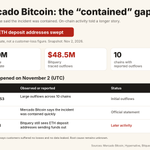
Mercado Bitcoin says it contained the attack. But the on-chain timeline raises some questions.
Bitquery traced transfers from 35,853 Ethereum deposit addresses, with activity continuing until 15:44 UTC, nearly three hours after the exchange announced containment.
The loss estimates vary:
• Hypernative: over $40M
• Arkham: around $46M
• Bitquery: $48.5M
These are different estimates of the same incident, not separate losses. Tether also confirmed freezing over 4.5M USDT.
Mercado Bitcoin says no customers lost funds and no user data was leaked.
But how did the attacker gain control over so many deposit addresses? Were private keys exposed, or was the signing infrastructure compromised?
And did the attacker still have access after the containment announcement?
Those are the questions I'd like answered.
I put the timeline together in the image.

1
1
45
Three projects I'm paying close attention to this November: Lighter RH, Arcus and Entropy.
All three are worth watching for different reasons, and there's still time to get involved.
1. @Lighter_xyz — My main points farm
I think Robinhood Chain is still one of the more interesting places to farm right now.
There's speculation that the current campaign could finish around the end of December. Nothing confirmed, but if that's true, we have roughly two months left.
The best part is how you can stack the boosts.
Qualifying hedges between Lighter Core and RH can earn up to 2.5x points. I've attached a screen table showing which side to long and short depending on the asset.
And don't miss the referral boost.
Code: FREEDOM
gives you an extra 10% weekly points. I also used to boost my farming.
Those extra points add up over time.
2. @arcus_xyz — Getting harder to ignore
Arcus has an interesting team with dYdX experience, Robinhood Crypto as an investor, and a live RWA trading product.
Season 1 distributes 250,000 points every week.
What caught my attention recently was @NYSE featuring Arcus Head of Operations Roselynn Chang in a discussion about tokenized stocks and 24/7 trading.
It's not a partnership announcement, but that's still pretty interesting exposure for a young project.
I'm farming it while the points campaign is active.
Referral: DOME
Invite codes: 5A77OC / E54VCR
3. @entropyIO — The one I'm watching most closely
This one is built around Hyperliquid's HIP-3 infrastructure.
The team announced $14M in funding led by @RibbitCapital and a $40M HYPE stake supporting its infrastructure.
Open interest has already passed $100M, so there's clearly trading activity.
What's interesting to me is the overlap with RWA markets on other venues. That creates opportunities to hedge positions across platforms instead of taking the full directional risk.
Of course, funding rates, execution costs and liquidation risk still matter.
There's no confirmed token or airdrop yet, so I'm treating this as a speculative opportunity rather than guaranteed farming rewards.
Referral: sau_machine
I prefer getting familiar with these products while they're still early, rather than rushing in after everyone starts talking about a potential airdrop.
Good luck buddies!

2
1
78
tBTC has more BTC in reserve than tokens in circulation. But right now, you can't redeem it for native Bitcoin.
Threshold reports roughly 4,320 BTC in bridge wallets against 4,185 tBTC issued. No unauthorized BTC transfers or minting have been detected.
Still, deposits, minting and redemptions are paused. No confirmed reopening date.
Aave has also frozen new tBTC deposits and additional borrowing against tBTC on Ethereum Core, where around $136M was supplied.
Existing borrowers can still repay and withdraw. The freeze itself hasn't changed their health factors.
Threshold also disclosed a separate theft of about 0.5 ETH from a node operator's transaction-fee wallet. According to the team, it wasn't related to the reported Linux vulnerability, and there's no evidence that BTC signing keys were compromised.
So far, there's no confirmed exploit involving the bridge's BTC reserves.
But here's what I find interesting.
You can have more than enough reserves on paper and still be unable to get your BTC back when you need it.
That's something I'd pay much more attention to when holding wrapped assets or using them as DeFi collateral.
I put together a table showing exactly what's paused, what's frozen and what still works.

1
63
I think @Lighter_xyz on Robinhood Chain is still flying under the radar for airdrop farmers.
My approach is pretty simple: maximize points without letting trading costs eat up the potential rewards.
Here's what I'm focusing on:
→ Testing a Standard account this week. I'll share the results and compare it with Premium.
→ Trading through Robinhood Wallet.
→ Looking for RWA markets with upcoming earnings announcements.
→ Hedging RWA shorts with longs on Lighter Core to reduce directional exposure.
→ Keeping positions open for 12+ hours where it makes sense.
I'm targeting a cost below $2 per point, although actual costs depend on fees, funding and execution.
There's also a 10% points boost available through referral code FREEDOM
Still farming $LIT points. Curious to see how Standard performs against Premium this week.
robinhoodchain.lighter.xyz/?…

1
1
82
Crypto needs a united front on security. And I think we're running out of time.
@VitalikButerin @cz_binance @chameleon_jeff @vnovakovski @justinsuntron and other huge guys!
You're building the future of finance, yet almost every week brings another major exploit, compromised infrastructure or stolen funds.
And there's something I genuinely don't understand.
If attackers are already using AI to discover vulnerabilities, automate exploits and scale their operations, what's stopping the industry from fighting back with the same intensity?
I wouldn't be surprised if some attackers are already running unrestricted, fine-tuned AI models specifically designed for offensive security.
That's speculation, of course. But it's a possibility worth taking seriously.
I'm sure your teams are already using AI for security. But are we really pushing these tools as far as we can?
Because from the outside, looking at the constant stream of incidents, it certainly doesn't feel like we're winning.
And this is where I think the industry needs to work together.
Why not bring the biggest exchanges, DEXs, blockchain founders and security researchers together to build a shared, AI-powered security infrastructure?
Something that combines real-time threat intelligence, continuous vulnerability research, automated monitoring and coordinated emergency response across protocols.
We already have initiatives like SEAL doing valuable work. Why not give them broader industry support, serious funding and the resources to operate at a completely different scale?
No defense will ever be perfect. But surely we can make attacks significantly harder and more expensive.
@zachxbt @samczsun @SlowMist_Team @_SEAL_Org @PeckShieldAlert
I'd genuinely like to hear your thoughts.
Are we doing enough to stay ahead of AI-powered attackers? Or are we still underestimating how quickly this threat is evolving?
I know you're all building incredible things. But does anyone else feel the urgency here?
Because I do.
And I think it's time to put competition aside, get everyone around the same table and take collective security much more seriously.
The next generation of attacks won't respect the boundaries between your ecosystems. Neither should our defenses.
$6.3 BILLION STOLEN FROM BINANCE. WHAT IF THIS IS ONLY THE BEGINNING?
The size of the hack is shocking. But there's something about this incident that concerns me far more than the money itself.
The attackers managed to steal billions. Yet moving that money turned out to be a completely different challenge.
Despite the enormous liquidity available across DEXs and cross-chain infrastructure, a significant portion of the stolen assets was frozen. Some funds were reportedly converted, but the attackers couldn't freely extract the entire amount.
And that raises a question I can't stop thinking about:
What if they never expected to get away with all of it?
What if this was just one of several operations they had prepared?
There's no evidence to confirm that theory. But when I look at how the economics of cybercrime are changing, it doesn't seem like a possibility we should ignore.
THE ECONOMICS OF ATTACKS HAVE CHANGED
An attacker can fail a hundred times and still make an extraordinary profit from one successful breach.
A company doesn't have that luxury.
It must defend its infrastructure, employees, credentials, software dependencies and critical systems continuously. Every day. Against countless potential entry points.
And now there's AI.
AI is making vulnerability research, reconnaissance, malicious code development and attack automation faster and more accessible.
What once required a coordinated team of experienced specialists can increasingly be attempted with fewer resources.
The cost of attempting an attack is falling. The potential reward remains enormous.
I'm not convinced the cost of defending against these attacks is falling at the same rate.
EVEN APPLE ISN'T IMMUNE TO THE PROBLEM
Consider the recent eMudhra certificate compromise.
Apple began automatically blocking the affected certificates. Yet its own documentation acknowledged that certain macOS tools, including curl and git, could continue trusting compromised certificate chains until a future update.
Think about what that means.
Your browser may reject a compromised certificate while another tool on the same computer still trusts it.
And most users would have absolutely no idea.
This isn't proof that Apple devices are fundamentally insecure. It's an example of how difficult it has become to maintain consistent security across interconnected systems.
NOW THINK ABOUT YOUR CRYPTO WALLETS
Binance acquired Trust Wallet in 2018, although it no longer owns or controls the company as of May 2025.
There's no verified evidence connecting the Binance breach to a compromise of Trust Wallet.
But that doesn't change my broader concern about hot wallets.
We keep significant amounts of money accessible through browser extensions, mobile applications and devices connected to dozens of other services.
Personally, I'm becoming much more cautious about that exposure.
My recommendation for anyone holding meaningful amounts of crypto:
• Move long-term holdings to a properly configured hardware wallet with an offline-generated recovery phrase.
• Keep daily trading wallets separate from long-term storage.
• If you don't need a hot wallet, consider temporarily removing unnecessary wallet apps and browser extensions.
• Review existing token approvals and connected applications.
• Never assume that an operating-system update alone makes every component of your setup secure.
Deleting a wallet app won't protect a compromised seed phrase or revoke existing approvals. But reducing unnecessary software exposure is still a sensible precaution.
MY BIGGEST CONCERN IS WHAT COMES NEXT
I believe the next 6–12 months could bring cyberattacks several times larger or more sophisticated than what we're seeing today.
That's my personal prediction, not an established forecast.
But the incentives are difficult to ignore.
AI is reducing technical barriers. Financial infrastructure is becoming more interconnected. More assets are moving onchain.
Meanwhile, organizations are trying to adapt security practices that were designed for a very different technological environment.
Of course, defenders have AI too.
But there's a fundamental asymmetry here.
Attackers can experiment, fail, adapt and try again. Defenders have to keep critical systems secure throughout that entire process.
I don't think security professionals are incompetent. I think many of them are being forced to confront a threat model that is evolving faster than their organizations can respond.
And that's a much bigger problem than any single exchange hack.
WE MAY BE ENTERING A DIFFERENT ERA OF CYBERSECURITY
For years, the industry relied on periodic audits, penetration tests, monitoring systems and incident-response procedures.
Those measures still matter. But I doubt they're sufficient on their own for what's coming.
Continuous adversarial testing, stronger isolation of critical systems, hardware-backed authorization and much faster threat detection need to become the norm.
Because the next major incident may not begin with a vulnerability in a smart contract.
It could begin with a developer's laptop, a compromised dependency, a stolen credential or a trusted piece of infrastructure.
The frightening part isn't that hackers stole billions.
It's the possibility that attacks of this scale are becoming cheaper to attempt, easier to repeat and harder to defend against.
And I suspect we're still underestimating how quickly that balance could shift.
@zachxbt @SlowMist_Team @PeckShieldAlert
I'd genuinely like to hear your perspective.
Are we prepared for the next generation of AI-enabled attacks, or are we still defending against yesterday's threats?
1
118