

Discover AI: see what is Possible + Safe + Profitable | Founder & CEO, SAVANT-AI | J.P. Morgan Private Bank · USMC · Columbia University
Austin, TX
Joined September 2022
- Tweets487
- Following738
- Followers220
- Likes1.1K





Lights, camera, action. The stage is set at The Austin AI Film Festival
The level of talent gathered here in Austin.
Loved this event last year and so much has changed.
Follow today and tomorrow for my insights and perspective.
@austinaifilm

2
38
3 mistakes when talking to AI:
1. Adverbs: "write clearly"
2. Adjectives: "make it beautiful"
3. Overconfidence: "I trust you"
Instead, do this:
1. Specify: "100 words, no jargon"
2. Show: "match this sample"
3. Verify: "cite your sources"
1
42
Accelerate. Augment. Automate.
But first, know your process.
The ancients said: Know thyself.
We say: Know your daily workflow.
That is the source.
1
15
Three mistakes people make when they ask AI to write for them:
1️⃣ They outsource their thinking.
2️⃣ They outsource their style.
3️⃣ They trust a database of common thoughts instead of themselves.
3 things the Marine Corps taught me that I use with AI:
1. Slow is smooth, smooth is fast.
2. Knowledge is good. Practical application is better.
3. Improvise, adapt, overcome.
The tools are new. The discipline isn't.
We've trained executives at 17 companies over the past year. Here's what surprised me most:
The leaders who adopt AI fastest aren't the most technical. They're the most curious.
They ask better questions. They're not afraid to be beginners again. That's the unlock.
1
1
30
We see the same pattern in our 4-week training:
Week 1 — skepticism and polite attendance.
Week 2 — one person builds something real and shows the room.
Week 3 — half the team is experimenting on their own.
Week 4 — they're teaching each other.
That's not a tool rollout. That's a culture shift. We've watched it happen from healthcare to senior living to private equity.
1
1
23
Last year we trained a 10-person C-suite. Every executive had a different AI need.
The CEO needed strategic briefings. The COO needed operational dashboards. The CFO needed scenario modeling. The VP of HR needed policy drafting.
One tool didn't solve it. One framework did.
1
31
The biggest risk in AI adoption isn't falling behind.
It's handing everything to the machine and losing the judgment that made you a leader in the first place.
Abdication is atrophy.
1
1
12
Claude Code didn't change how I write code.
It changed how I prepare for a room full of executives.
1
20
Before: research in Perplexity. Slides in Gamma. Notes in NotebookLM. Each one great — but I was the integration layer. I moved the output from tool to tool manually.
Now: I describe the client, the industry, the room. My system pulls from all of them, builds the brief, and delivers it coordinated — sometimes in the same hour.
The tools didn't change. The orchestration did.
1
20
A CEO told me last month: "We rolled out Copilot to 200 people. Nobody uses it."
I hear this every week. The tools aren't the problem. The adoption strategy is.
1
19
My AI agents talk to each other.
When I prepare for a negotiation, four agents activate: one builds the strategy, one reviews the contract, one checks positioning, one pulls the client history.
I don't coordinate this. I say "prepare for Tuesday's call."
1
12
We run our company with 12 AI agents. Each one has a name, a role, and a domain. This week I'm showing you how it actually works.
1
13
Yesterday I published an essay about four immigrants who built AI. Last night a man in India called me — a fellow Cranfield MBA alum.
He runs an innovation competition for 100,000 school kids.
Tomorrow I'm speaking to 100 of them on Zoom.
Write something real and it crosses oceans.
2
51
The AI revolution was built by immigrants.
A dry cleaner. A reform school kid. A taxi driver's son. Two grad students from the Soviet Union.
First essay from The Savant Society:
savantsociety.substack.com/p…
1
30
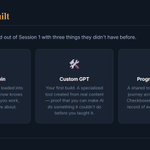
Every student left Session 1 with three working tools — not slides.
A Digital Twin. A Custom GPT. A Progress Tracker.
You don't learn AI by watching. You learn by building. With your own data, in the session.
Three tools built. Three weeks to go.
Follow us for BTS now. Join us next time. March 3.

33
17 professionals assessed their AI capability before our course started.
Avg score: 6.4 / 24
88% at Level 1-2
Automation: 0.6 / 4
These are smart people. They just haven't been shown what's possible yet.
March 3 cohort is open. The distance between curiosity and capability is shorter than you think.


24
Four AI Skills Non-Technical Leaders Can Learn in 30 Minutes Each linkedin.com/pulse/four-ai-s… via @LinkedIn

1
18
