

Programmable Markets Built on Uniswap V4 on @RobinhoodCrypto. CA: 0xbeD7c1660a01dbEEe225bd893ac31727a91A5773
Joined July 2026
- Tweets110
- Following2
- Followers1.8K
- Likes314


First I own our community an apology. I have been working on Sazare for the last few months. And I have loved working on it, I truly think the community of holders we have at this point are some of the best in the space. I love building new and interesting things.
However because of this it has created a increased amount of scattered attention, focusing on to many different things, and ultimately under delivering on all of them. For that I owe the community an apology.
Now we are not shutting down or anything like that, I still believe this is the best place to build and we are going to continue to build in this space. I believe in the tokenomics and the value that Sazare can create for this space.
But it is not going to be possible if I continue to scatter my attention.
Over the next few days what will begin to happen is we are going to go back to our roots and what we set out to build in the first place. Hooks and better protocols. Foundational level pieces that help protocols, are easy to understand, and capture the value that protocols actually create for themselves. Nothing more nothing less. In order to do this we will go through everything that we have built and cut what is waste. No more wasted energy on things that do not clearly fall into either hooks or protocol mechanisms.
For Sazare to continue our focus must be clear and not waiver. Next week we will bring out the exact roadmap for Sazare. It will be lean. Focusing just on what we set out to build in the first place.
We have built to many things, or are building to many things that do not clearly tie into one another. This creates confusion not only for holders but the builders we want to work with. This was my mistake and I apologize. Moving forward this will not happen again.
- Furyoku


These are the enemies. These are the people who have destroyed this space and the reason we are building what we are building.
Escape the trenches. Enter The Stronghold ™️


Uniswap V4 Hooks have opened up a new world for traders, gamers, and builders. Taking a once fairly fixed trading experience and making fees, liquidity, and pool behavior customizable on chain. We are still only scratching the surface of what people can build.
That freedom also creates a difficult problem. Every new idea can become another pool, another place to attract liquidity, and another trading experience that users and aggregators have to understand.
A pool might have dynamic fees, but what happens when its creators want to add limit orders? Or long-term trading? Or something entirely new that gets built six months later?
In V4, a pool’s hook is fixed when the pool is created. Unless that hook was designed to support new functionality, changing it means creating a different pool and convincing liquidity to move again.
Attract liquidity, make it sticky, start over.
A problem that has long plagued this space.
Sazare will build the most expressive and customizable foundation for pools that want to keep growing alongside the things being built around them.
To do that, we are building two things:
The Kernel Hook and The Hook Catalog.
The Kernel Hook lets pool creators assemble their own pool behavior from compatible hook extensions. They choose what to install, configure how it works, activate or deactivate it, and decide the order in which those extensions operate.
That configuration can begin before the pool ever opens. Later, extensions designed to support existing pools can be added without creating a new pool or asking everyone to move their liquidity.
This creates room for combinations that would otherwise need their own dedicated hook. Dynamic fees alongside limit orders. Long-term trading alongside launch protections. Custom trading mechanisms, volatility strategies, or games built around how a pool behaves.
The Hook Catalog is the curated set of extensions that Kernel pools can choose from. It will include things built by Sazare, third-party contributions, hackathon experiments, and whatever other amazing ideas people bring into this space.
Some will be serious trading infrastructure. Others will be gamified, wacky, or entirely new types of meta-AMMs.
Sazare controls what can enter the catalog, while pool controllers decide what their own pools use. Changing a catalog listing does not give us the ability to remotely remove an extension from someone else’s pool or rewrite its installed implementation.
There are also rules around how extensions operate together. Pools can limit how much work they perform, require essential behavior to succeed, and allow explicitly optional behavior to be skipped when it fails. Removal checks for remaining funds, positions, and obligations reported by the extension.
The bigger ambition is interconnectedness. Kernel extensions can coordinate trades and liquidity actions across participating pools within the same transaction, under defined execution rules. That gives us a foundation for meta-protocols: systems whose behavior spans multiple pools, with different extensions contributing to a larger trading experience.
Every compatible extension added to the catalog gives eligible pools another building block. More participating pools create more places for those building blocks to operate and interact.
Humans, teams, and agents could use the same foundation to assemble and manage these systems.
The surface of hooks is still being scratched. Pool controllers should be able to improve alongside it, and builders should be able to create things that grow together.
What happens when you can trade the parts of an asset?
We’re still thinking too narrowly about tokenization.
We talk about putting stocks, property, commodities and other assets onchain. There are good reasons to do that. But the part that is missing is what people could build around those assets once they’re there.
Owning something usually means accepting a package of things you may not want equally.
Someone buys a property for the rent. Someone else buys it because they think the neighborhood will become more valuable. A third person likes the property but needs predictable income for the next year.
They can agree that the asset is worth owning while wanting very different things from it.That is the kind of market Sazare wants to explore.
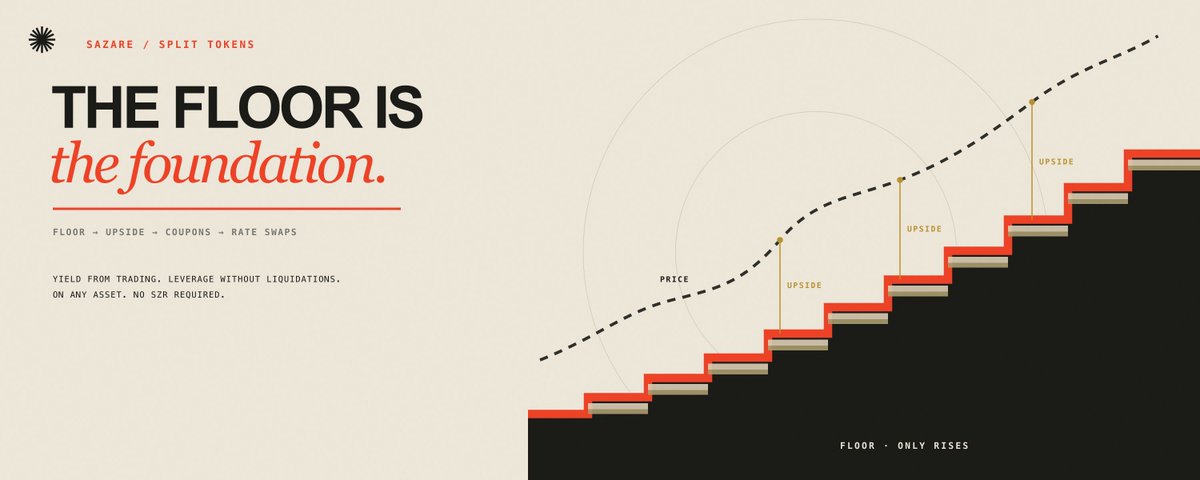
The starting point is splitting a token into FLOOR and UPSIDE. The idea is to give people separate ways to participate in the floor-related economics and coupon income, or in the more speculative part of the asset’s value.
A holder could keep one side and sell the other. A new buyer could choose the exposure they actually came for.
There is an important distinction in the current design: matching FLOOR and UPSIDE can be recombined into the underlying token, but the market decides how much each piece is worth. FLOOR on its own is not a guaranteed redemption at the underlying floor.
Even with that distinction, there is a lot worth building. And many ways the idea can be improved and iterated upon.
You might believe a market will stay active for years without having a strong opinion about where its token trades next week. You might want the upside and have little interest in collecting coupons. Or you might already own the asset and want to recover some capital while keeping part of your exposure.
Today, those views are often pushed into the same buy-or-sell decision. Separate instruments give people more room to express them.The fixed-term desk is where I think this becomes especially useful.
Variable income is attractive until you need to plan around it.
Suppose you hold a coupon-bearing position and would rather know what you will receive over the next ninety days. A desk could let you exchange that period’s variable coupons for a payment agreed in advance.
Someone else takes the other side because they think the income will be worth more than they are paying.
You get a defined payment. They get the uncertain receipts. Neither person needs to be wrong for the trade to make sense.
A treasury might value the certainty because it has expenses to meet. A trader might expect a busy quarter. A longer-term holder might give up a few months of income without wanting to sell their entire position.
Over time, you could have prices for thirty days, ninety days, six months or a year of exposure. Those prices would tell us something different from a spot chart: what people are willing to pay for income over time.
And I don’t think that idea should stop at crypto-native tokens.
Take a tokenized interest in a building. If the token carries enforceable rights to rental income, there could eventually be markets for that income over a particular period, alongside exposure to the property’s longer-term value. An owner might sell a year of eligible distributions to fund a renovation. A buyer might prefer that defined period to owning a property interest indefinitely.
With music, the underlying right could be royalties from a catalog. An artist might want money today to fund a tour or another recording. Someone else might be willing to buy a defined share of future receipts. The terms would determine exactly what changes hands and what the artist keeps.
For compute, the asset might be a claim on future GPU hours or revenue from supplying capacity. One participant could want predictable receipts to cover equipment costs. Another could take a view on demand over the next few months.
The same questions could arise around energy production, equipment leases, receivables, licensing rights or assets that do not have a widely used token standard yet.
Who wants to own the asset? Who wants its income? Who wants a particular period of exposure? Who is willing to pay for certainty, and who is willing to accept the uncertainty?
Those are useful questions wherever something valuable can be tokenized.
That does not mean every token should be forced into the same structure. A claim on electricity, a stock and a music royalty have different rights and different ways of settling. Some assets produce income directly. Others might support coupons funded by trading activity. Those sources should stay clearly distinguished.
Tokenization also cannot fix a right that is unenforceable, create backing that does not exist, or promise a payment nobody has funded.
What Sazare wants is a foundation that can accommodate those differences as the assets and integrations develop.
There is plenty of work between that ambition and a useful market. People need understandable contracts, reliable accounting, sensible collateral rules and enough liquidity to leave a position. A fixed-term payment needs defined obligations and funding behind it. Splitting an asset does not remove its risks.
But this direction is worth pursuing.
A person should be able to say, “I want the income for the next six months,” or “I want to keep the upside but sell some of the income,” and find a market that understands that request.
As more things become tokenized, the number of possible choices grows with them.
Make sure to tune in later today when we go on @MCGlive

This week on MCG, powered by @fomo, @MetaDAOProject
Monday 9/21
12:30 - $SZR @SazareProtocol w/@Furyoku0x1
1:00 - $ROUTE @routedotfun w/@rapidssh
Tuesday 9/22
12:30 - $PRIZE @dualmintrwa w/@billtlee (@MeteoraEco Eco)
1:00 - robinhood:0x398aca5e6ae801b002d684333affadc1a25e897c @Listedexchange w/@Akhileyyy
Wednesday 9/23
12:30 - $ARGUS @Arguspad w/@rdbotato (in @Arc eco)
1:00 - $TRENDS @Trendsdotrun w/@Jameseveryth1ng (@MeteoraEco Eco)
Thursday 9/24
12:30 - $ELA @RiskFDN w/@oxwasa @tzv
1:00 - $DREGG @dreggnet w/@ember_arlynx
Friday 9/25
12:30 - Open slot, @DineroDom0 for bookings
1:00 - $AMBA @amoebafarm w/@antimatterswx @ploopiebuttagi
Watch on - youtube.com/@McG_Live
Learn to DLMM -> @MeteoraAG @met_lparmy

There has always only been one way to trade new pairs on chain.
Buy or sell. That is really it. If you want to LP you can do that but it opens you up to impermenant loss which is extremely difficult to offset and limits the strategies you can run. Especially for new pairs where borrowing is not possible.
Sazare Split tokens up a new world for users to create new strategies.
By splitting the original asset into floor and upside tokens this opens up a new design space.
Floor tokens represent floor growth. Essentially a tokenized version of LP yields with no impermanent loss attached to them. Paid out in the settlement asset of that pool.
If the settlement asset is $ETH it is correlated to LP fees in ETH only, if it is Gold or Silver or whatever else the same applies.
Creating higher yield opportunities in the assets people already want, tied to the volume (not price) of any pair.
Upside tokens, in exchange for this, are able to get leveraged price moves. For large pairs that already exist it does not work as well, but for new pairs it is an excellent way to get leverage, with no liquidations.
This is different from the perps + credit modules as you are not borrowing anything, here it is all mechanism design.
Floor tokens also allow for new fixed income style products to be wrapped around them. Creating yield swaps and many other things you see in the world of Traditional Finance.
There is still so much experimentation to be done within this space and we are just getting started.

We want to thank @Uniswap and @UniswapBuilders for reviewing and approving out newest hook so quickly.
Traders can now trade our pools through the Uniswap Routing Algorithm!
As we continue to reach out to and work with teams building on $SZR we will use the generated protocol fees to buy back and burn $SZR tokens as promised.
The entire system of pushing collected fees to the treasury, to using these fees to burn $SZR is permessionless and can be done by anyone. The first transactions used 0.25 ethereum:native to burn 146,000 $SZR.
This can be seen below.
robinhoodchain.blockscout.co…

DM the dev and build with us.
Pack your bags its building season on @RobinhoodCrypto
First project has been live for just over 3 hours.
Creators have made nearly 1.5 ETH.
Volatility warehouse have over 0.5 ETH in profit for buy back and burns
4.5 ETH + 3.4% of total supply in the volatility warehouse with the floor increasing by ~0.5 ETH already.
This is just the beginning for them and they have already laid a solid foundation.
If you want to build with $SZR reach out I am happy to help. My dm's are open.
The new frontend and contracts are live at sazare.io
There is still a lot of work to do on the frontend for lots of different aspects. If you run into any issues at all please let us know so we can correct them as quickly as possible.
This is a major protocol upgrade for both the frontend and backend and there are some bumps expected. Especially with trading bots trying to pick up and understand the new hooks.
We have submitted the new hook with @Uniswap (cc @UniswapBuilders and @saintniko) and hopefully that will be resolved soon.
A lot has gone into this and a lot more to come. The frontend does allow for swaps with specific SZR markets.
Also remember to dyor and we are not providing any recommendations or financial recommendations of protocols that launch as we are a permissionless platform.
SZR Season
"Volatility is the gift this market gives you"
Unipics is right. We turned it into something profitable for every project. Volatility funds 3 distinct aspects of every $SZR launch
1. The warehouse: An internal AMM that buys dips and sells rips
2. Perps
3. Credit
This Friday

everyone melting down in a lot of group chats i'm in
panic
screams of 'it's over'
the earlier you realize that volatility is the gift this market gives you, the better
it's those violent dislocations that create opportunities for asymmetric upside
buy the dips the market gives you into q4
then chill
thank me later