

Science Zone is a Science Activity Centre in Boscombe, with workshops and big events, dinosaur and fossil shop, planetarium and science experiments.
- Tweets1.2K
- Following764
- Followers266
- Likes58







ALT This image of Stephan’s Quintet, a visual grouping of five galaxies, is contains over 150 million pixels and is constructed from almost 1,000 separate image files. Sparkling clusters of millions of young stars and starburst regions of fresh star birth grace the image. Sweeping tails of gas, dust and stars are being pulled from several of the galaxies due to gravitational interactions. Most dramatically, Webb captures huge shock waves as one of the galaxies, NGC 7318B, smashes through the cluster. Credits: NASA, ESA, CSA, and STScI

ALT This landscape of “mountains” and “valleys” speckled with glittering stars is actually the edge of a nearby, young, star-forming region called NGC 3324 in the Carina Nebula. Captured in infrared light by NASA’s new James Webb Space Telescope, this image reveals for the first time previously invisible areas of star birth. Credits: NASA, ESA, CSA, and STScI

ALT Two cameras aboard Webb captured the latest image of this planetary nebula, cataloged as NGC 3132, and known informally as the Southern Ring Nebula. Credits: NASA, ESA, CSA, and STScI

ALT NASA’s James Webb Space Telescope has produced the deepest and sharpest infrared image of the distant universe to date, known as Webb’s First Deep Field, this image shows galaxy cluster SMACS 0723. Credits: NASA, ESA, CSA, and STScI



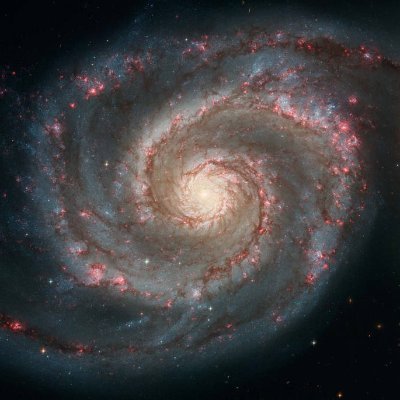

ALT This is NGC 1300, which is about 70 million light-years away on the banks of the constellation Eridanus. On close inspection, this classic barred spiral's nucleus shows a remarkable region of spiral structure about 3,000 light-years across. Like other spiral galaxies, including our own Milky Way, NGC 1300 is thought to have a supermassive central black hole. Image Credit: Hubble Heritage Team, ESA, NASA
