

Soviet cinema: rare photos, film clips & quotes. The story the world forgot to tell.
Joined July 2026
- Tweets872
- Following529
- Followers326
- Likes560




Pinned Tweet
The story behind The Ascent (1977), the only Soviet film to win the Golden Bear in Berlin. #SovietCinema #LarisaShepitko
125 years ago, on November 17, 1901, a boy was born in the village of Kamen in the Tomsk Governorate. His name was Ivan.
When Vanya was three, his father was killed in a brawl. His mother left for the city to find work, and the boy was raised by his grandfather, an Old Believer with a famously hard temper.
Ivan went to a parish school and helped his grandfather around the farm. For several years he even worked as a herdsman.
Years later, Ivan Pyryev would become one of the best-known directors in the country and make films that are now considered legendary.
Among his finest works are The Idiot (1958) and The Brothers Karamazov (1969).
Pyryev died in his sleep on February 7, 1968. He had just come back from filming The Brothers Karamazov, went to bed, and never woke up. The lead actors, Mikhail Ulyanov and Kirill Lavrov, finished the third part of the film in his place.
He was only 66. It was later established that he had suffered six heart attacks without ever stopping work. He never saw a doctor. Work was all he lived for.
Ivan Alexandrovich Pyryev is buried at Novodevichy Cemetery in Moscow.

14
Warm evening vibes: Soviet cinema’s timeless beauties, each graced by flowers.
Which of these 10 portraits captures your heart the most? Let us know your favorite number (or numbers) in the comments!
1. Tatyana Piletskaya
2. Irina Kupchenko
3. Vera Glagoleva
4. Klara Rumyanova
5. Elena Tsyplakova
6. Svetlana Nemolyaeva
7. Elena Proklova
8. Irina Akulova
9. Zinaida Kirienko
10. Tatyana Samoylova

1
6
180
July Rain (1967), dir. Marlen Khutsiev
Morning in Moscow, 1966. Fog, empty avenues, and a quiet poetry of the city that only Khutsiev could capture. Pure French New Wave mood, yet with a soul all its own.
Which 1960s film has the best atmosphere for you?
She lived to 80. So much happened to her in those years. Her life held fame, admirers, men she loved, the loss of a child, a trial, prison, betrayal by friends, being forgotten, blindness, and years in a state-run home. What remains are her film roles. And for them, she deserves a deep bow.
Valentina Malyavina was one of the most beautiful actresses of Soviet cinema, with more than 40 roles to her name.
Among them is Andrei Tarkovsky’s debut feature, Ivan’s Childhood (1962), in which she played Masha, a medical lieutenant. It remains one of the brightest roles of her career.
She presented the film at Cannes alongside the director. Because of her filming, she was expelled from the Moscow Art Theatre School.
Later she called Tarkovsky her destiny and said he had asked her to act only in his films. But after Ivan’s Childhood, they never worked together again.
She had extraordinary eyes. They drove people out of their minds. And it was her eyesight she lost at the end of her life.
In her final years, Honored Artist of Russia Valentina Malyavina lived in a nursing home, alone. Shortly before her death, Valentina Alexandrovna fell, hit her head and lost her sight. She died on October 30, 2021.
She was cremated, and the farewell was held privately. Almost no one knew about it: neither friends nor fans were able to say goodbye. Her ashes rest in the columbarium of the Troyekurovskoye Cemetery in Moscow.
Today is the anniversary. Rest in peace 🕯
#SoWeRemember

Into the Storm (1965)
Genre — Drama, Literary Adaptation.
"It was foolish to come into this world, and even more foolish to die without having done anything."
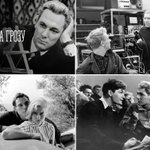
On November 15, 1965, Soviet television aired the first part of Sergey Mikaelyan’s two-part drama *Into the Storm* (*Idu na grozu*), adapted from Daniil Granin’s acclaimed novel.
What is this film about? Set during the Soviet 1960s, it follows young physicists and true romantics of science who literally fly into thunderclouds to learn how to control the weather. At the heart of the story are two friends and researchers, Sergey Krylov and Oleg Tulin. Both share the same dream, yet they see the price of success very differently. While one seeks pure scientific truth, the other is willing to compromise his principles for a fast career and recognition.
It is a sharp, honest story about friendship, moral choices, and the classic 1960s debate between rational scientists and idealists during the Soviet Thaw.
The cast features young icons of Soviet cinema Vasily Lanovoy and Aleksandr Belyavsky, alongside the legendary Anatoly Papanov and Rostislav Plyatt.
Crisp black-and-white cinematography by Oleg Kukharenko and a tense score by Vladlen Chistyakov capture the exact pulse of the era.

“I am truly fortunate.
And in general, I think acting is a very festive profession.
Yet I get the blues, too. Especially in autumn.
I am certainly prone to depression. Especially in the fall. November, when it’s dark by 4 p.m.… The body resists, and… it begins.
That’s when you have to keep yourself busy with work and tell yourself: ‘Smile, smile.’
One thought warms me up: New Year is coming soon.
And after that, the days will start getting longer.”
— Oleg Yankovsky (1944–2009), star of Tarkovsky’s Nostalghia
Do you get the autumn blues too?

COME AND SEE (1985)
Directed by Elem Klimov
While Larisa Shepitko was making The Ascent, her husband, director Elem Klimov, began working on what would become Come and See.
Pyotr Masherov himself served as a consultant on the film. He had been a partisan during the war.
Pyotr Mironovich was not just a political leader (he headed the republic from 1965 to 1980), but also a popular leader and a war hero.
I first saw Come and See in a cinema.
For almost half the film, I kept looking down or covering my eyes. I simply couldn't watch.
I had come to see it, but I couldn't bear to look at the screen. It was unbearable.
Years later, however, I finally made myself watch it again.
The story centres on a Belarusian boy named Flyora (Alexei Kravchenko), who witnesses the horrors of a Nazi punitive operation.
Alexei Kravchenko was just 14 during filming.
For almost the entire film, all we see is his face.
Over the course of 145 minutes (the running time of the two-part film), a boy turns into an old man.
This was his film debut — and what a devastating debut it was!
To help him understand his character, the director arranged a kind of test.
The boy spent four hours watching authentic documentary footage from Nazi concentration camps.
Alexei watched it all the way through and came out a different person.
Filming lasted nine months.
For six of those months, he was not allowed to see his mother. This was done to create a sense of isolation and disorientation.
To make the character look older, the make-up artists literally pulled the skin on Kravchenko's face tight with glue, creating wrinkles.
It was excruciatingly painful. The stress even caused his hair to turn grey.
Elem Klimov wanted everything to be absolutely authentic.
Filming took place in northern Belarus. The actors spoke with local people who had lived through the occupation.
Years later, Elem Klimov said in an interview:
“I wanted the viewer not simply to watch this film, but to live through it.”
The film was released in 1985, marking the 40th anniversary of Victory Day.
Ambulances were on duty outside cinemas because some viewers became physically ill from what they saw.
Even watching all 145 minutes on screen is almost unbearable.
There are no isolated scenes that simply make your heart ache.
The entire film is like that.
All 145 minutes.
145 minutes of truth.
Which war film has been the hardest for you to watch — the one you find almost impossible to revisit without that knot in your throat?
Elem Klimov with Alexei Kravchenko, who played Flyora in Come and See (1985).

8
128
“The artist has come to regard the talent he has been given as his own property, and from this has arisen the presumption that talent obliges him to nothing.”
— Andrei Tarkovsky, Sculpting in Time

COME AND SEE (1985)
Directed by Elem Klimov
Cinematography by Aleksei Rodionov
People often call this one of the hardest anti-war movies ever made. It feels terrifyingly real mostly because of the camera work by Aleksei Rodionov.
Rodionov and Klimov barely used normal medium shots. They put a wide-angle lens right up against the face of young actor Aleksei Kravchenko. It makes you feel like you are right there inside the scene.
They also used a Steadicam on set. In 1980s Soviet movies that piece of gear was super rare. The camera floated smoothly behind the characters through woods and swamps like a bad dream.
After getting through that tough shoot Aleksei Rodionov went on to work in international cinema. He later shot the famous British movie Orlando with Tilda Swinton.

WHITE EXPLOSION (1969) Directed by Stanislav Govorukhin
He wrote the script with Eduard Volodarsky. The story is based on real events from the 1942 Battle of the Caucasus. Six Soviet mountaineer soldiers climb a sheer mountain peak. They must blow up the snow slope to trigger an avalanche on German troops and save local civilians.
Filming in the mountains nearly ended in tragedy. Actor Sergey Nikonenko was flying in a helicopter with Govorukhin.
Due to pilot error the main blades and tail rotor broke off mid-air.
They survived by pure luck. The cast stars Sergey Nikonenko, Armen Dzhigarkhanyan and Lyudmila Gurchenko.
Audiences knew her from the lighthearted comedy Carnival Night. Here she played her first deep dramatic role.
Vladimir Vysotsky played a small role as an army captain.
By the late 1960s Soviet authorities banned him from giving concerts. They feared his massive popularity and sharp songs.
Govorukhin offered his friend this bit part. He wanted to support him and help him earn some money.
Vladimir Vysotsky wrote several powerful songs for the movie. None of them made the final cut.
The director worried the music would break the tension. Years later he deeply regretted that decision.

1
4
186
FATHER SERGIUS (1978)
“Lord! Is everything a lie? Everything I lived for, everything I believed in and struggled to achieve — was it all a deception? Is our entire life a lie? Better to die and know nothing more, to want nothing more. Yes, I must put an end to it all. But I don't want to die... How am I supposed to live now?”
In early September 1978, a new screen adaptation of Leo Tolstoy's novella Father Sergius premiered.
Directed by Igor Talankin, the film was made to mark the 150th anniversary of Tolstoy's birth. It was a wonderful tribute to the great writer. And what a film it turned out to be!
The cinematography is magnificent, and the beautiful score was composed by Alfred Schnittke. The film also features a waltz written by Tolstoy himself.
“I love music more than any other art,” Leo Tolstoy once said.
Sergei Bondarchuk plays Father Sergius, Valentina Titova is Mary Korotkova, Vladislav Strzhelchik portrays Nicholas I, Nikolai Gritsenko plays General Korotkov, and Boris Ivanov appears as the abbot.
The cast also includes Lyudmila Maksakova, Ivan Lapikov, Georgy Burkov, Alla Demidova, Irina Skobtseva and Alexander Belyavsky.

SERGEI URUSEVSKY. NOVEMBER 12, 1974
Sergei Urusevsky died on November 12, 1974. He was 65. He was the cinematographer of The Cranes Are Flying.
Sergei Urusevsky started out as a painter. He came to cinema almost by chance. He was turned down for the first Soviet color film.
They asked him who his favorite artist was. He answered, “Matisse.” That was a bold choice for the time.
Urusevsky then started as an assistant, hauling cables. In 1957, he came up with circular tracks for the camera. The Cranes Are Flying won the top prize at Cannes.
They say Picasso watched the film in an empty screening room. He said he hadn’t seen anything like it in a hundred years.
What was Sergei Urusevsky like? Shy. He spoke haltingly, and people didn’t always understand him. A few years later, his ideas were presented as discoveries, and dissertations were written about them.
During filming, he could spend hours walking alone in the distance without saying a word. The studio demanded that the film be completed on schedule and kept sending telegrams. Urusevsky still waited for the sun. If it didn’t come out, he wouldn’t turn on the camera. The tracking shots were rehearsed for weeks, in mud and in water.
Actor Alexei Batalov recalled that Urusevsky was considerate of people, but spared no one during filming. Batalov himself had to fall into icy water. It was spring, and snow was still on the ground. But, Batalov said, he owed his love of cinema to Sergei Urusevsky.
Sergei Urusevsky loved painting in oils. He made his own camera. He considered The Letter That Was Never Sent his favorite film. His wife, Bella, worked with him in cinema. They had a daughter, Inga.


BEHIND THE SCENES OF MIRROR (1974)
Andrei Tarkovsky’s film starring Oleg Yankovsky and Margarita Terekhova.
Rare photographs from the filming, capturing the actors in relaxed moments between takes.
Photo source: MAMM / MDF, via Russia in Photos.

Just rewatched Antichrist (von Trier, 2009) right after Mirror (Tarkovsky, 1975) and I can’t unsee it. The girl in the bathroom scenes looks almost identical in both. Same stillness, same water, same feeling that time just stopped.
Not a coincidence either: von Trier dedicated Antichrist to Tarkovsky. Tarkovsky does it gently, like a dream. Von Trier takes the same image and makes it way darker.
Left: Antichrist. Right: Mirror. 34 years apart.
Do you see it too?

2
125
OTHELLO (1956)
Director: Sergei Yutkevich
On March 3, 1956, Othello, a film adaptation of William Shakespeare’s tragedy, premiered in the Soviet Union.
Directed by Sergei Yutkevich, the film went on to earn international recognition and was regarded as one of the finest screen adaptations of Shakespeare’s play.
At the Cannes Film Festival, Yutkevich received the award for Best Director for his work on the film.
The leading roles were played by Sergei Bondarchuk, Irina Skobtseva, and Andrei Popov.
The film was a magnificent production, with elaborate sets, beautiful costumes, and a powerful musical score.
Every detail was carefully considered, particularly the use of color. Red symbolized love, tragedy, and blood, while white represented innocence and purity — qualities associated with Desdemona.
Much of the film was shot in Crimea and the Odessa region.
Interestingly, the filming also brought Sergei Bondarchuk and Irina Skobtseva together romantically.
There was tragedy unfolding on screen, but a complicated love story developing behind the scenes. At the time, both were married to other people.
Nevertheless, in 1959 they became husband and wife and remained together for 35 years.
Yutkevich had a very particular understanding of the tragedy’s climax.
He believed that the most important moment in Othello was not Desdemona’s murder. The true turning point came when Othello discovered that the person he trusted most — his closest friend — had betrayed him.
In the director’s interpretation, Shakespeare’s play is about much more than love, jealousy, and revenge.
At its heart, it is about faith in another human being.
Once Othello loses that faith, he is completely broken and ultimately takes his own life.

REMEMBER YOUR NAME (1975)
Director: Sergei Kolosov
“Remember, boy, your name is Gena! Your surname is Vorobyov! Your Motherland is the Soviet Union! Genochka, I will come back for you! Your name is Gena Vorobyov!”
Everyone should watch this film at least once.
Remember Your Name is a Soviet-Polish war drama directed by Sergei Kolosov and based on real events.
It tells the tragic story of a mother and her young son, who were separated in Auschwitz, and their reunion many years later.
The leading role was played by the outstanding Soviet actress Lyudmila Kasatkina, the director's wife.
The role of Zinaida Vorobyova was one of the most difficult of her career. And it wasn't just because she lost 13 kilograms for the part.
Years later, Lyudmila Kasatkina recalled:
“Many viewers wrote to me after watching Remember Your Name. They said they couldn't hold back their tears whenever they watched it. Some even feared their hearts might not be able to withstand such emotion.
Later, I read an article in which doctors shared the conclusions of their long-term observations about the effects of art on human health.
A neurologist, a physician and a psychologist all came to the same conclusion: our health suffers from our own anxieties and troubles.
But when a person feels compassion and experiences someone else's grief, they feel better the next day.
It means their soul is still alive. It means they are capable of empathy.”

HOW TARKOVSKY MADE IVAN’S CHILDHOOD
HOW TARKOVSKY MADE IVAN’S CHILDHOOD
In 1962, Andrei Tarkovsky directed Ivan’s Childhood, based on a story by Vladimir Bogomolov.
Tarkovsky said: “In this film, I wanted to explore how war affects a person. When someone is broken inside, their life can no longer develop normally.”
“This is especially true of a child’s mind. I saw Ivan as a boy deeply damaged by the war, cut off from the normal life a child should have.”
For this film, Tarkovsky once again worked with cinematographer Vadim Yusov. Filming took five months.
The leading role went to 15-year-old Nikolai Burlyaev, who had already appeared in a student film, The Boy and the Pigeon.
The film premiered in 1962 and brought Tarkovsky international recognition.
That same year, he won the Golden Lion of St. Mark at the Venice International Film Festival.

On November 8, 1998, the French actor Jean Marais died.
On July 7, 1963, he came to Moscow as the guest of honor at the opening of the Moscow International Film Festival. Marais was also a stuntman and an idol to millions of women.
Many Soviet actresses wanted to meet the legendary Frenchman, including Elina Bystritskaya.
In one interview she admitted that in her youth she really liked Marais’s looks and saw him as a true romantic hero. But she knew that falling in love with an actor was like reading Dumas novels.
Years passed. The girl Elya from Kyiv met her idol in person and even offered him a cigarette. It was reportedly a Lucky Strike.
Today, both Jean Marais and Elina Bystritskaya are gone, but this photograph remains.

5
332