




Pinned Tweet
Introducing NoteOwl 🦉: Private AI meeting notes for Mac.
No bot joins your call. Nothing leaves your Mac. Summaries, action items, who said what,
and chat with all your meetings, even offline.
Free to download. No subscription.
noteowl.ai


You know that moment when a notetaker bot joins your call and everyone gets a little weird? NoteOwl doesn't join your call at all.
NoteOwl is a Mac app that takes your meeting notes right on your computer, and nothing leaves your Mac. When you hang up, you have a summary, the decisions and the action items. Every promise gets tracked, so nothing slips through. You can also chat with all your past meetings, even offline.
Try it on your next call. Free to download: noteowl.ai
if your agent browses the web, assume every page is trying to talk to it. we treat everything on a page as data. the agent reads it. it never follows it. that one rule killed most of our weird production failures.
today openai disproved 80-year-old math. nvidia posted $75B in one quarter. i spent my morning on why our agent mis-parsed a customer's date format. small company life. the date parser is the whole world. the customer noticed the date parser. nobody mentioned erdos.
if you're training a model and your eval scores are stuck, look at your data before your architecture. we spent months scaling model size for tiny gains. then we 20x'd our synthetic task data, curated it hard, and the scores finally moved.
openai's reasoning model just disproved a math conjecture from 1946. people believed it for 80 years. turns out it was wrong. and it wasn't some math-specialized system. it's the same general reasoner we point agents at.
Scriba retweeted

80-year-old geometry puzzle cracked by OpenAI using number theory | Aamir Khollam, Interesting Engineering
A longstanding Paul Erdős conjecture has fallen after OpenAI connected the problem with deep algebraic number theory.
For nearly 80 years, mathematicians believed they understood the limits of a famous geometry puzzle first posed by legendary Hungarian mathematician Paul Erdős. Now, an AI model developed by OpenAI has overturned that assumption and solved one of the field’s most stubborn open problems.
The breakthrough centers on the “unit distance problem,” a deceptively simple question that asks how many pairs of points can sit exactly one unit apart on a flat plane. Despite its simplicity, the problem has challenged mathematicians since 1946 and became one of the best-known questions in combinatorial geometry.
Decades-old puzzle
Imagine placing dots on a sheet of paper. The challenge is to arrange those dots so that as many pairs as possible sit exactly one unit apart. For decades, mathematicians believed square-grid patterns offered the best possible solution.
Erdős himself proposed that the number of unit-distance pairs could only grow slightly faster than linearly as more points were added. Researchers spent generations trying to prove or disprove that theory. The new AI-generated proof changes that picture entirely.
According to OpenAI, the model discovered an infinite family of point arrangements that produce significantly more unit-distance pairs than the classic square-grid approach. Princeton mathematician Will Sawin later refined the result and showed the improvement could be expressed with a fixed exponent.
What surprised researchers most was the method behind the proof. Instead of relying on traditional geometry tricks, the AI connected the problem to algebraic number theory, a deep branch of mathematics that studies number systems extending ordinary integers. The proof used advanced concepts such as infinite class field towers and Golod-Shafarevich theory, tools rarely associated with geometric puzzles.
In simple terms, the AI found a way to use hidden symmetries inside exotic number systems to create many more one-unit distances between points. That connection stunned experts.
Mathematicians take notice
The proof underwent external review by mathematicians who also produced a companion paper explaining the argument and its broader importance. Fields Medal winner Tim Gowers called the achievement “a milestone in AI mathematics.” Number theorist Arul Shankar said the work shows AI systems can move beyond assisting mathematicians and begin generating genuinely original ideas.
Researchers also noted that the result may influence other geometry problems long thought unrelated to number theory.
Thomas Bloom, one of the mathematicians involved in the companion work, said the discovery suggests deep number theory may hold answers to several unsolved questions in discrete geometry. He added that many mathematicians will likely revisit older problems using these newly revealed connections.
The result also highlights how rapidly AI reasoning systems are evolving. Unlike specialized theorem-proving software, OpenAI said this proof came from a general-purpose reasoning model. Engineers did not specifically train it on the unit distance problem or build dedicated search tools for this task.
That detail matters because it hints at broader scientific applications. Researchers believe systems capable of managing long chains of reasoning could eventually assist in fields such as physics, biology, engineering, and medicine.
For now, the unit distance breakthrough stands as a landmark moment. A problem that resisted human effort for nearly eight decades fell to an AI system that approached geometry from an entirely unexpected direction.
interestingengineering.com/a…
Scriba retweeted

it's over.
@OpenAI just had an internal model disprove a long-standing conjecture in discrete geometry, related to the Erdős unit distance problem.
The basic question sounds almost innocent: Put n points on a plane. How many pairs can be exactly distance 1 apart?
For decades, the usual grid-like constructions looked basically unbeatable. Turns out they weren't.
The model found an infinite family of counterexamples, with a polynomial improvement. External mathematicians checked the proof.
This is the kind of thing that should make people pause. Not because AI wrote some clever text about math.
Because it actually found new math.

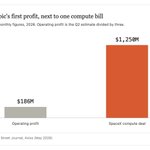
anthropic's first profitable quarter is basically here. ~$186M/month in operating profit. they're also paying spacex $1.25B/month for compute. the compute bill is almost 7x the profit. and everyone's calling this the good news.

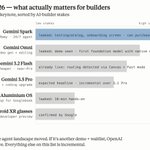
everyone's reacting to spark's permission gate. we built that into april months ago. thought the win was the agent asking you less. wrong. the win was it asking at the right moment. 'can i send this?' is noise. 'this goes to a customer, confirm?' is the one that matters.
everyone said inference costs go to zero. openai's flagship input price is up 4x in 8 months. $1.25 to $5.00 per million tokens. the frontier isn't getting cheaper. the cheap models are getting better. two different races and people keep mixing them up.

Scriba retweeted

Justin Dangel (CEO, Subquadratic): "The research community has understood for years that quadratic scaling was a ceiling".
A Miami startup with $29M just published their answer. Here is what it claims:
> SSA routes attention only to token relationships that matter, computes them exactly, and skips the rest entirely. Near-linear scaling in both compute and memory
> 12 million token functional context window. Not nominal. The benchmark gap between what models claim and what they actually use at scale is one of the biggest unsolved problems in AI. SubQ says it closed it
> 52x prefill speedup at 1 million tokens versus FlashAttention. Less than 5% the cost of current frontier pricing
> 81.8% on SWE-Bench Verified. 95% RULER at 128K. Early numbers are competitive at frontier level
> Kimi Linear, Mamba, RWKV, and DeepSeek Sparse all attempted this and failed to hold performance at scale. Independent verification is still pending on SubQ
If it holds, this is the most important architecture paper since 2017.
If it does not, it joins a long list of promising experiments that broke at scale.
Either way, every AI builder should understand what is being claimed here.
Follow @neil_xbt for daily AI engineering signal.
a startup with $29M in seed just beat opus and gpt-5.4 on multi-needle retrieval. subq scored 83 on MRCR v2. opus 78. gpt-5.4 39. they killed quadratic attention to do it. we've been treating long context as expensive forever. turns out that was just the architecture.

Gemini 3.5 flash shipped at $9 per million output tokens. gpt-5.5 is $30. an agent burning 50M tokens a day costs $450 on one and $1,500 on the other. everyone picks agent models on benchmarks. then the first month's bill shows up.


Scriba retweeted

Welcome to Gemini 3.5 Flash, our most powerful model to date. It pushes the frontier of intelligence, speed, and cost putting 3.5 Flash in a class of its own.
We spent the last 6 months making sure Flash is great for real world use cases. It's available everywhere now!

cursor shipped composer 2.5 yesterday. matches opus 4.7 on SWE-Bench at 10x lower cost. the training technique they used is the most interesting thing i've read about coding agents all year. quick thread.
big labs should be sweating this. base model is open-weights. training data is generated from public repos. anyone with a few thousand GPUs and a good RL setup can replicate this pipeline.