
📊 Cuenta dedicada a la inversion y macro 📖 Substacks - @seekingprofits https://nitter.cf/t.co/OcL9d3wvb6
Joined June 2024
- Tweets3.5K
- Following71
- Followers447
- Likes9.1K






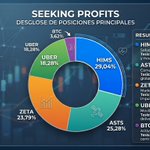

Y esos Use Case dependen íntegramente de los datos...
Long $ZETA

Stanley Druckenmiller just said:
We’re looking for AI use cases as opposed to infrastructure
Infrastructure might be a good tactical trade, but I don’t think that’s going to be the big scoop they were for us before. We think AI use cases could be that
If there’s going to be another big push in the market that’s where I think we’ll want to go

21
Por loq ue estoy viendo $CHTR ha sido algo así como un mono con una escopa en los últimos años.
De ahí que la valoración esté tan deprimida.
1
39
Chicos, acabo de vender $HIMS con una pérdida del 40%, con esto doy por cerrado el invertir sin cabeza y sin tener en cuenta la valoración de la empresa actual.
Aunque haya vendido las acciones, seguramente siga subiendo artículos sobre la empresa ya que puede ser el gran player del Tlehealth DTC en un futuro no muy lejano.
El cash lo he rotado a $CHTR, cuanto más investigo acerca de la empresa más me doy cuenta de que a nada que haga una simple reversión a la media, la empresa puede hacer un x4 en los próximos años.
A final de mes tendréis mis motivos...
2
239
Hace 17 días que llegué a la conclusión de que $HIMS estaba ampliamente sobrevalorada.
No que fuera mala empresa si no que la empresa estaba sobrevalorada.
Desde entonces ha caído casi un 40%...
131
Un data tracker para el Customer Journey de $HIMS son las descargas de Play Store y el Apple Store. Sin embargo, siempre se miden mal respecto a la competencia.
Ro suele estar ligeramente por arriba de Hims & Hers. Pero claro, Ro aglutina el público masculino y femenino en la misma plataforma. Mientras que Hims tiene dos diferentes.
Si Hims esta en el puesto #24, Hers en el puesto #27 y Ro está en el puesto #21. Hims está más arriba que Ro.
Por esta razón, de momento, Hims es mejor en la captación de clientes.
SeekingProfits retweeted

My thoughts on RO-
1) They copy $HIMS. And don’t really have any real original ideas.
2) They got the $LLY deal much earlier than HIMS (December 2024). Now we have the deal as well. This definitely gave them a temporary boost, but is now over.
3) RO’s likely extremely unprofitable acquiring high CAC and high churn customers.
Overall, I believe RO could potentially prove me wrong. So I always keep a watch. However, HIMS has always been the trail blazer. And imo is a mile ahead of RO. The FUDsters will conveniently leave these details out. And eventually numbers will show it.
Amigos, $ZETA presentó resultados a principio de semana, en su línea:
Números
- Los ingresos crecen un 46% YoY. Lo más interesante es que el 48% de ese crecimiento proviene de cuentas que ya eran clientes
- Revenue orgánico se acelera pasando de un 28% en el Q2 hasta 30% en elQ3
- Super-Scaled Customer crecen un 22% los ingresos YoY y un 18% el total YoY.
- FCF negativo en lo que va de año. Normal debido a las adquisiciones, repago de deuda y recompra de acciones (la empres ha usado $85M para recomprar acciones en lo que va de año)
- CFO, esto es lo realmente interesante chicos. En lo que va de año la empresa ya ha generado $120M de CFO normalizado. En todo el año pasado solo generó $105M de CFO normalizado. En solo 9 meses ya ha generado un 14% más que todo 2025.
- NRR del 125%
- Recievables se mantienen estables.
Y por último el número más importante de todos los resultados, el margen bruto. El Margen Bruto para el Q3 se expande hasta el 60%. Como ya expliqué en la tesis si ZETA consigue expandir el Margen Bruto la empresa multiplicará por 6. Lo están consiguiendo, veréis el Cost of Revenue es el gasto más importante de ZETA, se trata de pagar a los publishers como META o Google. ZETA está consiguiendo apalancarse a nivel operativo para expandir los márgenes.
Para que os hagáis una idea, la expansión de 100bsp han generado un aumento del Beneficio Neto Normalizado del 174%.
¿Como afectan los resultados a la tesis?
Solo puedo decir que en la llamada se ha confirmado la tesis de ZETA. Con esto me refiero a Athena.
En la tesis os comenté que Athena iba a ser ese catalizador que hiciera acelerar los ingresos. En la call el CFO ha confirmado esto.
El 50% de los Super-Scaled Customers usan Athena mensualmente, el Q2 eran el 40%.
Los 25 clientes que más usaron Athena aumentaron su gasto en un 70% QoQ.
Los clientes que usan Athena tienen un NRR 5 veces más alto.
Athena es ese guía divertido que te hace lavisita amena y saca el máximo partido del museo.
Por último, en la call han dejado una cosa clara.
ZETA tiene una de las mayores bases de datos proprietarias a nivel mundial y van a usar cada uno de esos datos para sacar el máximo dinero posible. Esto es solo el principio.
1
211
$ZETA está todavía lejos de mi precio objetivo para 2030.
Como dato curioso se ha convertido en mi segunda bagger con un +125%.
La empresa está transiocionando hacia ser el sistema operativo de los Large Enterprises, tendremos que actualizar la tesis.
1
3
372
SeekingProfits retweeted

$HIMS and $LFMD sell a commodity.
You can buy the same pill from Ro, Noom, your local pharmacy or a dozen other telehealth apps. No moat. No differentiation.
That’s the bear case. It’s also exactly why the winner could be enormous.
1. Same pressure, same response
Hims went from 2.89M to 2.79M subscribers in Q3. Gross margin fell from 63.8% to 57.2%. Gross profit still hit a record $509M.
LifeMD cut marketing 34% quarter over quarter, and subscribers held at ~350K. Management admitted some earlier cohorts underperformed, then changed pricing, plan length and the tech platform.
Both are pulling back on paid acquisition and chasing retention.
This isn’t saturation. At current product economics, buying the next customer with ads is often a bad use of capital. Both companies have reached the same conclusion: own a deeper, longer relationship with the patient.
2. $SPOT and $NFLX were here in 2022
New streamers kept launching, catalogs overlapped and acquisition was expensive. Investors asked what made $SPOT and $NFLX special if anyone could distribute content.
That was the wrong question.
Their edge was delivering a slightly better experience to millions of people, consistently, and reinvesting the cash to keep improving it.
They owned the customer relationship. That gave them behavioral data, which improved personalization, engagement and retention.
A small improvement looks irrelevant on its own. Across millions of users it raises engagement, which creates more learning, which makes the experience better again. Over years, that compounding is nonlinear.
None of this is specific to entertainment.
3. The current healthcare model is fragile
Today the sector is valued as:
Gross profit ≈ pills sold × profit per pill
With off-patent drugs, the molecule is identical everywhere. Competition comes down to price, convenience, trust, access and service.
Patents, manufacturing complexity and regulation can still protect some margins. The margin from simply distributing a commodity is hard to defend.
4. The counterintuitive part
The winner may be the platform that collapses medication margins, not the one that defends them.
If you can monetize the relationship, you can sell the pill cheaply. A cheaper pill means more patients, more engagement, better retention and a more valuable intelligence layer.
Low margins become a weapon.
Gross margin % isn’t the metric. Absolute free cash flow is. Hims already shows the gap: margin % down, gross profit dollars at a record.
$NFLX’s 2022 ad tier was read as weakness. It lowered the price of entry, reduced friction for customers and squeezed competitors. The rest is history.
5. From pills to tokens
Old model: acquire a patient, prescribe, earn a margin on the transaction.
New model: build a longitudinal record of biomarkers, symptoms, treatment responses, side effects, adherence and outcomes, then use it to train AI that personalizes care.
The objective becomes maximizing measurable patient outcomes per dollar.
The flywheel:
More patients → more longitudinal data → better AI → better outcomes per dollar → more adoption and retention → repeat
Healthcare raises the stakes. $NFLX helps you pick a movie. A health platform could pick the intervention most likely to improve your physiology, so personalization is worth far more.
You can get the pill anywhere. The intelligence about which intervention works for which patient, at what dose and in what combination, is the differentiated product.
New equation: relationships × recurring value per relationship. AI tokens are one input.
The goal isn’t to sell tokens. It’s to turn ever-cheaper intelligence into ever-more-valuable outcomes, and capture the value through subscriptions, care services and the marketplace.
6. Owning the patient flips the supply chain
Patients want outcomes. Manufacturers want patients who start treatment, stay on it and get results.
The platform sits in the middle. If it improves outcomes, both sides pay for access.
New drugs and suppliers plug into the existing network, the way $SPOT adds music and $NFLX adds shows.
Healthcare is harder. It needs clinical judgment, privacy and validation, and more data isn’t automatically better. Those same constraints make the capability harder to copy once someone builds it.
A competitor can source the same pill. It can’t easily copy millions of longitudinal patient relationships, the clinical infrastructure and validated treatment intelligence.
That’s the moat.
7. Why Hims
Millions of relationships, plus clinical services, pharmacy, diagnostics, multiple categories and AI-assisted care.
In Q3, its AI-native experience reached 70% of weight-loss subscribers, and those patients sent 4x as many messages.
That’s early engagement. The real test is whether engagement produces better data, better outcomes and better economics.
LifeMD is racing for the same goal: prescribing, pharmacy, labs and longitudinal care in one place.
The winner won’t be whoever has the biggest ad budget or the cheapest GLP-1. It will be whoever turns its network into a self-reinforcing edge in experience, outcomes and cost.
8. How to spot the winner
Organic subscriber growth: less dependence on paid ads
Engagement per patient: the relationship is getting stickier
Multi-condition adoption: the platform becomes the patient’s healthcare home
LTV vs CAC: the engagement shows up in unit economics
FCF per share: shareholders actually capture the value
The confirming signal is engagement up, retention up and FCF per share up, while medication margins fall.
9. How this could fail
Engagement doesn’t improve outcomes
The data doesn’t enable real personalization
Patients keep switching on price
Clinical AI becomes a commodity available to everyone
Those are the things to test over the coming years.
Bottom line
The market is pricing the distribution of interchangeable pills. The bigger opportunity is owning the patient relationship and the intelligence it produces.
Scale × engagement → proprietary data → better intelligence → better outcomes per dollar → more adoption → recurring revenue → FCF per share
Anyone can sell the pill. The winner will own the patient.

Hay un indicador no oficial para saber la salud del sistema financiero, ir a por el retail.
Ayer me salió un anuncio de Crescenta y sus fondos PE en youtube.
En el momento en el que necesitan al retail, es que algo no cuadra. Ya escribí un artículo comentando la mala situación del PE.
Os lo dejo abajo or si queréis leerlo:
1
2
280
Ya estoy con los resultados de $ZETA, no entiendo porque nadie está hablando de la expansión del margen bruto.
Veréis, el principal coste de ZETA son los COGS (en su caso pagar a los publishers como META o Google). En la tesis lo dejé muy claro, si ZETA es capaz de expandir el margen bruto, la empresa debería revalorizarse x6 en los próximos 4 años.
Para que dimensionéis esto, la expansión de 100bsp del Margen Bruto ha provocado un incremento del Beneficio Neto Normalizado del 174%.
Mañana sobre las 18:00 tenéis mi opinión.
3
445
Amigos, acabo de subir mi opinión sobre el Q3 2026 de $HIMS.
Resultados desastrosos a primera vista, sin embargo, considero que esconden dos cosas:
1. Cambio estructural que confirma parte de la tesis
2. Visión a largo plazo.
Aquí os dejo,
HIMS Q3 2026 - SE CONFIRMA LA TESIS
🤖 Made with AI


La semana pasada subí la tesis de $HIMS, en donde llegaba a la conclusión de que Hims era el mejor player dentro del Tele health, pero que estaba sobrevalorada.
-25% desde que subí el artículo.
1
1
570
No he podido leer todavía los earnings de $ZETA.
Solo he podido ver que el revenue de los Super Scale Customers se habí incrementado hasta $2M.
NRR - 125, sticky revenue.
Este fin de artículo con los earnings.
1
223