

I talk about growth stock investing, fundamental analysis with a long-term mindset. I provide earnings reviews and key news updates.
Joined December 2020
- Tweets17.1K
- Following214
- Followers16.8K
- Likes29.1K





Pinned Tweet
My portfolio is at an ATH.
Since January 2, 2023, my portfolio has outperformed S&P 500, gaining +180.1% compared with S&P 500’s +103.4%.
My portfolio is up +31.9% YTD, after recovering from the SaaS apocalypse, vs S&P 500’s +14.1% YTD.
Portfolio currently consists of 16 high-quality SaaS stocks.
Each month, I publish a full breakdown of every stock in my portfolio and comment on any portfolio changes. 👇

Sergey retweeted
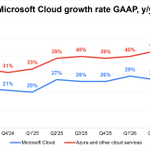
$MSFT Microsoft Cloud revenue growth accelerated to +30% YoY, while Azure growth accelerated to an impressive +48% YoY.
Growth was driven by strong AI infrastructure demand, core enterprise workloads, Azure AI Foundry, and improved monetization of existing computing capacity.
Azure AI Foundry revenue more than tripled YoY, supported by accelerating AI consumption, improved GPU utilization, and higher-than-expected revenue per token.

Sergey retweeted
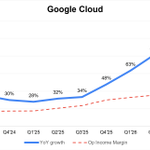
$GOOGL Google Cloud revenue growth accelerated to 102.6% YoY, reaching $30.7B and accounting for 24.1% of Alphabet's total revenue. Cloud operating margin expanded 12.5 percentage points to 36.2%.
Growth was driven by AI infrastructure demand, AI solutions, core Google Cloud Platform (GCP) services, and TPU system sales.
Google Cloud backlog reached $561B, with management expecting to recognize more than 55%, or approximately $308.6B, over the next 24 months.
Most of the backlog comes from core GCP contracts.
Growing AI adoption is also driving demand across Google Cloud's infrastructure, databases, and enterprise services.
Gemini reached 1B app users, becoming Google's fastest-growing product in company history.
Google's first-party AI model APIs now process approximately 32B tokens per minute, up 40% QoQ and more than 4x YoY, reflecting accelerating AI adoption and consumption.

$MSFT Microsoft Cloud revenue growth accelerated to +30% YoY, while Azure growth accelerated to an impressive +48% YoY.
Growth was driven by strong AI infrastructure demand, core enterprise workloads, Azure AI Foundry, and improved monetization of existing computing capacity.
Azure AI Foundry revenue more than tripled YoY, supported by accelerating AI consumption, improved GPU utilization, and higher-than-expected revenue per token.
$GOOGL Google Cloud revenue growth accelerated to 102.6% YoY, reaching $30.7B and accounting for 24.1% of Alphabet's total revenue. Cloud operating margin expanded 12.5 percentage points to 36.2%.
Growth was driven by AI infrastructure demand, AI solutions, core Google Cloud Platform (GCP) services, and TPU system sales.
Google Cloud backlog reached $561B, with management expecting to recognize more than 55%, or approximately $308.6B, over the next 24 months.
Most of the backlog comes from core GCP contracts.
Growing AI adoption is also driving demand across Google Cloud's infrastructure, databases, and enterprise services.
Gemini reached 1B app users, becoming Google's fastest-growing product in company history.
Google's first-party AI model APIs now process approximately 32B tokens per minute, up 40% QoQ and more than 4x YoY, reflecting accelerating AI adoption and consumption.
My Thoughts on $MSFT Microsoft Q3'26: Azure Growth Accelerates to 48%, Copilot Adoption Surges.
Microsoft delivered a strong quarter, with revenue growth accelerating to 18.8% YoY.
Microsoft Cloud GAAP revenue growth accelerated to 30% YoY, while Azure growth reached 48% YoY, an even more impressive result.
Cloud RPO increased 73% YoY, supporting continued revenue growth.
Foundry revenue more than tripled YoY, driven by stronger AI consumption and improved GPU utilization.
Copilot Adoption Accelerates
Microsoft introduced its largest Copilot upgrade, combining chat, co-work, autopilot, and coding into a unified experience.
Copilot daily users increased nearly 50% QoQ and more than 5x YoY. Automated tasks nearly doubled since July, while user satisfaction improved almost 20% QoQ.
GitHub agent-generated pull requests increased 6x over six months, with AI agents now creating more than one-third of all pull requests.
Copilot customers actively using consumption credits increased over 75% QoQ, demonstrating growing adoption of autonomous workflows.
AI Infrastructure Efficiency
Microsoft continues investing heavily in AI infrastructure, with calendar 2026 CapEx estimated at $170B, below the previous $190B expectation.
Its proprietary AI stack could improve computing efficiency and reduce infrastructure costs.
Maia 200 delivers up to 1.7x more tokens per watt on selected workloads, while Maia 300 is expected to deliver 40% better efficiency than leading GPU-based systems.
Engineering improvements also increased Copilot workload throughput by over 50% QoQ.
Cybersecurity and AI Governance
Agent 365 registered more than 50M agents, up over 30% QoQ, expanding centralized monitoring and governance.
Microsoft Purview audited 7.6B+ agent activities, up 5x QoQ, reflecting growing enterprise AI security requirements.
Margin Pressure
Despite strong growth, Microsoft Cloud gross margin declined to 66%, with management expecting approximately 65% next quarter.
Overall gross margin declined 1.3 percentage points YoY to 67.8%, primarily reflecting a higher contribution from infrastructure-intensive Azure revenue.
My View
Microsoft is building a full AI stack, combining cloud infrastructure, proprietary chips, AI models, agents, and cybersecurity.
I believe its investments are strengthening its economic moat, although rising infrastructure costs and gross margin pressure deserve attention.
At 11.3x EV/Sales and 25.7x forward P/E, sustained Azure growth and improving AI efficiency will be important.

$FTNT Fortinet: Billings Accelerate 29%, SASE and AI Security Drive Growth. Why Did Shares Fall 26%?
Fortinet delivered a mixed Q3. Shares declined 26% following earnings, reflecting concerns about slower service revenue growth and future guidance.
Revenue increased 20.5% YoY to $2.08B, decelerating from 25.6% in Q2.
More importantly, billings grew 29.2% YoY to $2.34B, significantly outpacing revenue growth. RPO increased 18.9% YoY to $7.98B, supporting future revenue visibility.
SASE Firewall billings increased 31% YoY, outperforming management’s estimated market growth of approximately 16%.
Operational Technology (OT) security billings grew nearly 40% YoY, supported by demand from manufacturing, transportation, and critical infrastructure.
AI-driven Security Operations billings grew 15% YoY, reflecting growing adoption of automated security workflows.
Fortinet is also expanding into AI data center security, benefiting from demand for high-performance firewalls, network segmentation, and protection of AI workloads.
Total contract value from deals exceeding $1M increased 51% YoY, demonstrating strong enterprise adoption.
Management reported that pricing increases contributed approximately 10 percentage points to billings growth, supported by higher-priced FortiGate appliances.
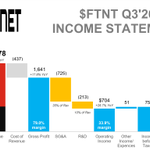
Non-GAAP operating margin expanded to a Q3 record of 38.2%, despite gross margin pressure.
FCF increased 52% YoY to $865M, while adjusted FCF reached $912M, representing a 44% margin.
Service revenue grew just 12.6% YoY, compared with 36.9% product revenue growth.
However, service billings increased 26% YoY, suggesting stronger underlying demand. Delayed service activation and enterprise contract consolidation are slowing revenue recognition.
Gross margin declined to 79%, pressured by higher component costs and a larger hardware revenue contribution.
Management’s Q4 guidance implies approximately 15% revenue growth, below Q3’s 20.5%.
Fortinet delivered strong operational results, supported by accelerating billings, AI security demand, and improving cash generation.
However, service revenue conversion remains the key metric to monitor.
Management expects service growth to improve in 2027, but slower recurring revenue monetization and a hardware-heavy sales mix create uncertainty.
At 11.1x EV/Sales and 36.3x forward P/E, sustaining growth and profitability will be important for valuation.

$NOW ServiceNow: Solid Q3 Results, Accelerating AI Adoption, and Strong Q4 Outlook. Why Did Shares Fall 18%?
For ServiceNow, Q3 was a noisy but fairly good quarter, despite the 18.1% stock decline following the earnings report.
$NOW RPO and cRPO growth in constant currency exceeded revenue growth, and RPO growth accelerated compared with Q2.
Q4 cRPO growth guidance of 18.5% is below the 19.5% guidance issued for Q3, which ServiceNow exceeded by 0.8 percentage points. This was a relatively small beat, similar to the modest revenue beat in Q3.
In Q2, ServiceNow exceeded its cRPO growth guidance by 1.9 percentage points. If ServiceNow beats its Q4 guidance by 1.4 percentage points, the average beat over the past two quarters, cRPO growth would reach 19.9% YoY, approximately in line with the current 20.3% YoY growth.
However, Q4 cRPO growth guidance is still lower than the guidance previously issued in Q1 and Q2.
It's also important to note that ServiceNow is transitioning from a seat-based pricing model to a hybrid model, making RPO a noisier metric as part of its revenue increasingly comes from consumption-based pricing.
Armis is expected to contribute 1.75 percentage points to Q4 2026 RPO and subscription revenue growth, comparable to the previous Q3 forecast, which included a 1.75-percentage-point contribution to subscription revenue growth and 1.5 percentage points to RPO growth.
Excluding the Armis impact, and assuming ServiceNow delivers a similar 0.3% revenue beat in Q4, revenue growth would reach 21.35% YoY, above the 20.7% YoY growth recorded in Q4 2025.
New large customer additions in Q3 were higher than a year earlier and approximately in line with Q3 2024.
Non-GAAP operating margin was approximately in line with last year, despite declining gross margin, primarily due to lower S&M and G&A expenses as a percentage of revenue. FCF margin also improved.
ServiceNow's AI business continues accelerating. Now Assist adoption increased across IT operations, employee services, CRM, and security.
Production agentic AI consumption increased more than 13x YoY year to date, demonstrating growing usage beyond initial licensing. Management expects AI to represent approximately 30% of total ACV by 2030.
For ServiceNow, the transition to a hybrid pricing model is important, and it is progressing successfully, ahead of management's expectations.
Acquisition integration creates execution risk, although management noted that early cross-selling is already visible. Management also reported that Armis, Veza, Moveworks, and Logik.ai are performing ahead of acquisition expectations.
On the negative side, EPS came in below analysts' expectations, and ServiceNow delivered only a modest revenue beat in Q3.
Gross margin declined to 77.3%, although the sequential decline from Q2 was relatively small. Net margin also declined.
Management raised full-year guidance only slightly, by 0.1%.
Overall, ServiceNow delivered solid Q3 results, with strong guidance for the next quarter and a Q4 2026 non-GAAP operating margin forecast of 32.0%, supporting the view that operating margins are stabilizing.
Management remains optimistic about long-term growth, and the transition to a hybrid monetization model is progressing successfully.

$GOOGL Alphabet: Cloud Revenue Surges 103%, Operating Margins Expand. But Can AI Growth Justify Record CapEx?
Google delivered a strong Q3, with revenue growing 24.7% YoY to $127.6B, slightly exceeding analyst estimates by 0.2%.
Gross margin improved to 59.7%, while operating margin expanded 1.3 percentage points YoY to 31.8%.
However, free cash flow turned negative at $9.1B, driven by record $51.4B quarterly CapEx.
Google Cloud was the standout performer. Revenue surged 102.6% YoY to $30.7B, accounting for 24.1% of total revenue.
Cloud operating margin expanded to 36.2%, up from 23.7% last year. Backlog reached $561B, providing substantial future revenue visibility.
Google Search revenue grew 12% YoY to $63.4B, although growth decelerated. Management reported its fastest query growth in five years, supported by AI-powered search.
YouTube advertising revenue grew 9.2% YoY to $11.2B, while subscriptions increased 11% to $14.3B.
Gemini reached 1B users, with API usage exceeding 32B tokens per minute, up more than 4x YoY.
Despite improving operating profitability, net margin declined 13.4 percentage points to 20.7%, partly due to an $8.2B net other expense, primarily reflecting an unrealized SpaceX investment loss.
EPS fell short of expectations by 29.8%.
Management maintained 2026 CapEx guidance of $195B-$205B, with further significant increases expected in 2027.
My Take: The market was disappointed by GOOGL's modest revenue beat, EPS coming in below analysts' expectations, and an even more negative free cash flow in Q3. stock drop -10% after ER.
Revenue growth in Google Search and YouTube Ads slowed, but both gross margin and operating margin improved YoY.
Meanwhile, Google Cloud revenue growth accelerated to +102.6% YoY, and its operating margin increased to 36.2%.
Overall, I believe $GOOGL delivered a strong quarter, despite the market's negative reaction.
Full earnings review in my newsletter. Link in bio.

$CRWD CrowdStrike Expands AI-Powered Cybersecurity with Autonomous SOC Agents
CrowdStrike is accelerating its transition toward autonomous cybersecurity, introducing AI agents capable of detecting threats, investigating incidents, identifying vulnerabilities, and automating security responses.
Growing adoption of AI agents creates new security challenges, expanding CrowdStrike's opportunities beyond traditional endpoint protection.
Falcon IQ: Automated Vulnerability Management
CrowdStrike introduced Falcon IQ, powered by NVIDIA Nemotron models, to automate vulnerability assessment, prioritization, and remediation.
Partners can develop custom AI agents tailored to specific customer environments, reducing manual security workloads.
Agentic SOC and Charlotte AI
CrowdStrike introduced coordinated multi-agent investigations across endpoint, identity, SaaS, cloud, and network security.
Charlotte AI AgentWorks allows security teams to build specialized AI agents in minutes without coding and run them through Claude.
This approach could improve security team productivity and accelerate threat investigations.
Falcon Guardian: AI Detection and Response
CrowdStrike is developing AI Detection and Response (AIDR) as a cybersecurity category focused on protecting enterprise AI agents.
Launched on September 1, 2026, Falcon Guardian monitors AI activity in real time, identifies Shadow AI, blocks prompt injection, and prevents unauthorized corporate data transfers.
Falcon Guardian integrates with OpenAI and Google Cloud, extending protection into enterprise AI environments.
SafeMind: Autonomous Cyberdefense
Developed with NVIDIA, CrowdStrike SafeMind continuously simulates attacks and defenses in isolated environments to identify vulnerabilities before exploitation.
Its architecture combines Red Tempest, an offensive AI model, with Blue Solano, a defensive model.
CrowdStrike reports 70% higher threat-detection accuracy than standard LLMs and potential 80–99% lower penetration-testing costs compared with manual testing.
These are company-reported performance claims, rather than independently established results across all environments.
Cyber Superintelligence Lab
Launched September 1, 2026, the lab develops cybersecurity AI models trained on Falcon platform telemetry.
Its objective is to improve automated threat detection, investigation, and response capabilities.
Project QuiltWorks: Expanding Security Integrations
Introduced in April 2026, Project QuiltWorks connects security technologies to strengthen protection against AI-powered attacks.
Integrations with Rubrik, Zscaler, Netskope, HackerOne, and ExtraHop bring additional security data into Falcon Next-Gen SIEM.
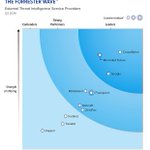
CrowdStrike was also recognized as a Leader in The Forrester Wave: Proactive Security Platforms, Q3 2026, receiving the highest ranking in the Strategy category.
CrowdStrike is expanding Falcon into a unified AI-powered security platform, combining autonomous investigations, proactive defense, vulnerability management, and AI agent protection.
Its integrated architecture and growing product portfolio could strengthen switching costs and support enterprise platform consolidation.


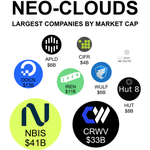
Neoclouds Are Building the Next Generation of AI Infrastructure, Backed by Massive Contracts
AI infrastructure demand remains strong, supported by multibillion-dollar contracts and triple-digit growth forecasts.
Neocloud Companies by Market Cap:
$NBIS Nebius: $41B
$CRWV CoreWeave: $33B
$DOCN DigitalOcean: $13B
$IREN IREN: $11B
$HUT Hut 8: $8B
$APLD Applied Digital: $6B
$WULF TeraWulf: $6B
$CIFR Cipher Digital: $4B
$WYFI WhiteFiber: $427M
Yet neocloud stocks have fallen sharply as investors question debt, CapEx, and future free cash flow.
Gartner warns over 80% of neocloud providers could lose independence by 2030, including through consolidation.


JPMorgan Sees $CRWD, $PANW, and $ZS as Long-Term AI Cybersecurity Winners. Can Smaller Rivals Compete?
AI is emerging as both a major cybersecurity threat and a powerful driver of industry growth.
Unlike broader software, which faces concerns about AI disruption, cybersecurity is benefiting from growing demand for protection against AI-powered attacks.
Cybersecurity Companies by Market Cap:
$PANW Palo Alto Networks: $329B
$CRWD CrowdStrike: $274B
$FTNT Fortinet: $136B
$NET Cloudflare: $117B
$ZS Zscaler: $42B
$OKTA Okta: $38B
$RBRK Rubrik: $28B
$NTSK Netskope: $11B
$S SentinelOne: $9B
$CVLT Commvault: $7B
$VRNS Varonis: $6B
$TENB Tenable: $5B
AI-driven cybersecurity demand could accelerate industry growth, but enterprise platform consolidation may favor larger vendors.

ServiceNow $NOW Q3'26 Earnings Preview
Consensus Estimates:
Revenue $4,092M (+20.1% YoY)
EPS $1.03 (+6.8% YoY)
If $NOW beat estimates by 1.6% (same as last quarter) Q3'26 Revenue Growth will be +22.0% YoY
Management Guidance:
Q3'26 $3,975 - $3,980M guide (+20.6% YoY)
$15,760 - $15,780M FY guide (+22.4% YoY) raised by 0.10%

$HACK Cybersecurity ETF: $3.7B in Assets Across Leading Cybersecurity Companies
Cybersecurity spending benefits from rising digital threats, cloud adoption, and growing AI-related attack surfaces. $HACK Amplify Cybersecurity ETF offers exposure to companies developing security software, hardware, and services.
Fund tracks the Nasdaq ISE Cyber Security Select Index, with 26 constituents. Eligibility rules include a minimum $1B market cap, 20% free float, and $1M average daily trading volume.
AUM: $3.7B | Expense Ratio: 0.60% | Quarterly Rebalancing
Leading Holdings:
$PANW Palo Alto Networks: 6.40%
Enterprise platform covering cloud, network, and security operations.
$AVGO Broadcom: 5.74%
Enterprise security software and networking technology.
$CRWD CrowdStrike: 5.70%
Falcon platform for endpoint, cloud, identity, and AI security.
$CSCO Cisco: 5.42%
Firewalls, SASE, and Splunk-powered security analytics.
$ZS Zscaler: 5.22%
Cloud-native zero-trust access and data protection.
$RBRK Rubrik: 5.20%
Cyber resilience, ransomware recovery, and data security.
$NTSK Netskope: 4.91%
Secure access, SaaS protection, and data security.
$NET Cloudflare: 4.90%
Edge security, DDoS protection, and zero-trust networking.
$FTNT Fortinet: 4.87%
Integrated firewalls and network security infrastructure.
$OKTA Okta: 4.84%
Identity security and access management.
Other holdings include $CHKP Check Point, $S SentinelOne, $TENB Tenable, $QLYS Qualys, and defense contractors $NOC Northrop Grumman and $GD General Dynamics.
HACK provides broader cybersecurity exposure than individual stocks, covering endpoint, cloud, identity, network, and data security.

$NET Cloudflare Expands AI-Powered Cybersecurity and Agent Infrastructure, Strengthening Its Platform
Cloudflare continues expanding beyond traditional networking and cybersecurity, introducing new AI-powered security capabilities, autonomous threat detection, and infrastructure for AI agents.
Adaptive Intelligence:
Cloudflare introduced Adaptive Intelligence, a continuously learning detection system integrated into Bot Management.
System analyzes over 1 trillion web visits daily, continuously retraining on real-world traffic to identify evolving threats and improve bot detection.
Growing network traffic strengthens Cloudflare's ability to detect malicious behavior and adapt security protections.
Automated Vulnerability Discovery:
Cloudflare introduced Vulnerability Discovery and Remediation, combining real-time network telemetry with OpenAI Daybreak models.
Operating within its Managed Defense service, the technology identifies vulnerabilities and supports automated remediation.
Cloudflare is moving toward real-time cybersecurity automation, reducing reliance on manual threat analysis and security configuration.
Post-Quantum Security:
Cloudflare plans to become a public Certificate Authority, issuing traditional TLS certificates alongside next-generation post-quantum Merkle Tree Certificates.
To support this expansion, Cloudflare plans to acquire publicly trusted Root CA key material from GlobalSign.
The initiative could strengthen Cloudflare's position in internet security infrastructure as demand for post-quantum cryptography grows.
Cloudflare also formed a strategic partnership with Deutsche Telekom, expanding its industry relationships.
AI Agent Infrastructure:
Cloudflare is benefiting from growing AI-driven internet traffic and expanding its developer platform.
Cursor Cloud agents can operate within customer-controlled Cloudflare Sandboxes, complementing integrations with Devin Outposts and Claude Managed Agents.
File system operations and browser activity run inside isolated Cloudflare environments, allowing enterprises to control how AI agents access and execute code.
This approach positions Cloudflare Sandboxes as infrastructure for deploying AI agents securely.
Cloudflare is becoming a broader platform combining networking, cybersecurity, developer infrastructure, AI agents, and identity.

AI Optical Networking Could Grow +39% Annually as Photonics Becomes Critical to AI Infrastructure
Photonics is a $1.0-1.5T market, growing +4-7% annually. AI optical connectivity is expanding much faster, potentially reaching $73B by 2030, up from $14B in 2025.
Demand for 800G/1.6T transceivers, optical switches, and silicon photonics is accelerating as AI clusters expand and require faster, more power-efficient connections.
Stocks below 52-week highs | Estimated NTM revenue growth:
$LITE -28% | +110%
$MRVL -29% | +66%
$AVGO -34% | +76%
$MTSI -42% | +50%
$CIEN -47% | +29%
$ALAB -48% | +120%
$COHR -50% | +49%
$CRDO -51% | +81%
$GLW -53% | +18%
$FN -57% | +31%
$AEHR -62% | +153%
$AAOI -69% | +195%
Optical Components and Systems
$LITE Lumentum benefits from strong laser demand and expanding optical circuit switch opportunities.
$COHR Coherent supplies lasers and transceivers, although lower-margin assembly could pressure profitability.
$CIEN Ciena reported $8.5B in backlog, supporting revenue visibility.
$GLW Corning benefits from accelerating fiber demand, but its valuation creates high expectations.
AI Connectivity and Semiconductors
$CRDO Credo achieved 68% non-GAAP gross margin, supported by low-power connectivity products.
$MRVL Marvell and $AVGO Broadcom benefit from optical networking and custom AI silicon, but face hyperscaler concentration risks.
$ALAB Astera Labs expects approximately 40% sequential revenue growth as Scorpio switches ramp.
$MTSI MACOM supplies components for high-speed optical links.
$FN Fabrinet provides optical manufacturing, $AEHR Aehr supplies testing equipment, and $AAOI Applied Optoelectronics manufactures lasers and transceivers.

$ANT Anthropic Targets a $2 Trillion Valuation: Revenue Surges 1,300%, but Can Growth Justify Massive Infrastructure Commitments?
Anthropic filed for an IPO on Nasdaq under ticker $ANT, revealing extraordinary revenue growth and accelerating enterprise adoption.
Revenue surged 1,300% YoY to $16.29B in H1 2026, exceeding the company's entire FY2025 revenue by 3.5x.
Gross profit reached $13.91B, with an impressive 85.4% gross margin.
Operating loss narrowed 67.5% YoY to $693M, improving operating margin from -183.6% to -4.3%.
Compute and infrastructure spending increased 283% YoY to $8.95B, but declined from 201% to 55% of revenue, demonstrating improving compute efficiency.
Enterprise adoption is accelerating rapidly.
Customers generating $100K+ annually increased approximately 12.5x YoY to more than 11,900.
Over 1,900 customers spend $1M+ annually, including approximately 250 spending $10M+.
Net Revenue Retention reached approximately 900%, reflecting extraordinary expansion among existing enterprise customers.
More than 50% of Fortune 500 companies use Anthropic, with significant room for deeper adoption.
Approximately 80% of revenue comes from consumption-based services, providing growth opportunities but also introducing spending volatility.
However, infrastructure commitments represent a major risk.
Anthropic faces more than $600B in potential infrastructure commitments, including $125.2B in Broadcom equipment lease payments over five years.
Meanwhile, Amazon and Google remain critical infrastructure providers, distribution partners, and competitors.

Neocloud Stocks Plunge, Despite Triple-Digit AI Revenue Growth Forecasts
AI infrastructure demand remains strong, supported by multibillion-dollar contracts. But rising debt and massive CapEx raise questions about future free cash flow.
52-week declines | Estimated NTM revenue growth:
$NBIS Nebius | -47% | +430%
AI cloud ARR reached $3B, supported by $40B+ in contracts. However, $5.7B quarterly CapEx, rising debt, and customer concentration create substantial risks.
$IREN IREN | -68% | +300%
A $9.7B Microsoft contract supports rapid AI cloud expansion. Operating ARR reached $1B, but $25B–$30B planned CapEx and deployment delays pose risks.
$WULF TeraWulf | -62% | +220%
Secured a $19B Anthropic lease covering 401 MW. Unlike GPU-owning neoclouds, WULF develops and leases data centers, avoiding direct GPU depreciation risk. Construction remains capital-intensive.
$CIFR Cipher Digital | -74% | +186%
Holds 700 MW of contracted HPC capacity, worth $11.4B. However, adjusted EBITDA remains negative, and new rental income depends on project completion.
$CRWV CoreWeave | -62% | +157%
Backlog reached $104.2B, but debt totaled $35.6B and quarterly FCF was -$5.74B. Heavy investment is required to convert contracts into revenue.
$WYFI WhiteFiber | -79% | +138%
Secured an $865M Nscale colocation contract. Customer concentration and limited contracted power capacity increase execution risks.
$DOCN DigitalOcean | -50% | +42%
AI customer ARR reached $234M, with a 40% adjusted EBITDA margin. Its diversified cloud model reduces reliance on debt-funded GPU expansion.
$APLD Applied Digital | -64% | +24%
Secured 1.41 GW in leases, but $6.4B in debt and rising interest costs pressure profitability. As a data-center landlord, tenant credit risk is critical.
$HUT Hut 8 | -57% | +5%
Holds 949 MW of contracted capacity, worth $26.6B. Long-term leases support future income, but much of its infrastructure remains under development.

$CRWD at 39x EV/S vs. $S at 5.9x: Is the Valuation Gap Justified?
CrowdStrike is trading at a Forward EV/Sales multiple of 39.0x, significantly above SentinelOne’s 5.9x.
Interestingly, in 2021, SentinelOne traded at a higher Forward EV/Sales multiple than CrowdStrike. Investors viewed SentinelOne’s innovative AI-powered platform as a potential disruptive threat to CrowdStrike, supported by SentinelOne’s significantly faster revenue growth.
However, market valuations have since reversed. CrowdStrike’s valuation has expanded over the past year, with its Forward EV/Sales multiple now reaching a 4-year high.
Is CrowdStrike Overvalued? SentinelOne Undervalued?

Analysts forecast CrowdStrike’s NTM revenue growth at +23.2%, among the highest in the cybersecurity sector, compared to +19.2% for SentinelOne.
Considering estimated NTM revenue growth, CrowdStrike trades at premium on EV/Sales relative to other cybersecurity companies, while SentinelOne appears undervalued relative to its expected revenue growth.
