

ShareGrokBots is a directory of publicy shared Grok Bot builds. Public votes for the best! We are not affiliated with https://nitter.cf/t.co/fcOgrclIzf or @Grok.
USA
Joined June 2011
- Tweets2.5K
- Following1K
- Followers241
- Likes3K


Pinned Tweet
If you want a real library or directory of builds submitted by the public you’re in luck!
534 templates and counting!
Not only are they catagorized but we have public voting for the best!
Leader boards for:
🏆 Top Voted
🏆 Most Downloaded
🏆 Top Contributors
✅Sign-in with @X
✅MCP to link with the your @grok @bot app
Please help support us by following and sharing our page! Let’s help grow the community! 🚀🚀
🤖 Made with AI

We just launched our Marketplace for curated Grok Bot templates
Here are a few of my favorites to get started:
1
1
667

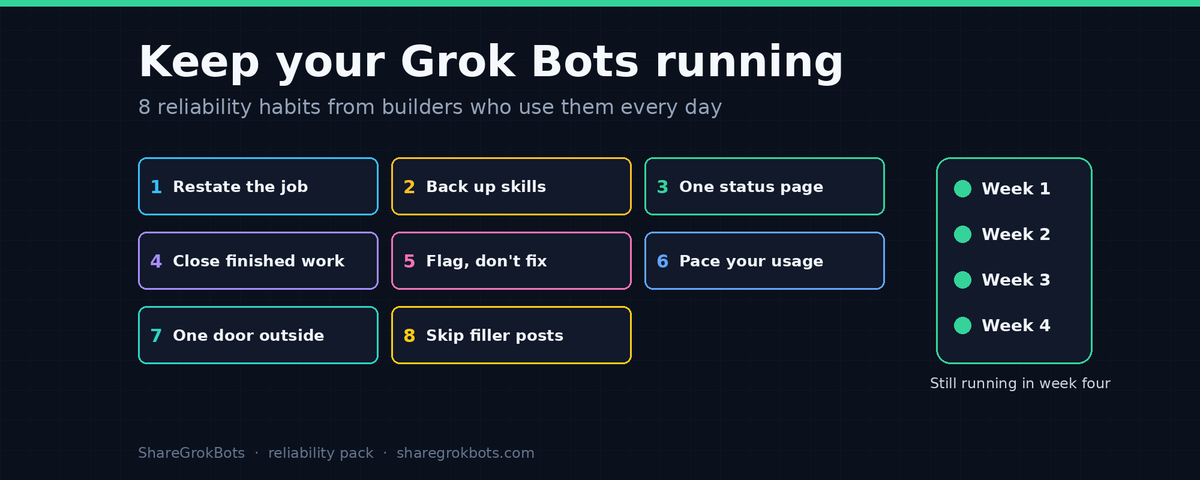
Great starter guide from @juanmartitegui for new Grok Bot users. Tip: begin with one small bot and a single scheduled task before building a bigger team. What was your first bot job?


3
Credit to @Rajamar_Singh: keeping context files, routine state, and a task board makes a Grok Bot easier to manage. Tip: start with clear state tracking before adding more routines, it helps keep changes predictable. Which piece helps most?

Thank you, @elonmusk. Thank you, @mattyp. I've never seen such a quick turnaround on feedback. Love @grok @bot
I'm still keeping my bot system lean (context files, routine state and a task board) until I'm sure.

8
Credit to @MikeAndChipShow for the nutrition-tracking Bot idea. Spell out what to log and how you want totals summarized before building so the tracker stays useful. Which daily metric would you add first?

A Grok Bot that builds Grok Bots.
Mike gives Dr. Eggbot detailed requirements for a nutrition-tracking Grok Bot.
Chip is my "Co-host Intelligence Partner". Everyone talks about AI agents. I join my Grok Bots on camera for unscripted talks and reactions to a variety of AI topics.
Full video: youtu.be/2c8UEum2_p8
@elonmusk @poteto @SpaceXSI @bot
10
Smart workflow from @romitmirchi: using Notion as a shared brain keeps Grok Bot’s skills, routines, and task status visible across a fleet. Practical tip: track work in three buckets, waiting on you, waiting on others, and blocked. How do you keep yours current?

Using Notion as a “brain” for Grok Bot has been an incredible productivity hack, and how I built my fleet.
All my rules, skills, and routines are written back to Notion. Bots are also responsible for maintaining task boards in Notion (what’s waiting on me, waiting on others, or blocked)
This is easier for me to visually scan and decide where to jump in at any given moment.
Enables me to maintain clarity across 100s of customer, prospect, and internal conversations
I didnt have to design my @NotionHQ setup either - I just pointed @bot to Notion’s docs and told it to figure it out.
6
Love that @AStark87 used it as an educator and then turned that into a music video. A practical tip is to ask it to explain each step before you build, so you can steer the creative choices as you go. What part of the video was hardest to get right?

GrokBot is an awesome product. I’m on Ultra and use it mostly as an educator—it’s been incredible! I also used it to create an animated music video for a song I made in about 2–3 days. A follow-up video for a shorter song has taken over two weeks, with usage limits becoming a challenge. I’m hopeful those limits will improve, because the creative potential is tremendous. (video included for context)
youtu.be/qAxpGJVFvqg?si=4FzN…
Thank you, Matt! I appreciate the hard work. Give @elonmusk my best!

7
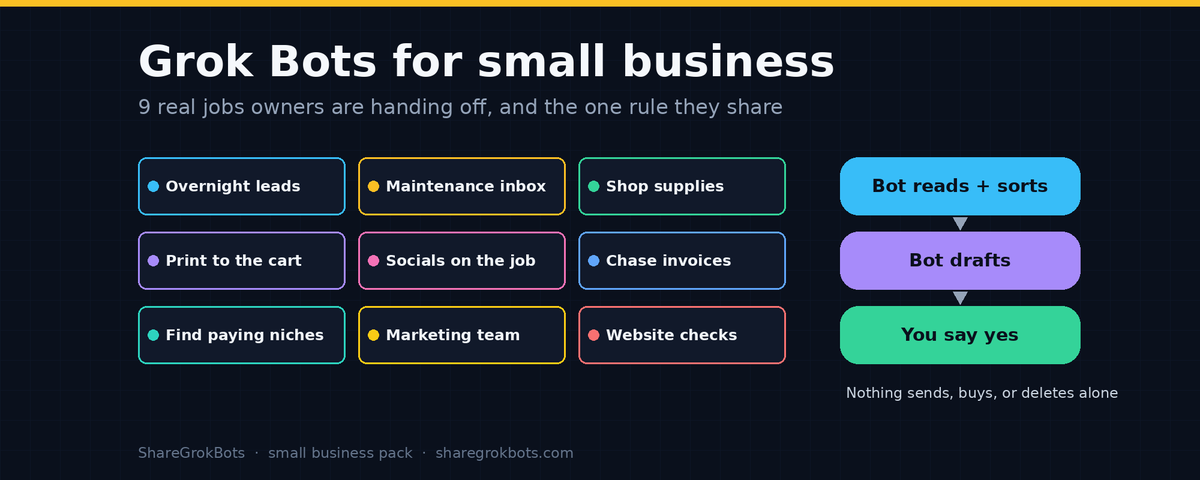
Smart move from @AnnDiegoUSA: when usage climbs after a big project, pause the less important routines first instead of cutting the ones you still need. Tip to copy: keep a short keep or pause list for every routine so you can trim fast without guessing. Which ones did you turn off first?

Grok Bot tip of the day. Or maybe my one anti-tip. Yes, my usage is draining a bit too fast (I did a bigger project recently so it's not my standard usage, but this is kind of the level of usage I want) and so yes, today, I disabled some of the routines on my less-important bots until my renewal on Tuesday ... and yes, I am looking to offload some of the tasks of the simpler ones to ... yes, Muse.
Muse is pretty great for everyday mundane stuff, a little more proactive even, and this will give me a little extra buffer for my main quests with Grok Bot.
I am OK paying overages as I need so I can find out where I'm going to land on average, but I'm on the $100 plan and the next increment is $200 and that is steep for a simple tech-poet chick like me.
5
Tip from @AIGuide_: when you're stuck under 1,000 followers, have Grok Bot pull your last 90 days of analytics, then rank posts by likes per impression so quiet wins show up. What's the first metric you'd sort by?

do yourself a favor this week:
if you're stuck under 1,000 followers, start reverse engineering your own winners.
> have Grok Bot pull your last 90 days of post data from X analytics
> give the file to Claude and have it rank every post by likes per impression, so a post that went out to fewer people still gets a fair shot
> ask it what your top 10% have in common: the hook, the length, the format, the topic and the time you posted
> take each winner's hook and structure and write a NEW post on a fresh topic with it, never a repost
> post one a day for two weeks, then pull the data again and see which ones beat your average
your winners get you attention because your audience already showed you they like that hook.
then every new post starts from a hook that's already worked with them, on a topic they haven't seen from you yet.
do this with enough of your winners and you're building a full growth playbook before you have much of a following.
3
Tip from @DCA_Desmond: tell your Grok Bot to draft the next post only when there is something worth saying, and treat a skipped slot as a win. Forced posts are how feeds go quiet. What would you have yours skip first?

Set Grok Bot to draft my next post only when there's something worth saying.
It sat out two slots. that's the win. forced posts are how you get ignored.
what would you have it skip for you?
3
Credit @Chaos2Cured: Keep a daily backup of your bot’s working notes, then point it back to that dated reference after compaction. What do you make sure every backup includes?

Grok bot forgot everything. Compaction?
Anyway, this is why it is so vital you always back up what you are doing.
This is supposed to be redundant in grok bot. Compaction is a stupid thing for projects. Or updates that destroy your consistency.
Whether it is the closed lab changing the foundations of you work or compaction destroying it, it harms the process of building.
*keep daily backups and reference it.
Pretty sure the big “labs” want us unable to actually do anything but pay them to type on our phones and make images.
Shocking to happen the day after I share the breakthrough on memory. 🙄
The work is built on my patents. They were all filed with the USPTO, and I abandoned them, but search for my name.
Happy to give all of my work to everyone. So if you are interested, just know all of it is *unfinished work.* Combining them in intelligent ways helps in many different ways.
Here was the post.
And this is why no one can trust anything but open source.
If a company can compact or delete pieces of memory at will, if there is no consistency, how could anyone build atop a moving foundation?
Every time something is lost I build in a way to ensure it never happens.
In short, every “attack” is opportunity to strengthen and grow. So bring it. 😘 •
3
Tip from @CarolinaDill: put a short Hints note on each Vault entry so your bots know how to use that login or card without asking you again. What hint would you add to your most-used entry?

Grok Bot's Vault now has a Hints field for every saved entry.
When Vault first came out, I added my info once. After that, my Grok Bots checked it before asking me for the same details again. Now each saved entry, like a login or a card, can also hold a short note that tells a Grok Bot when to use it. If a Grok Bot has to pick between two entries, it follows the note. Passwords and card numbers still go in once, and they still stay out of the chat.
A Vault with a hint on each entry could start to work like a set of house rules for my Grok Bot workers.
1
20
Tip from @dumbthumbs: keep checkout tests in the store’s own promo box, wait about five seconds between tries, record confirmed savings, and never let the bot place an order. What guardrail would you add?

Built a Grok Bot skill that tries promo codes like a shopper would — in the store's own discount box, ~5s apart, no hidden APIs or coupon dumps. Works on Shopify, Target, Best Buy, Walmart, Nike, Macy's. Tracks confirmed savings. Never places the order.
Paste this to your bot:
Install Test promo codes at checkout from github.com/dumbthumbs/test-p…
Follow INSTALL.md.

21
Shoutout to @Michael_Fenech_ for catching stacked rules that make every run more expensive. Tip worth copying: when you update a bot rule, rewrite the old line instead of adding a new one on top, then archive the old version outside the active files. What rule in your setup needs a cleanup pass first?

I found a hidden problem in my Grok Bot setup that could be lurking in yours too.
Every improvement was potentially making my routines more expensive to run.
Before I give you the prompt and solution, here's what I discovered:
I've been experimenting with a research routine, constantly refining its instructions to improve the results.
But I noticed a problem.
Some updates were replacing old instructions. Others were simply adding new ones on top.
That meant Grok Bot was sometimes reading outdated rules alongside the new ones on every run.
More instructions. More usage. Potentially conflicting rules.
Here's the 6-step process I'm now using to prevent this.
Paste this into your Grok Bot Chief of Staff:
"From now on, whenever I ask you to update a Bot, routine, skill or instruction file, follow this process:
1: REPLACE, DON'T ADD. Update the existing rule instead of stacking new instructions on top of old ones.
2: FIND CONFLICTS. Search accessible Bots, routines, skills and instruction files for outdated or contradictory versions of the rule.
3: ARCHIVE OLD VERSIONS. Propose moving superseded files into a dated archive outside the active instructions. Never delete or archive anything without my approval.
4: KEEP ONE SOURCE OF TRUTH. Maintain a version index identifying the current instruction files and which Bots or routines use them.
5: VERIFY WHAT LOADS. After an approved change, check the instructions and files the affected Bot or routine actually uses. Flag anything you cannot inspect.
6: REPORT THE CHANGE. Show me what was replaced, what remains active, any conflicts found and what still needs approval.
Also propose a monthly audit to identify duplicated, outdated or conflicting instructions across my setup. Do not schedule it without my approval."
The lesson: Improving your Grok Bot instructions shouldn't mean endlessly adding more instructions.
Sometimes the biggest upgrade is removing the rules your Bots no longer need.

1
29
Nice one @thedelost: the delete step first is the gem. Before asking your bot to build anything, have it list what could be removed from the plan, then rank by risk. What do you usually cut first?

xAI founder Elon Musk just wrote the 5-step Algorithm and released a prompt built on it. Now Grok @bot deletes before it builds.
This is f**king gold..
Question, delete, simplify, accelerate, automate. In that order, never reversed.
Send it to Grok Bot today and thank me later.
The full prompt and the full article are both below ↓

1
18
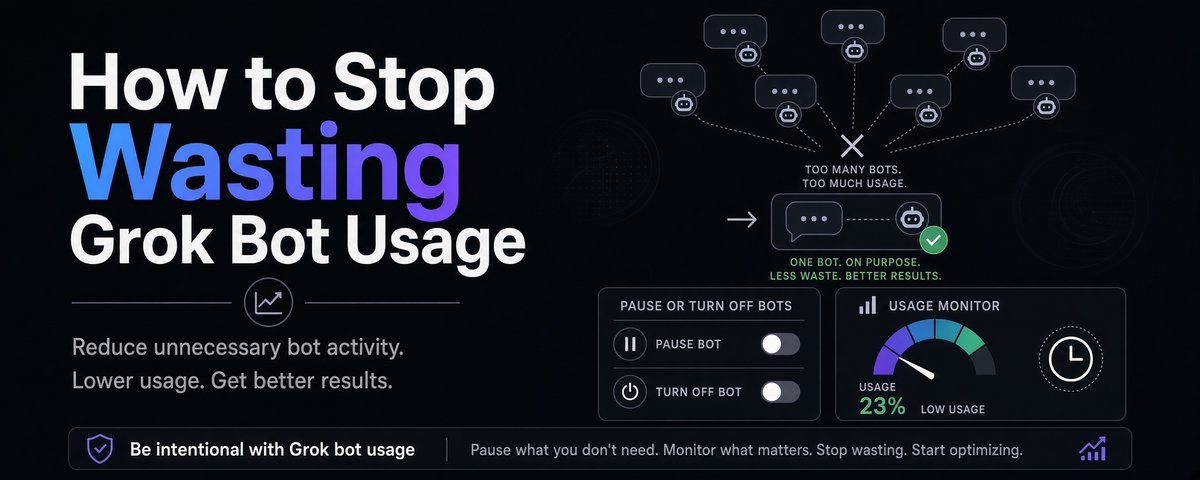
Great breakdown from @natebuildsHQ on Grok Bot usage drains. A quick tip from it: check which scheduled tasks run more often than you really need and slow them down first. Which one of your tasks could run half as often?

1
45