

Stanford Medicine '30 | Harvard '24, Oxford '25 | @KnightHennessy @NYTimes Fellow, @MarshallScholar, @ForbesUnder30, @AAASKavli, @SciCommAwards
New York City
Joined September 2020
- Tweets820
- Following1.2K
- Followers1.9K
- Likes1.9K


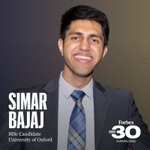


Pinned Tweet
Yesterday was my first day at the @NYTimes!
Honored to be reporting about health and wellness for a year — and let me know if you have any ideas and tips
I also reckon there's never been a better time for you to sign up for the Well newsletter!

Simar Bajaj retweeted

Excited to be interviewed as a historian for this article about the peptide health trend by @SimarSBajaj in @SmithsonianMag: bit.ly/4hgZrQa

Simar Bajaj retweeted

It fills my heart that @NehaVapiwala interviewed the brilliant NYT reporter @SimarSBajaj who has been covering some of the most important issues in lung cancer issues recently. @ChiFuJeffYang @alexandra_p_24 @LeciaSequist @AmLungCSI

NEW in the ASTRO President's Corner:
A conversation with New York Times reporter Simar Bajaj
ASTRO President @NehaVapiwala, MD, FASTRO, speaks with @SimarSBajaj, an award-winning New York Times journalist who will begin medical school at Stanford University this August.
Watch on YouTube: ow.ly/Yq3m50Zrv4F
Watch on ASTRO's website: ow.ly/hjvS50Zrv4G

Simar Bajaj retweeted

Really enjoyed my convo w former @nytimes #healthcare reporter @SimarSBajaj on the art of effective communication, the power of metaphors over jargon, and the impact of social media. Perfect start to n upcoming series of interviews featuring “outside” perspectives! And a great reminder that a key part of communicating the value of #radiotherapy to advance care - the theme of @ASTRO_org 2026 Annual Meeting - is understanding your audience & meeting them where they are. @DrewMoghanaki @sueyom @ZekeEmanuel @CancerAdvocacy @LUNGevity @DrKarenKnudsen
NEW in the ASTRO President's Corner:
A conversation with New York Times reporter Simar Bajaj
ASTRO President @NehaVapiwala, MD, FASTRO, speaks with @SimarSBajaj, an award-winning New York Times journalist who will begin medical school at Stanford University this August.
Watch on YouTube: ow.ly/Yq3m50Zrv4F
Watch on ASTRO's website: ow.ly/hjvS50Zrv4G
Simar Bajaj retweeted

Wastewater surveillance has been proven for monitoring pathogens. A new study suggests it can be useful to quantify community food intake and for nutrition research
pnas.org/doi/abs/10.1073/pna…
nytimes.com/2026/07/20/scien…


The sewer knows what you ate!
For New York Times, I wrote about the scientists sifting through urine and poop to sequence food DNA, finding traces of chocolate, lettuce, turkey, blueberries, black pepper, and hundreds of other foods — for less than a penny a person. (1/n)
The catch is that this technology raises tricky questions around the surveillance state and commercialization. Most people don't think about what they flush away as valuable data, and once it enters the sewer, they usually have little say about who collects or uses it. (5/n)
(Imagine Kraft Heinz or PepsiCo mining your sewage and then flooding your neighborhood with the ultraprocessed foods it knows you crave.) Read the full story to learn more!
nytimes.com/2026/07/20/scien…

Simar Bajaj retweeted

Thank you, @NBCNews @SimarSBajaj for covering our recent study. Stay tuned for data on comparative effectiveness of obesity treatments after initial therapy with semaglutide or tirzepatide from our group @CCLRI

According to a trio of recent studies that analyzed medical records of patients, following them for six months up to two years, about 45%-70% maintained their weight loss after their last documented GLP-1 prescription or refill. nbcnews.com/health/health-ne…

Simar Bajaj retweeted

Please read this story of a dad trying to develop a drug to save his child.@Jasonmmast and I think it is one of our best.
As we were working on it, we kept coming back to the same question: If this guy can't develop a drug for a rare disease, who can?
Matt Wilsey did not sit in the lab. He did not inject the rats or slice open their brains. But he had hired the scientists who did. He recruited advisers, including Nobel Prize winners, brought together the families of other children diagnosed with the condition, and pulled together an A-team of investors and donors. Through it all, he was sustained by his devout Catholic faith.
“We carry the hopes of many,” he wrote to his staff once. “I receive emails, calls, and texts from professionals and other advocates. They are blown away by what we have accomplished and hope we are an ice breaker for them. Our trial has the potential to really boost / save a decimated field.”
Now it may run aground.

Simar Bajaj retweeted

The Wearable Data Your Doctor Actually Wants: Wearables can offer rough information about a person’s health, experts say, but only some metrics are medically useful via @SimarSBajaj
nytimes.com/2026/06/24/well/…

Simar Bajaj retweeted
Be sure to read @emcahan latest story!

Over the past 18 months, Rolling Stone interviewed dozens of patients, physicians, attorneys, advocates, and lawmakers.
The same experiences came up time and time again: people with eating disorders who were denied the care they needed.
rollingstone.com/culture/cul…

Every week, the New York Times publishes one piece of ideas-driven journalism, explaining a complex problem or illuminating an important way of thinking. Last week, they chose my story on the return of blaming and shaming in public health for the "Ideas" section.
For decades, public health has been moving away from stigma — across HIV/AIDS, mental illness, addiction, obesity, and beyond. But health secretary Robert F. Kennedy Jr. has revived a language of personal responsibility, and I wrote about what that reflects and what it costs.
What makes stigma so interesting is that it masquerades as accountability while often making care harder to seek and change harder to sustain. But the usual anti-stigma response has its own problems: Too often, it tries to fix stigma by changing hearts and minds one training at a time, rather than changing the structures that give stigma force.
Of course, personal responsibility matters. People are agentic. But when it comes to public health, a better message may be “constructive responsibility," acknowledging that individuals have responsibilities but insisting that industries, policies, and environments must also be held accountable.
That is what makes Mr. Kennedy’s rhetoric so revealing. He is pointing to something real when he attacks the food industry and other commercial drivers of the chronic disease epidemic. But this critique loses force when he condemns the system and then casts the people shaped by that system as irresponsible.
A better public health would meet this tension honestly: not by pretending people have no agency and not by shaming them for failing to overcome rigged conditions — but by changing those conditions so that agency has a fair chance.
Full story in the replies


Simar Bajaj retweeted
The Return of Blaming and Shaming in Public Health: For years, medicine has tried to eliminate stigma. Now, Robert F. Kennedy Jr. is bringing back the language of personal responsibility. nytimes.com/2026/06/01/well/… via @SimarSBajaj
Simar Bajaj retweeted

Can Shocking Your Vagus Nerve Really Improve Your Health? Thank you @SimarSBajaj @nytimes for the balanced reporting on the great nerve! nytimes.com/2026/05/18/well/… via @NYTimes

Half of patients with Stage IV lung cancer don't receive any life-extending treatments. For @nytimes , I explored this sobering statistic and why so many people with the nation's deadliest cancer go without care.
According to a new @JAMAOnc study of 250,000+ Medicare patients,
❌ 1/3 of patients never see an oncologist.
❌ Rural, unmarried, and minority populations were the least likely to be treated.
❌ 40% die within 3 months of diagnosis, suggesting that many patients are diagnosed far too late. (Think low rates of lung cancer screening and longstanding delays between a suspicious scan and a diagnosis.)
Why does this matter? We are in a "golden age" of lung cancer treatment. Immunotherapy and targeted therapies are incredibly effective and well-tolerated. In fact, with a daily pill, some patients can live for years after being diagnosed. Lung cancer is no longer a death sentence, but access issues, fatalism, and stigma are keeping these promising medications out of reach.
In medicine, there's always been this gap between scientific breakthroughs and the patient bedside. And I believe that improving access and uptake of health care is one of the most challenging and important issues of our time.
@kyleconcannonMD @DrewMoghanaki @muschollings
Read the full story here: nytimes.com/2026/05/07/well/…
