

The fractals of infinity are as the living waters; as deep or as shallow, beyond measure, as one has the capacity and will-power to explore.
Joshua Is of ALL
Joined May 2014
- Tweets17.9K
- Following42
- Followers1.8K
- Likes5.5K









Pinned Tweet
`
What is Kriya Meditation?
It is the way to the Kingdom of Heaven within you.
Learn more @ SpiritMaji.com/Kriya
.


Joshua retweeted

Every guest at Steve Jobs's memorial was handed a small brown box on the way out.
Inside was a book, and in that book is the story of a man in the Himalayas who, according to the people who met him, never grows old.
His story begins with an accountant who was sent into the mountains by mistake.
In 1861, Lahiri Mahasaya was 33 years old and working as an accountant for the British army's engineering department in Danapur, in northern India. He had a wife, children and a desk, and for years he had been meditating quietly at home. Then a telegram arrived from head office. He was being transferred to Ranikhet, a new army post high in the Himalayas.
One afternoon he was walking on a mountain called Drongiri when he heard a voice in the distance calling his name. He climbed toward it and found a young man waiting for him, smiling, who looked almost exactly like him except for his copper-coloured hair.
"I see my telegram took effect," the stranger said.
Lahiri had no idea what he meant.
The young man explained that it was he who had quietly placed the idea of the transfer in the mind of Lahiri's superior. Then he led him into a small cave with a few woollen blankets and begging bowls, pointed at one folded blanket in the corner, and asked whether he remembered that seat. It was Lahiri's own, he said, from a life before this one.
According to the story, the memories came back. That night the young man initiated him into an old meditation practice called Kriya Yoga.
The stranger never gave a name, a birthplace or an age.
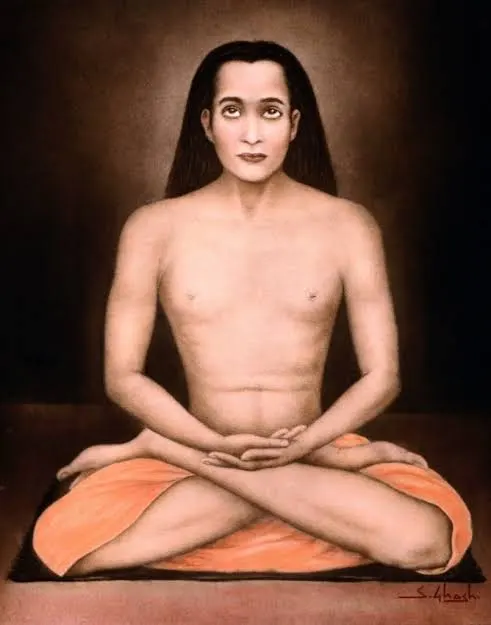
His followers simply called him Babaji, revered father, and people who said they met him over the following decades all described the same young man, as if time did not touch him.
Lahiri did what anyone would do. He begged to stay. He wanted to give up the office, the city and the whole noisy life below and live in the mountains with his teacher for the rest of his days.
Babaji said no.
Your role in this life has to be played on an outward stage, he told him. Your life is in the crowded markets, where you can be an example of something people have almost stopped believing in: "the ideal yogi-householder." Go back down. Go back to your wife, your children and your desk.
Soon afterwards a letter came from head office. His transfer to Ranikhet, it said, had been made by error.
So Lahiri went home.
He sat at his accountant's desk for years, raised his children, retired on a government pension, and quietly taught the practice to anyone who came to his door, Hindus, Muslims and Christians alike.
Babaji had promised to come to him whenever he called, and later added a correction that his students would repeat for generations: "I shall come when you need me, and not always when you call me."
Lahiri taught a man named Sri Yukteswar. Sri Yukteswar taught a young monk named Yogananda. In 1946, Yogananda wrote the whole story down in a book called Autobiography of a Yogi.
A teenager in California read it in high school.
He read it again when he travelled to India, and then once a year for the rest of his life. Years later, it was the one book he had downloaded on his iPad. When he knew he was dying, Steve Jobs arranged for a copy to be given to every person who came to say goodbye.
All of it grew out of one choice. A man finds his teacher in a cave in the Himalayas, the place every seeker dreams of ending up, and the teacher sends him back to the office.
We tend to believe the opposite.
We think awakening is waiting somewhere else, in a retreat, in a cave, in a different life with fewer obligations, once the kids are older and the money is sorted. The man who, according to his followers, has not aged in centuries looked at a family man with a nine-to-five and told him that was exactly where the work was.
Your desk, your inbox, your children, the queue at the supermarket. That is the outward stage. The practice was never meant to get you out of your life. It was meant to be lived in the middle of it.
The transfer to the mountains was the mistake.
The way back down to his desk was the whole point.


Leviticus 18:21
You shall not give any of your children to offer them to Molech, and so profane the name of your God: I am the Lord.
Psalm 106:37-38
37 They sacrificed their sons
and their daughters to false gods.
38 They shed innocent blood of their sons and daughters


