Pinned Tweet
If you're still using EDGAR to read SEC filings, you're wasting your time!
Just use SECSift: secsift.com
It's the obvious solution if you want to cut down the time spent reading filings by more than half and better understand any business.
Fajasy retweeted
Well, that just happened...
More than $4.1 TRILLION has now been wiped out in the stock market since October 6th...
More than 60% of S&P 500 stocks are now in a BEAR MARKET, down 20% from their highs...
So what happens now? What should you do?
I'm explaining everything...
David Gardner, who co-founded The Motley Fool, never invests more than 5% of his portfolio in a new stock, so a portfolio built his way holds at least 20 stocks. He adds to the stocks that go up and lets his winners grow into his biggest positions. By his own account, 21 of his first 200 Stock Advisor picks lost half their value or more, but Netflix rose 180-fold by October 2018.
TOYO Co., Ltd’s $TOYO strategy chief says full output at its Texas panel plant would bring in “about $140 million a year” of U.S. tax credits, 85.6% of its market cap, and $TOYO leaves them out of its forecasts.
Regardless of how the four U.S. trade actions on its Ethiopian cells turn out, $TOYO’s answer is to make more in the U.S., which has plenty of panel capacity but few cell plants.
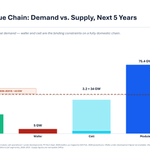
The Solar Energy Industries Association’s October update counts 75.3 GW of operating U.S. module capacity, but $TOYO’s deck counts just 3.2 GW of operating U.S. cell capacity, citing SEIA’s September data, so most U.S. panel makers still rely on imported cells.
Texas modules qualify for the Section 45X production credit, a U.S. tax credit earned on each unit of solar equipment made in the U.S.
For modules, it’s $0.07/W at full value through 2029, then 75%, 50%, and 25% of full value in 2030-2032, and nothing after.
$TOYO said on July 21 that its Texas subsidiary expects to be eligible to claim the credits for its 2025 tax year, which covers the plant’s first months of production.
But Rhone Resch, $TOYO’s Chief Strategy Officer, said on the Q2 call that $TOYO will quantify the credits only after its tax, legal, and accounting work is done.
For the panels themselves, $TOYO announced $185.6M of purchase orders under two master agreements with U.S. developers on June 10, and ~$240M of binding contracts signed “since mid-June” on September 28, with deliveries through H1 2027.
The releases don’t say whether the two overlap, so to stay conservative, I only count the ~$240M.
If priced like $TOYO’s H1 2026 module sales (~$0.25/W), ~$240M would be ~1 GW of panels, or ~6 months of the Texas plant’s 2 GW nameplate.
Continue reading here for how $TOYO plans to pay for the $357M cell plant it wants to build next to its panel plant: newsletter.stablebread.com/p…
Quantum $QMCO ran to $34.50 on October 2, 2026, and has fallen 41.3% since, to $20.25/share.
No $QMCO insider has bought or sold shares in the open market since my August 16 update, including Dialectic, the activist fund managed by director John Fichthorn.
Dialectic received 14.1M shares in June when it settled its convertible notes, 35.8% of the 39.4M shares outstanding, which makes it $QMCO’s largest shareholder.
Its lockup, which also covered $QMCO’s officers and directors, ended on August 23, 30 days after the PIPE shares were registered for resale.
So Dialectic could’ve sold into the run to $34.50, and it hasn’t reported a sale.
On October 1, $QMCO granted options to buy shares at $31.885, that day’s close, to three executives:
→ Hugues Meyrath (CEO): 500,000 options.
→ James Clancy (COO): 400,000 options plus 150,000 RSUs.
→ Anthony Craythorne (Chief Revenue Officer): 200,000 options.
The options vest monthly over four years and only pay off above $31.885, 57.5% above $20.25.
CFO William White, fired eight days later, got no grant.
So the largest holder hasn’t sold, and management’s new options only pay off above $31.885.
But no insider bought during the drop either.
Continue reading here for my updated valuation of $QMCO: newsletter.stablebread.com/p…
In 1956, John Kelly, a physicist at Bell Labs, worked out how much a gambler with an edge should bet to grow their money as fast as possible. Ed Thorp proved that if your edge is half what you think, betting the full Kelly amount grows your money no faster than Treasury bills. So he suggests betting half the Kelly amount or less, which keeps three-quarters of the growth with half the swings.
On October 2, 2026, Seagate $STX and Western Digital $WDC each fell 10.2%, while Quantum $QMCO rose 8.2% to its $34.50 peak.
$QMCO’s drop started the week before it fired its CFO on October 9, along with a selloff in hard drive stocks.
Toshiba, which makes hard drives like $STX and $WDC, said on October 2 that its Philippine plant is “aiming to nearly double its annual production capacity” of data center hard drives by its fiscal year starting April 2027.
More hard drive supply could (1) hurt $QMCO by easing the disk shortage that helped push customers toward tape, as I covered in my April 22 tape primer, and (2) help $QMCO by easing the constraints on “certain disk drives” that CEO Hugues Meyrath mentioned on the June-quarter call.
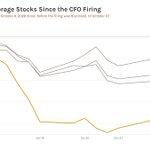
From October 2 to October 9, $QMCO fell 11.8%, vs. 4.3-8.0% for SanDisk $SNDK, $STX, and $WDC.
Then, from the October 9 close, before the firing was disclosed, to October 27, $QMCO fell another 33.4%, vs. 4.1-17.5% for the three storage stocks.
So the storage selloff explains part of the drop from $34.50, but most of it came after the firing, which is specific to $QMCO.
If First Solar $FSLR wins its patent case at the U.S. International Trade Commission (ITC), TOYO Co., Ltd’s $TOYO cells could be barred from the U.S.
First Solar filed a complaint at the ITC on February 24, 2026, claiming certain TOPCon cells, a common high-efficiency silicon cell design, infringe one of its patents.
The ITC voted on March 26 to open Investigation 337-TA-1494, naming $TOYO, its Texas subsidiary, VSUN (the Vietnamese panel maker $TOYO was carved out of), and VSUN’s U.S. arm among 47 respondents.
The ITC’s target date is November 15, 2027.
The patent case won’t be decided before late 2027, but it’s another way $TOYO’s cells could be stopped at the border.
I’m not worried about the patent case yet, since the ITC’s target date is more than a year away and dozens of other respondents face the same claim.
Continue reading here for the three other U.S. trade actions, which all land well before the ITC rules: newsletter.stablebread.com/p…
New on SECSift: Insider Cash-Outs, how much insiders sold at each U.S.-listed company and how much cash they received from prepaid forwards, from their Form 4 filings.
→ 2026 so far: $140.55B sold, plus $897.7M from prepaid forwards.
→ Top: Medline, with $6.80B sold, 52.3% of its public float.
→ Insiders: Open a company to see who sold. At Walmart, the Walton Family Holdings Trust sold $2.31B.
→ Periods: 1M, 3M, YTD, 1Y and 2025.
→ Free here, no account needed: secsift.com/filings/cash-out…
In a 1994 talk, Charlie Munger said the wise ones bet heavily when the world offers them that opportunity. His partnership, Wheeler, Munger & Co., owned very few stocks and returned 19.8% per year from 1962 to 1975, versus 5% for the Dow. But being concentrated also meant bigger drops, roughly 32% in 1973 and again in 1974.
On December 4, TOYO Co., Ltd’s $TOYO Ethiopian cells start paying a 15% U.S. tariff, unless Commerce approves its request for relief.
Section 232 of the Trade Expansion Act of 1962 lets the U.S. president restrict imports that threaten national security.
On August 6, 2026, a proclamation added a 15% tariff, from December 4, on the ingots, wafers, cells, and modules made from polysilicon, for Ethiopia and most other countries, plus minimum import prices of $0.22 per watt (/W) for cells and $0.38/W for modules.
The proclamation also created an onshoring program, run by Commerce, that grants relief to companies building U.S. polysilicon, wafer, or cell plants, as long as construction under an approved plan begins by January 20, 2029.
Section 232 helps $TOYO’s Texas panels but hurts its Ethiopian cells:
1) Texas modules: Imported panels will face the $0.38/W minimum import price from December 4, above the $0.33/W average in Q2 2026 for U.S. utility-scale modules, per the Solar Energy Industries Association (SEIA) and Wood Mackenzie.
2) Ethiopian cells: $TOYO’s cells are imports too, so from December 4, 2026, they pay the 15% tariff and must clear the $0.22/W minimum price. Rhone Resch, $TOYO’s Chief Strategy Officer, said at its October 6 Analyst Day that using Ethiopian cells means $TOYO’s Texas panels are “not a purely U.S. product,” and that $TOYO has presented Commerce a term sheet for onshoring relief tied to its planned Texas cell plant, though he said many such agreements probably won’t come until after December 4.
Notably, Jeffrey Kessler, Commerce’s Under Secretary for Industry and Security, praised $TOYO at its October 6 ribbon-cutting in Texas for “committing to use exclusively US polysilicon,” and his department approves onshoring plans.
Still, 30% of the polysilicon in $TOYO’s Ethiopian cells comes from Malaysia.
CEO Takahiko Onozuka said on the Q2 call that $TOYO anticipates its Ethiopian cells “will be eligible for the relief under the framework now taking shape.”
But he also said in the August 19 release that $TOYO expects an impact on its H2 2026 results, “though the magnitude is not yet certain.”
So Section 232 should lift prices for $TOYO’s Texas panels, but it taxes the Ethiopian cells those panels are made from unless Commerce approves $TOYO’s term sheet.
I won’t be comfortable with Section 232 until Commerce approves the term sheet, and Resch expects many such agreements only after the tariff starts on December 4.
Continue reading here for the $357M Texas cell plant $TOYO’s term sheet is tied to: newsletter.stablebread.com/p…
The first thing I said I’d watch on Quantum $QMCO in my August 16 update was $IBM’s tape drive supply, since CEO Hugues Meyrath said on the June-quarter call that “customers’ demand remains stronger than our ability to fulfill it.”
The LTO Program, the group of $HPE, $IBM, and $QMCO that sets the LTO tape standard, reported on September 1, 2026 that tape capacity shipped in Q1 2026 rose 57% from Q1 2025.
The 57% measures data capacity, and each new LTO generation holds more data per cartridge, so capacity shipped can grow faster than the number of cartridges sold.
Meyrath said on the June-quarter call that $QMCO’s $82.0M ±$2M revenue guidance for the September quarter is only “mildly up” because tape drive supply had stayed “flat for the past handful of months.”
$IBM, which supplies the drives, had told $QMCO it would increase production toward the back half of the year, but Meyrath said the increase still hadn’t shown up as of August.
So by Meyrath’s account, $IBM’s drive supply, not demand, limits how much $QMCO can sell for now.
$QMCO’s quarterly revenue has risen from $62.7M in the September 2025 quarter to $80.8M in the June quarter.
Secondary storage, which $QMCO’s 10-K describes as “primarily tape storage systems,” drove the growth.
It doubled from a year earlier to $37.0M in the June quarter, 46% of total revenue, up from 29%.
That $18.5M increase was more than the $16.5M rise in total revenue, since primary storage, $QMCO’s file and object storage systems, fell to $8.5M from $12.5M.
See $QMCO’s revenue by solution in its 10-Qs here: secsift.com/?t=QMCO&a=000162…
Continue reading here for whether $QMCO insiders sold into the run to $34.50: newsletter.stablebread.com/p…