

Senior Integration & Solution Architect
Helsingborg, Sweden
Joined January 2009
- Tweets3.7K
- Following2.6K
- Followers2.3K
- Likes3.8K




I've updated my X (formerly Twitter) handle from @Stephan_UNISOT to @StephanTrenob, reflecting the planned closure of UNISOT and the next chapter of my professional journey with Trenob Group.
Stephan Nilsson retweeted

••• EU-förordningen som dödar den småskaliga gränsöverskridande e-handeln kommer knappast att ändras i år, om alls. •••
Förra veckan skrev vi om hur EU:s nya förpackningsförordning (PPWR EU 2025/40) dödar den småskaliga gränsöverskridande e-handeln.
På grund av groteska och kostsamma byråkratiska krav [1] med olika rutiner och på olika språk i de 27 medlemsstaterna blir det i stort sett omöjligt för de nästan två miljoner [2] små web-butiker i EU som säljer över gränserna att fortsätta sin verksamhet.
Det handlar om specialiserade butiker, hantverkare, konstnärer, komponent- och kontrakttillverkare, författare som ger ut på eget förlag, smyckeskonstnärer, klädskapare, instrumentmakare, säljare av lokalproducerade produkter – och väldigt många andra som försörjer sig helt eller delvis på småskalig postorder och e-handel till eller inom EU.
Det går inte ens att sälja något till andra EU-länder på eBay längre utan att ange sina registreringsuppgifter (Extended Producer Responsibility Packaging Registration Number) för varje nationell marknad där produkten skall erbjudas. Detsamma gäller den som säljer via plattformar som Etsy, Amazon, Fyndiq och Zalando. Även om det bara handlar om ett paket.
Vad som började som en frihandelsunion har nu utvecklats till ett byråkratiskt monster som hindrar handel över gränserna, i namn av en överordnad grön omställning.
Så vad händer nu? EU kan ju vara blixtsnabbt och runda hörn när det gäller sådant dess makthavare vill ha, som Chat Control.
Svaret är att det knappast blir någon förändring i år, om någon alls.
Enligt Die Welt har en hög EU-tjänsteman uppmanat medlemsstaterna att tills vidare inte tillämpa de nya reglerna strikt och att avstå från sanktioner. Men något sådant uttalande ändrar inte den gällande lagstiftningen.
Vilken företagare vågar verka på en marknad under så diffusa förutsättningar? Och marknadsplatserna vi nämnde ovan har ju redan stängt den möjligheten.
Vad är det för slappt lagstiftningsarbete som till synes saknar all verklighetskontakt och konsekvensanalys? Vad är det för lagstiftare som tyckte att detta var en bra idé? Hur tänkte de då?
Redan i december 2025 insåg kommissionen att kravet på lokala auktoriserade ombud kunde bli ett problem. Därför föreslog den att just detta krav skulle skjutas upp för EU-baserade företag till den 1 januari 2035. (COM(2025) 982) Men det kräver beslut i EU:s ministerråd och i Europaparlamentet. Och alla andra krav ligger kvar.
En stor majoritet av medlemsstaterna i rådet skall enligt uppgift ha motsatt sig förslaget. Rådets behandling av frågan lades åt sidan den 24 juni i år.
Europaparlamentet fortsätter dock att behandla ett nedbantat förslag, med undantag för företag med högst 49 anställda och högst 10 miljoner euro i årsomsättning. En utskottsomröstning väntas tidigast i början av oktober.
Det är därför oklart om parlamentet kommer till skott innan årsskiftet. Om alls. Och om ministerrådet fortsätter att sätta sig på tvären kan processen dra ut på tiden hur länge som helst.
Under tiden går många små postorder- och e-handelsföretag under – och den fria rörligheten för varor inom EU hindras.
---
[1] Om du säljer förpackade varor till kunder i ett annat EU-land kan du, beroende på mottagarlandets system och hur reglerna slutligen genomförs, behöva:
• Registrera dig i varje enskilt mottagarlands producentregister.
• Ansluta dig till varje enskilt mottagarlands återvinnings- eller producentansvarssystem.
• Redovisa förpackningarnas mängder och materialslag i varje enskilt mottagarland.
• Betala miljö- eller återvinningsavgifter i varje enskilt mottagarland.
• Utse ett auktoriserat ombud för producentansvaret i varje mottagarland där du inte är etablerad.
Det finns inget gemensamt EU-register utan 27 olika nationella system med olika register, olika blanketter och språk, olika rapporteringsperioder, olika definitioner och undantag, olika återvinningsorganisationer, olika avgifter och olika krav på lokala ombud.
[2] EU har cirka 24 miljoner små och medelstora företag. 22 procent av dessa säljer sina varor via en egen webbplats eller app. En tredjedel av dessa säljer sina varor över gränserna.
Not: Elva av Sveriges 21 Europaparlamentariker röstade ja (S+V+MP+L) till den slutliga förpackningsförordningen. Fem röstade nej (C+SD+Folklistan) och fem avstod (M+KD). När frågan därefter slutligt avgjordes i ministerrådet röstade den svenska regeringen ja.
(Länkar och resurser i bloggposten i kommentarerna.)

Stephan Nilsson retweeted

1. Inför en vansinnig lag. 2. Säg åt medlemsstaterna att inte upprätthålla den. 3. Hoppas att alla drabbade småföretag vågar bryta mot lagen och att det inte får konsekvenser. - Vem kan, vill eller vågar driva företag under sådana förhållanden?

The European Commission has urged EU member states not to enforce key provisions of the new Packaging and Packaging Waste Regulation (PPWR) and to refrain from imposing penalties, days after the rules became applicable across the bloc.
brusselssignal.eu/2026/08/co…



Stephan Nilsson retweeted

KRW Stablecoin running in BSV Infrastructure.
bitcoinworld.co.in/krw-stabl…
Stephan Nilsson retweeted

The European Commission offered 𝕏 an illegal secret deal: if we quietly censored speech without telling anyone, they would not fine us.
The other platforms accepted that deal.
𝕏 did not.

In our view @X doesn’t comply with the DSA in key transparency areas. It misleads users, fails to provide adequate ad repository and blocks access to data for researchers. It’s the first time we issue preliminary findings under the Digital Services Act. 👇 europa.eu/!CGPVCV

Stephan Nilsson retweeted

"Upcoming 'Bitcoin' Movie With Casey Affleck, Gal Gadot Probes Satoshi’s Identity"
news.bitcoin.com/upcoming-bi…

History of Bitcoin, Part 0: Pre-History youtube.com/live/2_igDJ1AK6I… via @YouTube

Stephan Nilsson retweeted

Chronicle activates April 7th.
I want to take a moment to explain why this upgrade matters - not just technically, but personally.
First, huge thanks to everyone involved. The developers who did the actual work, and the community members who contributed to ensuring the scope was as airtight as possible while promoting stability. Maintaining stability while restoring the original protocol was a delicate balance, and the final release reflects all the hard work that went into ensuring that.
Why restore the original protocol?
This isn't just about completion for its own sake. Over the years, a lot of restrictions were added to Bitcoin. And in the same way that central planning can destroy an economy, centrally planning and limiting developer creativity means we have no idea what possibilities the original protocol actually enabled. We know it allowed more flexibility. We imagine that as better Bitcoin scripting engineers emerge and people learn more about the underlying protocol, they'll take advantage of use cases we can't even predict yet. Chronicle removes those artificial constraints. This is the core of the BSV Association's mandate. There should be no central person or group of people that tell you how you can build on top of the protocol.
Original Transaction Digest Algorithm (OTDA)
One of the most significant changes is the restoration of the Original Transaction Digest Algorithm. BSV will now support both the OTDA and the current BIP143 digest algorithm. Developers can opt into OTDA by setting the new CHRONICLE sighash flag (0x20). If you do nothing, existing behavior is preserved - BIP143 continues to work exactly as before. This gives developers the flexibility to choose which digest algorithm fits their use case, whether that's maintaining compatibility with existing systems or leveraging the original protocol's behavior.
Transaction malleability
Transaction malleability has been treated as this big scary problem throughout Bitcoin's history. There were a lot of patches added to Bitcoin over the years specifically to prevent it. But in doing so, they limited developer flexibility significantly.
Here's the thing: transaction malleability itself isn't actually a problem. It was only perceived as one because of how people were doing payments in Bitcoin - which was always wrong. Payments in Bitcoin were always meant to be peer-to-peer, then broadcast directly to the mining network. This is outlined in the Simplified Payment Verification section of the white paper. The work that has been done on all of the development tooling and the BRC-100 standard has enabled users and developers to utilize SPV.
Transaction malleability was a concern based on a misunderstanding of the payment flow, and a misunderstanding of nodes themselves. Because they misunderstood how payments should work and are convinced that miners will behave irrationally, they put in a bunch of restrictions on developers.
And here's the clever part: this is opt-in. Transactions using version 1 keep all existing restrictions. Only transactions with version > 1 get the relaxed rules. Existing applications remain completely unaffected. So if you are reading this and think "no way Connor is right about this" - then you can continue to ensure payments made with your wallet or application are not susceptible to malleability.
Restored opcodes
Chronicle re-instates several opcodes that were disabled years ago. Of note:
• OP_VER, OP_VERIF, OP_VERNOTIF — access the transaction version directly in script
• OP_LSHIFTNUM, OP_RSHIFTNUM — numerical bit shifting (restored to mimic the original behavior of OP_LSHIFT and OP_RSHIFT)
Business continuity
In line with BSV's commitment to stability: if you do nothing, nothing breaks. Existing applications using BIP143 without the CHRONICLE flag remain completely unaffected. The changes are all opt-in. This was deliberate - we needed to restore the original protocol while respecting that real businesses depend on the current state.
Personal note
I've been in BSV since day one. The uniting goal, shared with other community members, was always restoring the Bitcoin protocol and locking it. Set in stone. I'm proud to have played my part in that, and to have been involved in the actual work being done by the developers to enable it.
The work of the Association in doing this restoration is finally done. The protocol Satoshi designed is back.
This is cause for celebration. Let's build.
Beyond Fraud: Tether’s Secret Plan to Replace the Fed 🏦 youtube.com/live/xLIkilqViK4… via @YouTube


Stephan Nilsson retweeted

woah! you mean exactly like this app from 2017?
vimeo.com/247986405
Stephan Nilsson retweeted

BSV - It’s time.

Bitcoin SV is designed with a three-layer architecture:
Layer 1 – Core Node Network (Teranode):
At the center of the architecture is the core node network powered by Teranode. These nodes form an ultra-small-world network and maintain the global ledger while handling extremely large transaction volumes.
Layer 2 – Overlay Services:
Surrounding the core are overlay services that manage business logic and specialized transaction functionality. These services allow developers and enterprises to build dedicated environments for specific applications while distributing network load.
Layer 3 – SPV Wallets:
At the outer edge of the architecture are SPV (Simplified Payment Verification) wallets. These wallets allow users to send and receive transactions directly without intermediaries. Users can verify payments efficiently without running a full node, enabling instant p2p transactions with minimal resource requirements.
@BSVAssociation @nChainGlobal @BSVBlockchain
#BSV #Bitcoin #Blockchain #BuildOnBSV #Teranode

Stephan Nilsson retweeted

Who Hijacked Bitcoin? @steveinpursuit and @aaronrday on DarkHorse
00:00:00 Bitcoin: The Questions That Matter
00:03:01 Sponsor: Helix
00:05:26 The Purpose of Bitcoin
00:10:52 Digital Cash
00:18:38 The Reality of Bitcoin Transactions Today
00:27:22 Sponsor: ARMRA
00:29:46 The History of Bitcoin
00:42:14 Preempting the Bitcoin Experts
00:50:20 Bitcoin History: Two Camps Emerge
00:59:57 Bitcoin History: The Mainstream Phase
01:01:59 Bitcoin Corruption: New Information from the Epstein Files
01:04:35 Government Crackdown on Crypto
01:13:25 Is Bitcoin Really Decentralized?
01:35:16 The Connection to Howard Lutnick
01:44:41 CBDCs Should Be Top of Mind
01:45:54 The Coming Financial Collapse
01:47:13 Do We Already Have a Backdoor CBDC?
01:51:44 Tokens and The Great Taking
01:56:38 The Technocracy Movement
02:00:30 Digital Currency Naivety
02:11:32 Morality as a Constraint
02:21:43 Rights as an Irritant to Power
02:23:50 Protecting Yourself
02:25:51 Fighting Back
Stephan Nilsson retweeted

See how Bitcoin is hijacked by Epstein,
The Original Bitcoin is #BSV not #BTC
corbettreport.com/how-epstei…

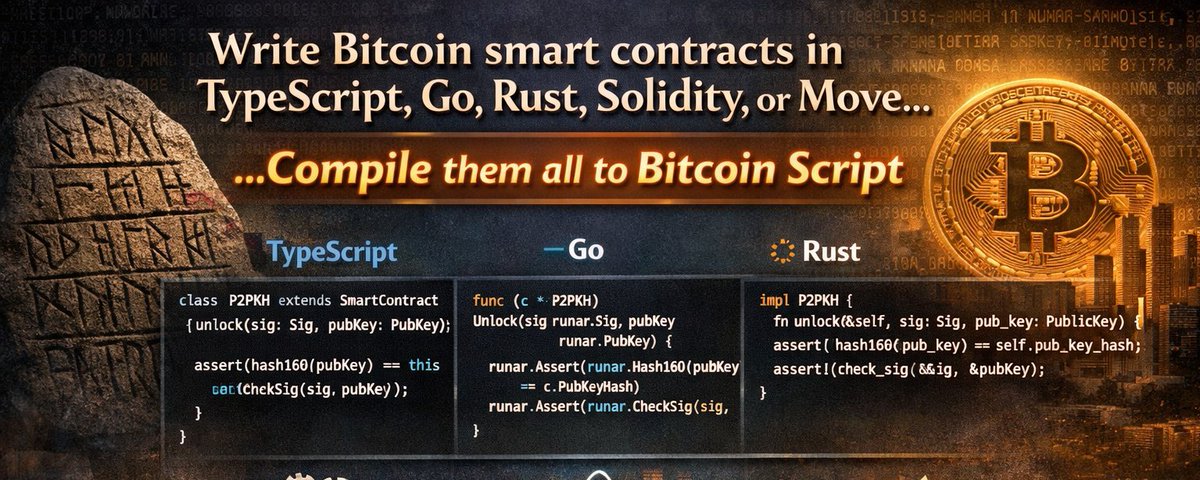
Wow:
- Post-Quantum Wallets (WOTS+ and SLH-DSA FIPS 205)
- Zero-Knowledge Proofs (Schnorr protocol on secp256k1)
- Stateful State Machines (counter, auction with time-locked bidding)
And ten more functions in the new Rúnar Bitcoin Smart Contract compiler, in TypeScript, Go, Rust, Solidity, and Move!


Stephan Nilsson retweeted

Heads up my fellow BSV devs and users. We’re about to release a new major version of the TypeScript SDK.
github.com/bsv-blockchain/ts…
We expect there to be a few apps which may raise new errors as they migrate from older versions since there is a low level breaking change. If you leave the whole stack alone, it’ll still work, but if you update the backend without updating the front you’re likely to see errors.
We’ll do our best to update all the demo apps and production apps in the wild over the next few days. Please report any errors in this thread or with the developers of the app in question.
Chronicle features will hereon be supported. Testnet already live. April 7th on Mainnet.
Thank you for your attention to this matter!

