

⚽ Analysis and Methodology Formerly @realmadrid @intermiamicf @laliga @univmiami @fcdinamotbilisi @concacaf
Joined December 2021
- Tweets2.3K
- Following435
- Followers394
- Likes21






“The game model is the coach. The framework is the club.”
A key point for any club, no matter the level, made by Chris Loxston, Technical Director at San Diego Wave , in this article about the importance and benefits of a clear club identity/framework.
hudl.com/blog/san-diego-wave…

However, there are others who may suggest that the coach first, then the club culture and strategy after.
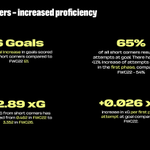
🧵Continuing from my last post about the FIFA World Cup 2026 Technical Report, one of the aspects I decided to look at in depth first was set-pieces.

This only makes the margins thinner and the competition more intense as teams continuously adapt and react to one another. Creativity matters in these situations, as through different runs, blockers, routines etc. teams have various ways to create high-quality opportunities.
Steven Dabdoub retweeted

Italy’s 4-3-3 currently shows a strong positional orientation in the first phase, with automatisms designed to facilitate progression and Pio Esposito acting as a reference for direct play.
There are clear similarities with Conte’s Napoli, where the structure was also a 4-3-3 heavily automated in deep build-up and Lukaku played a key role as the target and reference point for more direct solutions.
But higher up the field, Italy moves towards a much more relational version, with both wingers moving inside and the full-backs joining dynamically to provide the width. Diagonals, quick one-twos centrally, with Pio Esposito acting as a reference to pin the centre-backs and allow his teammates to receive free between the lines.
Italy has traditionally been a place where coaches develop a high number of automatisms in deep build-up, using pre-established patterns to escape the predominantly man-to-man pressure found in Italian football. Coaches such as Conte, Sarri, Farioli and De Zerbi are all Italian coaches who understand very well how to coach these mechanisms.
Italy might therefore maintain this more traditional approach in the first phase of the possession, but higher up the field, something is clearly changing. The game becomes much more relational and much more adapted to modern football, particularly when it comes to breaking down deeper and more compact low blocks.
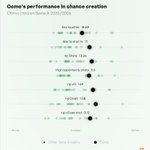
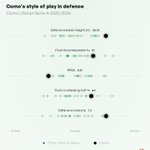
Cesc Fàbregas' Como could be a good role model for Italy. Cesc has been able to mix positional play and automatisms with a much more relational approach.
What he essentially does, and what I believe makes him so successful, is that players start positionally: they recognise themselves within certain spaces, use automatisms and pre-established patterns to find the free player and establish possession. Once possession is established, however, the team can move towards a more relational approach, with players gathering closer to the ball and greater freedom being given to certain players, while still maintaining defensive balance.
Football seems to be moving increasingly towards this combination of positional play and relationalism. The difficulty is not understanding either concept individually, but knowing when and how to combine them.
Only a select group of highly knowledgeable coaches, with a clear understanding of when to apply each concept, seem capable of making these two approaches coexist successfully within the same game model.


Brilliant.

Italy’s 4-3-3 currently shows a strong positional orientation in the first phase, with automatisms designed to facilitate progression and Pio Esposito acting as a reference for direct play.
There are clear similarities with Conte’s Napoli, where the structure was also a 4-3-3 heavily automated in deep build-up and Lukaku played a key role as the target and reference point for more direct solutions.
But higher up the field, Italy moves towards a much more relational version, with both wingers moving inside and the full-backs joining dynamically to provide the width. Diagonals, quick one-twos centrally, with Pio Esposito acting as a reference to pin the centre-backs and allow his teammates to receive free between the lines.
Italy has traditionally been a place where coaches develop a high number of automatisms in deep build-up, using pre-established patterns to escape the predominantly man-to-man pressure found in Italian football. Coaches such as Conte, Sarri, Farioli and De Zerbi are all Italian coaches who understand very well how to coach these mechanisms.
Italy might therefore maintain this more traditional approach in the first phase of the possession, but higher up the field, something is clearly changing. The game becomes much more relational and much more adapted to modern football, particularly when it comes to breaking down deeper and more compact low blocks.
Cesc Fàbregas' Como could be a good role model for Italy. Cesc has been able to mix positional play and automatisms with a much more relational approach.
What he essentially does, and what I believe makes him so successful, is that players start positionally: they recognise themselves within certain spaces, use automatisms and pre-established patterns to find the free player and establish possession. Once possession is established, however, the team can move towards a more relational approach, with players gathering closer to the ball and greater freedom being given to certain players, while still maintaining defensive balance.
Football seems to be moving increasingly towards this combination of positional play and relationalism. The difficulty is not understanding either concept individually, but knowing when and how to combine them.
Only a select group of highly knowledgeable coaches, with a clear understanding of when to apply each concept, seem capable of making these two approaches coexist successfully within the same game model.
🧵 1/13
FIFA have released their 2026 World Cup Post Tournament Analytics Report, and it is a massive and interesting document for anyone working in football analysis, scouting and/or coaching.

12/13
This report is a prime example of the depth to which we can analyze the game, but yet emphasizes the point that identifying absolutely key insights and communicating them with simple, easy-to-understand terms and putting them into actionable strategies is most important.
13/13
That said, over the next few days I will dive deeper into the report and share some of the interesting detailed insights with their contexts as I go along.
fifatrainingcentre.com/en/fi…
