

Scientist, Paleontologist, Zoologist, Curator of Paleontology at the New Mexico Museum of Natural History and Science, teaches at Harrisburg University
Joined March 2020
- Tweets718
- Following1.1K
- Followers625
- Likes1.1K
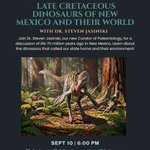


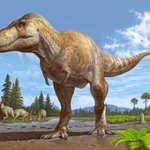
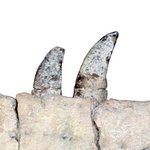

For those in New Mexico, namely the Albuquerque area, I will be giving a talk on Thursday at the New Mexico Museum of Natural History & Science on Cretaceous dinosaurs and their world, stop by to hear me discuss New Mexico's 'terrible lizards.'

Just wanted to say our new paper is out re-investigating the taxonomy of a group of fossil turtles that survived the End-Cretaceous mass extinction!
Re-Evaluation of Compsemys and North American Compsemydids (Testudinata) mdpi.com/4029962 #mdpitaxonomy via @Taxonomy_MDPI

And a reconstruction of the new genus of troodontid, named Dinevenator robustus, was done by the amazingly talented Sergey Krasovskiy (@SergeyAtrox1)

ALT Dinevenator robustus reconstruction by Sergey Krasovskiy
And now I am happy to say our new paper is out naming a new genus of troodontid from New Mexico. The paper, naming Dinevenator from the Late Cretaceous of New Mexico, is free to download here: mdpi.com/2813-6284/4/3/21

I have already started, but I can officially say that I have been hired as the Curator of Paleontology at the New Mexico Museum of Natural History and Science. Here's to lots more science and discovery moving forward!
For a story from Harrisburg University (@HarrisburgU) on the new hyaenodonts from Pakistan study from my colleagues and myself, you can read about it here: harrisburgu.edu/news/2026-05…

Here is an excellent reconstruction of the new hyaenodont, named Metapterodon anari. The reconstruction of this fascinating carnivorous mammal (in the foreground) from the early Late Miocene of Pakistan was done by the incredibly talented Sergey Krasovskiy (@SergeyAtrox1)

ALT Metapterodon anari (foreground) reconstruction by Sergey Krasovskiy
Happy to say our new paper is out on hyaenodonts from the Miocene of Pakistan. Worked with the wonderful group of fellow researchers on this, and it includes the new species Metapterodon anari. Can be found here: link.springer.com/article/10…, or contact me for a copy.

Easier to digest story from @HarrisburgU on Ahshislesaurus wimani can be found here: harrisburgu.edu/news/2025-10…

So, happy to say that our new paper on a new species of hadrosaur dinosaur is out, meet Ahshislesaurus wimani from the Late Cretaceous of New Mexico. Find it for free through ResearchGate (researchgate.net/publication…) or you can contact me about it.

And here is the artwork by the wonderful Sergey Krasovskiy (@SergeyAtrox1 ) of the new saurolophine hadrosaurid Ahshislesaurus wimani.

ALT Reconstruction of Ahshislesaurus wimani by Sergey Krasovskiy.
Steven Jasinski retweeted

Several people asked me after the Civettictis drawing if I thought giant prehistoric civet would be dangerous. The recently described Vishnuictis plectilodous (largest known civet?) from Pliocene India may have been Panthera size. Any carnivoran that size deserves respect...

Steven Jasinski retweeted

Researchers, incl. HU's Dr. Steven Jasinski, discovered two new carnivoran species from ancient India: Circamustela bhapralensis and Vishnuictis plectilodous. harrisburgu.edu/news/2025-04…

And for the other reconstruction of these new carnivores, this is the new giant fossil viverrid Vishnuictis plectilodous done by the amazing @SergeyAtrox1; this giant viverrid grew to the size of some big cats today, probably larger than an adult leopard at over 100 kg.

ALT Vishnuictis plectilodous reconstruction (by Sergey Krasovskiy) (v3)
And for the reconstructions of these new carnivores, this is the new fossil mustelid Circamustela bhapralensis done by the amazing @SergeyAtrox1; this little mustelid was roughly the size of pet ferrets today at perhaps 1.5 kg.

ALT Circamustela bhapralensis reconstruction (by Sergey Krasovskiy) (v2)
For anyone interested in the paper we recently published on the fossil carnivorous mammals from the foothills of the Himalayas in India, but want it in an easier to read format, here is a press release from @HarrisburgU: harrisburgu.edu/news/2025-04…
Our new paper is out on fossil carnivorous mammals from northern India is now out! We describe new species of mustelid and viverrid, as well other fossils. Great group of researchers I was able to work with on this!
The paper can be found here: link.springer.com/article/10….

