

Political Editor & Commentator at TVP World | Poland & CEE | Politics, elections, security and geopolitics | Warsaw-based | Views my own
Warsaw
Joined March 2018
- Tweets5.1K
- Following1.5K
- Followers11.6K
- Likes1.5K



Pinned Tweet
A shocking part of the Trump–Russia "peace plan" isn’t just what it does to Ukraine. It is what it quietly does to Poland.
Buried in point 9 is a sentence that looks harmless: European fighters will be stationed in Poland.
On paper, that sounds fine. In practice, though, it looks like Washington and Moscow have agreed over Poland’s head to limit the presence of foreign forces on Polish soil, including US forces, and to put a ceiling on NATO air power over the region.
If “European fighters” are explicitly named, the obvious Russian reading is simple: no US jets in Poland. And if Russia is co-signing language that defines who and what can be stationed here, it is also a de facto say over NATO air policing in the Baltics and the rest of the eastern flank.
That is not “Pax Americana.” That is the US accepting a Russian veto over the security posture of front-line allies.
For Polish politics this hits a very specific nerve. For years, Jarosław Kaczyński and now President Karol Nawrocki have built their doctrine on one core idea: forget Brussels, forget Berlin, our security rests on a direct, privileged relationship with Washington.
For a country that has spent a decade telling itself that American power is the only real guarantee, that should be a brutal wake-up call.

BIG UPDATE on the events at Poland's Constitutional Tribunal tonight.
It's increasingly looking like a coordinated attempt to break the existing leadership's hold over the court.
Justice Minister and Prosecutor General Waldemar Żurek has now filed five applications to lift the immunity of the Tribunal's president and deputy, backed by 50 volumes of case files.
Both Żurek and the judge who ordered their suspension had contacted police in advance about security concerns.
All this on a Friday evening, while President Nawrocki was travelling to Senegal.
The timing and coordination are striking. The legality of the operation remains disputed.
Prime Minister Donald Tusk has defended the government's approach, saying: “Restoring the rule of law is our duty.”
But constitutional lawyer Marcin Matczak, a longstanding critic of PiS's judicial reforms, has questioned the legality of the suspension:
“I consider Bogdan Święczkowski the worst person to serve as president of the Constitutional Tribunal. But there is no legal basis for ordering a break in his duties or suspending him.”

It's all kicking off at Poland's Constitutional Tribunal tonight.
Police are on the scene, protesters have gathered outside, and a judge has ordered the suspension of the court's president and his deputy.
President Karol Nawrocki is out of the country on a visit to Senegal, although he's reportedly cutting his trip short to return to Warsaw.
It looks as though the confrontation over the Tribunal, which Donald Tusk's government has been trying to overhaul, is entering a new and much more confrontational phase.
A bit of background for those who haven't followed this complicated saga.
The dispute goes back to 2015, when PiS began reshaping the Tribunal, provoking years of controversy over its independence and legitimacy.
Tusk's government argues that the institution was captured and needs to be put right. PiS insists it is legitimate and accuses Tusk of trying to seize political control.
The immediate issue concerns judges elected by the current parliament whose authority the existing Tribunal leadership and President Nawrocki refuse to recognise.
Now one of those judges, Anna Korwin-Piotrowska, has issued an order suspending Tribunal president Bogdan Święczkowski and his deputy for a month.
PiS is calling it an unlawful takeover.
The Tribunal's website announced the suspension, while its official X account claimed the website had been unlawfully taken over so it looks like two rival groups are battling over control of communications.
Police are outside, with PiS supporters and right-wing activists protesting. There are reports of objects being thrown at officers and chains being placed on the building's doors.
PiS leader Jarosław Kaczyński accused Tusk of staging a “coup against the Constitutional Tribunal”, declaring: “From today, Poland is becoming a police state, and from there it is a straight road to authoritarianism.”
Warsaw police rejected claims of a forcible takeover, stating: “Police officers are not inside the Constitutional Tribunal building.”
They said officers were responding to disturbances outside, including dangerous objects being thrown at them, and were there to restore public order.
wiadomosci.wp.pl/przewrot-w-…
A new opinion poll suggests that Donald Tusk's best chance of staying in power after Poland's 2027 election may actually involve winning fewer votes.
The key would be to persuade all four parties in his governing coalition to run on a single electoral list.
Here's how the numbers work.
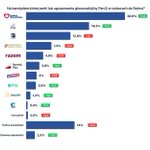
A new United Surveys by IBRiS poll gives Civic Coalition (KO), the New Left, the Polish People's Party (PSL) and Poland 2050 a combined 41.8% if they run separately.
But with PSL and Poland 2050 falling below the 5% electoral threshold, the governing camp would win just 217 seats. Four parties on the right would take 243.
Now put the governing parties on one list. Their combined support actually falls to 39.4%, but their projected seat total rises to 228.
The right falls to 232, within the model's three-to-five-seat margin of error.
The explanation lies in Poland's electoral system. A joint list would rescue votes otherwise wasted on parties falling below the threshold, while also benefiting from the D'Hondt system, which favours large groupings when allocating seats.
The catch for the governing coalition is that only 55% of surveyed PSL voters say they would support such a joint list, with most of those who would defect moving to the Morawiecki's Rozwój+.
Source: wiadomosci.wp.pl/jedna-lista…

What we know so far about the Polish-Ukrainian row over Lviv's decision to honour the UPA and Roman Shukhevych in 2027.
Kyiv appears to be backing away from the controversial commemoration following an unusually broad backlash in Poland. 1/
tvpworld.com/96046372/sikors…

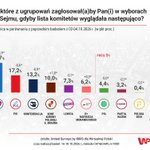
The latest Polish election poll (United Surveys for WP, 16–18 October) shows little change in the balance of power.
The four parties of the right have a projected 242 seats:
- PiS: 17.2%
- Confederation: 13.2%
- Braun’s KKP: 10%
- Morawiecki’s Rozwój Plus: 6.2%
Meanwhile, KO (29.7%) and the Left (7.3%) would have just 218 seats, short of the 231 needed for a majority.
For me, the most interesting figure is PSL's 4.4%. Still below the 5% threshold, but closer to remaining in
parliament than it has looked in some previous polls.


How to deal with Grzegorz Braun is becoming one of the defining questions on the Polish right ahead of next year's parliamentary election.
Braun's Confederation of the Polish Crown is polling at around 9–11%. In many recent seat projections, PiS and Konfederacja cannot reach the 231 seats needed for a parliamentary majority without Braun's MPs.
President Karol Nawrocki appears to recognise this reality. In recent interviews with Rzeczpospolita and Polsat News, he has signalled an openness to Braun and his voters, although he has stopped short of endorsing a governing coalition.
Mateusz Morawiecki is taking a different approach.
At the weekend's Rozwój Plus congress, the former prime minister declared that his movement should be a "barrier against the Braunisation of Polish politics", rejecting Braun's "de facto pro-Russian" policies.
His calculation is that he wants to remove Donald Tusk from power while establishing himself as the conservative politician who can keep Braun out of the next government.
If he can pursuade centrist voters it would give him considerable leverage among the competing parties of the right.
Morawiecki's problem is that he is hovering around the 5% electoral threshold. He said at the congress that his ground (not yet a party) has an "intention" to run on an independent list, but if his group is arind the threshold he may have to rejoin forces with PiS.
wiadomosci.onet.pl/kraj/mate…

We're now roughly a year away from Poland's parliamentary election, and the most interesting development for me this week was President Karol Nawrocki's tentative opening towards Grzegorz Braun's far-right party. 1/

Meanwhile, four new polls put Tusk's Civic Coalition comfortably ahead, although the parliamentary arithmetic remains much less favourable.
I've unpacked all this, the latest polling and the developing campaign strategies in this week's PolandWatch election newsletter.