

Liberation does not come as a gift from anybody; it is seized by the masses with their own hands. - Frantz Fanon
Tamil Eelam
Joined May 2022
- Tweets6.7K
- Following452
- Followers4.1K
- Likes49.8K





Pinned Tweet
I lost my account with 30,000 followers, an archive dedicated to preserving the history of Tamil Eelam.
It had a good run. Over a year of people trying to get the account banned, and we still made it to 30,000 followers.
Now I’m starting from scratch. If you want to support the archive and help preserve this history, make sure to follow and share the account.
instagram.com/tamilguerillo?…
🤖 Made with AI

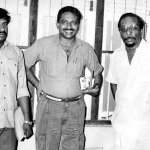
19 years ago, S. P. Thamilselvan was assassinated by the Sri Lankan government in an airstrike that also killed five other members of the Tamil resistance: Lt. Col. Anpumani (Alex), Major Mikuthan, Major Nethaaji, Lt. Aadchiveal, and Lt. Maavaikkumaran.
Thamilselvan had been a member of the Tamil resistance from a young age, worked his way up through the ranks, and played a significant role in negotiations between the Liberation Tigers of Tamil Eelam and the Sri Lankan government.
After Anton Balasingham, the diplomat of Tamil Eelam, fell ill, Thamilselvan played a major role in negotiations and became the international face of Tamil Eelam in matters of diplomacy.
He was a beloved figure in the diaspora, in Tamil Eelam, and in the international community. His calm and beautiful smile even mesmerized his enemies, but that smile should not be mistaken for weakness. Thamilselvan was known for being firm with his enemies and never abandoned the aspirations of his people.
The Sri Lankan government’s assassination of such an important figure during peace talks demonstrated their intransigence on the Tamil national question and their willingness to use military force to crush the Tamils, showing they were not genuinely interested in a peaceful solution.
While Eelam Tamils mourned their heroes and sought peace, the bloodthirsty Sinhalese celebrated this brutal murder in the Sinhalese south and advocated a purely military solution.
„It was never the intention of the Tamil people even in the early 1950s even to ask for federalism. They only asked that we be allowed to co-exist but don’t treat us as second-class citizens,“ he said. „No government in Colombo has the political will or courage to educate their constituents about providing a solution to the Tamil political crisis. We have to get our own independence.“ - Thamilselvan

31 years ago, the Jaffna Exodus occurred, when over 500,000 Eelam Tamils, half a million people, were forced to flee Jaffna as Sri Lankan occupation forces launched Operation Riviresa to capture and occupy the Jaffna peninsula.
Jaffna, the cultural capital of the Eelam Tamils and of Tamil-speaking people on the island, was one of the most densely populated areas and a major center of Tamil resistance.
The exodus caused one of the biggest humanitarian crises in Sri Lanka’s history. Hundreds of Tamil civilians were killed by heavy artillery shelling and cluster bomb attacks. Panic-stricken Tamils fled their homes without any belongings, leaving everything behind for the advancing Sri Lankan army. The assault destroyed entire families, many of whom were scattered across refugee camps throughout the island, uncertain whether their loved ones were alive or dead.
Sri Lanka refused and even banned aid from entering Tamil areas, despite international reports describing the situation as dire. During this time, the LTTE guided displaced Tamils into the Vanni while simultaneously resisting the occupying forces.
Life under Sri Lankan occupation in Jaffna was a nightmare for those who remained. There were widespread reports of disappearances, mass graves, sexual violence, and assassinations of Tamil civilians, often carried out with the help of Tamil paramilitary groups such as the EPDP, which forced vulnerable Tamil families even into prostitution and human trafficking. Support for the Tamil struggle often meant a death sentence.
The exodus marked the second largest displacement of Tamils in the island’s history, after the expulsion of the Malaiyaha Tamils following independence.
The international community and many military analysts believed that this exodus marked the end of the Tamil Eelam national struggle. Some even argued that surrendering and abandoning the pursuit of sovereignty was the only path forward. But little did they know that this tragedy only made the Tamils and their resistance stronger.
Between 1995 and 2000, the LTTE struck back, giving Sri Lanka its harshest lessons and coming close to liberating the entire Jaffna peninsula once again.
Never forget. Never forgive.
Tamil Guerilla 📕 ☭ retweeted

NEW REPORT: The Battle of Ananthapuram.
ITJP’s new report, available in English and Tamil, documents survivor accounts, examines the last major battle of the war and points to an alleged massacre of more than 300 severely wounded Tamil fighters by the Sri Lankan Army in April 2009. Around 800 LTTE cadres, many already seriously wounded, were trapped and cut off from ammunition, medical supplies, food and water. Approximately 150 escaped. Hundreds of wounded fighters left behind have never been seen again.
Read full report: itjpsl.com/reports/battle-of…

Eelam Tamil Activism After Gaza. 🇵🇸
Eelam Tamil activism after Gaza exposes how dominant western liberal frameworks weaponise narratives of pathology to legitimise state-sanctioned annihilatory violence. By contrasting the structural amnesia surrounding the tragedies of Mullivaikkal and Gaza with shifting electoral, academic, and literary terrains, the analysis demonstrates how collective counter-mobilisation shatters state obfuscation to reclaim historical truth and political agency.
northeastmag.com/features/ee…

A Rare and Intimate Interview with Kutti Kannan. (1993)
During the Tamil Eelam liberation struggle, numerous male and female singers, both in the homeland and across the diaspora, captivated the hearts of Eelam Tamils with their beautiful songs. However, one person stood out not only for his voice but also for his remarkably young age.
Kutti Kannan was approximately 10–11 years old when he began singing. He started out performing in live theatre, which was highly popular in Tamil Eelam and served as an important medium through which Tamils could express themselves politically, socially, and culturally.

Tamil Guerilla 📕 ☭ retweeted

Actually this has been going on in Batticaloa since the end of the war. Different governments but the same issue persists. Hundreds of Tamil-owned cattle have been killed by state-sponsored Sinhalese encroachers in a bid to convert this Tamil pastureland into a Sinhalese Buddhist settlement.
In 2023 Tamil activists protesting against this were held hostage and a Hindu priest was assaulted by a Sinhalese mob led by the infamous Buddhist monk who threatened cut Tamils into pieces and installed a Buddha statue there. Tamil farmers in the area have also been assaulted and tortured by Sinhalese settlers, soldiers and police.
All these have been backed by various government departments such as the Mahaweli Authority, the primary culprit behind the demographic engineering in Eelam, with the collusion of local Muslim officials.


Tamil Guerilla 📕 ☭ retweeted

Saudi Arabia overturns death sentence for man over Facebook comment bbc.in/4dEv18x

On May 21, 1991, in Sriperumbudur, Tamil Nadu, India, Rajiv Gandhi was assassinated.
Rajiv Gandhi was responsible for the disastrous Indian Peace Keeping Force (IPKF) operation in Sri Lanka from 1987 to 1990, which resulted in the deaths of thousands of innocent Tamil civilians at the hands of the Indian Army during its occupation.
The disastrous intervention in Sri Lanka also contributed to the second JVP insurrection, which led to the deaths of thousands of innocent civilians in the Sinhalese south at the hands of both the Sri Lankan state and the JVP.
Despite warnings and requests from Indian officials and politicians not to intervene militarily, Rajiv Gandhi insisted on and pushed ahead with the military intervention in Sri Lanka.
The intervention was never intended to resolve the Tamil national question. Rather, it was primarily aimed at bringing Sri Lanka closer to India’s geopolitical sphere of influence. The Indian Army became notorious for its repeated use of sexual violence against women, children, and men; enforced disappearances; looting; the burning of entire villages; censorship; and brutal massacres, all of which were known to Rajiv Gandhi.
Despite several offers from the Tamil resistance to resolve the issue diplomatically, the warmongering Rajiv Gandhi insisted on a military solution.
He betrayed the special relationship that Indira Gandhi had forged with the Eelam Tamils. The Eelam Tamils had respected India as their neighbour and regarded it as their second home.
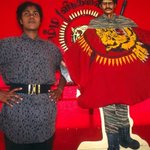
A female Tamil Tiger standing in front of a cardboard cutout of a Tamil guerrilla carrying a wounded fighter. (1994)

October 10 is Tamil Eelam Uprising Day.
On this day, we remember the thousands of brave Eelam Tamil women who sacrificed their lives and participated in the Tamil Eelam liberation movement.
Tamil women played a key role in the armed struggle, from mobilizing the masses to participating directly in the armed resistance against the Sri Lankan state.
Due to the conservative nature of Tamil society, women faced oppression not only at the hands of the Sri Lankan and Indian armies but also within their own society because of their gender. They were often expected to do nothing more than work in the kitchen and take care of the children.
During their transformation of Tamil society, the LTTE challenged these traditional gender roles. The very act of women cutting their hair short, wearing trousers or khaki uniforms, and carrying guns radically transformed the stereotypical image of the Tamil woman as shy, submissive, and head-down.
In the beginning, the LTTE, like many other Tamil militant groups, hesitated to involve women in the armed struggle, partly because of the backlash they might face from a deeply conservative society. Even prominent figures within the Tamil resistance opposed women’s participation. However, Velupillai Prabhakaran recognized not only the oppression women faced but also their courage and determination. He spoke of how Tamil women had protected him and sheltered him in their homes while he was being pursued by the Sri Lankan police.
The LTTE produced numerous writings and publications addressing the oppression of Tamil women, describing them as being subjected to a form of subjugation under male chauvinism.
The LTTE promoted women’s liberation through education, music, the arts, and magazines. But this transformation was not limited to words. Women took on new responsibilities, supported one another, developed their skills, and challenged the restrictions imposed on them by traditional gender roles. Their participation in education, public life, and the armed struggle reshaped the role of women within Tamil society and challenged long-standing expectations of what a Tamil woman could be.
On this day, we remember the courage, sacrifices, and contributions of Eelam Tamil women who played a defining role in the struggle for Tamil Eelam.
Tamil Guerilla 📕 ☭ retweeted
Even a Malayaha Tamil woman from Colombo who identifies as Sri Lankan is being attacked by the Sinhalese as a “Tamil Tiger” for calling out their rampant anti-Tamil racism. People talk about translating Israeli tweets in Hebrew but Sinhala Facebook posts would make even Zionists blush.


A Tamil diaspora returnee tried to sing kumbaya with the Sinhalese and they showed him his place. The Sinhalese may welcome white tourists and even pimp their children to them but won’t hesitate to organize another Black July against Tamils in the same breath.
Since independence the Sinhalese have been reminding Tamils in the south that their true home is in the north and have sent them there in refugee ships in 1958, 1977 and 1983. When we finally asked to be left alone in our own home, they couldn’t let us have that either and turned it into a killing field.


39 years ago, at 10:48 a.m. on 26 September 1987, Thileepan died during his fast-unto-death protest over the demands of his oppressed nation.
His last words were: “Let the Tamil people’s war for independence erupt!”
To this day, Thileepan remains an inspiration and also a powerful lesson for Eelam Tamils.
An inspiration because, at the young age of 23, when he had everything going for him, he decided to sacrifice his life for his people.
The lesson that Eelam Tamils learned that day is that not only is non-violence ineffective against an enemy that is itself not non-violent and is not interested in a non-violent approach, but also that Eelam Tamils have no one but themselves.
India, which was considered a big brother that looked after Eelam Tamils and even trained several resistance groups, decided to show its true face by abandoning the Tamils and joining Sri Lanka in the oppression of Tamils.
Rare footage of Lt. Col. Borg during his training and preparation for his Black Tiger attack against a Sri Lankan Army camp.
He fell in battle on 23 November 1990.
Tamil Guerilla 📕 ☭ retweeted

In light of coordinated review-bombing of #bestofthebest, we encourage everyone who has watched the film to share their genuine thoughts on Rotten Tomatoes. If this film resonated with you, made you feel seen, or simply brought you joy, let your voice be part of its reception ♡


Progressive Voice | Volume 1, Number 2
ARMY OCCUPATION - POLICE MASSACRE YOUTH : 8 MURDERED - 350 ARRESTED
PDF: drive.google.com/file/d/1usB…
