

Virgil says ' Timeo Danaos et dona ferentes ', I say I'm a Phlegmatic Perquisite Perjurer following ' La Forza del Destino ' of Verdi !
India
Joined July 2015
- Tweets10.9K
- Following5.8K
- Followers476
- Likes16.1K


Subash S retweeted

Topological Data Analysis with Applications: amzn.to/3Sn7QrN
What kind of Applications? Here are some:
◉ Modeling data for geometric objects
◉ Modeling complex graphs & networks
◉ Modeling high-dimensional datasets
🔴The book also examines a number of case studies drawn from monitoring the progression of infectious diseases to the study of motion capture data.🔴

Subash S retweeted

This is brilliant. Finally, we have a strong new open model for science.
As I said before, nothing beats a specialized model, and I think this will be even more important for science.
Hydrogen-1.0 is Deep Principle's first open-weight model for scientific research. They post-trained GLM-5.3 on their own scientific data, lab records, and discovery trajectories.
They report 38.3% on FrontierScience-Research, compared with 33.3% for GPT-6-Astra.
We need more of this.


We’re introducing Hydrogen-1.0, our first open-weight model for scientific research. We post-trained GLM-5.3 (@Zai_org) on our internal scientific data, lab records, and discovery trajectories.
It scores 38.3% on FrontierScience-Research vs GPT-6-Astra’s 33.3% and scores 93.0% on GPQA-Diamonds.
We believe science should be open, collaborative, and democratized, rather than proprietary. Only open weights let researchers inspect, adapt and build on the unprecedented speed of AI growth. There are many recent models named by chemical elements, but we believe Hydrogen-1.0 is the first aiming towards and open scientific superintelligence for discovery. 🧵
Subash S retweeted

Your research workflow doesn’t need to live across disconnected chats and folders.
Dr. Claw is an AI research workspace for researchers and builders working from literature review through experiments, paper drafts, and presentations.
It helps you organize that workflow by turning a research idea into a structured brief and task list, with progress and generated artifacts tracked in one place.
Key features:
• Chat-driven planning – describe your idea and generate a research brief and task pipeline
• Research Lab dashboard – review tasks, progress, source papers, and outputs across five research stages
• Research skills library – reusable skills cover literature surveys, experiment development, analysis, writing, and review responses
• Multiple agent backends – choose Claude Code, Gemini CLI, Codex, or OpenRouter for task execution
• File and Git tools – browse and edit project files, inspect diffs, stage changes, and commit without leaving the workspace
It’s open-source (GPL-3.0 + AGPL-3.0 licenses).
Link in the reply 👇

Subash S retweeted

New Meta paper finds that AI agents improve more from their past attempts when each new problem is matched to notes from similar problems, instead of one shared record of everything they have done.
A simple way to let agents learn from past runs is one shared history. With mixed tasks, it gets costly and mixes unrelated experience.
Routed CL adds an LLM router that reuses a memory cluster or starts a new one before each run. Each cluster uses 1 of 5 memory types, such as raw past runs or distilled lessons.
Across 398 mixed problems and 4 models, the shared history barely beat no memory, with a mean gain of 0.015 out of 1. Routed CL beat it by 15% to 30% of the maximum possible score and cut estimated API cost by 65% to 72%.
If your agents handle mixed task types, split their memory into separate pools by problem type instead of sharing one history.

Subash S retweeted

I used to pay ~$700/year in subscriptions to collect testimonials and transcribe recordings.
Now I run my own apps on a $5/mo VPS, plus API usage costs.
I also self-host Katabench on a VPS fleet: a few thousand users, p99 latency under 70ms.
This is why I like self-hosting: low costs, good performance, and software I can change to fit how I work.
I put those foundations into Pragmatic Self-Hosting. I'll walk you through the single-VPS setup below so you can use it for your own apps.
Check out Pragmatic Self-Hosting:
milanjovanovic.tech/pragmati…

ALT The Pragmatic Self-Hosting system on one VPS. Public HTTPS reaches the .NET and React app through Traefik. Tailscale keeps SSH and Dokploy private. GitHub Actions tests and publishes images to GHCR, Cloudflare R2 stores backups, and an external monitor checks readiness. PostgreSQL and Redis stay on a private Docker network.


Subash S retweeted

10 GitHub Repos Using AI to Turn Satellite Images Into Real-World Insights
What if you could identify forests, map roads, detect buildings, and monitor floods using nothing but satellite imagery and AI?
That's exactly what these open-source projects are helping developers and researchers do.
Here are 10 repositories worth exploring:
1. TorchGeo
A powerful toolkit for training deep learning models on geospatial data and satellite imagery.
github.com/torchgeo/torchgeo
2. Segment Anything
Use prompt-based segmentation to identify objects and regions in images.
github.com/facebookresearch/…
3. Clay
Explore foundation models built specifically for Earth observation and geospatial intelligence.
github.com/Clay-foundation/m…
4. Prithvi
NASA's geospatial AI models for applications like flood mapping, land cover analysis, and environmental monitoring.
github.com/NASA-IMPACT/Prith…
5. SAMGeo
Bring promptable image segmentation into satellite and geospatial analysis workflows.
github.com/opengeos/segment-…
6. eo-learn
Create reusable pipelines for processing satellite imagery and detecting changes across landscapes.
github.com/sentinel-hub/eo-l…
7. Raster Vision
Build computer vision pipelines for classifying images and detecting geographic features.
github.com/azavea/raster-vis…
8. DeepForest
Detect individual tree crowns from aerial imagery using deep learning.
github.com/weecology/DeepFor…
9. Solaris
Develop geospatial computer vision workflows for object detection and image segmentation.
github.com/CosmiQ/solaris
10. SpaceNet
Access satellite imagery datasets and benchmarks for mapping roads, buildings, and infrastructure.
github.com/SpaceNetChallenge
The exciting part?
These aren't just tools for looking at satellite pictures. They help turn raw imagery into useful information about our changing planet.
From tracking deforestation to understanding urban growth, the applications are enormous.
Save these repos. The next big AI breakthrough might come from looking down at Earth.



Subash S retweeted

Downloading a YouTube video should take 5 seconds. Not 5 popups.
Please don't tell the downloader sites about this.
You paste a link. 3 popups. 2 fake DOWNLOAD buttons. A redirect to a casino. Then a blurry, low-res file.
Pablo Stanley built the fix.
It's called yoinks. One line in your terminal.
Paste a URL. Pick a resolution. Done.
> YouTube, X, Instagram, Threads, TikTok
> 1,800+ sites total
> Pick the highest quality available. Up to 4K.
> Audio-only mp3 if you just want the sound
> No popups. No fake buttons. No redirects.
> Saves straight to your Downloads folder
Just type: npx yoinks
(All you need is Node 18+.)
Under the hood it runs yt-dlp and sets it up for you. No Python needed.
6.4K GitHub stars. MIT license. 100% free.
But DO NOT install it. We should all keep the popup ads in business.
100% Open Source.
(Link in the comments)

Subash S retweeted

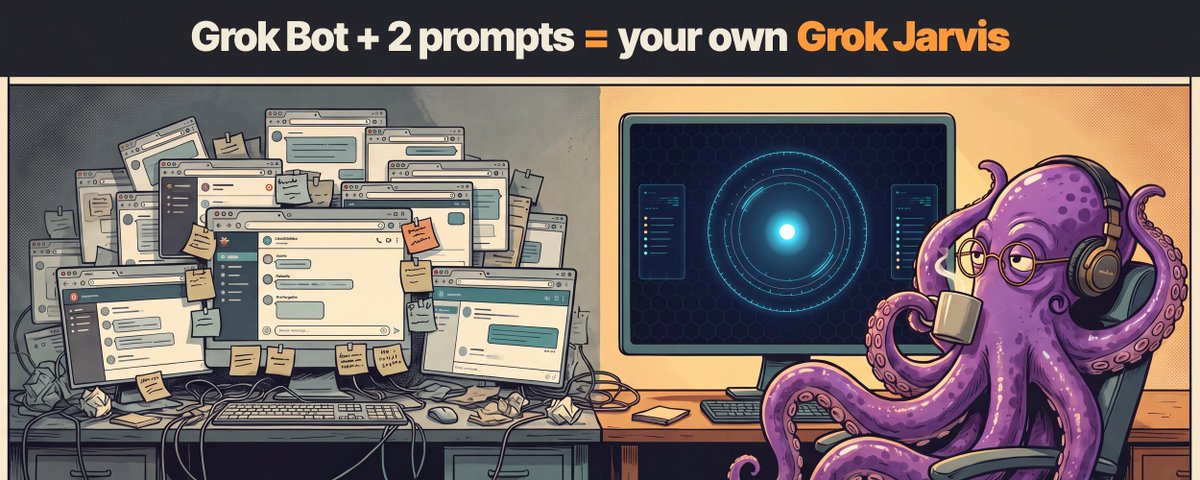
STOP SCROLLING AND OPEN THIS GROK JARVIS ARTICLE NEXT TO YOUR GROK BOT.
this is my whole Jarvis build in one article: 2 prompts and 1 fix.
it's enough to run every bot you have from one screen.
thank me later.

Subash S retweeted

Top 12 agentic use cases for Jev:
(bookmark this)
Jev handles semantic decisions that ordinary code cannot express reliably. It returns typed answers and probabilities, while code continues to cover the workflow.
Here are 12 practical use cases for Jev:
1. Browser next action
> Convert the current DOM state into a bounded action such as click, type, or stop. Code executes only valid operation-target pairs. There are already several open-source Jev web agents.
2. Context compaction
> Decide which events from a long agent trace should remain. The selected text stays verbatim instead of being replaced with a generated summary.
3. Skill and context loading
> Compare the current user turn against the available skills. Load only the instructions needed for that turn instead of filling the context window with every skill.
4. Typed tool-call compilation
> Map a natural-language request to a function and fill its typed arguments. Each argument is evaluated separately before code allows execution.
5. Citation verification
> Check whether a quoted passage exists and whether the surrounding evidence supports the claim. The output can be supported, unsupported, or contradicted.
6. Extraction verification
> Run a cheap extractor first, then use Jev to verify questionable fields. Clean records stay on the fast path while uncertain ones reach a reasoning model.
7. Agent trace evaluation
> Turn raw trajectories into queryable labels such as progress and repetition. This avoids asking another LLM to write a full review of every run.
8. Semantic regression tests
> Replay a trace suite against a new agent build. Semantic checks can then pass or block prompt, model, tool, and policy changes in CI.
9. Jevgrep code search
> Search a codebase by what the code does rather than its exact words. Jev scores candidate snippets and returns the most relevant code first.
10. Entity alignment
> Compare two candidate records and decide whether to merge, review, or keep them separate. Candidate generation remains deterministic while Jev handles semantic identity.
11. Retrieval reranking
> Let embeddings retrieve a broad candidate set, then use Jev to reorder passages by relevance. The generation model receives the most useful evidence first.
12. Memory promotion gate
> Capture a completed agent trace, then judge whether its corrections contain a reusable lesson. Trace-backed lessons can be promoted while task-specific noise is discarded.
If you want to dive deeper, we also wrote a hands-on guide. It covers building a Jev-style decision path with open models, entirely locally.
Read it below.

Subash S retweeted

A visual masterclass in LLMs for free.
12 chapters. LLMs, tokens, transformers, prompt engineering + 7 more.
Get the repo (before they take it down):


Subash S retweeted
The Most Complete AI Agentic Engineering System — Step-by-step guide to build, optimize, and scale LLM agents: amzn.to/3L5p3BS
Some highlights of what you will learn to launch and/or boost your Agentic AI Engineering portfolio:
🚀A precise definition of AI agents across academia industry and startups so you will learn to align stakeholders quickly and prevent scope creep
🚀Modular architecture patterns so you will learn to replace components safely and scale without regressions
🚀Perception reasoning action loop diagnostics so you will learn to cut latency and cost while fixing failures at the right step
🚀Memory designs for short term episodic semantic and long term so you will learn to stabilize long context OCR and multi file workflows
🚀Security guardrails and red teaming methods so you will learn to resist prompt injection data leakage and risky code execution
🚀Model selection and routing rubric so you will learn to hit SLOs while reducing spend without sacrificing quality
🚀Evaluation harness tied to business KPIs so you will learn to measure accuracy reliability and cost under real load
🚀Deployment playbooks with error handling so you will learn to move from staging to production with rollbacks alerts and audit trails
🚀Case study blueprints with before and after numbers so you will learn to present ROI clearly and secure buy in fast

Subash S retweeted

Claude keeps giving you a safe small version of any task.
There's a skill to fix that and give you Claude’s full potential.
It's called /be-ambitious.
It forces the agent through altitude, depth, and range before it starts:
- Altitude: what's the goal beyond the goal?
- Depth: what would a real expert do, and what outside check proves it?
- Range: which other fields should weigh in, doing their real jobs?
Install (all projects):
git clone github.com/robonuggets/be-am… ~/.claude/skills/be-ambitious
Then:
/be-ambitious [your task]

Subash S retweeted
Your AI tutor shouldn’t forget what you learned last session.
Tutor MCP is an MCP server for builders and self-learners who want structured, personalized tutoring inside their AI assistant.
It helps you move beyond disconnected study chats by keeping a learning history, tracking knowledge estimates, and guiding what to practice or revisit next. The AI handles explanations and exercises; the engine manages progression.
Key features:
• Curriculum graphs – maps a subject into concepts, prerequisites, and goals instead of a loose list of topics
• Knowledge tracing – uses Bayesian Knowledge Tracing to estimate what you know from recorded interactions
• Spaced repetition – uses FSRS to schedule reviews so earlier material stays in the learning loop
• Session memory – keeps summaries, goals, and recurring misconceptions to inform the next conversation
• Local learning history – runs over stdio with SQLite storage; compatible clients can share history through the same installation
It’s open-source (MIT license).
Link in the reply 👇

Subash S retweeted

Claude Code just found proof that the tiny apps making real money online are hiding in plain sight. an email app for mac. a collector-car price checker. a form builder. they're making up to $14,201 a month and almost none of them tell you where their customers come from. i have the data to prove it.
i've suspected this for months but last week something happened that made me finally check.
my friend spent 5 months building an app ChatGPT called "a million-dollar idea." launch day he opened Stripe next to me and the whole dashboard was zeros. "0 customers." "$0.00 this month." he looked at me and said "why did ChatGPT tell me this would work." i said i don't know. but i did know.
i opened Claude Code on my MacBook and ran Opus 5.5 that same night.
it reverse-engineered the 25 fastest-growing businesses on TrustMRR, a site that reads revenue straight from Stripe. not the numbers founders post on X. not the "i made $50k" screenshots. only money Stripe actually saw land in their accounts in the last 30 days.
what it found:
→ bytemail, an email app for mac, made $14,201 in 30 days
→ Skillry, a library of AI skills that started in August → $10,519
→ Intentsly → $7,388
→ WESAM.ai → $7,304
10 of them landed between $1,000 and $20,000 a month. small enough to run alone. every dollar checked and sitting on a public page anyone can open.
Claude Code pulled what every one of them sells:
→ "oil and gas safety audits" — $2,226 a month. i didn't know this was a business
→ "collector-car pricing" — $1,860 from one tiny niche
→ "cloud macs for ai agents" — $1,288 from a problem that didn't exist 2 years ago
→ "ai image and video generator" — $5,341
→ "form builder" — $1,187. the most boring idea on the list. still paid
those businesses were sitting on a public page sorted by growth. bytemail had the most. Skillry was second. and 8 of the 10 left one field blank: where their customers come from. so Claude Code dug it up anyway, from reviews, Reddit, X and YouTube.
the craziest one was Skillry. it started in August. the founder wrote one line that explains the whole business: "their visual output often looks generic." AI builds sites that all look the same. Skillry sells the fix. free skills, Premium at $9.99 a month. $10,519 in 30 days. i've read that complaint a hundred times. never thought to sell the fix.
then i checked the list everyone else uses. Indie Hackers, where founders type their own numbers. the #1 "business" by revenue claimed ten quadrillion dollars a month. typed by hand. nobody checked. that's the kind of list people copy their ideas from.
i asked Claude Code how to steal one. it mapped Skillry's demand, offer and channels and built a one-page steal sheet.
what i did:
→ told it the kind of business i'd actually run
→ set it to check TrustMRR again every Monday at 9am
→ had it put only new winners on top, with a steal sheet for the top one
→ said no once to the ones i'd never build, so they never come back
Claude Code confirmed the Monday job was live. one catch: it only runs while my laptop is awake. so i handed the same job to viktor, an AI employee in my Slack that works from his own computer in the cloud. same steps, one paste. his first run took 4 minutes: 25 businesses checked, 2 winners in an Excel file, a steal sheet in my Slack.
i sent the Excel file to my friend. he went quiet for a minute, then said "why didn't ChatGPT show me any of these." that's when i knew for sure. the ideas that already make money aren't secret. they're on a public list almost nobody checks.
the full step by step is in the article below: the Claude Code build with every prompt, and the viktor version that runs while your laptop sleeps. the prompt is in the first reply. one paste. save it so you don't lose it and send it to anyone who's ever said "every good idea is already taken." it is. now you can find who took it and steal it.


Subash S retweeted
Build an agent demo without committing to one model provider.
Gofannon is a toolkit and web app for builders and subject matter experts prototyping AI agents and the lightweight web interfaces around them.
It helps you test an agent-driven user journey by composing tools, data sources, and decision paths through a guided interface, then previewing interactions in real time.
Key features:
• Guided agent building – compose tools, data sources, and decision paths in one interface
• Real-time previews – iterate on agent interactions with immediate feedback
• Lightweight web UIs – pair agents with forms, chat surfaces, and dashboards to test user journeys
• Multiple model providers – supports OpenAI, Anthropic, Gemini, and others through LiteLLM
• Docker Compose quickstart – the README provides clone, directory, and build commands, with environment setup covered in the linked guide
It’s open-source (Apache 2.0 license).
Link in the reply 👇

Subash S retweeted
This book had a big impact on my thinking (graph databases, linked data, semantic knowledgebases, contextual metadata, connected IoT, context engineering, etc.): amzn.to/4cBYJIi
"Linked: How Everything is Connected to Everything Else — What It Means for Business, Science, & Everyday Life"
