

Full-time Systematic Trader | $1M+ Funded I help traders beat prop firms with systematic portfolios Free Strategies→ https://nitter.cf/t.co/vhGPjsmIIz
Start here →
Joined May 2022
- Tweets4K
- Following60
- Followers2.9K
- Likes5.6K






Pinned Tweet
WE ARE LIVE 🚀
I got tired of seeing gurus sell courses built around random discretionary concepts.
No structure. No systems. No repeatable edge.
Over the past month I’ve been focused on building something different: System Theory.
Until now, I’ve only shared it with a small group of close friends and traders. Today is the first public launch.
This is built for both beginners and advanced traders.
Inside, I’ll guide you through the framework I use for systematic trading and building structured trading systems around prop firms and live capital.
You’ll get access to:
• My trading frameworks and processes
• Strategy analysis tools and software
• Portfolio and system-building concepts
• Education around automation and systematic trading
• Direct support from me and a trading software developer
From building your first strategy, to understanding portfolios, to solving VPS and technical issues — we’re here to help.
This isn’t about chasing signals.
This is about building systems.
Welcome to System Theory.
thesystemtheory.com/


People making money people building and scaling with prop firms this is what @SystemTheoryHQ is all about.

HOW TO BUILD A TRADING SYSTEM THAT ISN'T GARBAGE
Save this one. Ten steps, in order, no skipping.
I'm using a moving average cross as the example on purpose. It's public, it's boring, and everyone's seen it. That's the point. The edge was never in the rules.
1️⃣Start with a reason, not a chart
Why should this make money? Who's on the other side?
"Breakouts work on indices because institutions can't fill a position in one go" is a reason.
"The line crossed the other line" is not a reason. It's a coincidence you haven't caught yet.
No reason, no system. Stop here.
2️⃣One market. One timeframe.
Not seven pairs. Not four timeframes you'll "check".
One. You can add more once this one works, and you won't want to.
3️⃣Write it so a stranger could trade it
Hand your rules to someone who's never traded. If they ask you a single question, the rules aren't finished.
"Buy strength" is not a rule. "Buy when X is above Y at the close" is a rule.
The test isn't whether it sounds good. It's whether two people reading it would take the same trade.
4️⃣Build the exit first
Everyone spends their life on entries. Entries barely matter.
Decide first: where are you wrong, where do you take profit, and what makes you leave if neither happens?
Your exit is where the money is. Your entry just gets you in the room.
5️⃣Lock the risk and stop counting dollars
Same percentage, every trade, forever.
Now a win is +1.8R and a loss is −1R, and you can compare any system to any other system. Dollars lie. R doesn't.
6️⃣Test it on 8 to 15 years
Not six months. Not the last bull run.
You need the system to live through a crash, a chop year, and a year where nothing worked. If your data doesn't include a bad regime, you haven't tested it. You've admired it.
7️⃣Five numbers. Ignore the rest.
→ Number of trades (under 100 and it's noise)
→ Profit factor
→ Sharpe Ratio
→ Max drawdown
→ Longest flat period
That last one is the one that makes people quit. Mine once went 154 days without a new high.
8️⃣Now try to destroy it
Shift every setting by 20% either way. Run it on a market it was never built for. Double the spread and commission. Cut the data in half and test each half separately.
If it survives all of that, you've got something.
If it dies, you just saved yourself the challenge fee. That's a win too.
9️⃣Does it even fit the account?
Here's where most "profitable" systems die.
Your firm gives you 10% to lose. A system with a 12% historical drawdown cannot fit inside that. Not with discipline, not with luck. The maths doesn't care.
Check that your worst drawdown fits with room to spare, not barely.
🔟Does it fit what you already run?
The last question, and the one nobody asks.
If it makes money at exactly the same times as your other systems, you didn't build a second system. You doubled your first one.
Run the correlation. A boring system that loses at different times is worth more than a brilliant one that loses alongside everything you own.
Then go live small.
One month, tiny size. Does the live account look like the backtest? If it doesn't, your backtest was lying and you need to find out why before it costs you real money.
That's the whole process. No secret settings. No indicator pack. Just steps most people won't do because testing is boring and buying a challenge is exciting.

HOW TO PASS YOUR FIRST @FTMO_com PROP FIRM CHALLENGE
STEP 1 — BUILD 5 UNCORRELATED SYSTEMS
Uncorrelated is the word doing the work. Five breakout systems on three indices is one system wearing five hats. Different markets, different styles, different directions. Five systems that lose at different times cut your risk to under half of what one system carries.
STEP 2 — COMBINE, VALIDATE, DEPLOY
Size them so no single one can sink the account. Check the combined drawdown fits inside the firm's limit with room, not barely. A system with a 12% drawdown will never fit a 10% loss limit, no matter how good it looks. Then put it on a VPS and get out of the way.
STEP 3 — SCALE
Scale capital, not risk. More accounts, more systems, same percentage per trade. The moment you raise your risk to go faster, you hand back everything the first two steps bought you.


I can show you two things that make exactly ZERO.
Put them together, change nothing, and they make 6% a year.
No leverage. No prediction. No edge of any kind.
This isn't a trick, it's arithmetic, and once you see it you understand why hedge funds think in portfolios and retail thinks in setups. 🧵
1/ Something that shouldn't be possible
Every market lesson says the same thing: more return means more risk. You can't get something for nothing.
Portfolio theory is the one exception ever proven.
Markowitz called diversification the only free lunch in investing. He wasn't being poetic. There's a demonstration where you can literally watch money appear out of nowhere.
2/ Here's the setup
An asset that does one of two things each year, 50/50:
→ It doubles
→ Or it halves
Hold it forever and where do you end up?
Nowhere. Up 100%, down 50%, up 100%, down 50%. Your long-run growth is exactly 0%.
A pure coin flip. Worthless.
3/ Now hold half of it
Put 50% in that asset, 50% in cash. Cash earns nothing.
At the end of each year, rebalance back to 50/50.
→ If it doubles: portfolio = +50%
→ If it halves: portfolio = −25%
Long-run growth: +6.07% a year.
Zero plus zero equals six.
4/ Where the money comes from
Nothing was created. The rebalance did it.
When the asset doubles, rebalancing forces you to sell some.
When it halves, rebalancing forces you to buy some.
You bought low and sold high without ever deciding to. The rule did it, not you.
This is known as Shannon's Demon, after Claude Shannon, the man who invented information theory.
5/ Now the part that breaks people
Make the asset genuinely bad. It doubles, or it drops to 40%.
Held alone, that asset loses 10.6% a year. It's a disaster. Nobody would touch it.
Half of it plus cash, rebalanced: +2.47% a year.
A losing asset inside a winning portfolio. Read that twice.
6/ The reason behind all of it: risk doesn't add up
This is the engine. Five systems, 15% volatility each:
→ 1 system: 15.0%
→ 2 systems: 10.6%
→ 3 systems: 8.7%
→ 5 systems: 6.7%
→ 10 systems: 4.7%
Returns add. Risk doesn't.
Every other quantity in finance gets bigger when you add more. This one shrinks. That's the whole magic trick, and everything else is a consequence of it.
7/ Correlation is the dial
That only works if the systems are actually different. Correlation decides how much of the magic you get.
→ ρ = 1: no benefit at all
→ ρ = 0.5: small
→ ρ = 0: the full √N effect
→ ρ below 0: better than free
Most traders never check it. It's the single most important number in their account.
8/ Negative correlation is the jackpot
Two systems, 5% return, 20% volatility each. Alone, each has a Sharpe of 0.25. Mediocre.
→ ρ = 0: Sharpe 0.35
→ ρ = −0.5: Sharpe 0.50
→ ρ = −0.9: Sharpe 1.12
Nothing about either system improved. Not one entry changed.
Two mediocre systems that lose at opposite times beat one brilliant system. Every time.
9/ The catch, because there's always one
→ The rebalancing magic needs volatility. A quiet asset gives you nothing
→ Costs and spreads eat it. Rebalance too often and you pay the magic away
→ Nothing saves an asset falling hard enough. The maths has a limit, and past it you're just losing slower
→ Negative correlation is rare and it decays. Check it, don't assume it
Anyone who shows you this without the caveats is selling something.
10/ What it means for your account
A prop firm gives you 10% to lose. That's the entire game.
→ One system with a 12% drawdown can't fit. Ever
→ Five truly different systems sharing that same risk fit with room to spare
→ Rebalance risk back to equal, or your best performer quietly becomes your only position
→ Judge a new system by what it does to the portfolio, not by its own curve
The maths has been telling us for 70 years that it doesn't exist, and that it doesn't need to.

100+ PAYOUTS & 7 YEARS OF TRADING
I will give you 3 TIPS
1- avoid 3 step challenges
2- avoid new prop firms with cheap prices but no proven payouts and bad reviews
3-avoid prop firm models with crazy low consistency rules

HOW TO NEVER LOSE WITH PROP FIRMS
1️⃣Have atleast 5 uncorrelated systems tested for the past 8-15 years
2️⃣You failed an account because of a bad month? Buy a new one
3️⃣ Hate your system after 3 losses? You never tested it. Go test it again
4️⃣ Strategy works on 3 months of data? Thats not and EDGE
5️⃣ Bad week? Don't touch the systems let them do their JOB
6️⃣ The challenge fee is like rent pay it and move on
7️⃣ Want more profit? Add a system, not more size

Almost 7 years of trading.
If I started again as a beginner, this is the whole plan:
1️⃣ Find at least 5 uncorrelated systems
2️⃣ Never change risk after a losing streak
3️⃣ Test everything on years of data before you pay for a challenge
4️⃣ Expect to fail some challenges. Don't ditch the system after one
5️⃣ Scale capital, not risk

Time to run this beast and adapt it for @Vest
Lets see what this hype is all about and farm some accounts!

Discretionary Trading WILL NEVER BEAT SYSTEMATIC TRADING.
This is the clearest explanation of why I automated everything.👇

Why discretionary trading will (almost) never beat systematic trading 🧵
I’m not saying discretionary traders can’t make money. Some do. I’m saying that for most traders, the odds are against them, and here’s the maths of why.
1/ You can’t test a feeling.
A system can be tested on years of data before it risks a cent. “I’ll know a good setup when I see it” can’t be tested. You’re trading on trust, not evidence.
2/ Same chart, different decision.
A system takes the same trade every time the rules are met. A human decides differently depending on mood, sleep, and how the last trade went. Same setup, three different answers.
3/ Losing streaks break people, not systems.
After 5 losses in a row, a system takes trade 6 exactly as planned. A human hesitates, skips the next winner, or revenge trades. A normal losing streak becomes a blown account.
4/ You can’t measure your edge.
To know if you have an edge you need hundreds of trades under the same rules. Discretionary traders change the rules constantly, so there’s no clean sample. Luck and skill look identical.
5/ You have one pair of eyes.
A trader watches a few charts for a few hours. A system watches every market, all day, including 3am. It doesn’t get tired, distracted or sick.
6/ It doesn’t scale.
More accounts or more markets means more screens and more stress for a person. A system can run on many markets at once, which is what lets you spread risk.
7/ Prop firm rules punish human behaviour.
Daily loss limits and max drawdown are rules, and systems are built to live inside rules. Humans break them when they’re emotional. Most failed challenges are discipline problems, not strategy problems.
8/ You only see the winners.
Social media shows the few discretionary traders who made it. You never see the thousands who didn’t. That’s survivorship bias, not proof it works.
9/ The fair counterpoint.
A few gifted traders do beat systems. But you can’t tell if you’re one of them without data, and a process anyone can follow beats a talent only some people have.
10/ The bottom line.
Discretionary trading asks you to be right. Systematic trading asks you to be consistent. Consistency is much easier to build.

This is what our Discord looks like during active sessions.
Members posting their weekly results. Indices. Gold. USDJPY. Some on one account, some on several. Wins and the occasional red trade, all in the open.
No gurus. No signals to blindly follow. Just rule-based systems and traders who check each other’s numbers.
One thing you’ll notice: it’s different systems on different markets. That’s not an accident. It’s how we build for prop firm rules: systems that don’t all lose at the same time.
If you want to see how it’s built and join people doing the same, the free Discord is open. Link in my bio.

Let me explain how an IPO works. Sit down.
The bank sets the @AnthropicAI price at $83. The family gets first pick. They take their shares quietly, in the back room.
Then the doors open and the public walks in.
$111.50. That’s the open. That’s you. That’s the “special price for a friend.”
By closing time it’s $97.17.
The family is up 17%. You’re down about 13%.
Nobody broke the law. Nobody had to. The table was set before you sat down.

the fastest way to fail a prop firm challenge 🤡
risk 3% per trade
trade one strategy on one pair
“I’ll add the stop loss later”
double your size after a loss, to get it back
never check if the drawdown is static or trailing
read the rules after you pay
trade through news because “this one feels different”
do all of that for 30 days and you’ll fail with a confident smile
or the boring way:
small risk. several systems. rules written before you trade. no feelings.
boring passes.
Which one do you choose?

WHY YOU KEEP FAILING PROP FIRM CHALLENGES
(it’s not your strategy)
1️⃣You risk too much per trade.
Same trader, same edge: 0.5% risk passes about 80% of the time, 1% risk about 58%. You didn’t change the strategy. You doubled the bet.
2️⃣You trade one system.
One strategy has one bad month waiting for it. When it hits, the challenge is over. Several systems that don’t lose together smooth that out.
3️⃣You chose the wrong rule model.
Same trader, same win rate: about 80% pass on a static 2-step, about 36% on a trailing futures-style model. Know the rules before you pay for the account.
4️⃣You chase the target.
Behind on the target so you double the size. This is how a normal drawdown becomes a blown account.
5️⃣You trade a strategy you never tested properly.
Backtested on one market, no costs, tuned until it looked perfect. Then it goes live and falls apart.
6️⃣You override your own rules.
One “this setup looks good, I’ll take it anyway” trade is how a rule-based system turns into gambling.
7️⃣You think a high win rate is the goal.
A 90% win rate with one big loser can lose to a 40% win rate with winners that run. Expectancy beats win rate.
The traders who pass aren’t luckier. They’re more boring.
BE BORING AND WIN

Been awhile since i found new edge.
Time to improve my portfolio and add more strategies.
And deploy this monster on new firms.
Next on my list is @tradeifyforex

Why would you rely on just one strategy?
You can have 5 profitable systems, and each one will go through bad periods.
That's exactly why you combine them.
Stop trying to find the perfect strategy. It doesn't exist.
Firms like @FTMO_com and @the5erstrading and @E8Markets,@fintokei give traders access to large capital, but you still have strict drawdown limits to respect and the easiest way to do that is with an automated PORTFOLIO.
STOP USING 1 SYSTEM.
It’s the most common beginner mistake, and it’s why so many people quit.
One strategy has good months and bad months. When the bad stretch comes (and it always does), you have nothing else to fall back on. So you panic, change the rules, and start over.
The fix isn’t a better system. It’s more than one.
Different systems on different markets don’t lose at the same time:
→ one is flat while another is climbing
→ the bad month of one is covered by the good month of another
→ the ride gets smoother, so you can actually stick to it
Think of it like a team, not a star player. One player can have a bad game.
A good team still wins.
The math behind it is real: spread the same risk across 5 systems that don’t move together, and your overall swings drop by more than half.
No magic. Just not putting everything on one bet.

Same trader. Same strategy. Same risk.
At one prop firm model, he gets paid 80% of the time.
At another, 36%.
Nothing changed except the rules.
I simulated one systematic trader 100,000 times on 4 of the most common prop firm models. He wins 40% of his trades, his winners are 1.75R, and he takes 1 trade a day. Same edge on every account.
The chance he reaches his first payout, at 0.5% risk per trade:
🟢 Classic 2-step (8% + 5% target, 10% static max loss): 80%
🔵 1-step (10% target, 6% static max loss): 68%
🟠 1-step (10% target, 6% trailing max loss): 48%
🔴 Futures-style (6% target, 4% trailing max loss): 36%
Read that again.
The SAME trader is more than twice as likely to get paid depending on which firm he picks.
Here’s why:
1/ Static beats trailing.
With a static max loss, your floor never moves. With a trailing one, every new high drags the floor up behind you. Your winners make the account more fragile. A normal pullback after a good run, which every strategy has, can end the account.
2/ Room vs target is everything.
10% room to make 8% is breathing space. 4% room to make 6% means your drawdown room is smaller than your target. Even a good strategy needs a lucky start.
3/ Two steps aren’t worse.
Everyone hates 2-step challenges. But with 10% of room, a real edge has time to work. The “easier” 1-step with a tighter or trailing drawdown often has WORSE odds.
4/ Your risk still matters most.
Go from 0.5% to 1% risk and every model gets worse: 80% → 58%, 68% → 47%, 48% → 31%, 36% → 25%.
So stop picking prop firms by price, profit split or the biggest discount code.
Pick them by the maths. Look at the max loss type, the room vs target and the daily limit. Then size your risk so your strategy survives its worst streak inside those rules.
The cheapest challenge is the one you actually get paid from.
Which model is your prop firm? Tag them below👇
Mine currently are:
@FTMO_com
@fintokei
@the5erstrading

Same trader. Same strategy. 7 different prop firm challenges.
Nothing changed except the rules.
Most people pick a challenge by price or discount code.
Wrong. Check these 3 things:
1️⃣ How much can you lose? (10% is a lot safer than 5%)
2️⃣ Does the loss limit move up with your profit? (trailing = harder)
3️⃣ How many steps? (more steps = more chances to fail)
Bad strategy? Maybe. But a lot of the time you just bought the wrong rules.

In this video, I break down exactly how I'd approach my first challenge if I were starting from zero today.
No shortcuts. No gambling. Just a systematic approach.

Only 7% of people who buy a prop firm challenge ever get paid.
93% pay the fee and walk away with nothing.
I’ve passed challenges at multiple firms, and I don’t do it by gambling.
So I made a video showing EXACTLY how I’d pass my first prop firm challenge if I was starting again in 2026.
Step by step:
→ How to choose a strategy that can actually pass
→ How much to risk per trade (most people get this wrong)
→ Why one strategy isn’t enough
→ How to use statistics instead of luck
→ What to do after you get funded
No hype. No “pass in 2 days” nonsense.
Just the maths and the process.
Full video below 👇

HOW TO STOP CREATING SHIT SYSTEMS
1️⃣ Start with a reason, not a chart.
If you can’t explain WHY it should make money (a behaviour, a flow, a structural edge), you’ve found a pattern in noise. No hypothesis, no system.
2️⃣ Write the rules before you test.
Entry, exit, stop, size. Written down. If you change them after seeing the results, you’re not testing, you’re fitting.
3️⃣ Fewer parameters.
Every extra parameter is another way to overfit. The best systems I run have almost nothing to tune.
4️⃣ Test on data it has never seen.
A backtest on the data you built it on proves nothing. Hold data back. If it only works on the data you tuned it on, it doesn’t work.
5️⃣ Test it on other markets.
A real edge shows up somewhere else too. If it only works on one chart, it’s a coincidence.
6️⃣ Put real costs in.
Spread. Slippage. Commission. Half the “profitable” systems on Twitter die the moment you do.
7️⃣ Nudge the settings.
Change every parameter a little. If the results collapse, the system was never robust, it was lucky. A real edge survives small changes.
8️⃣ Judge it by drawdown, not profit.
Prop firms don’t care how much you made. They care how much you lost. Know the worst case before you go live.
9️⃣ Don’t marry one system.
Build several that win and lose at different times. One strategy is a bet. A portfolio is a business.
🔟 Automate it and take your hands off.
A system you override isn’t a system. Rules in, emotions out.

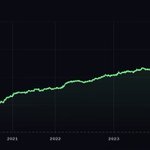
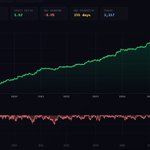
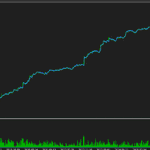
I don’t trade one strategy. I run 9-10 PER PORTFOLIO
This is the combined equity curve of my systems on my prop firm accounts.
Here’s how it’s built 👇
📈 THE UPSIDE BIAS SYSTEMS (breakout, long only)
1️⃣ Crypto breakout
Purpose: capture the long-term upside bias of crypto.
2️⃣ Metals breakout
Purpose: capture the upside bias of metals.
3️⃣ Indices breakout
Purpose: capture the upside bias of indices.
⚡ THE INTRADAY SYSTEMS (breakout, long and short)
4️⃣ FX intraday breakout
Purpose: catch volatility expansion in FX, in both directions.
5️⃣ Indices intraday breakout
Purpose: catch the fast moves on indices, up or down, including the days the long systems struggle.
6️⃣ Metals intraday breakout
Purpose: catch the volatility bursts in metals.
🔄 THE MEAN REVERSION AND TIMING SYSTEMS
7️⃣ Mean reversion on indices
Purpose: buy panic. Makes money when the breakout systems are stuck in chop.
8️⃣ Mean reversion on FX
Purpose: fade stretched moves when the market is ranging.
9️⃣ Seasonality on indices
Purpose: a calendar edge that shares the risk with mean reversion.
The point isn’t that each system is amazing. Some of them are boring. Some lose for months.
The point is that they don’t all lose at the same time.
Different markets.
Different timeframes.
Different logic.
Long and short.
When one system is in drawdown, another is carrying the account.
That’s how you build something that fits inside prop firm drawdown rules: you don’t need a perfect strategy, you need a portfolio.
Pass prop firms with rules, not LUCK.
You can use this on any prop firm @FTMO_com @the5erstrading @fintokei @MyFundedFutures @MyForexFunds @TradingLucid
And I teach you how to build exactly this, step by step, inside my Discord. Free to join. Link in my bio💎
