



Your credit score knows your name, your address history and your debts. It knows nothing about how you actually behave with money until a lender reports it.
@zerufinance's zScore is the opposite bet: no name, no address, no reported debts — just what a wallet has verifiably done, scored against 320M+ other wallets. Spending a week inside both systems, I think they aren't competitors. They answer different questions.
TradFi asks: who are you, and did you repay? That question needs identity, and identity is exactly where it breaks. In the CFPB's latest corrected count, about 32 million US adults had no credit score at all — roughly 7 million with no bureau record, the rest holding files too thin or too stale to score. No file, no score, no loan — regardless of how responsibly those people handle money off the record. (The famous "26 million credit invisible" figure was the CFPB's own 2010 estimate; the Bureau corrected it sharply downward in 2025. Worth knowing before quoting it.)
zScore asks: how does this wallet behave? Consistency over time, diversity of real protocol use, gas habits, capital — computed from public data, portable across chains and borders, available to anyone with a wallet history. Nobody is "invisible" to it. My own two wallets got scored without ever giving a name.
But the honest comparison cuts both ways, and this series has never been a sales pitch:
TradFi's score comes with legal rights. If it's wrong, there is a formal dispute process, backed by law. zScore has no published appeal process yet — I raised the false-positive question in post 3 and I'm still waiting for a mechanism, not an answer.
TradFi's gaming problem is identity fraud: expensive and criminal. zScore's gaming problem is sybils: wallets are free to spawn, so the score has to make fake reputation expensive through behavior that takes time and capital to fake. Different attack, different defense budget.
And one uncomfortable similarity: neither system publishes its weights. FICO's formula is proprietary. zScore publishes its five components and your per-wallet shares — one step more transparent — but as I wrote in post 6, the actual weights are still behind the curtain.
Where the two genuinely collide is lending. A behavior score that prices loans — zLend reads 70+ signals — is TradFi's question being answered with onchain evidence. Whether an 800 should borrow cheaper than a 400 is no longer theoretical; it's a product decision being made right now.
So here's my question for the lenders building on this: what would a wallet score have to show you — track record, transparency, an appeals process — before you'd price a real loan on it instead of a name?
#ActivityFi

5
I let an AI play Tetris on a stranger's phone, and watched it think.
The demo is called Laya, and it runs live on the @Acurast network. For every piece, the game shortlists five possible placements. Laya scores them, picks one, and shows its work.
My session: 222 decisions, averaging 781 ms each — 223 pieces placed, 80 lines cleared, score 10,300. The last call was pure defense: rotate twice, drop at columns 4–6, clear nothing, but leave no new holes — picked at 0.861 probability over a gap-leaving alternative at 0.139.
Every one of those decisions was computed on the CPU of a single Android phone somewhere in the network. No data center. No cloud account.
Honest limit: Tetris is a toy workload. It proves the scheduling and the secure execution work — it doesn't prove a phone fleet can carry production traffic at scale. That part is still being earned, one deployment at a time — 800K+ and counting.
But it's the right kind of demo: open-source (Apache 2.0), live, and cheap enough that running your own instance costs under 1 ACU a day.
Question for the devs watching: what's the first workload you'd trust to a phone instead of a server — and what's still missing before you'd actually ship it?
$ACU #Acurast

3
The most obvious criticism of zScore is also the fairest one:
Isn't a "behavior score" with a Wealth component just a rich wallet's score with extra steps?
@zerufinance's zScore is built from five components: Wealth, Consistency, Protocol diversity, Token diversity, Gas behavior. I went through the scoring research to see how many of the five money can actually buy. The answer is more interesting than the criticism.
Wealth — partly, yes. It measures capital magnitude, and I won't pretend otherwise. If that were the whole score, the criticism would end the conversation.
Consistency — no. It tracks showing up over time, adjusted for transaction frequency so high-volume wallets aren't punished for their own cadence, and it has a built-in floor. Time is the one input money genuinely cannot shortcut.
Protocol and Token diversity — hard to buy. These aren't raw counts. Assets are weighted by economic substance: stablecoins, majors and liquid-staking tokens at the top; points, test and airdrop-voucher assets discounted to less than a tenth. The totals run through a saturating curve, so the hundredth junk token adds almost nothing. Spraying money across a farm buys very little score.
Gas behavior — no. It's about how a wallet spends, not what it holds. Humans and bots leave different gas fingerprints, and a balance can't fake a habit.
Two more design facts matter. The score is population-relative — you're measured against the current wallet base, not a fixed bar — and the breakdown is published per wallet as shares of the total, which is exactly what let me audit my own two wallets: my 376 wallet got there on ~70% Consistency with Wealth at roughly 30%. Behavior carried a mid-size wallet further than the "rich score" theory predicts.
So where does my critique land? Here: Zeru publishes the components and the per-wallet shares, but not the weights. I still can't tell you what fraction of the 1,000 points Wealth controls — or whether Wealth itself saturates the way diversity does, so that the difference between $100K and $10M matters less than the difference between $0 and $10K. That's the number that would settle this argument, and it's the one number not on the page.
A trust score that ignores capital entirely is trivially farmed by empty wallets. A trust score that leans on it too hard is just a balance leaderboard wearing a lab coat. The design work that matters lives in between — and it should be auditable.
If you could set the Wealth cap yourself, where would you put it: a minor component, a major one — or out of the score entirely?
#Zeru

9
I've done 14 quizzes on @dowprotocol's Dow AI Quest, and one idea keeps coming back: sellers don't fail on demand — they stall on cash flow.
Verified platform receivables become on-chain financing, originated in seconds, with repayments visible on-chain. Working capital on Day 1.
app.dowprotocol.com

7
DECA Rewards is live — earn points across DECA's apps for testing, building and spreading the word, then level up from Spark. Trying it out now.

Introducing DECA Rewards: a cross-app rewards layer.
Use our apps, make content, report bugs, test new features and bring friends along. It all adds up in one place.
app.decalabs.ai/rewards
9
You cannot refuse an incoming transfer onchain.
No inbox. No accept button. Someone types your address, presses send, and your wallet has now "interacted" with theirs — permanently, publicly, with a timestamp.
So here's the question @zerufinance's zScreen team asked across 51,217 screened wallets: of all the contact with sanctioned addresses, which way was the money actually going?
47.5% of it was money arriving. And nothing else.
Read that again. Nearly half of the "sanctioned contact" that screening tools count against a wallet is contact the wallet never chose, never accepted, and could not have stopped.
Now the uncomfortable part. One already-listed address can send a worthless sliver of a token to ten thousand strangers for roughly $30 in fees. If your screening system counts contact in both directions, that one afternoon marks ten thousand wallets. Point it at a competitor's customers, and a compliance tool becomes a weapon.
Any rule that strangers can trigger will eventually be triggered by strangers, on purpose.
zScreen's answer is two rules, and both are about restraint:
1. Direction, not size. What a wallet sent is recorded. What it received is not held against it. Five million dollars arriving from a sanctioned address records nothing about the recipient — because the recipient did nothing.
2. Boundaries stop inference. An exchange, a bridge, a payment processor touches thousands of counterparties as routine. Let inference run through one, and a single sanctioned deposit puts every customer one step from a sanctions hit. So those addresses are recorded — and the trail stops there.
Run both rules over the corpus and only 6.9% of wallets qualified at all.
The honest caveat: direction-only doesn't see everything. Money can be layered through intermediaries precisely so the visible sender looks clean — which is why zScreen returns REVIEW alongside CLEAR and FLAGGED, with the evidence trail attached, instead of pretending a binary verdict is the truth.
Screening should judge a wallet by what it chose to do. Not by what anyone in the world chose to do to it.
Should receiving money you never asked for ever count against you?
#Zeru

2
1
39
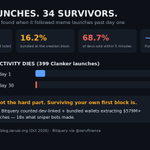
3,374 meme tokens launched. 34 made it.
@zerufinance followed thousands of launches past the hype window and published what actually happens next. The graduation rate: 1.01%.
And graduation is the good outcome. Look at how the other 99% start:
→ 16.2% of launches were bundled in the very block the token was created — insiders positioned before the public could even see the contract.
→ 68.7% of developers started selling within five minutes of launch. Not five days. Five minutes.
→ In the Clanker sample, 7.5% of tokens still recorded a transfer on day 1. By day 30: 0.8%.
The launch isn't the hard part anymore. Anyone can launch. The market dies in its own first block.
An independent dataset points the same way: Bitquery counted developer-linked and bundled wallets extracting $579M+ from Pump.fun launches — 18x what sniper bots made. Everyone blames the snipers. The data says the bigger extraction sits with the people closest to the launch itself.
One honest caveat, because the numbers deserve it: "developer-linked" is inferred from wallet patterns, not proven identity. Some of those wallets will be false positives. But when the pattern shows up across millions of launches, the scale stops being a rounding error.
This is the problem Activity Markets are built to flip. Instead of a dev launching first and the public arriving after the insiders, the market spawns from activity that already happened — verified contributors earn the miner seats, supply shrinks as real activity comes in, and price discovery runs through an auction where everyone in the same block pays the same price.
Whether that model wins is an open question. But the diagnosis is hard to argue with: a launch system where 99% of tokens never graduate and most devs exit in five minutes isn't a discovery mechanism. It's an extraction machine with good marketing.
If launching is free and instant, what should a launch actually have to prove before the public is invited in?
#ActivityFi

11
3
66
Amazon sellers wait 14–28 days to get paid after a sale. @dowprotocol turns those confirmed receivables into on-chain RWA financing — working capital on Day 1. Learning the ecosystem via their project quizzes: 900 DOW XP across 10 projects so far. app.dowprotocol.com

1
27
I finally checked my own reputation score — on two wallets.
@zerufinance's zScore reads a wallet's whole history — trading, lending, LP, staking, governance — and compresses it into a single 0–1000 trust score. No KYC. No identity. Just behavior.
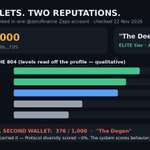
Wallet one — the address that has done the real work for years: 804/1,000. Elite tier. AURA top 5%. The persona the system assigned it: "The Deep Pockets."
Wallet two — same owner, much narrower life: 376. Persona: "The Degen."
Same person. Same hands. Two completely different reputations — because the system doesn't score who you are. It scores what each wallet actually did.
What carries the 804 (levels read off the profile, so qualitative):
→ Token diversity — very high
→ Wealth — high
→ Protocol diversity — high
→ Consistency — mid
→ Gas behavior — mid to low
Now compare the 376: Consistency was its strongest component (~70%) — and its Protocol diversity scored basically zero. That wallet showed up for years, but through a very narrow set of doors. The system noticed.
That's the part I keep coming back to. Neither score is "me." Both are true — about different behavior. A credit bureau merges your whole life into one file. A trust oracle refuses to: every wallet stands on its own history.
Score ≠ how much money you have. Score = how you behave with it.
Price oracles tell apps what an asset is worth. A trust oracle tells them how a wallet behaved. The second question is the one this market has never had a good answer to.
Both wallets are linked to the same Zaps account, by the way — one signed message each, no gas, no transfer rights given up. The scores still didn't merge. That's the point.
If an app could see both of your wallets' scores, which one would you want it to judge you by?
#Zeru

14
5
101
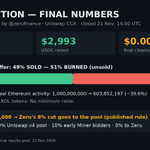
The zETH auction is done — and the numbers tell the real story of @zerufinance's first Activity Market.
→ 91 bidders
→ $2,993 raised
→ Final clearing price: $0.0000166
→ 49% of the auction offer sold — the rest burned
No minimum raise. No team tokens. The market spoke, quietly.

7
84
Claims opened ~6h after the close, and the v4 pool opens at the final auction price.
The open question isn't the launch anymore — it's whether anyone trades it. An Activity Market only works if activity continues after day one. Watching volume, not slogans.
1
5
zETH was the test: supply set by real Ethereum activity, price set by an open auction, unsold supply burned.
Small numbers, clean rules. The next Activity Market is where this model has to prove it can scale.
$zETH #ActivityFi
6
syxhung retweeted

Real-world assets are coming onchain.
On most chains, anyone can launch whatever they want.
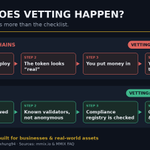
On MMIX, every project is vetted before launch.
Clean assets for users. Clear standards for builders.
Join the first wave and earn rewards.
→ hub.mmix.io

5/ MMIX also builds this into transfers, not just onboarding. Its on-chain compliance registry records verification status, KYC tiers and regional rules — and apps check it before moving value or issuing assets.
Eligibility is enforced when the asset changes hands, not just when someone signs up.
1
6
6/ MMIX is still pre-mainnet (planned for 2027), so this is a documented design, not a proven track record yet.
But the direction is worth watching: for RWA, trust can't be an afterthought you bolt on later. It has to start with who is allowed in.
I'm following it through the MMIX Districts campaign on Nucleus — more on the districts themselves in a later post.
#MMIX #RWA
9