

Founder, @DaywardAI. I help companies position and explain their AI, and I build things with it. 22 years at Apple. Not investment advice.
San Jose, California
Joined December 2006
- Tweets6K
- Following521
- Followers21.7K
- Likes8.8K





Pinned Tweet
Here’s an Apple secret:
Success comes from culture, not technology.
Like many at Apple, I worked for many years under John Brandon, our longtime head of sales. He had his “Top Ten Rules for Success” which I carried around and lived by.
It’s easy to spot someone from Brandon’s team by how they collaborate. I tried to be one of them. I mopped the floor (literally at times), I shared everything I knew without gatekeeping, I always assumed the customer knew their business.
I think about AI the same way. Most AI advice right now is for builders. Almost nobody is helping the marketers, sales engineers, and execs who actually have to put AI in front of customers. That’s the gap I work in.
I left Apple last month after 22 years. After some thinking and a lot of conversations, I’m now doing what I did inside Apple, but for other organizations: AI positioning, helping businesses understand AI, and creating Apple-level presentations and content.

ALT Image: JB Top 10 Rules for Success — John Brandon Let go of the old, focus on future Always tell the truth, bad news sooner than later Highest level of ethics, when in doubt ask Learn to be a good business person, not just a great sales person Everybody sweeps the floor Be professional in your style, speech, and follow through Listen to your customer, they almost always “get it” Create “win-win” relationships with our customers Look out for each other, sharing information is a good thing Don’t take yourself too seriously
Idea: use AI to make an info sheet for an event and share with friends. @slashlast30days was super useful for this.
Here’s mine for underworld/moby in LA tonight, 90’s zine style!
moby-zine-bq3fs.sprites.app/


Todd Dailey retweeted

Omarchy 4.5 on three generations of my machines: a 2011 iMac (i5-2400S, 8GB, a spinning 7200rpm HDD at 113/91 MB/s), an M1 MacBook Air, and my RTX 4090 AI shed. Same tiling desktop, same keyboard flow.
@JoshuaSWarren told me yesterday to try it on my M1 Air, done! 😁 Thanks @martiano and @JoshuaSWarren for native Mac support, @dhh for Omarchy and the Jade Horse theme, and @tcballard for the Starship wallpaper!
Omarchy 4.5 装上了三代机器:2011 年 iMac(机械硬盘读写 113/91 MB/s 照样流畅)、M1 MacBook Air,还有 4090 AI 小屋。同一套平铺桌面,同一套键盘流。昨天 Joshua 让我在 M1 Air 上试试,今天装好了!


You know you can put Omarchy on that M4 Pro. 😁
Support isn’t in Omarchy stable yet, but it’s emerging quickly from volunteer and community PRs.
As dhh says, we can fix everything.
Even if you don’t use the M4 as a daily driver, under Omarchy it’s easy to put its GPU cores to use as a local AI inference server.
Todd Dailey retweeted

Finally solved the long-standing issue with Linux on Apple Silicon, power management
Neo during suspend now draws **0.05 W** on average, just like macOS. It cuts off the power rail to SoC while keeping DRAM in self-refresh loop and still supports wake over LAN/USB/BT, so it works well in docked setups too
And now it's finally possible to just let your Mac running Linux sleep for days without losing battery (well, negligible amounts)! Most of the time was spent covering all sorts of edge cases with USB / weird coprocessor gotchas across suspend
As expected, it wasn't too big like the GPU work was (just difficult to get right, and touches a fairly big amount of subsystems to implement suspend/wake in each) - needed me to sit down for a while and actually get it done... it took a lot of tiny details to get here, but I've finally developed a nearly complete understanding of how it works. 2 days into this rabbit hole and the result is, deep sleep works on Neo and expectedly super similar across M4-M6, where deep WFI looks a little different, others on team like Andreas and @tiredkebab have gotten it to work on M1/M2 as well
Technical deep dive in a blog post coming soon from me and @RyanTheTide regarding the whole Neo bringup we did in the matter of 2 months, it's been a lot of fun & it's just the beginning of what @AuroraSilicon team is doing with @OmarchyMac
Will be working on shipping this feature to our mainline kernel now


At a great exhibit at @LACMA - all about the home of the future viewed through the past. Really great, personally love the mid century modern vibe


After 22 years of working for Apple and always traveling with a Mac laptop, this weekend I brought a Mac but not macOS. My M1 MacBook Pro is running Omarchy Linux.
Everything works! WiFi on the plane, Apple Music, speakers, airdrop. It’s super fast, and it’s AI native, you can literally just prompt what you want. Claude, grok bot, discord, all my go to apps just work.
It’s still got some rough edges but it’s freeing to have full control of your OS. Even if you don’t want to daily drive it any good techy should try it to see what an AI-first OS looks like.

Todd Dailey retweeted

Companies that offer integrated solutions for local inference will boom in the next few years. I'm not talking about another GPU in a case.
Hardware + OS + an inference stack that makes open models easy to run. A plug-and-play system.
Ease of use is still underrated.
Todd Dailey retweeted

Just passed 10,000 followers. Thank you.
You shouldn't need a $15K rig to run a serious local AI model. I want everyone running the most powerful model their budget allows, starting with the hardware they already own.
This week:
- A 2021 M1 Max got 25-29% faster GPU decode on Linux from one power-management fix
- GPT-OSS 120B on a laptop plus an RTX 5060 Ti eGPU, 25 tok/s
- Qwen3.8 Flash Next at 89 tok/s on a DGX Spark
- Omarchy on a Mac mini M6, first GPU llama.cpp run included
My AI hardware has outgrown my home office, as you can see! I'm turning our spare room into an AI lab. Every machine I can test becomes a budget tier I can show you how to use.
The lab still needs two 100G cables and a Thunderbolt 5 PCIe box so the ConnectX-5 isn't stuck at Thunderbolt 3 speed. If you want to help, sponsor me or send hardware: joshuawarren.com/sponsors
I'll post what arrives and what it unlocks. And as always, all of my work is open source, on my GitHub.


Todd Dailey retweeted

Dream come true: visited @M5Stack factory today :)
It was so fun to see where my favorite products get made - they also use a ton of their own products to manage the fab.
and met their founder Jimmy, absolute legend who still designs everything.
We are thinking about a collaboration product…

Todd Dailey retweeted

Omarchy 4.5 is finally here! Traditional desktop mode, M1/M2/M3/Neo compatibility, 50 languages, 7-second installs, and a million other features, fixes, and improvements. omarchy.org/news/2026/11/oma…


Custom touchbar on Omarchy on a M1 MacBook Pro using barux: Claude usage, Omarchy menu button, battery toggle, extra row of functions either fn-shift.
Just told Claude to do it and it made it happen! We can fix everything! 🚀
Todd Dailey retweeted

efficiency will be the big AI story in 2027.
we're hitting intelligence saturation on many tasks where smaller open weight models can do the same work as frontier models.
then the thing to optimize isn't raw intelligence, but economic value per TCO (hardware + energy). labs will co-optimise across the stack (hardware, software, models) to maximize this.

AI is using more and more of the world’s energy. But how much economic value are we getting from AI?
We’re introducing Joules-to-GDP (J2G), a framework that measures how well AI turns energy into economic value and shows which tasks, models, and hardware give the best return.
Across 44 occupations in finance, engineering, law, administrative work, and more in @OpenAI's GDPval, we arrive at three findings:
1) The tasks with the highest economic value are not the tasks with the highest economic value per joule. For example, CAD design earns ~10% more per task than building websites, but the latter earns ~27% more value per joule.
2) The most powerful model isn’t always the best use of energy. Gemma 4 31B delivers 56% of GLM 5.2’s net value with 23% of the energy, for 2.5x the value per joule.
3) More chips don’t guarantee proportionate returns. Moving the same model from 1 to 8 NVIDIA H100s uses 3.2x the energy but cuts completion time by only 22%, with about the same value.
With @SnorkelAI, we’re also releasing GDPWorks, a benchmark for economically valuable tasks across 36 additional occupations.
Joint work co-led by @amirzeinaalii and @Avanika15, with @Mersad_Abbasi, @Jon_Hartley_, John Hennessy, @HazyResearch, and @Azaliamirh.
More details below 🧵
I like the term "modest intelligence" - as David says
"If a model with 8 billion parameters can reliably complete the same work as one with hundreds of billions, why pay for the larger model?"

Modest intelligence is arriving faster than most people realize.
Today, we're open-sourcing TwIL-8B.
Just 8.8 billion parameters, yet approaching frontier-model scores on several difficult benchmarks:
• 93% of frontier performance on coding
• 92% on instruction following
• 90% on contest mathematics
All from a model small enough to run on your own hardware.
But the benchmarks aren't the most important part of this announcement.
For years, the AI industry has focused on building the most capable model, regardless of the cost required to run it.
I believe that equation is changing.
The next era of AI will be defined by the cost of completing work. Not simply the intelligence of the model, but how efficiently that intelligence can accomplish the task.
If a model with 8 billion parameters can reliably complete the same work as one with hundreds of billions, why pay for the larger model?
As smaller models become more capable, intelligence becomes something we can distribute, specialize, and run across the hardware we already own.
That's the future we're building at @thewebAI
TwIL-8B is available today. Open weights.
And this is just the first of several announcements we're making today.
HF Link: huggingface.co/webAI-Officia…
Omarchy is the most fun I’ve had running an OS in a long time. It’s an AI-forward OS, the first of its kind, and a good vision of the future. If you have an old M-series Mac, or even an old Intel Mac, it’s worth a spin. My old 8GB 12" Intel MacBook is perfectly usable as a couch browser and Netflix machine with Omarchy.
My M1 MacBook Pro with Omarchy is super performant, and it actually makes the Touch Bar fun and useful!
I expect Omarchy to push up the price of used M1, M2 and M3 Macs. SECURE YOUR COMPUTE! 😀
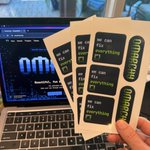
Bringing some stickers to an Omarchy event tonight!


