






Gmaven retweeted

AI made everyone fall in love with data again.
It also made bad data infinitely more dangerous.
20 years in high-stakes commercial property data (inseparable from the businesses and people data behind it) taught me 12 lessons worth passing on.
Seven will make you want to argue. The other five you'll nod at instantly - which is exactly why they're dangerous.
If you make decisions off data, all 12 are for you.
🧵First, the seven that go against the grain

Gmaven retweeted
Success isn’t random - it’s seasonal. 🇿🇦📈
Out of curiosity, we looked at the birth dates of 15K SA high value commercial property owners. The data reveals two massive birth peaks: March and September.
The 9-month reverse math?
❄️ Winter holidays (June/July)
☀️ Summer breaks (Dec/Jan)
But the insight is in the troughs. November/December births are significantly lower, supporting @Gladwell's “Outliers” theory. In SA schools (Jan start), these are the youngest in the class.
Turns out, being the oldest in Grade 1 might be your first high-value ROI.
Are you a "peak month" director?
#CRE #Data #Outliers


Feeling like Homer Simpson with AI taking over? Using AI, we collapsed a 6 week ordeal into a 15-day win. Read how a 45 year old non-software engineer, new to AI, could boost sales efficiencies and sweat Gmaven #CRE data. If we did this, so can you!
bit.ly/4o4zAfm
🧐 Remember school? "Passed your year?" "Got 50 marks." "Out of?" "200." "Ouch, fail!"
In SA biz, data without context = same fail.
Your sales/risk etc.? That's the numerator. Missing the denominator (total market)? You're flying blind.
💡 your data now: bit.ly/436x5R8

Great insight here. Note, because of size of BH, WB is forced to filter out opportunities based on min value criterion

Warren Buffett thoughtfully explains why investing in stocks/equities is better than real estate, during Berkshire's latest annual meeting:
"In respect to real estate, it's so much harder than stocks in terms of negotiation of deals, time spent, the involvement of multiple parties in the ownership.
Usually when real estate gets in trouble, you find out you're dealing with more than equity holder. But there have been times when large amounts of real estate...
I've changed hands at bargain prices, but usually stocks were cheaper, but there were a lot easier to do.
Charlie did more real estate. Charlie enjoyed real estate transactions, and he actually did a fair number of them in the last five years of his life.
But he was playing a game that was an interesting game to him. But I think if you'd asked him to make a choice when he was 21, he'd either be in stocks exclusively the rest of his life or real estate the rest of his life. He would have chosen stocks in a second.
There's just so much more opportunity, at least in the United States. There's so much more opportunity that presents itself in the security market than it does in real estate and in real estate.
You're usually dealing with a single owner or a family that owns maybe a large property they've had a long time. Maybe they've borrowed too much money against them. Maybe the population trends are against them. But to them, it's an enormous...
When you walk down to the New York Stock Exchange, you can do billions of dollars worth of business totally anonymous, and you can do it in five minutes. And the trades are complete when they're complete.
In real estate, when you make a deal, a big deal with a distressed lender, when you sign the deal, then you go into another phase. Then people start negotiating more things and more things. It's a whole different game. And a different type of person, to some extent, enjoys the game.
We did a few real estate deals that came our way in 2008 and 2009, but the amount of time that they would take us compared to doing something intelligent and probably better in securities, there was just no comparison.
I mean, in a real estate deal, every sentence is important. In stocks, if somebody needs to sell 20,000 shares of Berkshire or something and they call us and the price is right, it's done in five seconds. And it closes all the time."
62
Gmaven retweeted

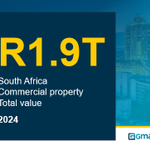
According to Gmaven, South Africa's CRE market value hit R1.92 trillion by June 30, 2023, a 48% increase from R1.3 trillion in 2015, when official data was first released.
#SACREMarket
#RealEstateGrowth
#MarketValue
#PropertyMarket
#CRETrends
@TeamGmaven

Gmaven retweeted

The South African commercial real estate market has surged to nearly R2tn bizcommunity.com/article/the… via @Biz_Property @TeamGmaven

South Africa’s commercial property market is valued at R1.92T.
bit.ly/3U0H1r7
48% up from previous study done in 2015.
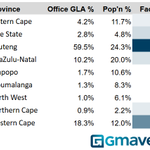
Discover the hidden opportunities for businesses across provinces! #CRE #SouthAfrica #Investments

Gmaven retweeted

Technological shifts often enable new entrants to displace incumbents. When they do, it tends to be permanent. So whether we like it or not, our default assumption should be that this is the new order of things.


For the "but commercial property is simple" crowd:

Once again I was asked to hop on a quick call to explain what people need to know in order to run a real estate fund.
Trouble is, it would be a really long call for me to actually explain how to value a site using price per foot instead of cap rate, interest rate impact on real estate, parking ratios, elbow spaces, traffic counts, running a sales team, leasing spaces, choosing the right subcontractors, a successful signage program, quarterly investor updates, Securities and Exchange Commission (SEC) regulations, value-add via mark-to-market, the difference between big box retail and neighborhood strips, verifying accredited investor status via third parties, obtaining the right loan for each property, buying all-cash and putting the financing on later, using a line of credit on the buy as needed, CRM software, allowing brokers to double-end deals in order to win, utilizing in-house leasing as a major part of the strategy, buying in markets that have less sharks, estoppel certificates, surveys, investor capital calls, reading environmental reports, co-tenancy clauses, negotiating with local mom-and-pop tenants vs national tenants, how to use tenant improvement allowances and free rent to maximize value, exclusive-use clauses, excel, carried interest, hurdle rates, renewal options, CPI increases vs fixed, reviewing title reports, broker networking, pro-rata share, CAM reconciliation, fund administration, investor portals, triple net leases, ADA laws, personal guarantees and when to require them, giving your architect direction, grease trap installation and maintenance, AMP requirements, working with cities, operating agreements, investor distributions, waterfalls, choosing a buyer who will actually close, natural hazard disclosure reports, asset management, insurance requirements, implications of property tax increase upon purchase, gathering rental data from local tenants, reviewing tax returns from CPA, bookkeeping, cross-easements, CC&Rs, title exceptions, market brokerage commissions, waiver of subrogation, assignment and subletting clauses, eviction process, recapture clauses, impact of each tenant on the rest of the property, monument signage, HVAC maintenance, deprecation, down gradient vs up gradient, private placement memorandum, pitch deck, proper use of costar, loopnet, crexi, miscategorized listings, subscription documents, audits, investor quarterly account statements, PCE, vapor extractions systems, REG D 506c, blue sky filings, accrued vs cash accounting, legal disclosures, IRRs, MOIC, investment period, optimal loan to value, putting together an investment thesis, market fees, institutional capital, minimum commitments, analyzing comps efficiently, putting together effective leasing brochures, reaching national tenant brokers, value-add through lease-up, value-add through mispricing, redevelopment, 1031 exchange, identifying operational inefficiencies, understanding when to sell, ability to analyze a property via an aerial, identifying the cosmetic updates that add the most value for your dollar, analyzing the spread between in-place rents and market rents, interpreting demographic data, managing the appraisal process, selecting the right lender, understanding every single word and clause in a lease, and that you have a ton of control over the value of your property.
And that’s just a start.
31

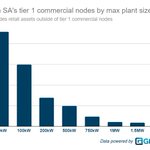
Solar energy is the bright light in the SA commercial property sector's gloom - it promises a 3 punch combo: transfer wealth from grid to prop owners, reduce carbon emissions, and curb daytime loadshedding
bloomberg.com/news/articles/…

99
Solar energy is the bright light in the SA commercial property sector's gloom - it promises a 3 punch combo: transfer wealth from grid to prop owners, reduce carbon emissions, and curb daytime loadshedding
bloomberg.com/news/articles/…
1
38
Self-generated solar power delivers a 3 punch combo: transfer of wealth from public grid to suffering private commercial property owners, reduced carbon emissions, and a potential reduction in SA's daytime loadshedding by almost 5 stages
bloomberg.com/news/articles/…?
28