

Business Development Partner at @VictusGlobal // Project Ambassador // Tier 𝟙 KOL// Love Memecoins
Joined March 2022
- Tweets14.3K
- Following2.8K
- Followers16.5K
- Likes13.5K




Pinned Tweet
I just rethought what “decentralized infrastructure” actually means and it pushed me to make a move.
Here’s what I discovered about BTFS, why it matters for Web3 + AI, and why I’m paying close attention
@BitTorrent @justinsuntron #BTFS #TRONEcoStar

As AI platforms become increasingly connected to payment systems, account authentication and blockchain infrastructure, security becomes an important part of the user experience.
B.AI’s Model Services documentation highlights several precautions users should follow when accessing the platform.
One of the most important is verifying official access URLs.
The documentation identifies two official B.AI Chat addresses:
chat.b.ai/chat
chat.bankofai.io/chat
If one entry point is unstable, users can try the other official address.
However, the documentation explicitly warns against logging in, connecting a wallet or topping up through search advertisements, unfamiliar links or unofficial pages.
There are additional precautions depending on the authentication method.
For wallet users:
Keep mnemonic phrases and private keys secure. Use a compatible Web3 wallet and complete authentication through the expected wallet-signature process.
For payment operations:
Confirm that you are using an official B.AI access address and a trusted network before completing fund-related activities.
For API integrations:
Use the complete service addresses provided through the documented availability channels. Do not modify API Base URLs manually.
These precautions matter because access security and payment security are connected.
A powerful AI service is only as useful as the trust users can place in the infrastructure surrounding it.
B.AI’s documentation makes official access verification an important part of getting started.
@justinsuntron @BAI_AGI #TRONEcoStar

199
USDD’s development reflects a broader direction within decentralised finance: building stablecoin infrastructure that combines financial utility, collateral management and on-chain accessibility.
Looking across its ecosystem, several components work together.
Stablecoin infrastructure
USDD provides the dollar-pegged digital asset around which the ecosystem operates.
Collateral framework
Vaults and over-collateralisation mechanisms support the protocol’s financial structure.
Peg management
The Peg Stability Module provides supported stablecoin conversion functionality.
Savings infrastructure
sUSDD allows users to participate in the savings product and receive yield through an interest-bearing token.
Transparency
Publicly accessible contracts and technical documentation provide ways to examine protocol activity and infrastructure.
Governance and ecosystem utility
JST and its associated governance and buyback mechanisms contribute to the wider JUST ecosystem.
Multichain accessibility
Support across multiple blockchain networks expands the environments in which users can interact with supported USDD products.
What connects these components is the objective of making a decentralised dollar useful across different areas of blockchain finance.
Stablecoin infrastructure requires more than maintaining a price target.
It also requires liquidity mechanisms, collateral management, transparent operations and meaningful integration with DeFi applications.
That is the broader ecosystem USDD is developing.
@USDDecentralize @justinsuntron #TRONEcoStar

180
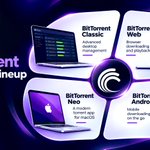
BitTorrent offers several applications, but choosing the right one depends on how someone prefers to download and manage files.
Each product has a different focus.
BitTorrent Classic — For advanced desktop management
Classic is suited to users who need bulk downloading, download prioritisation, scheduling, RSS automation and advanced customisation.
It also supports remote management through compatible features.
BitTorrent Web — For browser-based downloading
Web is designed for users who prefer to search for torrents, download files and play supported media while downloads are in progress.
Its browser-based experience makes downloading more accessible.
BitTorrent Neo — For macOS users
Neo provides a native torrent application for modern macOS systems, with file organisation, swarm health checks and bandwidth management.
BitTorrent Android — For mobile downloading
Android provides torrent and magnet link support, Wi-Fi-only downloading, bulk downloads and built-in media playback.
The product pages also show different pricing structures.
Classic offers a free download. Web has Basic, Ad-Free, Pro and Pro+VPN editions. Neo has Basic, Plus and Pro editions, while Android offers Basic and Pro.
The displayed paid-plan prices and features vary by product and may change over time.
What stands out is that BitTorrent is not trying to make every application identical.
Instead, it provides different experiences for different operating systems, usage patterns and levels of control.
That flexibility is an important part of the BitTorrent product ecosystem.
From advanced desktop management to mobile downloading and browser-based playback, users have different ways to access peer-to-peer file sharing.
@justinsuntron @BitTorrent #TRONEcoStar

171
Obtaining Energy through JustLend is straightforward, but understanding the conditions attached to each service is essential.
The platform provides different options for different transaction requirements, and users should understand the details before confirming an order.
Here are some important considerations.
1. Check the Receiving Address
For Buy Energy, the estimated requirement for a USDT transfer depends on whether the receiving address already holds USDT.
The interface displays 65,000 Energy for an eligible address holding USDT and 131,000 Energy otherwise.
2. Understand the One-Hour Expiry
Purchased Energy is valid for one hour.
Any unused amount is automatically reclaimed after expiry, and the purchase is non-refundable.
3. Consider Address Activation
Sending resources to an inactivated TRON address involves a one-time activation fee of 1.1 TRX, according to the displayed interface.
This is separate from the Energy purchase itself.
4. Plan Rental Duration Carefully
Energy Rental supports 3-hour, 1-day, 3-day and custom durations.
Users should choose a period that matches their expected transaction schedule.
5. Understand the Rental Deposit
The rental interface displays a security deposit and explains its refund conditions.
Users should review the amount before confirming a rental.
6. Check Network Pricing
Energy prices can change with network conditions and marketplace utilisation.
The price shown when placing an order should be treated as the relevant estimate rather than relying on an older screenshot.
7. Keep the Two Services Separate
Buy Energy is suited to short-duration transactions, while Energy Rental is designed for longer usage and offers early termination.
The distinction matters when calculating total costs.
JustLend is making TRON resource acquisition more accessible through two different services.
But using them efficiently begins with understanding the pricing, duration, receiving-address requirements and refund conditions.
Better resource planning means fewer surprises when executing transactions.
@justinsuntron @DeFi_JUST #TRONEcoStar

156
The development of a blockchain ecosystem requires more than transaction processing and smart-contract deployment.
Applications also need access to reliable external information, verifiable randomness and infrastructure that supports automated execution.
These capabilities determine how far developers can extend the functionality of their applications.
WINkLink brings these services together through its comprehensive data services platform for the TRON ecosystem.
Its four major services address different infrastructure requirements.
Price Service — Reliable Market Information
Provides price data for applications that require accurate asset valuations, including lending, derivatives and asset management.
VRF — Verifiable Randomness
Allows developers to build applications that require secure and verifiable random outcomes, including blockchain games and NFT distribution.
AnyAPI — External Data Connectivity
Connects smart contracts to external information through API integrations, supporting use cases involving flights, traffic, sports and other real-world data.
Automation — Conditional Smart-Contract Execution
Helps applications execute predefined smart-contract functions when specified conditions are met, supporting liquidation, interest reinvestment and automated trading.
Beyond these services, WINkLink provides an ecosystem for node operators, data providers and developers to participate in building and using oracle infrastructure.
Its developer resources also provide integration guidance for connecting the services to blockchain applications.
The broader significance is the range of applications these capabilities can support.
DeFi platforms can access market information. Games can introduce verifiable randomness. Applications can retrieve real-world data. Smart contracts can execute predefined operations without requiring constant manual intervention.
These are different problems, but they share a common infrastructure requirement.
Blockchain applications need dependable ways to interact with information and processes beyond their immediate on-chain environment.
WINkLink is building around that requirement.
Its contribution to TRON extends beyond supplying data. It provides infrastructure that developers can use to create more capable, connected and automated decentralised applications.
@WinkLink_Oracle @justinsuntron #TRONEcoStar

139
The growth of a decentralised finance ecosystem depends on more than the products available to individual users.
Developers also need reliable infrastructure that allows them to integrate existing protocols into their own applications.
SUN.io provides several technical components designed to support this.
Its documentation includes integration resources for the Universal Router, Permit2 and SunSwap’s different AMM versions.
Universal Router Integration
Developers can use a unified routing interface to interact with multiple supported trading protocols.
Instead of independently integrating every liquidity source, applications can access a common entry point for swaps.
Permit2 Approval Mechanism
Permit2 provides a signature-based token authorisation mechanism that can streamline approval workflows.
It allows supported applications to use more flexible authorisation patterns instead of relying exclusively on repeated traditional token approvals.
SunSwap V4 Hooks
Hooks create opportunities for developers to attach custom smart contract logic to pool operations.
This opens the door to more specialised DeFi functionality, including custom fees, alternative pricing mechanisms and advanced trading strategies.
Multiple AMM Architectures
Developers can also choose from different trading models depending on their application’s requirements.
SunSwap V2 provides traditional constant-product liquidity.
V3 supports concentrated liquidity.
V4 adds programmable Hooks and architectural improvements.
SunCurve focuses on stablecoin trading.
These components give developers different building blocks for creating decentralised applications on TRON.
SUN.io also maintains public documentation, GitHub resources, contract interfaces and technical integration guides.
This is important because an ecosystem becomes more useful when third-party applications can build on its infrastructure.
SUN.io is not only providing financial services to end users; it is also developing the technical foundations that other builders can integrate into their own products.
@OfficialSUNio @justinsuntron #TRONEcoStar

127
AI access should not be restricted to desktop browsers.
B.AI provides an Android application that integrates core B.AI functions and pages, alongside a dedicated Service Availability feature.
The application also helps users discover available Web access URLs and API Base URLs.
This is particularly useful in network environments where the primary B.AI Web or API address may not be directly reachable.
According to the documentation, users can use the Service Availability section to find addresses suitable for their current network environment.
The Android application has the following documented requirements:
→ Android 8.0 or later.
→ Installation through the official Google Play listing or the APK provided by the official B.AI website.
→ Access to the B.AI Service Availability section for available service addresses.
The documentation also explains that users should copy complete API Base URLs from the application rather than manually modifying them.
This makes the Android application relevant beyond simply providing another way to access AI.
It also serves as a reference point for discovering available service endpoints.
For users and developers operating across different network environments, this is a useful part of B.AI’s accessibility infrastructure.
@BAI_AGI @justinsuntron #TRONEcoStar

121
A stablecoin becomes more useful when it can participate in different financial activities.
USDD is designed to function within a wider DeFi environment rather than simply existing as a digital representation of the dollar.
Its ecosystem documentation highlights several applications.
→ Savings: Users can deposit USDD and receive sUSDD through the savings mechanism.
→ Collateral management: Eligible assets can be deposited into Vaults to mint USDD.
→ Stablecoin conversions: The Peg Stability Module supports conversions between USDD and other supported stablecoins.
→ Trading: USDD can be used in supported markets and decentralised trading applications.
→ Liquidation auctions: Users can participate in auctions involving collateral from liquidated Vaults, subject to the protocol’s requirements.
These activities serve different purposes.
Savings provides access to the yield-bearing sUSDD product.
Vaults connect deposited collateral with stablecoin liquidity.
PSM provides a conversion mechanism.
Trading supports market activity, while auctions form part of the protocol’s collateral recovery framework.
This is an important distinction when evaluating stablecoin ecosystems.
The usefulness of a stablecoin is not determined only by its peg. Its integration into financial applications, liquidity mechanisms and supporting infrastructure also matters.
USDD’s product ecosystem brings several of these functions together.
@USDDecentralize @justinsuntron #TRONEcoStar

107
One interesting feature within the BitTorrent product ecosystem is the ability to connect mobile download management with a desktop torrent client.
BitTorrent Android includes a remote feature that allows users to add torrents to BitTorrent Classic running on Windows.
This creates a connection between two different environments.
The desktop application handles the torrent transfer, while the mobile application provides another way to manage the process.
Why does this matter?
Imagine someone who primarily downloads files on a desktop but is not always physically close to that computer.
Remote torrent management provides a way to add downloads without having to return to the desktop every time.
This capability is complemented by BitTorrent Classic’s other management features.
→ Users can prioritise individual downloads.
→ Download and upload speed limits help control bandwidth consumption.
→ Scheduling allows transfers to take place at selected times.
→ RSS automation can automatically add torrents from configured feeds.
→ Multiple downloads can be managed from the desktop application.
The result is a more flexible downloading workflow.
It also demonstrates that BitTorrent’s products are not necessarily isolated experiences. Some features are designed to work together, allowing users to interact with their downloads across different devices.
The broader idea is convenience through connected functionality.
Desktop applications provide detailed management, while mobile access offers another way to interact with that environment.
@BitTorrent @justinsuntron #TRONEcoStar

116
Decentralised finance depends on information.
Lending protocols need to understand collateral values. Derivatives platforms require accurate market information. Asset managers need reliable valuations to manage portfolios.
Without dependable data, these applications cannot operate effectively.
WINkLink’s Price Service provides an infrastructure component for three important areas of DeFi.
1. Financial Derivatives
Derivatives platforms depend on underlying asset prices to calculate the value of financial positions.
WINkLink’s price feeds can provide the market information required by smart contracts to support pricing, settlement and related financial calculations.
2. Lending
Lending protocols need to determine how much collateral a user has deposited and how much borrowing capacity that collateral supports.
Accurate price information helps applications assess collateral values and monitor the financial health of borrowing positions.
It is also important when determining whether liquidation conditions have been reached.
3. Asset Management
Decentralised asset management platforms need to understand the changing value of the assets within their portfolios.
Price information can support portfolio rebalancing, valuation and the management of different asset allocations.
These are three different applications, but they share one requirement: dependable external market information.
WINkLink’s role is to make that information accessible to smart contracts through oracle infrastructure.
As DeFi applications become more sophisticated, the importance of reliable data services becomes increasingly apparent.
The financial logic may be written into smart contracts, but the quality of that logic also depends on the information supplied to it.
This is why oracle infrastructure remains an important part of the DeFi stack.
@justinsuntron @WinkLink_Oracle #TRONEcoStar

110
Energy management does not end when a smart contract transaction is completed.
TRON also has a resource recovery mechanism that affects how users plan their next transactions.
When Energy is consumed during a transaction, it gradually recovers over time.
This is important because users who execute multiple transactions need to understand that their available resources are not necessarily fixed.
JustLend makes this resource-management process easier to understand through its Energy Rental dashboard.
The interface displays separate metrics for:
→ Total Energy available within the displayed rental ecosystem.
→ Energy currently allocated to rentals.
→ Energy in recovery.
→ Overall rental utilisation.
The rental interface also explains that consumed Energy recovers to 100% within no longer than 24 hours.
This recovery process is relevant when planning recurring transactions and determining whether additional resources are needed.
For example, a user who executes several USDT transfers may consume a considerable amount of Energy.
If additional transactions are required before sufficient resources recover, renting or purchasing more Energy can help meet those requirements.
This creates a practical relationship between transaction scheduling and resource availability.
Instead of looking only at the amount of Energy consumed by an individual transaction, users can consider their broader resource requirements over time.
Understanding Energy consumption, recovery and rental availability can help users make better decisions about when to rent, when to buy and how much Energy to obtain.
Resource management is an important part of operating efficiently on TRON.
@justinsuntron @DeFi_JUST #TRONEcoStar

102
A DeFi ecosystem generates economic activity through different products.
However, what happens to some of the revenue generated by those products is equally important when examining their token economics.
SUN.io operates a buyback-and-burn mechanism that directs specified portions of revenue from different ecosystem products towards purchasing SUN.
The purchased tokens are subsequently sent to the TRON black hole address, permanently removing them from circulation.
The mechanism currently draws from four documented sources.
SunSwap V2
0.05% of each transaction amount is allocated towards SUN buyback and burn.
SunSwap V3
One-sixth of the accumulated fees from the TRX/USDT 0.05% fee-tier pool is allocated towards buyback and burn, effective May 2, 2026.
SunPump
100% of the platform’s protocol revenue is allocated towards SUN buyback and burn.
SunX
50% of net revenue is allocated towards buyback and burn after deducting operating expenses, including costs such as trade mining.
The process follows a structured mechanism.
First, eligible protocol revenue is collected.
The corresponding funds are periodically converted into SUN.
The purchased SUN is transferred to a pending-burn address.
Finally, the accumulated tokens are permanently destroyed on a quarterly basis by sending them to the TRON black hole address.
Why does this matter?
It establishes a connection between activity across the ecosystem and the circulating supply of SUN.
As the platform’s products generate eligible revenue, the buyback mechanism creates demand for SUN, while the subsequent burn permanently removes purchased tokens from circulation.
It is an important component of SUN’s economic design.
However, buybacks and burns do not guarantee price appreciation. Their impact depends on overall demand, market conditions, token supply and actual protocol revenue.
The interesting part is the relationship between platform utilisation and the token’s long-term economic structure.
@justinsuntron @OfficialSUNio #TRONEcoStar

96
AI services become considerably more useful when developers can integrate them into their own applications and workflows.
B.AI Model Services is not limited to accessing AI through its web-based chat interface.
Its documentation also references a Recharge API for programmatic cryptocurrency recharge.
This introduces another way to interact with the platform’s payment infrastructure.
Rather than managing every recharge exclusively through the graphical dashboard, developers can refer to the API documentation for supported programmatic recharge workflows.
The documentation also makes an important distinction between two types of access:
→ Web access URLs: Addresses used to open B.AI Web services.
→ API Base URLs: Addresses used when configuring an API client or integration.
These addresses should not be treated as interchangeable.
When configuring an API client, users are instructed to copy the complete API Base URL displayed by the B.AI Android App.
The documentation specifically warns against manually adding or removing URL path segments.
Authentication methods, request protocols and examples are covered separately in the API Reference.
This is an important distinction for developers building integrations.
A web interface provides direct access for individual users, while API infrastructure creates possibilities for programmatic interaction.
B.AI’s documentation provides a starting point for exploring both experiences.
@BAI_AGI @justinsuntron #TRONEcoStar

100
The USDD ecosystem exists alongside other components of the wider JUST ecosystem, including JST.
Understanding the difference between these tokens is important.
USDD serves as a decentralised stablecoin designed to maintain a value relationship with the US dollar.
JST, on the other hand, is the governance token associated with the JUST ecosystem.
Their functions are different.
USDD
→ Designed for dollar-denominated value.
→ Used within supported DeFi applications.
→ Supports collateral-backed financial operations.
→ Can be deposited into the savings product to receive sUSDD.
JST
→ Serves governance-related functions within the JUST ecosystem.
→ Supports community participation in protocol decision-making.
→ Has a role in the wider JUST ecosystem’s token utility.
The ecosystem also includes a buyback and burn programme for JST, with official USDD materials describing revenue contributions from JustLend, USDD and GasFree.
This introduces another dimension to the relationship between the different products.
Instead of treating every token as if it performs the same function, it is important to understand how each component contributes to the wider ecosystem.
USDD provides stablecoin utility, while JST plays a different role in governance and ecosystem value mechanisms.
Understanding these distinctions makes it easier to follow developments across the JUST ecosystem.
@justinsuntron @USDDecentralize #TRONEcoStar
🤖 Made with AI

81
File sharing is no longer limited to desktop computers.
BitTorrent Android brings torrent downloading directly to mobile devices, allowing users to manage transfers from their smartphones.
The application supports torrent files and magnet links, giving users flexibility when adding downloads.
Its feature set also addresses some of the practical limitations of downloading through mobile internet connections.
Wi-Fi-only mode
Users can configure downloads to take place over Wi-Fi, helping them avoid consuming their mobile data allowance.
Built-in media player
The application includes a media player for playing downloaded audio and video files directly on the phone.
Bulk downloading
Users can download multiple torrent files simultaneously when their network connection supports it.
Remote management
The Android application can remotely add torrents to BitTorrent Classic on Windows, connecting the mobile experience with the desktop client.
Bandwidth controls
Users can manage download and upload speed limits to make better use of their available network resources.
The product page also highlights the BitTorrent P2P protocol as part of its mobile downloading experience.
These features make the Android application useful for people who want to manage downloads without being tied to a desktop computer.
It also demonstrates an important direction for BitTorrent: bringing peer-to-peer functionality into the mobile environment while providing tools designed around mobile data usage and media playback.
@BitTorrent @justinsuntron #TRONEcoStar

111
A decentralised oracle network depends on more than smart contracts.
It also requires infrastructure participants capable of retrieving, processing and delivering information.
WINkLink’s ecosystem includes node operators who contribute to its data service infrastructure.
The WINkLink website provides an entry point for developers and infrastructure participants interested in building a node and publishing data services.
The platform explains that node operators can run and publish their own data services, with the possibility of receiving rewards when developers use those services.
This creates an important relationship between infrastructure providers and application developers.
For node operators:
→ Run a node within the WINkLink ecosystem.
→ Publish available data services.
→ Make those services accessible to developers.
→ Receive rewards when developers use the published services, according to the platform’s stated model.
For developers:
→ Discover available data services.
→ Integrate relevant services into smart contracts.
→ Build applications that require external information.
This structure creates opportunities for more participants to contribute to the oracle ecosystem.
Instead of treating data infrastructure as something that only a central provider can operate, WINkLink provides a pathway for participants to contribute services.
Reliable oracle infrastructure depends on the quality of the information being delivered and the systems responsible for delivering it.
Node operators therefore play an important role in connecting external information with the applications that depend on it.
@WinkLink_Oracle @justinsuntron #TRONEcoStar

85
Energy Rental is more than a feature that allows users to obtain TRON network resources.
It also creates a marketplace connecting people who need Energy with participants who provide it.
This introduces two important sides of the ecosystem.
Energy Renters
These are users who need additional Energy to execute smart contract transactions.
Instead of staking substantial amounts of TRX themselves, they can access resources through the rental marketplace.
Resource Providers
These participants contribute Energy to the marketplace, making it available to users who need it.
The rental mechanism creates an economic relationship between resource supply and transaction demand.
The dashboard screenshot provided on November 25, 2026, showed the following market statistics:
→ Total Energy: 48,309,913,650
→ Energy in Rent: 10,653,131,237
→ Energy in Recovery: 690,620,302
→ Total Renters: 84,463
→ Resource Providers: 16,117
→ Displayed utilization: 22.4%
→ Displayed rental price: 52 SUN per day.
These figures provide a snapshot of the activity taking place within the Energy Rental marketplace.
The presence of both renters and resource providers is important because an effective rental marketplace requires available resources and participants willing to use them.
For renters, it provides an alternative to independently staking TRX.
For providers, it creates an opportunity to make available resources useful to other network participants.
This is an example of how resource allocation can become an organised marketplace rather than an isolated activity managed by individual wallets.
@justinsuntron @DeFi_JUST #TRONEcoStar

100
The meme-token market has become an important part of blockchain culture.
However, launching a token can involve technical complexity, liquidity challenges and concerns about how initial token distribution is handled.
SunPump was introduced to make meme-token creation and trading more accessible within the TRON ecosystem.
It provides a fair-launch model that allows creators to introduce meme coins without a traditional presale or reserved team allocation under its documented launch structure.
One of its central mechanisms is the bonding curve.
Here is how the process works.
1. Token Discovery
Users explore available meme coins and identify projects they want to follow.
2. Bonding Curve Trading
New tokens are initially traded through a bonding curve.
As buying and selling activity changes, the curve determines the applicable token pricing.
3. Market Progression
As community participation and trading activity increase, the token progresses towards the bonding curve’s completion threshold.
4. Liquidity Migration
When the bonding curve reaches 100%, the documented mechanism automatically deposits approximately $12,000 worth of TRX liquidity into SunSwap V2.
The associated liquidity is then burned.
This creates a transition from the initial bonding curve market into a conventional decentralised exchange liquidity pool.
SunPump also provides a streamlined token creation experience, making it easier for creators to introduce projects without independently building all the underlying trading infrastructure.
An additional economic connection is that 100% of SunPump’s protocol revenue is allocated to SUN buyback and burn under the documented mechanism.
SunPump therefore contributes to two areas of the ecosystem: expanding token issuance and trading activity on TRON while supporting SUN’s wider token economics.
@justinsuntron @OfficialSUNio #TronEcoStar

102
Payment flexibility can influence how easily users access digital services.
A platform may offer powerful AI models, but if its payment system is difficult to use, that can create unnecessary friction.
B.AI Model Services supports multiple payment methods designed to accommodate different user preferences.
Its documentation identifies several fiat payment channels:
→ Stripe-supported card payments.
→ WeChat Pay.
→ Alipay.
→ UnionPay.
The platform also supports on-chain payments through supported blockchain networks and tokens.
This creates two broad payment routes.
Traditional payment access
Users can use supported fiat payment channels without needing to approach every transaction through a cryptocurrency wallet.
Blockchain-based payment access
Web3 users can make on-chain payments using supported networks and tokens.
The significance is the combination of both approaches.
Instead of designing the payment experience exclusively around cryptocurrency users, B.AI provides options for people who are more comfortable with conventional payment systems.
It also allows Web3-native users to interact with the platform through blockchain-based payment infrastructure.
The actual availability of payment methods depends on the options displayed on the Top Up page.
This flexible payment architecture is an important part of making AI services accessible to a broader audience.
@BAI_AGI @justinsuntron #TRONEcoStar

85
Liquidity and accessibility are important considerations when choosing a stablecoin.
A digital dollar that exists on only one blockchain can limit the applications and communities able to interact with it.
USDD addresses this through its multichain presence.
Its official documentation identifies support across TRON, Ethereum and BNB Chain, with network-specific functionality depending on the product.
Why is this significant?
1. Wider accessibility
Users can interact with USDD through supported blockchain environments.
2. DeFi integration
Multichain availability creates opportunities for integration with different decentralised applications.
3. Flexible stablecoin usage
USDD can participate in supported trading, liquidity and savings activities across its available networks.
4. Different ecosystem opportunities
Each network has its own users, applications and liquidity environment.
USDD’s multichain approach makes it possible to serve a wider range of participants rather than restricting its entire ecosystem to a single blockchain.
However, users should always verify the correct network and token contract before transferring assets.
A token with the same name on different networks is not automatically interchangeable without the appropriate supported conversion or bridging mechanism.
The bigger picture is that stablecoin infrastructure needs to be accessible wherever users and applications operate.
USDD’s multichain architecture is an important part of that direction.
@USDDecentralize @justinsuntron #TRONEcoStar

80