

bioengineer guy @try_litefold
conserved motif
Joined April 2025
- Tweets4.5K
- Following793
- Followers2.9K
- Likes33.4K








nabajit (bio/acc) retweeted

We are proud to announce we’ve hit the early drug discovery milestone in our AI-powered oncology collaboration with Servier, just 10 months in!
This triggers a milestone payment from Servier and underscores the power of combining Insilico’s generative AI capabilities with Servier’s deep clinical expertise to accelerate the discovery of novel small-molecule therapeutics.
Thank you to Drug Discovery World for the coverage: ddw-online.com/partnership-a…
#DrugDiscovery #AIDD #partnerships

nabajit (bio/acc) retweeted

Launching RNAFoundry.com – we manufacture personalized cancer vaccines.
nabajit (bio/acc) retweeted

Less Time Connecting the Dots
Research generates data. But how much time does your team spend connecting it?
Structure predictions, screening results, molecular analysis and experimental findings often sit across different workflows.
LiteFold aims to bring scientific intelligence and computational workflows closer together, helping researchers focus more on insights and less on fragmented analysis.
nabajit (bio/acc) retweeted

when you think about how recent all scientific advancements are it might give you a mini existential crisis
like calculus is 300 years old
how did we live for thousands of years before that without calculus....
and also the fact that we went from calculus to superintelligence in 300 years is even more shocking
nabajit (bio/acc) retweeted

Natural language is becoming a practical interface for protein design. Recent work such as Prompteina shows how text can guide the generation of protein sequences and all-atom structures.
Here we wanted to explore a more unified approach: can we make language, sequence, and structure native to one generative language modeling framework?
We're excited to share Trion-1, our native tri-modal diffusion language model for proteins, developed at GenSI, Tsinghua AIR, and Shanghai AI Laboratory.
Prompteina adds text conditioning to a pretrained all-atom protein generator. In contrast, Trion-1 jointly models natural-language, amino-acid, and quantized backbone structure tokens with a shared diffusion language model (dLLM).
As a 4B language model, Trion-1 enables six any-to-any capabilities cross its internalized modalities: folding, inverse folding, sequence and structure understanding, and text-conditioned sequence and backbone design.
Two highlights:
· On Folding, but as an LM, Trion-1 reaches TM Score of 0.86 on the PDB test split.
· Sequence understanding: Trion-1 reaches 62.16% on GeneralQA, closely matching Claude Opus 4.7's 62.37%.
The broader goal is a protein-native language model that lets us move naturally between describing a function, generating a sequence, and modeling its structure.
More on the motivation, design, and results are elaborated in the following thread. Also, please check out our manuscript: arxiv.org/abs/2610.31215 @haozhou_ai @hello_gensi


nabajit (bio/acc) retweeted

I encourage protein design tool developers to consider first-class support for apple silicon. My experience with BindCraft has been eye-opening. With a little kernel engineering, an M5 max MBP can hold its own against dedicated NVIDIA cards. Time per full trajectory shown below.

nabajit (bio/acc) retweeted

If you wanna try such a similar system, an autonomous system of agents working together to understand the disease biology, finding targets, designing binders, optimizing them, ensemble models and a lot more!
Try at studio.litefold.ai


🚀 Excited to share BindClaw! 🦀
Starting from a prompt or research paper, BindClaw connects biological mechanisms to protein design: identify targets and binding sites → build mechanism-specific computational assays → generate and assess binders → refine designs using the results.
We use agents to evaluate whether designs fit the intended biological objective, including competition with a native partner and preference for a particular molecular state. 🧬
In a human-guided calmodulin campaign, 15 of 18 designs showed binding to calcium-loaded CaM, including subnanomolar binders supported by both BLI and SPR.
This work is an incredible team effort together with @DidiKieran , @saint__ai, @ Kyle Gion and @sacdallago and many others!
📄paper/project: research.nvidia.com/labs/dbr…
💻code: will be released in a few weeks!
nabajit (bio/acc) retweeted

In new work, we report a surprising finding: prompting Evo 2 with a handful of sequences of shared function can steer the model to generate new sequences with similar function, a form of generative in-context learning (ICL). This is an emergent phenomenon that we did not anticipate during training.
In a first study, led by Alex Hao, we show that ICL enables few-shot design of mammalian regulatory elements, including novel enhancers with cell-type specificity for a neuronal subtype in the mouse brain.
In a second study, led by @garykbrixi and Alex Hao, we extend these results to the computational design of natural proteins, de novo antibodies, protein-RNA systems, and complete bacteriophage genomes.
As part of this work, we also release several useful new artifacts, including a highly efficient new inference stack. 1/n

nabajit (bio/acc) retweeted

What kind of data do we need for DNA foundation models?
At @RelationRx, we have developed a new protocol for prime-editing perturb-seq to help generate training data.
biorxiv.org/content/10.64898…
CC @JensBagerChris1 , @j_opzoomer (other authors not on twitter!)
Thread below..


nabajit (bio/acc) retweeted

Formation Bio CEO @BenjamineYLiu predicts AI will solve drug discovery long before it solves clinical trials:
"In our industry, there's three consequential predictions. Drug design, what might cause a tox issue in a human, and clinical efficacy."
"The things that will get solved first are where the data's the most copious, the benchmark's the cleanest, and the feedback loop’s the shortest."
"Drug discovery is getting increasingly efficient, and arguably we think it will be commoditized over time, because the data is very copious. It's physics. It's chemistry. Understanding whether a drug binds a target is minutes to days of experiments."
"Tox is weeks to months. If every trial takes a few years, closing the loop just takes longer, and the data around human-based perturbations doesn’t largely exist yet."
"Our society's gonna have drug abundance of ideas and candidates, but until you empirically prove them out in clinical trials, that’s gonna be a fundamental bottleneck."
@formationbio

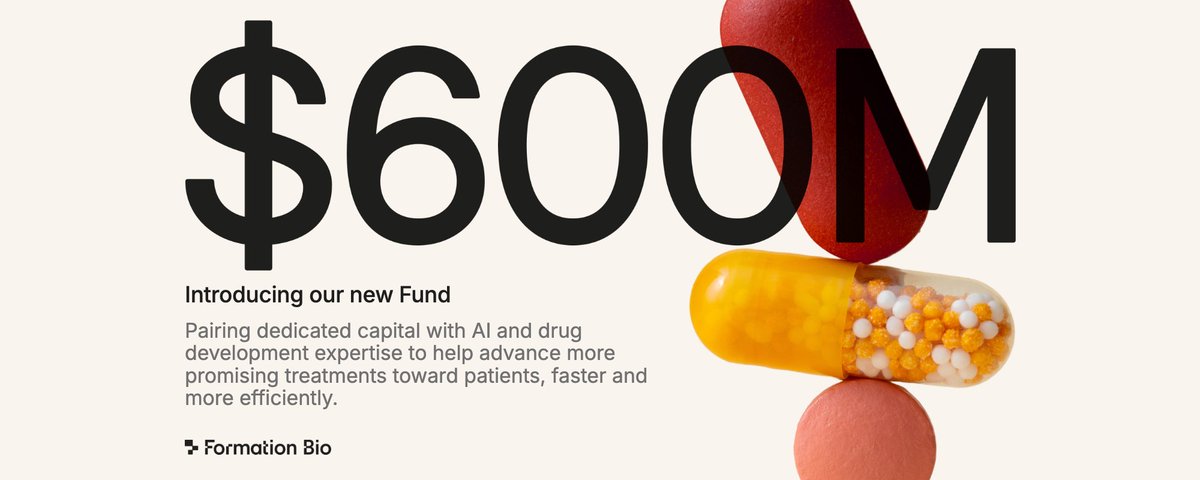
Today we’re announcing the $600M Formation Bio Drug Development Accelerator Fund.
@lintaho and I started @FormationBio because we believed the biggest bottleneck in bringing new medicines to patients wasn’t drug discovery, but drug development.
As AI dramatically accelerates discovery, that bottleneck is only becoming more acute. Without the capital and capacity to advance promising drugs through clinical trials, much of that progress won’t translate into medicines for patients.
Our new Fund brings together dedicated capital, drug development expertise, and AI-powered development capabilities to acquire promising drugs and advance them through the clinic.
nabajit (bio/acc) retweeted

Great little review. The lipid membrane is probably the most underrated and poorly studied part of the cell.
When people make "synthetic" cells, they usually do so using a single type of lipid. And yet, for reasons we don't yet understand, cells have dozens of different lipids in their membranes, some of which have remarkable properties.
"It was recently shown," Sáenz writes, "that in deep-sea ctenophores, plasmalogens, a type of curvature-promoting lipid, keep membranes functional under extreme pressure."
Oddly enough, when the J. Craig Venter Institute cut down a Mycoplasma cell's genome size to its near-minimum, and then studied the resulting organism, they "found around 90 different lipids, a number comparable to that of the naturally occurring mycoplasma from which its synthetic genome was derived. A minimal genome, it turns out, does not produce a minimal lipidome." Cells seem to *want* to have a high variance of lipids in their membranes, for reasons that are not clear.
Furthermore, when the researchers found ways to finally cut down the number of lipids in the Mycoplasma membrane, the cells still found clever ways to get around their constraints. "The cell...resists lipidome minimization," in other words. In one case, the researchers gave the cells "a conventional phospholipid" in their growth medium, and the cells quickly "scavenge[d] the acyl chains through the activity of lipases and rebuil[t]
a diverse lipidome from the pieces."
They finally cut down the number of lipids in these cells to just two, but this caused the cells to grow slowly and become artificially enlarged. So one argument for why cells try to maintain such a panoply of lipids in their membranes might be because it "allows them to control otherwise coupled properties independently of one another." From the review:
"Chain length, unsaturation, head-group chemistry and molecular shape
provide chemical degrees of freedom for tuning membrane properties. Because changing any one feature (for example, a double bond or a longer or shorter chain) generally shifts several properties at once, a minimal or fixed composition offers only coupled control. But not all lipidomic degrees of freedom are equivalent. Some properties can be produced through many lipidomic solutions, whereas others require a specific molecular structure."
Interesting throughout.


nabajit (bio/acc) retweeted

We. love. to. make. lab. data.
Awesome free DRUG-seq data set just dropped on 10,000s of clinically relevant drug molecules from @Ginkgo Datapoints service. Happy model training!
can download it here: thevirtualcell.com/


nabajit (bio/acc) retweeted

Introducing Pythia-1, a frontier generative model for protein design.
In our new study, we used it to rapidly design full-length human agonist and antagonist antibodies for hard-to-drug targets.
We’re sharing complete sequences of all lead antibodies to support independent validation and further research. 1/8

nabajit (bio/acc) retweeted

Introducing Mol-1: Open Frontier Biomolecular Intelligence 🚀🚀🚀
📊 75.0% on FoldBench-AB, near IsoDDE's reported 75.58%!!!
🧬 60k-token assemblies on one single H20, outperforming Anthropic 8/10.
🎯 VHHs binding hit rate as high as 63% with best SPR KD at 43 pM.
GitHub: github.com/molence/Mol-1
Try it: lab.molence.com
nabajit (bio/acc) retweeted

Many protein interactions involved in disease are difficult to target with small molecules. Peptides offer a way to engage some of these interfaces.
In our new piece in @CellBiomat @CellPressNews, we discuss how experiments and AI can help us understand these interactions and design peptides to target them. We cover high-throughput screening, structural modeling, and generative design, with examples including KRAS, MDM2, and PD-L1. We also discuss the chemical modifications needed to improve properties such as stability and cell permeability.
I’m particularly interested in how we can use what we learn in the lab to improve our models, then use those models to decide which peptides to make and test next. Over time, I think this could make peptide design more predictive and help us address targets that remain challenging today.
Grateful to Huazhang Ying, Yipin Lei, Yihai Luo, and Jianyang Zeng!
Link to the paper: sciencedirect.com/science/ar…
@ZJU_China @Westlake_Uni @Tsinghua_Uni @Penn @CBE_Penn @PennBioeng @PennEngineers @PennMedicine @PennChemistry @PennMicro @PennPsych @PennSAS

nabajit (bio/acc) retweeted
High ipTM. Low ipSAE. Should you order the peptide you designed?
ipTM reflects global confidence in chain placement, but it's normalized over total chain length, so a high score doesn't guarantee a well-resolved binding interface.
ipSAE focuses on inter-chain residue pairs with low predicted alignment error and scales confidence based on the interface, rather than the full chain length and is computed per direction (A→B, B→A) to expose asymmetric confidence.
Score ipSAE for your peptides using the (github.com/DunbrackLab/IPSAE ) or on LiteFold.
