

Not financial advice
Joined October 2026
- Tweets96
- Following11
- Followers7
- Likes106
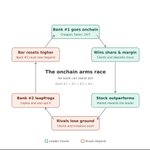

It’s not going to be instantaneous and the BME really doesn’t matter. The only thing that matters is overall USD burns. This means more customers paying more money to use Canton. If this number go up, value of network and token go up.
2
2
139

BlockMain retweeted

I see a lot of misunderstandings about what actually matters for the AI trade. Here is a clean playbook.
You can view AI as having 3 layers: frontier labs, financing layer (hyperscalers/neoclouds), supplier layer (semis/others).
Here are the underlying debates.
1. What is the end demand to pay for models? This is the willingness of enterprises to pay for the usage of AI. We already know that consumers don't want to pay which is why OAI has struggled with margins and FCF. End demand impacts every layer of the stack.
1a. Are frontier models truly necessary? Or do we hit a point where most use cases can be satisfied with a lesser model. Consider whether eventually only the most open-ended (scientific research) or gladiatorial (markets/strategy) use cases need frontier models and most corporate customers will be more focused on cost. Even for my own work, I have started to notice that I am jocking the absolute frontier less, and it doesn't make a huge difference that I am using the newest model on the maximum setting.
1b. Does the top frontier lab (Anthropic) have an edge with non-frontier models, in other words, can they use their cutting edge model to make lesser models more cost effective than competitors? There is small but not yet decisive evidence that this is true.
1c. How much competition will the frontier labs see from other models including open source and Chinese models? Chinese models seem to be falling behind, and we have gone back and forth on US open source given Jensen's death and resurrection. Ultimately this is the same debate as 1b given that addresses the crux.
More than anything else, re-acceleration in frontier lab ARR will satisfy these debates.
2. What is the forward shape of the compute buildout? This mainly impacts the financing and supplier layer.
2a. Given that the AI buildout is dependent on external financing, how much willingness is there to finance this? Credit availability is clearly exhibiting downward reflexivity as negative sentiment on AI overall flows into financing, which then flows into more negative sentiment. There is risk of saturation in credit mandates given hard limits in how much concentration they can have in specific issuers/sectors (they are much stricter than equity mandates in this regard). And of course we are seeing Fed rate hikes - there is the core problem of there not being enough money in the world (see my pinned post) to finance everything while maintaining high asset prices. Equity financing can replace credit to some extent but that also directly pressures equity prices.
2b. Is there any backstop on financing? The Fed is the most unlikely, they clearly want to take air out of the AI boom given its flow-through into inflation, and its general tone is hawkish as I have explored in recent posts. The Trump admin resurrected Jensen, so it is possible they would intervene. Their options are more limited with AI-opposed Dems holding both chambers of Congress, but they still have levers like the DoE and EXIM facilities which are controlled through the Executive Branch. Still, I would assume that things would have to get worse first.
More than anything else, improvement in financing conditions and velocity will satisfy these debates.
2c. How much are we seeing in efficiency gains? Can the same amount of compute be harnessed to deliver more tokens given optimizations. This benefits the frontier lab layer at the expense of the supplier layer. This is difficult to quantify although we know that frontier labs are extremely incentivized to drive this and there are signs that AI models themselves are getting better at driving their own optimizations (this also flows into debate 1b).
--
Some of these debates are difficult to answer and I could argue both sides convincingly. This is why I have been in cash and not trying to take a side. I prefer to only bet when there is an overwhelming and obvious direction, like a blackjack card counter.
Understanding the structure of these debates also helps determine where in the stack you would want to take a position. Semis are in a tough spot no matter how you cut it. On a bounce they will have a lot of juice but they have fewer outs here. OAI has fewer outs vs. ANT (either ANT pulls away, or they all price cut each other to death). Hyperscalers are better positioned but most of them have trouble in their core businesses. ANT is interesting to me but faces huge unlocks. Again, I end up at the conclusion to do nothing for now, and let an outrageous opportunity present itself.
It's been a tough market, hope this is helpful.
BlockMain retweeted

Universal Burn (CIP-0129) is coming to Canton (estimated Q1 2027), which will eventually move private enterprise networks off license fees and into $CC burns.
The follow-on CIP-0132 (the Paymaster Model) is still just a proposal right now. It lays out Phase 1: private networks self-report their data traffic, and a "Paymaster" burns $CC post-hoc to pay the bill.
Before you buy the "supply shock" hype, read the fine print:
Bullet Paymasters burn $CC and immediately earn validator/app rewards right back.
Bullet Fees are priced in USD per MB, if $CC goes up, they just burn fewer tokens.
Bullet Phase 1 runs on the honor system with off-ledger discounts (e.g., 50% off) and 7–14 day burn smoothing to prevent buy spikes.
Great enterprise infrastructure for institutions. Terrible setup for retail hoping for a moonshot. I’ll be researching this further as it develops and comes for full vote/approval.


@LongViewCrypto the daily burn in USD has been steadily declining since mid-summer. What is going on in your mind?
1
1
14

BlockMain retweeted

The @CantonNetwork ecosystem is one you probably don't understand but really should.
If you're serious about the institutional adoption of blockchain, then here's what you need to know ⬇️
bsc.news/post/banks-firms-be…

BlockMain retweeted

i liked one network, now I like two
after half a decade building on @hedera, here's how I got canton pilled, and the 5 tests I now judge every network by...
what got you into @CantonNetwork?

Why do banks choose Canton. Custom built for them.
A front-runner needs to see your order and pay to jump ahead of it.
Canton has no mempool and no paid ordering, so neither condition exists.
@YuvalRooz on why the tip a bot pays understates what traders lose, and why it matters as tokenized stocks move onchain.
11
@DigitalFinanceD not attacking you also, this is just a frustrating narrative I’ve seen and I work in the VC space. The VCs invested in DA, DA’s equity value increases with Canton Coin. Therefore the VCs value increases with Canton Coin. Many own the coin directly as well.
1
13