

Advancing decentralization through research and policy. Subscribe to the newsletter: https://nitter.cf/t.co/lmH9yV5Dmm
Joined March 2022
- Tweets1.8K
- Following23
- Followers4.5K
- Likes686





Pinned Tweet
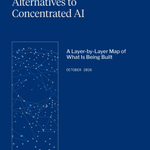
1/ Today, the Decentralization Research Center published "Alternatives to Concentrated AI: A Layer-by-Layer Map of What Is Being Built," authored by our head of research, @samuelvancelaw, and our executive director, @KyleBligen.
Over the past year, we talked to people building AI at frontier labs, universities, startups, and open-source nonprofits on five continents.

DRC’s comment letters on proposed Regulation Crypto Assets ask the SEC for a bright-line, control-based safe harbor for when essential managerial efforts have ceased. @SH_Brennan, DRC senior legal advisor, explains what it means for decentralized networks.

1/ Incentives and institutions dictate how concentrated or distributed a technology can be, our report found.
For private data, @iamtrask and Lacey Strahm of @openminedorg argue in their case study, control comes down to two design choices. The model travels to the data, and the holder’s rules are enforced where the data lives.

2/ Read @openminedorg’s full case study in “Alternatives to Concentrated AI”: thedrcenter.org/research/alt…

1/ The Decentralization Research Center has submitted two comment letters to the @SECGov addressing its March 2026 interpretive guidance on crypto assets and proposed Regulation Crypto Assets.
Our first letter examines the interpretation and its implications for the proposed rules. Our second recommends specific regulatory changes.


4/ We welcome the SEC's efforts to modernize digital asset regulation and look forward to continued engagement with the Commission.
Our recommendations are designed to make the framework administrable, actionable, and durable.
5/ Read our letters:
March Interpretation: sec.gov/comments/S7-2026-27/…
Regulation Crypto Assets: sec.gov/comments/S7-2026-27/…
Six AI companies signed a White House accord that promises outside audits. Each still picks its own auditor and decides what that auditor gets to see.
Our head of research @samuelvancelaw writes for @CoinDesk on what would make those audits count:
coindesk.com/opinion/2026/10…

The future of decentralized, permissionless technology cannot depend on any one bill or rulemaking.
In a guest thread for @ethereum, our Executive Director @KyleBligen explains why DRC engages policymakers early to advocate for decentralization across AI, privacy, and policies that support permissionless technologies like Ethereum.

"If you want change, you have to advocate for it.”
In this guest thread, @KyleBligen, Executive Director of @TheDRC_, explains how the Decentralization Research Center is working with policymakers to support a safe and competitive decentralized future.

Open-source AI is not simply a smaller version of frontier AI. Differences in control, transparency, and development matter, and policy should reflect them.
On Oct. 19, DRC Executive Director @KyleBligen will join the Open Source Policy Strategy Session hosted by @github, Proteus Strategies, and @uclaw_sf in San Francisco.
Kyle will bring findings from DRC’s Alternatives to Concentrated AI research to the discussion as participants consider U.S. policy priorities for open source development in 2027, including governance, developer liability, cybersecurity, and model infrastructure.

1/ Compute and power are two of the critical inputs where AI development remains highly concentrated.
As policymakers develop rules for advanced AI, they should expand access to these inputs and ensure policy enables competition rather than unintentionally entrenching today’s concentration.
DRC will be at the table early—working with Congress, federal regulators, and builders while these policy frameworks are still taking shape.

“Abundant energy and infrastructure growth must be reliable, responsible, and durable,” said @Rashan in CCI’s breakout session at DC Fintech Week.
Thank you to CCI members Will Paul (@blocks), Natalia Li (@galaxyhq), and @KyleBligen (@TheDRC_), and to CCI’s @Rashan, for leading the discussion on the defining issues for digital assets and AI and outlining what’s next.

2/ Thank you to @crypto_council for ensuring decentralization is part of the conversation as the Digital Energy Council begins its next chapter, and to @fintechthinksdc for bringing policymakers and builders together to tackle the infrastructure questions shaping the digital economy.
AI and digital assets are driving up demand for compute and electricity, and the policy questions about energy development and grid capacity are arriving with it.
On Wednesday at DC Fintech Week (@fintechthinksdc), our Executive Director, @KyleBligen, joins the @crypto_council Digital Energy Council's panel on powering the digital economy. He will bring DRC's research on where AI development concentrates and how decentralized alternatives resolve concerns within the stack.
Also on the panel: @Rashan of the Crypto Council for Innovation, Natalia Li of @galaxyhq, Will Paul of @blocks, CleanSpark's @mdplaisted and Paradigm's @domsimonee.

This Thursday in Washington, our Executive Director, @KyleBligen, takes the stage at the DC Privacy Summit 2026.
With the CLARITY Act’s path through the Senate still unsettled, Kyle will look at where the industry stands in this political moment, and where it goes from here.

SPEAKER ANNOUNCEMENT: We're incredibly lucky to have @KyleBligen from @TheDRC_ speaking about the onchain future on our DCPS stage next week.
🎟️ Grab a ticket and join us on October 15: luma.com/p60o9q3i

1/ The policy decisions being made today on privacy, AI, digital ID and civil liberties will shape our digital lives for decades.
At DRC, we believe privacy and control over your own identity and data should be designed into the systems being built now, from the start.
That’s the conversation we’ll be joining at the DC Privacy Summit 2026.
The DC Privacy Summit returns next week!
--> What does privacy look like when AI agents can act as you?
--> Can we avoid digital ID becoming a surveillance tool?
--> What are the real limits of techno-solutionism?
--> And what happens when crypto, AI, and politics collide?
We’ll be digging into all of it on October 15 at the National Union Building.
🎟️ Secure your spot: luma.com/p60o9q3i

3/ The roundtable looks at how incident response works in practice, and how public and private actors can coordinate better when funds are stolen.
Our executive director, @KyleBligen, will give closing remarks at the afternoon session.
4/ Secure your spot with $100 off through this link: luma.com/p60o9q3i?coupon=DCP…