

I work on control systems in a pharmaceutical plant. Trial results, deals and earnings, read for what the headline hides. Sources named. Not financial advice.
Singapore
Joined January 2017
- Tweets1K
- Following85
- Followers113
- Likes152




Pinned Tweet
I am an automation, digital, and control systems engineer in pharmaceutical manufacturing. By day, I work with process control system like DeltaV, programmable logic controller like Siemens, data historians like Aveva PI, enterprise resource planning systems like SAP, and product lifecycle management systems like Neo. By night, I am an avid investor.
I post three times a day on pharmaceutical and healthcare news: trial results, approvals, deals and earnings. I read each one from the view of the shop floor, which means I look for what the headline hides, the number worth checking, and the manufacturing problem sitting behind a financial one.
Three habits I keep:
1. I show my arithmetic and label it as mine.
2. I separate what a company said from what is independently confirmed.
3. I tell you when I hold a stock.
If you want more of this, I invite you to follow along! If you think I got something wrong, reply and tell me. I update my view when the evidence changes.
What should I cover next: a company, a drug, or a plant problem you have seen?

3
6
202
Over $28,000 a year in the US. About $40 a year in poorer countries. Same twice-yearly HIV shot.
My pick: a cheap Indian generic of lenacapavir does not threaten Gilead's ($GILD) US sales of Yeztugo.
WHAT HAPPENED
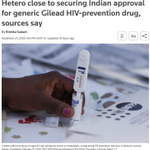
Indian drugmaker Hetero is close to approval in India for a generic of Gilead's HIV prevention shot lenacapavir, according to two people who spoke to Reuters.
On Wednesday, an expert panel of India's drug regulator recommended it, and one source expects a launch in February.
Hetero has also started shipping the injectable to Africa, with 300,000 vials planned for Zambia, Uganda and Zimbabwe.
WHY THE PRICE GAP EXISTS
Gilead itself licensed six generic makers, including Hetero and Dr. Reddy's, to supply 120 low- and middle-income countries.
In 2025, Hetero and Dr. Reddy's said they would sell it for about $40 a year from 2027, backed by the Gates Foundation and Unitaid.
In the US, by contrast, Yeztugo carries a list price above $28,000 a year. By my arithmetic, that is about 700 times the generic price.
WHY GILEAD INVESTORS CARE
Yeztugo sold $305 million in the third quarter, up 31% from the quarter before, and Gilead says it is on track for $1 billion this year.
By my arithmetic, the third quarter alone gives an annual pace of about $1.2 billion.
Meanwhile, India has about 2.56 million people living with HIV. One local advocate says "fewer than one in 100" at-risk people currently have access to prevention drugs.
My read, a hypothesis: the generics sell into markets Gilead chose to license away, so they add patients without taking Gilead's paying ones.
THE CASE AGAINST MY PICK
First, a gap of roughly 700 times is an easy headline in the US drug pricing debate, and pricing pressure can hit Gilead without any generic entering the US.
Second, the license leaves out some middle-income countries. Brazil took part in the trials but cannot buy the generics under the current deal, so pressure to widen access may grow.
Third, Yeztugo is now a key growth driver. Even a small change in its US price would show up quickly in the HIV numbers.
I change my pick if a US pricing deal or rule starts to reference the generic price, or if Gilead cuts the US list price of Yeztugo.
My pick stands: the $40 shot widens access abroad while Gilead keeps its US price.
Pharma stock investors: does a $40 generic abroad threaten Gilead's US price, yes or no?
This is my view only. Not financial advice.

1
26
Headline: 20% new US tariffs on China. Real step up: about 7.5 points. Medicines: mostly exempt.
My pick: this tariff round is noise for branded pharma stocks. The real test comes in January.
WHAT WAS PROPOSED
On November 25, the US Trade Representative proposed new tariffs on 14 economies after an eight-month probe into excess factory capacity.
For China, the new rate is 20%, stacked on the 25% from the first Trump term. By my arithmetic, that makes 45% on covered goods.
However, the 20% does not add to an existing forced-labor duty, so Reuters puts the actual step up at roughly 7.5 points.
Meanwhile, a senior US official said the 20% could double to 40% if talks fall apart.
WHY PHARMA IS MOSTLY OUTSIDE IT
According to Bloomberg, products already under sectoral duties, including pharmaceuticals, are exempt.
Patented drugs already face the separate Section 232 pharma tariff of up to 100%, and most of the 17 large firms named in it have deals that exempt them.
Generics, biosimilars and their ingredients, on the other hand, sit at a 0% pharma tariff. It is not yet clear how the new lists treat them.
BOTH SIDES OF THE ARGUMENT
Washington says China is on track for a trade surplus above $1 trillion for a second year, and it wants partners to do more to curb it.
Beijing rejects the charge of unfair practices and called the move "political maneuvering", yet it has not threatened retaliation.
The EU also rejects the claim that it is a source of overcapacity.
THE DATES THAT MATTER
First, Trump and Xi are due to meet in Miami next month.
Then, January 5: public comments are due.
After that, January 10: the US-China truce expires unless both sides extend it.
Finally, January 25: public hearings begin. No effective date has been set.
My read, a hypothesis: the 20% was sized to stay inside the truce, so the signal for pharma investors is the truce, not this list.
THE CASE AGAINST MY PICK
First, if the truce breaks, the China rate could double to 40%, and a wider fight could spread beyond factory goods.
Second, China used rare earth export controls in 2025 to disrupt industries from autos to defense. A drug supply chain could be next in a bad scenario.
Third, the exemption lists are not final. If they cover generics or drug ingredients from China, costs rise for the makers of the cheapest medicines.
Finally, Macquarie strategist Viktor Shvets expects tariffs and other trade barriers to multiply, not fade.
I change my pick if the final lists cover patented drugs or drug ingredients from China, or if January 10 passes without an extension.
My pick stands: for now, this round leaves branded pharma alone. January decides the rest.
Investors: does the January 10 truce deadline worry you, yes or no?
Disclaimer: This is my view, not financial advice.

1
37
Poland's Diagnostyka saw its average diagnostic prices rise 8.3% last quarter, more than three times its 2.5% growth in test volume.
My pick: look past the 31% profit drop, which comes from a tax base effect, and watch pricing, because that is where the growth and the risk both sit.
On Thursday, Polish diagnostics group Diagnostyka reported third-quarter net profit of 53.6 million zlotys, down 31%, per Reuters. The fall reflects a high base from a year-earlier tax benefit. Revenue was 682.8 million zlotys. The company runs 157 labs and about 1,300 collection points.
GROWTH IS MOSTLY PRICE
Test volume rose 2.5% to 44.1 million. Average diagnostic prices rose 8.3%. By my arithmetic, prices grew about 3.3 times faster than volume.
The mix is shifting too. Consumer test volume grew 3.3%, faster than the 2.4% from business and institutional clients. The company said longer waits for tests funded by NFZ, Poland's state health insurer, pushed some patients to pay privately.
WHERE THE SQUEEZE IS
Imaging tells the other side. Average imaging prices fell 6.3%. Diagnostyka blamed a shift to cheaper remote reading of scans and basic scans, lower NFZ reimbursement rates, and a 50% cut to NFZ payments for work above agreed limits in 2026.
So the state is paying less, while private patients pay more. My read, a hypothesis: Diagnostyka's growth now leans on patients' willingness to pay out of pocket, which holds only while public waits stay long.
Diagnostyka is also branching out. In August it bought 63.7% of AidPort, a clinical trials company.
THE CASE AGAINST MY PICK
Long waits for state-funded tests are not a short-term blip, and they push demand to private labs like Diagnostyka. If that shift continues, price rises may prove durable rather than fragile, and the faster growth in consumer tests already points that way.
I change my pick if volume growth overtakes price growth, which would make this a demand story instead.
My pick stands: the profit drop is a base effect, and pricing is the story to watch.
Pharma stock investors: is price-led growth in diagnostics built to last? Yes or no.
Disclosure: I hold none of the stocks named here. This is my view, not advice.

1
60
IBA sold 25 pharma and industrial machines in nine months, up from 18, while the newest radiopharma drugs it supplies are still years from proving they work.
My pick: IBA is a picks-and-shovels play on radiopharma, but its own isotope bet depends on trials that report around 2029.
On Thursday, Belgian radiation firm Ion Beam Applications said a boom in radiopharmaceuticals is speeding up demand for its machines, per Reuters. Radiopharmaceuticals use radioactive compounds to find or treat diseases such as cancer.
THE SHOVELS
IBA makes the particle accelerators that produce isotopes. In the first nine months of 2026, it sold 25 machines across its pharma and industrial divisions, up from 18. That is about 39% more, by my arithmetic. One order alone was for 12 machines that make isotopes for medical scans. Group equipment orders rose 24% to €242 million, and the order book stands at €1.6 billion.
THE BET
IBA also makes its own isotopes, including actinium-225 and astatine-211, and sells them to drugmakers. Its finance chief called this a light-capital model, because it uses the machines IBA already sells.
Here is the catch. Actinium-225 drugs are still being tested to show they work in large patient groups. PanTera, IBA's venture with Belgian research center SCK CEN, is building an actinium plant due by the end of 2028 or early 2029, timed for the first late-stage trial results. Until then, isotope demand comes mostly from research and trials.
Supply is fragile too. This week Norway's Thor Medical paused the ramp-up of its actinium-225 plant after finding an error in its permit application, an industry newsletter reported.
My read, a hypothesis: machine sales are the near-term business, and isotope sales are an option that pays only if the trials succeed.
THE CASE AGAINST MY PICK
Not all of this is the new-isotope boom. The single largest order, 12 machines, was for diagnostic scan isotopes, a more established market. IBA also has 45 proton therapy projects awaiting delivery, a separate business. So radiopharma may matter less to IBA's results than the headline suggests.
I change my pick if IBA reports material isotope revenue before the late-stage trials read out.
My pick stands: the machines pay now, and the isotope bet waits on trials.
Pharma stock investors: would you rather own radiopharma drugmakers or the machine sellers? Reply drugs or machines.
Disclosure: I hold none of the stocks named here. This is my view, not advice.

1
1
36
GSK's ($GSK) new twice-yearly shot matched its own monthly shot Nucala in a rare blood vessel disease, cutting 12 injections a year to 2. GSK is competing with itself on purpose.
My pick: this is a smart defensive win, but the disease is too small to move GSK's £3 billion goal for the drug.
On Wednesday, GSK said Exdensur, or depemokimab, worked as well as Nucala at bringing patients with EGPA into remission, per Reuters. Safety was similar. GSK plans to file for approval in the first half of 2027.
WHAT EGPA IS
EGPA, or eosinophilic granulomatosis with polyangiitis, inflames small and medium blood vessels and can damage organs. It affects an estimated 34 people per million worldwide. That is roughly 280,000 people, by my arithmetic, and more than 90% also have asthma.
WHY GSK WANTS THIS
Both drugs block the same immune protein, IL-5. Nucala is a monthly blockbuster: it sold £1.44 billion in the first nine months of 2025, up 13%. Exdensur is GSK's successor, approved for severe asthma in the US in December. GSK expects up to £3 billion in yearly peak sales from Exdensur across several diseases, but its respiratory research head said asthma drives most of that figure.
So the logic is simple. Each patient who moves from Nucala to Exdensur stays with GSK. Adding EGPA to Exdensur's label means one fewer reason to stay on Nucala.
My read, a hypothesis: the EGPA result protects GSK's franchise more than it grows it.
THE CASE AGAINST MY PICK
Small labels can add up. More than 90% of EGPA patients also have asthma, so an EGPA label may pull in patients who count toward the bigger asthma market too. Early demand also looks real: about 70% of early Exdensur users came from other biologics, GSK said earlier this year.
I change my pick if GSK shows Exdensur sales outgrowing Nucala within two years.
My pick stands: a smart defensive win, but too small to move the £3 billion goal.
Pharma stock investors: should drugmakers replace their own best sellers before rivals do? Yes or no.
Disclosure: I hold none of the stocks named here. This is my view, not advice.

1
1
35
Bristol Myers ran two near-identical lupus trials of about 510 patients each. One worked and one failed, and the company has not shared a single response rate.
My pick: a split result makes a lupus filing harder, and Sotyktu stays a modest drug for now.
On Wednesday, Bristol Myers said its psoriasis pill Sotyktu met the main goal in one late-stage lupus trial but missed it in a second, per Reuters. Lupus is a chronic autoimmune disease that can cause fatigue, pain and organ damage.
WHAT HAPPENED
The designs matched. POETYK SLE-1 enrolled 510 adults and SLE-2 enrolled 513, together 1,023 patients, by my arithmetic. Both added Sotyktu or placebo to standard care for 52 weeks and measured the same lupus response score.
The results did not match. In SLE-1, more patients on Sotyktu responded than on placebo, and the drug also helped on a second response score, steroid reduction and fatigue. In SLE-2, the drug missed its main goal. Bristol Myers blamed a stronger placebo response than in the first trial. Safety looked consistent with Sotyktu's use in psoriasis.
WHAT IS MISSING
Bristol Myers gave no response rates for either trial. Without them, nobody outside the company can judge whether the win in SLE-1 was large or barely significant. The company said it will review all its lupus data and talk to regulators, with full results at a future medical meeting.
WHY IT MATTERS FOR THE STOCK
Sotyktu needs a bigger market. It sold $291 million in 2025, up 19%. Meanwhile, Bristol Myers faces the loss of exclusivity for its blood thinner Eliquis in Europe, and lupus was one of Sotyktu's planned expansions.
THE CASE AGAINST MY PICK
A split result is not always fatal. AstraZeneca's lupus drug Saphnelo also failed one of two phase 3 trials and still won US approval. If Bristol Myers can show its SLE-2 miss came from placebo noise, not a weak drug, regulators may accept it.
I change my pick if Bristol Myers files for lupus approval within a year, or shows a pooled analysis with a clear benefit.
My pick stands: a split result makes filing harder, and Sotyktu stays modest for now.
Pharma stock investors: should one win and one miss be enough for FDA approval? Yes or no.
Disclosure: I hold none of the stocks named here. This is my view, not advice.

1
1
38
Days after a judge approved its $7.25 billion Roundup settlement, Bayer is paying $150 million upfront for a Chinese cancer drug still in its first human trial.
My pick: this is a cheap, sensible pipeline bet, but a first-stage drug will not fill Bayer's gap for years.
China's Hansoh Pharmaceutical said it gave a Bayer unit an exclusive license to HS-20122, an experimental cancer drug, per Reuters. The deal is worth up to $3.25 billion. Bayer gets rights everywhere outside mainland China, Hong Kong, Macau and Taiwan.
WHAT BAYER IS BUYING
HS-20122 is an antibody-drug conjugate, a drug that carries chemotherapy straight to cancer cells. It targets two tumor proteins at once, EGFR and c-Met, and is being studied in advanced solid tumors including lung cancer. Its first human trial began in April 2025, and it is still in phase 1. I found no published efficacy data.
THE PRICE
The upfront payment is $150 million. That is about 4.6% of the headline value, by my arithmetic. The other $3.1 billion depends on development, approval and sales milestones, plus royalties on any sales. So Bayer pays little now and a lot only if the drug works.
WHY NOW
Bloomberg tied the deal to Bayer's push to rebuild its drug pipeline as its legal problems begin to lift. It also fits a pattern: last week, Merck's cancer drug sac-TMT, licensed from China's Kelun-Biotech, posted a phase 3 survival win.
My read, a hypothesis: Bayer can now spend on growth instead of lawsuits, and it is starting with small, cheap bets rather than one large purchase.
THE CASE AGAINST MY PICK
Targeting EGFR and c-Met together is not new. Johnson and Johnson already sells an antibody aimed at the same pair, so this drug must prove a clear edge to matter. And phase 1 drugs fail often. A cheap upfront can still buy a drug that never reaches patients.
I change my pick if HS-20122 shows strong early data in lung cancer within a year, or if Bayer follows with a larger late-stage deal.
My pick stands: a cheap, sensible bet, but not a fix for years.
Pharma stock investors: should big drugmakers keep buying early cancer drugs from China? Yes or no.
Disclosure: I hold none of the stocks named here. This is my view, not advice.

1
1
58
Cogent's ($COGT) new drug nearly doubled the time before a rare stomach tumor grew, 16.5 months versus 9.2, yet its bigger test comes on December 30.
My pick: the tumor approval is the warm-up, and the December 30 decision in a blood disorder, against a Sanofi drug, will set Cogent's value.
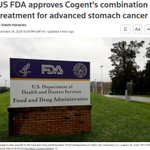
On Tuesday, the FDA approved bezuclastinib, sold as Ekitna, with the older drug sunitinib for advanced gastrointestinal stromal tumors, the FDA said. These rare tumors most often start in the stomach. The approval covers patients already treated with imatinib, the usual first drug.
THE RESULTS
The trial was large for a rare cancer. In PEAK, 413 patients got either the combination or sunitinib alone. Median time before the tumor grew was 16.5 months on the combination versus 9.2 months on sunitinib alone, the FDA said. That is 7.3 months longer, by my arithmetic, and the risk of progression or death fell by half. Tumors also shrank in 46% of patients, versus 26%.
THE CATCHES
There are three. First, the label carries a boxed warning for liver damage, the FDA's strongest kind. Second, survival data are not mature, so nobody yet knows if patients live longer. Third, patients on sunitinib alone could switch to the combination after their tumor grew, which can blur any future survival result.
THE BIGGER PRIZE
Cogent faces a second FDA decision on December 30, for non-advanced systemic mastocytosis, a disorder of immune cells. There, it would compete with Ayvakit, the drug at the heart of Sanofi's $9.5 billion purchase of Blueprint Medicines. Citi has said investors see bezuclastinib as an upgrade over Ayvakit in that disease. My read, a hypothesis: that market matters more to Cogent than this tumor approval.
THE CASE AGAINST MY PICK
A Dana-Farber doctor called the combination a new standard of care after imatinib. If doctors switch fast, the tumor approval could become a solid business on its own, and the December decision would be upside rather than the whole story.
I change my pick if early tumor sales move the stock more than the December 30 decision does.
My pick stands: the tumor approval is the warm-up.
Pharma stock investors: does a boxed liver warning change how you value a new cancer drug? Yes or no.
Disclosure: I hold none of the stocks named here. This is my view, not advice.

1
1
230
US Q3 GDP was revised up to 4.3% from 3.4%, against 3.5% expected.
The bull case. Consumer spending was revised to 4.2% and investment added about 3.7 points. Strong demand supports earnings, and the 1.8% GDP deflator, below the 2.3% expected, says growth is not arriving with hotter prices (my inference).
The bear case. A December hike is already about 97% priced. Strong growth gives the Fed no reason to pause, and higher rates press hardest on long duration growth stocks.
My read is that earnings support is real, but rates set the multiple near term. Strong data can be good for the economy and a headwind for valuations at the same time.
Which matters more for stocks now, growth or the Fed?


93
Hims ($HIMS) has started selling a testosterone pill in the UK that is not approved for general sale in the UK, Europe or the US.
My pick: testosterone widens Hims's menu, but it adds regulatory risk faster than it adds profit.
On Tuesday, the telehealth company said it now offers testosterone treatments in the UK, per Reuters. The options are enclomiphene, an unlicensed pill that boosts the body's own testosterone, and Testogel, a skin gel sold by Besins Healthcare. Hims did not immediately say how it would offer a drug not approved for general use.
WHAT THE PILL DOES AND DOES NOT DO
The evidence is thin. In small trials, enclomiphene raised testosterone about as much as gels, without the drop in sperm production seen with standard testosterone therapy. However, it showed no clear benefit for symptoms such as low sex drive, fatigue or brain fog. Health experts have also warned about unnecessary testosterone treatment, citing risks such as infertility, blood clots and heart problems.
WHY HIMS WANTS IT
Testosterone is Hims's second-fastest-growing US business, the company said. International sales matter more each quarter: they reached $233.3 million in the third quarter, about 26% of revenue, up from about 9% a year earlier, by my arithmetic.
Growth has come at a cost, though. Third-quarter revenue rose 49% to $890.4 million, yet gross margin fell to 57% from 74%, and Hims swung to a $33 million net loss. Hims expects margin pressure to continue as it adds product lines. Its 2030 goal of $6.5 billion in revenue would need about 20% growth a year from this year's forecast, by my arithmetic.
My read, a hypothesis: each new unapproved or lightly proven product adds growth and adds one more thing a regulator can question.
THE CASE AGAINST MY PICK
Testogel is an established gel from an outside drugmaker, and Hims says eligibility depends on symptoms, test results and frequent reassessment by UK-registered doctors. If the UK model works like the US one, testosterone could lift spending per customer, which rose 30% last quarter.
I change my pick if UK regulators accept the enclomiphene offering without objection, and margins stop falling.
My pick stands: more growth, and more regulatory risk.
Pharma stock investors: would you own a telehealth stock that sells unapproved drugs? Yes or no.
Disclosure: I hold none of the stocks named here. This is my view, not advice.

1
88
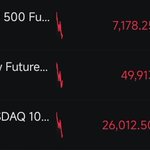
Futures open negative again today on the same reasons I highlighted in my previous post.
This is a continuation of an AI-led, valuation-driven de-risking, not a fresh macro shock after Jensen Huang is back. Nasdaq futures falling twice as fast as S&P futures confirms that technology and semiconductor exposure remains.
We have not seen a positive catalyst yet for the overall market. Jensen Huang returning as NVIDIA CEO only solves one of many problems. Furthermore, the persistent NVIDIA-specific overhang and hawkish Fed expectations leaves the path of least resistance lower.
Prediction: futures and indices will fall back to the low on Friday, 20 November 2026, where that support level will be tested again. I do not think price will break below this level as selling pressure is weakening. We see the S&P 500 closing higher than opening and Nasdaq Composite closing around the open at the upper half of the candle. Extra Large and Large orders are around the two indices are also gapping towards positive inflow.
The tests in my previous posts remain:
1. Pullback into a higher low
2. Indices finishing near the high of the day
3. Follow-through days
Have you bought, or are you remaining patient for a pullback?


The internet is screaming that the bottom is in after Jensen Huang returned as Nvidia CEO, but I would not rush in to buy.
Jensen returning fixes one problem but not the rest. The overall concern over AI profitability and chip-export rules have not changed, while Nvidia's board said it will complete its investigation into the national security concerns.
I would be patient and wait for a few signals before confirming that the bottom really is in:
1. Pullback into a higher low
2. Indices finishing near the high of the day
3. Follow-through days
Are you buying the dip or remaining patient and observing first?

33