THE WORLD CORRESPONDENT (@TheWorldCorresp) header
THE WORLD CORRESPONDENT (@TheWorldCorresp) profile picture

A WINDOW ON GLOBAL EVENTS, GEOPOLITICAL AND GEOECONOMIC INSIGHTS, AND DAILY GLOBAL NEWS NOT FOUND ELSEWHERE; FOLLOW THE PAGE.

The World.
Joined February 2022
Photo by THE WORLD CORRESPONDENT (@TheWorldCorresp)Photo by THE WORLD CORRESPONDENT (@TheWorldCorresp)Photo by THE WORLD CORRESPONDENT (@TheWorldCorresp)Photo by THE WORLD CORRESPONDENT (@TheWorldCorresp)Photo by THE WORLD CORRESPONDENT (@TheWorldCorresp)Photo by THE WORLD CORRESPONDENT (@TheWorldCorresp)Photo by THE WORLD CORRESPONDENT (@TheWorldCorresp)Photo by THE WORLD CORRESPONDENT (@TheWorldCorresp)Photo by THE WORLD CORRESPONDENT (@TheWorldCorresp)Photo by THE WORLD CORRESPONDENT (@TheWorldCorresp)
OUR TASK IS TO INFORM, NOT TO PUBLISH WHAT CONFIRMS SOMEONE'S IDEOLOGIES OR SOCIAL AND POLITICAL THESES, LETTLESS WHAT MAKES OTHERS PLEASURE. THE WORLD CORRESPONDENT. ECONOMY - GEOPOLITICS - CONFLICTS - CLIMATE. UNDERSTAND TODAY. ANTICIPATE TOMORROW. OUR APPROACH: BEYOND SIMPLE HEADLINES: DATA-DRIVEN ANALYSIS, CONTEXT, AND INTERNATIONAL PERSPECTIVES TO EXPLAIN WHY THE NEWS IS HAPPENING. CONNECTING THE DOTS OF A CHANGING WORLD. The world is changing faster than ever. Conflicts, climate crises, and shifting economic balances require more than just headlines. They require context, depth, and on-the-ground perspective. Welcome to The World Correspondent, your independent hub for international politics, global economy, and climate analysis. WHAT WE COVER & WHY IT MATTERS: - GLOBAL ECONOMY & FINANCE: Unpacking macro trends, supply chain crises, energy markets, and how local policies impact global wallets. - FOREIGN POLICY & GEOPOLITICS: Moving beyond western-centric views to analyze global power shifts, alliance dynamics, and diplomatic strategies. - GLOBAL CONFLICTS & SECURITY: Rigorous, factual updates from conflict zones, focusing on humanitarian impacts and strategic outcomes. - CLIMATE & ENVIRONMENT: Documenting the climate crisis not as an isolated issue, but as the ultimate multiplier of global instability and migration. OUR APPROACH WE DON'T JUST REPORT THE WHAT. WE EXPLAIN THE WHY. THROUGH A NETWORK OF INTERNATIONAL CONTRIBUTORS AND DATA-DRIVEN ANALYSIS, WE BRING YOU INSIGHTS THAT CUT THROUGH THE NOISE. Join Our Global Community; Follow world correspondent, Give us a follow. TURN ON NOTIFICATIONS TO NEVER MISS A BREAKING ANALYSIS. UNDERSTAND THE WORLD TODAY. ANTICIPATE TOMORROW.
1
1
493
UNITED ARAB EMIRATES AND SOMALIA: THE INVESTIGATION INTO THE BERBERA AND BOSASO AIRPORTS AND THE DIPLOMATIC RUPTURE The crisis between Mogadishu and Abu Dhabi reached a boiling point in the second half of November 2026, intertwining the diplomatic expulsion ordered by the Somali federal government with the visual investigation published by the New York Times on November 20th into the airport infrastructure of Berbera (in Somaliland) and Bosaso (in Puntland). At the heart of the conflict is not just a single military dossier, but a now-consolidated rift between the central Somali power and the regional administrations that control strategic portions of the coast overlooking the Gulf of Aden. 1. WHAT THE INVESTIGATION ON BERBERA AND BOSASO SHOWS According to the investigation based on satellite imagery and flight data published by the New York Times on November 20, 2026: • Berbera (Somaliland): The airport—linked to an agreement initiated in 2017—has seen the construction of facilities typical of a military outpost over time, including underground fuel and ammunition depots, defensive positions, fortified areas, and aircraft and helicopter infrastructure. • Bosaso (Puntland): Since the end of 2022, the airport has undergone significant expansion, with a runway extended to 3,200 meters, new hangars, helipads, underground facilities, and enhanced security systems. • The role of the United States: The investigation highlighted movements and visits by US military personnel linked to the two sites, at a time when Washington is increasingly focusing on operational bases along the maritime routes between the Red Sea and the Gulf of Aden. 2. THE EXPULSION OF THE AMBASSADOR AND THE CONFLICT OF SOVEREIGNTY The publication of the investigation came shortly after a very harsh diplomatic move by Mogadishu: following televised accusations by President Hassan Sheikh Mohamud (November 18), on November 19, the Somali federal government ordered the United Arab Emirates ambassador to leave the country within 72 hours and recalled its envoy from Abu Dhabi, denouncing interference deemed to undermine national sovereignty. The crisis has its roots in a dynamic that had already erupted at the beginning of 2026, when Mogadishu declared the bilateral agreements on security and port/infrastructure concessions with Abu Dhabi null and void. The critical point, however, remains the lack of effective control by the federal government: both Somaliland (which has claimed de facto independence since 1991) and Puntland (a federal state often at odds with the federal presidency) have asserted the validity of their relations with the Emirates, scaling back Mogadishu's ability to impose its veto on the northern coast. Abu Dhabi continues to reject accusations of interference and violation of Somali sovereignty, maintaining that its relations must remain anchored to concrete interests and not to Somalia's internal political dynamics. 3. WHY THE HORN OF AFRICA HAS BECOME A CENTRAL CROSSROADS The tension between the Emirates and Somalia is part of a broader issue involving maritime security, regional projection, and neighboring conflicts: • Control of routes to the Red Sea: Berbera and Bosaso are key locations along the Gulf of Aden and the corridors connecting the Indian Ocean to the Bab el-Mandeb Strait, amidst significant regional instability. • External struggles for influence: Mogadishu accuses Abu Dhabi of fueling internal divisions and using regional logistics networks, with repercussions on conflicts in the region (including accusations related to routes to Yemen and Sudan, which the Emirates promptly deny). • Fragile federalism: As long as the Somali federal government and regional administrations continue to compete for jurisdiction over ports, airports, and security, external powers will find local maneuvering spaces difficult to close with diplomatic decrees alone. #Somalia #UnitedArabEmirates #HornOfAfrica #Somaliland #Puntland #Geopolitics #Foreign Affairs #WorldCorrespondent
🚨Émirats arabes unis 🇦🇪 x Somalie 🇸🇴 : à partir d’images satellites, le New York Times a révélé vendredi 20 novembre, comment les Émirats arabes unis ont transformé les aéroports de Berbera, au Somaliland, et de Bosaso, au Puntland, en importantes installations militaires. L’enquête documente notamment la construction de hangars, de structures souterraines et de dispositifs de défense, ainsi que des déplacements de militaires américains vers ces sites. Deux jours auparavant, le président somalien Hassan Sheikh Mohamud a accusé Abou Dhabi d’établir des bases militaires sans l’autorisation de Mogadiscio. Le gouvernement somalien a depuis ordonné l’expulsion de l’ambassadeur émirati, accusant les Émirats de porter atteinte à sa souveraineté. Abou Dhabi rejette toujours ces accusations.
30
"VODKA BY THE FIREPLACE" IN MOSCOW: DIPLOMATIC BEHIND THE STORY OR COMMUNICATIVE SKILLS BETWEEN JOHNSON AND ZAKHAROVA? The episode, circulating in interviews and on social media, resurfaces a past diplomatic trip—Boris Johnson's visit to Moscow in December 2017, when he was UK Foreign Secretary—transforming a failed attempt at bilateral dialogue into a surreal exchange with Russian Foreign Ministry spokesperson Maria Zakharova. Beyond the anecdotal nuance, the exchange reveals two opposing communication styles and the political weight that trip has borne in hindsight. 1. THE CONTEXT OF THE DECEMBER 2017 VISIT When Johnson flew to Moscow in late 2017, relations between London and Moscow were already strained, but the former British prime minister presented the mission as an attempt to "reset" and reopen a channel with the Kremlin. The meeting with President Vladimir Putin did not take place, and the confrontation took place with Foreign Minister Sergei Lavrov. In Johnson's account of the trip in November 2026 on the Tres Respuestas podcast (hosted by former Colombian president Iván Duque), he dismisses it as a total failure: Johnson describes Lavrov in harsh terms, claims he sat him in front of a very hot fire and forced him to drink an enormous amount of vodka, and compares the experience to "detention in a Victorian private school" (a direct reference to his own time at Eton, where physical punishment and excessive rowdiness were part of the boarding school's imagery). 2. MARIA ZAKHAROVA'S REPLY AND THE NARRATIVE WAR Maria Zakharova's reply completely turns the tables: according to the Russian spokesperson, who was present at the meeting, there was no coercion, wine was also available on the table, and Johnson himself repeatedly asked for more vodka. Since this was a private conversation at the table, there are no transcripts to clarify who poured what or with what insistence, but the political thrust of the confrontation is clear: • Johnson's key: He retrospectively reinterprets his own attempt at dialogue in 2017 as an almost "Victorian" act of naiveté in the face of an interlocutor deemed unreliable and hostile, reinforcing his hard line toward Moscow in the following years. • Zakharova's key: She uses irony to ridicule the former British prime minister's story, painting him as a far from reluctant guest who now tries to shift the blame for a failed evening and political mission onto his host. 3. WHEN ANECDOTE BECOMES A POLITICAL WEAPON In international public debate, stories like this work because they blend recognizable elements of Johnson's character—hyperbolic rhetoric, self-deprecation, or references to British education—with geopolitical polemics against Moscow. Whether the truth about that glass lies somewhere in the middle or on one side or the other, the episode shows how even the most frivolous details of diplomatic ceremonial are reused years later to reinforce opposing narratives. #BorisJohnson #Lavrov #Zakharova #Moscow #Diplomacy #UnitedKingdom #Russia #ForeignPolitics #WorldCorrespondent
27
CUMULATIVE INFLATION FROM 2019 TO 2026 IN THE UNITED STATES AND THE WESTERN WORLD: WHY SHOPPING CART AND BILLS MATTER MUCH MORE THAN THE GENERAL INDEX The list circulating on social media—which captures cumulative price increases in the United States from late 2019 to the fall of 2026 (based on Bureau of Labor Statistics series, the Case-Shiller index, and KFF health data, synthesized by financial platforms such as Charlie Bilello and Unusual Whales)—exposes the main divide dominating Western economic and political debate: even as the annual inflation rate slows from the 2021-2022 peaks, the absolute price level does not rebound and continues to accumulate on essential goods. 1. THE GAP BETWEEN GENERAL INFLATION AND MANDATORY SPENDING IN THE US While the general consumer price index (CPI-U) in the United States recorded a cumulative increase of around 28–30% between the end of 2019 and the end of 2026, the table shows how the most frequently purchased or mandatory spending items increased at double or quadruple speed: • Agricultural and climate shocks (Coffee +122%, Eggs +81%, Ground beef +76%): The record price increases for individual food commodities are not solely due to monetary expansion or post-pandemic logistics costs. Drought, frost, and supply tensions in the main producing countries (Brazil and Vietnam) have impacted coffee; eggs have been impacted by the recurring impact of avian influenza on US farms; and beef has been impacted by the historic reduction in US herds following years of drought and rising feed prices. • Energy and mobility (Heating oil +91%, Gasoline +62%, Domestic gas +57%, Electricity +45%): After falling prices in 2020 and the surge following the energy crisis in 2022, energy and utility costs have settled at structurally higher levels, also fueled by growing electricity demand from data centers and network investments. • Housing and fixed costs (House prices +59%, Car insurance +49%, Shelter/Rentals +35%): Rising real estate prices, combined with much higher mortgage rates than in 2019, have made home ownership significantly more expensive, while the increase in repairs, spare parts, and claims has pushed up car insurance premiums. 2. THE SCENARIO ACROSS THE WESTERN WORLD (2019–2026) The US inflation shock was not an isolated anomaly, but the reflection of a synchronized inflation shock that hit the entire Western bloc between 2021 and 2026, albeit with different drivers and distributions between the two sides of the Atlantic: Area / Country Cumulative inflation 2019–2026 (general index) Cumulative food and energy price increases Dominant dynamic United States ~28% – 30% Food ~33% / Energy ~45–60% Massive fiscal stimulus, tight labor market, housing and insurance costs Euro Area (average) ~24% – 27% Food ~35–40% / Energy ~40–55% Russian gas shock of 2022, transmission across food and industrial supply chains Italy ~21% – 24% Food ~30–35% / Energy ~45–65% Heavy initial dependence on imported gas and price increases in the grocery basket Germany ~24% – 27% Food ~35–40% / Energy ~40–55% Loss of cheap Russian gas, rising industrial and food prices United Kingdom ~29% – 33% Food ~38–45% / Energy ~55–70% Combination of European energy shock, post-Brexit frictions, and labor shortages Canada and Australia ~24% – 28% Food ~30–36% / Housing +40–55% Housing pressure, mortgage costs, and rising prices of imported goods (Note: In Central and Eastern Europe, member states In the EU—such as Poland, Hungary, or the Baltic countries—cumulative inflation over the same period reached even higher peaks, between 45% and 65%, due to greater energy exposure and rapid wage convergence. Overall, between the end of 2019 and 2026, the G7 and OECD economies suffered a cumulative loss of purchasing power of between 20% and 30% on average, wiping out in seven years a share of real value that had taken almost twenty years to materialize in the previous two decades (2000–2019). While in the United States, the initial push came mainly from domestic demand, fiscal deficits, and the housing market, in Europe and the United Kingdom, the main trigger was the energy shock of 2021–2022, which then cascaded across fertilizer, transportation, food, and services. 3. WHY HOUSEHOLD PERCEPTION IS WORSE THAN MACRO STATISTICS These numbers explain a phenomenon observed identically from Washington to Milan, from London to Berlin: the disconnect between official macroeconomic data and consumer sentiment. 1. Disinflation does not mean deflation: When central banks (Federal Reserve, ECB, Bank of England) announce that inflation has returned to the 2-3% target, many citizens interpret the message as a return to pre-pandemic prices. In reality, it simply means that prices continue to rise, but at a slower pace, on a base that has already increased by a quarter or a third compared to 2019. 2. The burden of non-compressible expenses: A household can postpone the purchase of a new car or a durable good, but it cannot easily cut food, rent, electricity, or compulsory insurance. Since these items have seen the largest cumulative increases across the West, the erosion of purchasing power perceived by the middle and lower-middle classes is well above the weighted average of the statistical basket. THE POLITICAL AND ECONOMIC ISSUE The picture of cumulative price increases since 2019 makes it clear why the cost of living remains the main factor of electoral and social instability in Western democracies: until real wage growth sustainably reabsorbs the gap accumulated over the past seven years in food, energy, and housing, the gap between GDP growth indicators and perceived household well-being will continue to linger. #Inflation #Economy #CostOfLiving #UnitedStates #Europe #West #Prices #Energy #Finance #Macroeconomics #WorldCorrespondent
122
THE DEATH OF FATIMA HASSOUNA IN GAZA AND THE CANNES SELECTION: BETWEEN THE ACCOUNT OF THE RAID, THE CONTEXT OF THE REPORTING, AND MILITARY RESPONSIBILITY The news of the killing of 25-year-old Palestinian photojournalist Fatima Hassouna and several members of her family in an Israeli air raid in the Gaza Strip—which occurred shortly after the announcement of the Cannes selection of Iranian director Sepideh Farsi's documentary "Put Your Soul on Your Hand and Walk," in which Hassouna starred and co-wrote the visuals—has sparked widespread international resonance in the worlds of journalism, film, and human rights organizations. To frame the episode with editorial rigor, it is necessary to distinguish between the documented facts of the raid, the timeline with the Cannes announcement, and the broader toll affecting Palestinian journalists in Gaza. 1. WHO WAS FATIMA HASSOUNA AND HER CONNECTION TO THE CANNES FILM FESTIVAL Fatima Hassouna was a young photographer and documentary filmmaker from Gaza who, since October 2023, had been documenting daily life, displacement, and destruction in the northern Strip through images and videos. The film Put Your Soul on Your Hand and Walk, directed by Sepideh Farsi and constructed through video calls and footage shot by Hassouna herself in the field, was selected for the ACID (Association of Independent Film for Diffusion) parallel section of the 2025 Cannes Film Festival. A few hours after the ACID program was released in April 2025, an Israeli airstrike hit her family's home in Gaza City (in the Al-Tuffah neighborhood), killing Fatima Hassouna and about a dozen of her family members inside the building (estimates reported by local sources and press organizations indicate around ten victims within the family unit, a dramatic figure, although lower than the figure of twenty people circulating in some social media posts). 2. TARGETED RAID OR EFFECT OF LARGE-SCALE OPERATIONS? The narrative circulating on social media directly links the Cannes announcement to the airstrike, suggesting an immediate execution linked to the documentary's international visibility. On this point, it is necessary to maintain the distinction between verified temporal coincidence and proven intentionality: The position of press freedom organizations: Associations such as Reporters Without Borders (RSF), the Committee to Protect Journalists (CPJ), and the organizers of the ACID section of Cannes have strongly condemned Hassouna's killing, calling for an independent investigation and emphasizing that his death is part of an uninterrupted chain of attacks targeting the homes of journalists and media workers in Gaza. The Israeli military version and the limits of verification: The Israel Defense Forces (IDF) have claimed in similar cases to conduct raids exclusively against Hamas or Islamic Jihad targets and militants, denying targeting journalists as such. However, the inability of independent international media to freely access the Gaza Strip and the systematic use of bombings on densely populated residential buildings make it nearly impossible to verify the presence of military targets on the ground and have a devastating impact on civilians and local reporters. 3. THE UNPRECEDENTED STATUS FOR JOURNALISM IN GAZA Beyond the singular temporal connection with Cannes, the case of Fatima Hassouna takes on enormous symbolic weight because it reflects a documented trend on a large scale. According to data collected by the Committee to Protect Journalists (CPJ) and Reporters Without Borders, the conflict that began in October 2023 represents the deadliest period on record for journalists and media workers since international records began, with over 170–200 Palestinian reporters and media workers killed in the Gaza Strip. Because foreign press has been effectively barred from independent entry into the territory, local photojournalists and reporters like Fatima Hassouna have remained the only direct witnesses on the ground, paying a high price for documenting the conflict. #Gaza #FatimaHassouna #Cannes #Journalism #Palestine #Israel #FreedomOfThePress #MiddleEast #Foreign Affairs #WorldCorrespondent
37
SIZEWELL C AND THE UK'S ENERGY DILEMMA: WHY LONDON IS FOCUS ON A €40 BILLION REACTOR DESPITE THE EXPANSION OF RENEWABLES The debate surrounding the Sizewell C nuclear power plant, on the Suffolk coast, epitomizes one of the most controversial strategic issues in Europe's energy transition: does it make sense to commit tens of billions of pounds and wait over a decade for new nuclear capacity in a country that is already rapidly expanding offshore wind and solar power? Behind parliamentary criticism of the costs and risks passed on to taxpayers' bills lies a real technical and economic issue that affects the stability of the entire UK electricity grid. PROJECT NUMBERS AND FINANCIAL ISSUES (RAB MODEL) Sizewell C involves the construction of two EPR-type pressurized water reactors (a French EDF design, similar to the one under construction at Hinkley Point C in Somerset) with a total capacity of 3.2 gigawatts, enough to cover approximately 5-7% of the UK's electricity needs for at least sixty years once fully operational, with an estimated commissioning horizon of around the late 2030s. Criticism from various parliamentary committees (particularly the House of Commons Public Accounts Committee) and independent observers focuses on two points: Cost escalation: From the approximately 20 billion pounds assumed in the initial phases, updated estimates have reached 38-40 billion pounds, reflecting material inflation, the cost of borrowing, and the delays and overruns already experienced at the sister construction site, Hinkley Point C. Risk transfer to consumers: Unlike Hinkley Point C—where the construction risk fell entirely on the developers (EDF and its Chinese partner CGN, later ousted) in exchange for a very high guaranteed price for the electricity produced—the British government introduced the Regulated Asset Base (RAB) model for Sizewell C. This mechanism allows investors to begin collecting regulated remuneration during the construction phase through a small deduction from residents' electricity bills. This reduces the overall financing cost, but directly exposes consumers to the risk of delays and budget overruns well before the plant produces a single kilowatt-hour. WHY THE UK DOESN'T FIND RENEWABLES ALONE SUFFICIENT The question raised in the news report—why continue investing in nuclear power if renewables have much lower marginal costs—is answered by the physics of electricity grids and the UK's decarbonization objectives: Intermittency and Dunkelflaute: The UK is heavily investing in offshore wind in the North Sea, but renewable generation remains dependent on weather conditions. During prolonged winter periods characterized by low wind and solar radiation (known in European energy jargon as Dunkelflaute), wind generation can drop dramatically for days or weeks. The problem of seasonal storage: Lithium batteries are effective for balancing the grid on an hourly basis, but they are not yet economically or technically capable of storing enough energy to cover entire weeks of low winter production for an entire industrialized country. Without a programmable, low-carbon source, the system is forced to operate reserve gas-fired power plants, leaving it exposed to the volatility of international natural gas prices (as demonstrated by the 2022 energy crisis). Growth in electricity demand: The electrification of transportation, heating (heat pumps), and especially the expansion of data centers linked to artificial intelligence are expected to significantly increase national electricity consumption by 2040, necessitating a continuous generation baseload. A HIGH-COST CHOICE BETWEEN NETWORK SECURITY AND ACCOUNTING RISK The Sizewell C case illustrates the true trade-off in British and European energy policy: renewable sources remain the fastest and most cost-effective way to reduce emissions in the short to medium term, but the lack of programmable generation exposes national systems to relying on gas or very high balancing costs. The London government is betting that replicating the Hinkley Point C project will reduce learning curves and costs; critics, however, fear that taxpayers will end up funding a monumental project whose final cost risks exceeding all initial estimates. #UnitedKingdom #Energy #Nuclear #SizewellC #Renewables #EnergyTransition #Economy #Foreign Affairs #WorldCorrespondent
Known as Europe's biggest construction site, Sizewell C will be massive in scale, projected to cost nearly £40bn and generate around 5% of the UK's power. The project in Suffolk could start operating in 2039, but MPs have previously called it a "terrible deal for the UK taxpayer". With renewable energy in focus for the future, @pkelso asks why we need more nuclear reactors to power Britain. 🔗 trib.al/sO70Xe6
102
THE MODI EFFECT IN ASIA AND INDIA'S IMPACT IN THE ASIA POWER INDEX: BETWEEN CULTURAL DIPLOMACY IN NEPAL AND REGIONAL POWER RELATIONS The media launch—taken from an Indian television program and focusing on Balen Shah's (Balendra Shah, mayor of Kathmandu) visit to India before China, on religious and cultural ties linked to the cult of Ram between India and Nepal, and on data from the Lowy Institute's Asia Power Index—condenses two distinct but complementary layers of New Delhi's regional strategy under Narendra Modi: on the one hand, cultural and religious diplomacy in neighboring countries (Neighborhood First), on the other, the structural competition with Beijing for influence in the Indo-Pacific. 1. THE NEPAL ISSUE: BALEN SHAH, THE DIPLOMACY OF SACRED PLACES, AND THE BALANCE BETWEEN INDIA AND CHINA The reference to Balen (Balendra Shah, a central figure in contemporary Nepalese politics and an emblem of a new generation alienated from traditional parties) and the decision to travel to India before China touches a sensitive nerve in Himalayan geopolitics. Caught geographically between two Asian giants, Nepal historically oscillates between India's historical, economic, and cultural orbit and the infrastructure investments of China's Belt and Road Initiative. In this context, the reference to the spiritual connection between Ayodhya (the birthplace of Ram according to Hindu tradition, where the Modi government inaugurated the great Ram Mandir temple in 2024) and Janakpur in Nepal (the birthplace of Sita) is not merely a religious fact, but an explicit instrument of soft power. Through the so-called "Ramayana circuit" and civil and cultural diplomacy, New Delhi aims to consolidate a bond of identity and popular support with Nepal that no Chinese railway line or infrastructure loan can symbolically replicate. 2. WHAT THE ASIA POWER INDEX DATA REALLY SAYS The second part of the launch recalls the Asia Power Index, the annual study developed by the Lowy Institute of Sydney that measures the overall capacity of 27 Asia-Pacific countries and territories to exert external influence through eight key indicators (economic capacity, military capacity, resilience, future resources, economic relations, defense networks, diplomatic influence, and cultural influence). The index data confirms India's rise, but also accurately reflects the true balance of power on the continent: The top ranking: The United States remains in first place overall (around 80 points out of 100), closely followed by China (around 72–74 points), which leads the rankings in regional economic relations and diplomatic influence. India's consolidation in third place: India remains firmly in third place overall, ahead of Japan (with an overall score in the 39–41 point range out of 100), strengthened by demographic and economic growth, increased future resources, and improved cultural diplomacy and diplomatic influence. The Remaining Gap: A full reading of the index, however, puts the triumphalist tone of certain television communications into perspective: although New Delhi is closing part of the gap thanks to its economic dynamism and role in the Quad, the overall gap between China and India still remains above 30 points, particularly in terms of industrial capacity, military spending, and trade integration with the rest of Asia. BETWEEN DOMESTIC NARRATIVE AND REGIONAL REALPOLITIK Juxtaposing the Nepalese case with the Lowy Institute's numbers shows how Modi-era foreign policy operates on a dual register: towards domestic and regional public opinion, it emphasizes India's civilizational and religious primacy as the natural center of gravity of South Asia; geostrategically, it uses this cultural legitimacy and economic growth to contain Chinese penetration along the Himalayan borders and in the Indian Ocean, despite recognizing that rebalancing power with Beijing remains a long-term game. #India #Asia #Geopolitics #Nepal #China #Modi #AsiaPowerIndex #IndoPacific #Foreign Affairs #WorldCorrespondent
100
THE IRAQ WAR BETWEEN VISUAL MEMORY AND CINEMATIC NARRATIVE: A CONFRONTATION OF ABUSE ON THE FIELD AND THE REPRESENTATION OF TRAUMA The post circulating on social media—which pairs footage of the 2003 invasion of Iraq, in which US soldiers drag a Meal, Ready-to-Eat (MRE) tied to a Humvee while Iraqi children chase it, with a critique of Hollywood film production focusing on post-traumatic stress disorder (PTSD) and the heroism of veterans—touches on one of the deepest cultural and political tensions of the post-9/11 era: the rift between the material reality of military occupations and the construction of public memory at home. THE CONTEXT OF THE 2003 FOOTAGE AND THE REALITY OF THE OCCUPATION IN IRAQ The images referenced in this post belong to the stream of videos shot directly by the military during the 2003 invasion of Iraq and the early years of the occupation, many of which emerged in subsequent years on digital platforms or in documentaries and journalistic investigations into the conduct of troops on the ground (such as The War Tapes or archival collections from the YouTube era). In a context marked by the collapse of Iraq's civilian infrastructure, the sanctions of the 1990s, and the economic and food crisis following the fall of Saddam Hussein's regime, the asymmetry between the US military's logistical power and the vulnerability of the civilian population generated not only episodes of daily humiliation, but also serious documented violations—from Abu Ghraib prison to the Haditha massacre—that profoundly undermine the official image of the intervention as a "liberation" operation. THE CULTURAL INDUSTRY AND THE "VICTIM SOLDIER" PARADOX The second part of the commentary points to a phenomenon widely analyzed by American film critics and cultural studies (often summarized in the phrase "shoot and cry," originally coined to describe a certain war narrative): Shifting of the moral center of gravity: In many major Hollywood productions about Iraq and Afghanistan—from The Hurt Locker to American Sniper to numerous dramas about returning veterans—the emotional focus of the narrative focuses almost entirely on the psychological torment, isolation, and trauma of the American soldier, relegating the Iraqi or Afghan population to a vague backdrop, a hostile threat, or a silent extra. Depoliticizing the Conflict: Focusing on the clinical and individual dimensions of post-traumatic stress disorder (PTSD) allows the culture industry and public discourse to acknowledge the human cost of war without fully questioning the political responsibility for the invasion (based on proven unfounded evidence regarding weapons of mass destruction), the legitimacy of the intervention, or the hundreds of times greater impact suffered by Iraqi civilians. TWO TRUTHS THAT COEXIST WITHOUT CANCELING EACH OTHER To maintain a rigorous and balanced reading, however, it is necessary to distinguish between self-absolving rhetoric and the clinical and social reality of veterans. Post-traumatic stress disorder and the high suicide rate among US veterans of the wars in Iraq and Afghanistan are real and documented phenomena, often linked precisely to so-called moral injury, that is, the trauma resulting from having participated in or witnessed acts perceived as unjust or dehumanizing in conflicts lacking any real strategic justification. At the same time, the criticism raised by the post remains centered on an undeniable political point: when a national culture elaborates a war by almost exclusively recounting the suffering of those who invaded and ignoring that of those who were invaded, historical memory becomes a mechanism of collective absolution. #Iraq #UnitedStates #War #Geopolitics #Cinema #Media #History #Foreign Affairs #WorldCorrespondent
132
THE DOLLAR CIRCUIT AND THE "EXORBITATING PRIVILEGE": HOW AMERICAN MONETARY HEGEMONY REALLY WORKS The satire circulating on social media—which describes the path of dollars exported from the rest of the world and then reinvested in the purchase of US goods, stocks, armaments, and Treasury securities—polemically portrays a mechanism that economists and historians of international finance have studied for over sixty years: the so-called "exorbitant privilege" of the US dollar, a term coined in the 1960s by then-French Finance Minister Valéry Giscard d'Estaing. Behind the text's sarcasm lies a recognizable description of the functioning of the post-Bretton Woods monetary system, but also some simplifications that deserve attention. 1. FROM THE GOLD STANDARD TO THE PETRODOLLAR: WHAT BACKS THE DOLLAR TODAY The opening observation—that the United States issues dollars without physical backing—captures the turning point of August 15, 1971, when the Nixon administration ended the dollar's convertibility into gold (Nixon Shock), ushering in the era of pure fiat currencies. Since then, the greenback has no longer been pegged to a metal reserve, but rests on three material and institutional pillars: The depth of US financial markets: No other market in the world offers the liquidity, scale, and legal protection of US Treasuries and Wall Street securities, making them the primary safe haven where central banks, sovereign wealth funds, and large investors park their reserves. Trade and Commodity Infrastructure: Most strategic commodities—from oil to industrial metals to agricultural commodities—continue to be priced and settled predominantly in dollars, as is much of global sovereign and corporate debt. Geopolitical and Military Projection: The United States' network of security alliances and military capability have historically consolidated the international acceptance of the US currency among major energy and manufacturing exporters. 2. THE LAUNDRYING OF TRADE SURPLUSES: THE REAL CORE OF THE SATIRE The central passage of the text—the return of dollars to the United States through the purchase of Treasuries, stocks, and military supplies—captures a structural mechanism of the global economy, often referred to as the recycling of trade surpluses and petrodollars. Because the United States has been chronically running a trade deficit for decades, it continually injects dollars into the global economy in exchange for real goods (Asian manufacturing, raw materials, energy). The exporting countries accumulating these currency surpluses—like China, Japan, Germany, or the Gulf States—can't simply keep billions of dollars sitting idle without remuneration: they reinvest them in American financial markets, purchasing US government debt, stocks, or high-tech and military-grade goods. In this way, the rest of the world finances US government debt and consumption at historically low rates, closing the circle described in the post. 3. THE LIMITS OF THE NARRATIVE: IT'S NOT JUST A ZERO-SUM GAME To avoid a purely conspiratorial interpretation, it's important to remember why this structure has held up for so long, with the consent—at least partial—of the exporting countries themselves: The Triffin Dilemma and Global Demand: An expanding world economy needs an abundant and liquid reserve currency to regulate trade; if the United States did not run an external deficit, the world would suffer from a shortage of international liquidity. The export-driven development model: Many emerging and Asian economies have deliberately accumulated dollar reserves and purchased US Treasury securities to keep their national currencies competitive and support their industrialization through access to the gigantic American consumer market. The flip side for Washington: The structural strength of the dollar also entails a domestic cost for the United States, contributing in the long run to the loss of competitiveness of part of the American manufacturing industry and the accumulation of public debt that has exceeded $40 trillion. CRACKS IN THE SYSTEM AND THE PUSH TO DE-DOLLARIZATION The cycle described in the satire works as long as foreign dollar holders believe their assets are safe and profitable. In recent years, however, Washington's increasingly frequent use of financial sanctions—culminating in the freezing of Russian foreign exchange reserves in 2022—along with the growth of US federal debt has prompted several countries, particularly in the BRICS+ region, to seek trade settlements in local currencies and increase central bank gold reserves. The dollar remains the irreplaceable linchpin of global finance, but the automatic consensus surrounding its "exorbitant privilege" appears more contested today than at any time since the end of the Cold War. #Dollar #Economy #Geopolitics #UnitedStates #Finance #GlobalTrade #Debt #BRICS #WorldCorrespondent
37
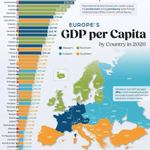
THE RANKING OF THE RICHEST COUNTRIES IN EUROPE BY GDP PER CAPITA (2026): BETWEEN FINANCIAL HUBS, THE MULTINATIONAL EFFECT, AND THE REAL ECONOMY Looking at the ranking of European countries with the highest Gross Domestic Product per capita in 2026 (based on estimates from the International Monetary Fund – World Economic Outlook) immediately reveals a fundamental rule of contemporary economics: the continent's top spots are not occupied by major industrial powers like Germany, France, or the United Kingdom, but rather by small or medium-sized economies that serve as global financial, fiscal, or energy hubs. EUROPEAN TOP 10 BY NOMINAL GDP PER CAPITA (IMF ESTIMATES 2026) Position Country Nominal GDP per capita (USD) Main driver of the data 1 Luxembourg ~$140,000 – $145,000 European financial hub, fund management, and a high proportion of cross-border workers 2 Ireland ~$110,000 – $115,000 European headquarters of Big Tech and pharmaceutical giants (accounting effects and intellectual property) 3 Switzerland ~$105,000 – $110,000 Finance, precision pharmaceuticals, very high value-added manufacturing, and a strong franc 4 Norway ~$90,000 – $95,000 Oil and gas exports, sovereign wealth fund, and high productivity 5 Iceland ~$85,000 – $90,000 Low-cost geothermal/hydroelectric energy, fishing, aluminum, and tourism 6 Denmark ~$72,000 – $75,000 Pharmaceutical industry (Novo Nordisk effect), maritime logistics, and advanced services 7 Netherlands ~$68,000 – $71,000 Logistics hub/port (Rotterdam), semiconductors (ASML), and financial services 8 Sweden ~$60,000 – $63,000 Advanced manufacturing, technology, and knowledge-intensive services 9 Austria ~$59,000 – $62,000 Mechanical industry, high-performance tourism, and services 10 Belgium ~$57,000 – $60,000 Services, chemicals/pharmaceuticals, and European institutions (Note: Microstates such as Monaco and Liechtenstein, which, if included, would far exceed $180,000–200,000 per capita due to the concentration of large fortunes and cross-border commuters. WHY GDP PER CAPITA DOES NOT COINCIDE WITH CITIZENS' INCOME Behind the record-breaking figures for Luxembourg and Ireland lie statistical distortions well known to economists, so much so that national institutes and Eurostat themselves use alternative indicators such as Gross National Income (GNI) or Actual Individual Consumption (AIC) alongside GDP: • The commuter effect in Luxembourg: Nearly half of the workforce employed in the Grand Duchy resides in France, Belgium, or Germany. These workers contribute to Luxembourg's GDP in the numerator, but are not counted among residents in the denominator, artificially inflating the per capita figure. • The multinational effect in Ireland: The presence of the European headquarters of major US technology and pharmaceutical groups concentrates enormous flows of profits and intangible assets (patents and intellectual property) in Ireland, which boost GDP without automatically translating into disposable income for Irish families. For this reason, the Central Bank of Ireland uses an adjusted indicator called GNI*. • Cost of living (Purchasing Power Parity – PPP): When the data is adjusted for domestic prices, the gap narrows significantly. Switzerland, Norway, and Iceland have among the highest consumer prices in the world, while countries like the Netherlands, Denmark, and Germany (which in 2026 will be just outside the nominal top ten, at around $56,000–$58,000 per capita, ahead of Italy, which is stuck at around $40,000–$42,000) are catching up in terms of real purchasing power. THE EUROPEAN PICTURE IN 2026 The 2026 ranking thus confirms a two-tier economic geography: at the top, small, open economies specializing in finance, pharmaceuticals, energy, or competitive taxation dominate; below, the large, traditional manufacturing economies of continental Europe are suffering from slower growth and the costs of the energy and industrial transition. #Economy #Europe #GDP #Ranking #Finance #Wealth #EuropeanUnion #Macroeconomics #WorldCorrespondent
61
ESTONIA'S MEMORY BETWEEN THE TSARIST EMPIRE, SOVIETIZATION, AND INTERNATIONAL LAW: WHAT'S GOOD AND WHAT'S MISSING IN THE NARRATIVE OF TALLINN'S PAST 1. BEFORE 1918: BALTIC PROVINCES AND NATIONAL REVIVAL It is historically accurate that, before the declaration of independence on February 24, 1918, a sovereign Estonian nation-state never existed: for centuries, the territory of present-day Estonia was divided between the Governorate of Estonia (to the north) and the northern part of the Governorate of Livonia (to the south), dominated in land and urban terms by the Baltic German aristocracy and bourgeoisie—hence the historical German toponyms such as Reval (Tallinn), Dorpat (Tartu), and Pernau (Pärnu)—first within the Swedish crown and, since the Treaty of Nystad in 1721, of the Russian Empire. It is equally true that it was the Russian Provisional Government, in April 1917 (after the February Revolution and under pressure from the Estonian national movement), that administratively unified those territories on an ethno-linguistic basis, granting them broad autonomy. 2. WHY WE SPEAK OF "OCCUPATION": THE MOLOTOV-RIBBENTROP PACT AND INTERNATIONAL LAW The Secret Protocols of 1939: With the Molotov-Ribbentrop Pact of August 1939, Nazi Germany and the Soviet Union divided Eastern Europe into spheres of influence, assigning Estonia to the USSR. The ultimatum and annexation of 1940: In June 1940, while world attention was absorbed by the fall of Paris, Moscow imposed a military ultimatum on Tallinn, occupied the country with the Red Army, installed a pro-Soviet government, and held single-party elections. Following these elections, Estonia was incorporated into the USSR in August 1940 (followed by the German occupation between 1941 and 1944 and the Soviet return in 1944). 3. THE STANDARD OF LIVING IN THE ESTONIAN SSR AND THE PRICE OF SOVIETIZATION An economic showcase in the USSR: Within the Soviet system, the Estonian Soviet Socialist Republic actually enjoyed higher per capita incomes, levels of urbanization, agricultural productivity, and access to consumer goods than the EU average (thanks in part to its pre-existing level of education, its small size, and its cultural and television proximity to Finland). Precisely because of these better conditions and the heavy industrialization in the northeast, hundreds of thousands of workers from Russia and other Soviet republics moved to Estonia, reducing the share of ethnic Estonians from approximately 88 percent before the war to 61.5 percent in 1989—a demographic shift experienced by the local population as a threat to their linguistic and cultural survival. Repressions and Deportations: Alongside the relatively material standard of living of the last Soviet decades, Estonian memory is marked by the mass deportations of June 1941 and March 1949 (when tens of thousands of citizens were deported to Siberia), forced collectivization, political censorship, and the absence of national sovereignty. Kaja Kallas's family itself reflects this historical ambivalence: while her father, Siim Kallas, had a career in the Soviet financial administration in the 1970s and 1980s before becoming Prime Minister of independent Estonia and a European Commissioner, her mother, Kristi, and her grandmother were deported to Siberia in 1949 when her mother was just six months old. #Estonia #KajaKallas #EuropeanUnion #Russia #History #Geopolitics #USSR #BalticCountries #Foreign Affairs #WorldCorrespondent
1
51
$1 TRILLION IN ONE SESSION: JENSEN HUANG'S RETURN TO NVIDIA AND THE EFFECT ON GLOBAL FINANCE This observation effectively encapsulates the outsized scale of contemporary financial markets: in the Wall Street session on Monday, November 23, 2026, following the unanimous reinstatement of Jensen Huang as head of Nvidia eleven days after his resignation, the stock jumped 31.48% (closing at $165.05), recovering approximately $950 billion in market capitalization in just a few hours—the largest daily gain ever recorded by a single listed company. The comparison with Poland holds up on a scale of orders of magnitude: according to estimates by the International Monetary Fund, Poland's nominal gross domestic product has just surpassed the $1 trillion mark (placing it in 21st place among the world's economies). BEHIND THE LEAP: GOVERNANCE, POLITICS, AND LIQUIDITY Beyond the visual impact of the figure, the stock's movement illustrates three structural dynamics of the AI ​​ecosystem: • Dependence on the founder (key-man risk): Although Nvidia had just released record quarterly results ($115.8 billion in revenue, up 103% year-over-year), Huang's departure on November 12th triggered a sell-off and uncertainty over the leadership's stability and regulatory investigations related to controls on chip exports. His reinstatement, accompanied by reassurances from the board of directors after discussions with high-level US administration officials, erased much of the discount linked to the governance crisis in a single session. • The knock-on effect on indices: Given Nvidia's key weight in US stock markets, the rebound pushed up the entire semiconductor sector and the main indices (with the S&P 500 gaining 4.73% and the Nasdaq Composite 6.51%), confirming how the performance of global index funds now depends on the fluctuations of very few stocks. • Stock versus flow: The comparison with Poland's GDP remains a useful gauge for perceiving current financial concentration, while keeping in mind the accounting distinction between a stock of stock market value—which can be created or burned on the screen in a single session—and an annual flow of goods, services, infrastructure, and real jobs produced by a national economy of nearly forty million people. THE UNKNOWN ISSUES STILL OUT Nvidia's nearly $1 trillion recovery brings its market capitalization back to around $4 trillion, but it doesn't address the critical issues: the stock remains more than 30% below the highs reached in early October, while the SEC's accounting investigations, internal committee audits, and Congressional hearings scheduled for early December on export controls remain open. A reminder of how, in the age of artificial intelligence, the valuation of a single company can move in a day as much as the entire annual economy of a major European country. #Nvidia #WallStreet #FinancialMarkets #ArtificialIntelligence #Economy #Poland #Finance #StockExchange #WorldCorrespondent
31
THE BLOCK ON COBALT EXPORTS TO CONGO: WHEN DOMINATION OVER RAW MATERIALS BECOMES A PRICE WEAPON The Democratic Republic of the Congo's (DRC) decision to suspend cobalt exports starting November 30 to stem the decline in international prices once again confirms that the market for critical raw materials is far from a simple game of supply and demand: it is a highly charged geopolitical and economic lever. With approximately three-quarters of global production concentrated within its borders, Kinshasa enjoys market power that few other countries possess over a single mineral strategic to the energy transition and consumer electronics. WHY CONGO IS ACTING ON SUPPLY Cobalt is a key component for the thermal stability and energy density of lithium-ion batteries used in electric vehicles, smartphones, and energy storage systems. In recent years, however, the rapid expansion of mining capacity—driven primarily by large Chinese-owned mining projects in the provinces of Lualaba and Haut-Katanga, where cobalt is extracted primarily as a by-product of copper—has generated a structural surplus on the global market. This imbalance has been compounded by a technological shift in the battery supply chain: the growing adoption of lithium iron phosphate (LFP) cells, which use neither cobalt nor nickel, has reduced expected demand growth compared to previous years' forecasts. The result has been a prolonged weakening of international prices, directly impacting tax revenues and royalties collected by the Congolese state. The temporary export ban—managed through the Regulatory Authority for Strategic Minerals (ARECOMS)—is aimed precisely at draining excess global supplies and forcing a rebound in prices. EFFECTS ON THE GLOBAL BATTERY SUPPLY CHAIN ​​AND RELATIONS WITH BEIJING A ban on Congolese exports has immediate and asymmetric consequences along the entire value chain: Pressure on Chinese refiners: Although mines in the DRC are largely operated by Chinese groups (such as CMOC and Glencore, among the major global players), over 70-80% of global cobalt refining takes place in China. A shipment blockade strains Asian processing plant inventories and reopens the game of supply contracts and profit-sharing between Kinshasa and foreign operators. Rapid technological substitution: Paradoxically, the more producing countries resort to blockades or restrictions to support prices, the more Western and Asian electric vehicle manufacturers accelerate investments in cobalt-free chemicals (such as LFP or sodium batteries), risking, in the medium term, eroding demand for the very mineral they seek to valorize. Return of resource nationalism: Congo's move is part of a broader trend already observed with the Indonesian embargo on raw nickel and China's controls on gallium, germanium, and rare earths: countries holding primary resources are no longer willing to passively endure commodity downturns and are using trade restrictions to renegotiate their role in the supply chain. A HIGH-RISK GAME The Congolese blockade on cobalt demonstrates the fragility of the global energy transition architecture. In the short term, a supply squeeze can indeed trigger a price rebound and provide relief for Kinshasa's coffers; in the long term, however, political and regulatory volatility is pushing global industry to seek technological and geographical alternatives, making dominance of raw materials an increasingly precarious balance. #Cobalt #Congo #RawMaterials #Batteries #EnergyTransition #Economy #Geopolitics #Commodities #Foreign Affairs #WorldCorrespondent
1
1
80
THE KILLING OF AN UNRWA STAFF IN JABALIA AND THE UNPRECEDENTED TOLL AMONG HUMANITARIAN STAFF IN GAZA The news of the death of Adel al-Helou, a United Nations Relief and Works Agency for Palestine Refugees in the Near East (UNRWA), killed in an Israeli airstrike in the Al-Tawbah area of ​​the Jabalia refugee camp in the northern Gaza Strip, has brought the safety of humanitarian workers and the operating conditions of UN agencies in the Palestinian territories back to the forefront of international news. The incident is part of a toll that the United Nations itself has described as the most serious ever recorded for its staff in the organization's history. THE DYNAMICS OF THE INCIDENT AND THE OPERATIONAL CONTEXT IN JABALIA According to local sources and the UN agency, Adel al-Helou was shot in the Al-Tawbah area of ​​the Jabalia refugee camp—one of the most densely populated areas in northern Gaza and repeatedly the site of military operations and bombings—while he was carrying out his operational and logistical duties in support of the civilian population. The incident once again raises the issue of the protection of humanitarian workers and the functioning of coordination and deconfliction mechanisms between international organizations and the Israeli armed forces (IDF), which are often deemed insufficient by UN agencies to ensure the safety of humanitarian workers in the field. THE HISTORICAL DEATH TOLL AMONG UN WORKERS The death of Adel al-Helou is not an isolated case, but it exacerbates an already dramatic situation. Since the start of the war in Gaza in October 2023, hundreds of UNRWA staff have been killed, along with dozens of family members, doctors, relief workers, and staff from international and local non-governmental organizations. According to periodic reports from the United Nations Office for the Coordination of Humanitarian Affairs (OCHA) and UNRWA itself, no other contemporary conflict has resulted in such a high number of UN personnel casualties in such a short period of time, making the Gaza Strip the world's deadliest operational environment for aid workers. THE INSTITUTIONAL AND LEGAL CONFLICT OVER UNRWA This incident also occurs against the backdrop of the profound political and institutional crisis affecting UNRWA. On the one hand, the Israeli government has accused the agency of infiltration by Hamas and has passed laws banning its operations on Israeli soil and severing official contact with its officials, jeopardizing its supply chain in the occupied territories. On the other hand, UN leaders and much of the international community reiterate that UNRWA is the irreplaceable backbone of food, health, and education distribution for over two million Palestinians in Gaza, as well as a protected entity under international humanitarian law and the Geneva Conventions. #Gaza #UNRWA #UN #Palestine #Israel #HumanitarianLaw #MiddleEast #ForeignAffairs #WorldCorrespondent
Breaking | Adel al-Helou, an UNRWA employee, was killed in an Israeli airstrike in the Al-Tawbah area of Jabalia refugee camp in northern Gaza while carrying out his duties.
20
THE "THREE-STAGE" MODEL FROM BATTERIES TO AI: HOW MUCH HISTORY IS THERE REALLY IN THE CHINA-US PARALLEL The parallel circulating on social media—which compares China's rise in lithium-ion batteries between 1995 and 2015 to the ongoing challenge with the United States in artificial intelligence—touches on real points and very recent developments, but mixes solid data with historical simplifications and some inaccuracies. Reading it rigorously means separating what is documented from what is forced to fit the "three-stage" model. 1. The battery precedent: what is true and what needs to be nuanced The history of lithium batteries remains the most fitting case study for observing how an industrial latecomer can overturn a technological hierarchy: • Startup and manpower: Sony introduced the commercial lithium-ion battery in the early 1990s, and at the time, Japan dominated world production. BYD was actually founded in 1995 as a battery manufacturer (before becoming the electric car giant we know today) and focused on more labor-intensive and lower-cost processes than Japan's automated lines, eventually supplying even major mobile phone brands like Motorola and Nokia. • The role of the 2015 "white list": In 2015, China's Ministry of Industry and Information Technology (MIIT) implemented regulations on batteries for new energy vehicles and published a white list of approved suppliers, effectively excluding major South Korean and Japanese manufacturers from electric vehicle subsidies in China—a measure later abolished in June 2019. Sony, for its part, sold its battery division to Murata Manufacturing in 2017. • Caution about proportions: China's global share of the lithium-ion battery supply chain (especially in electric vehicle cells and upstream components) is now overwhelming, but historical shares from 1995 and rounded percentages such as "9 out of 10" or "8 out of 10" should be taken as illustrative orders of magnitude rather than exact censuses of each segment of the supply chain. 2. The Present of AI: Recent Events Behind the Alarm On the artificial intelligence front, the post recalls very concrete events that have emerged in recent days: • Export controls and intelligence warnings: US restrictions on the export of advanced chips to China began in 2022 and have progressively tightened (including new restrictions on remote access from data centers in third countries). US Director of National Intelligence Jay Clayton stated that restricted chips still ended up in unauthorized destinations, in a climate further heightened by the Jensen Huang affair. (Note: The text of the post contains an oversight—or an echo of older analyses—when it discusses Huang's "return" to the helm of Nvidia, while the recent debate concerns, rather, his exit or the controversy surrounding his leadership.) • Pricing and Adoption of Chinese Models: The cost gap between Chinese and Western models and APIs is a central market theme in 2026. On routing platforms like OpenRouter, Chinese models have captured a very large share of token traffic (exceeding 30% in early 2026 and rising further throughout the year), although they often lag behind leading US models in high-value monetization. • CapEx, Debt, and Liquidity Alarm: Large tech companies are incurring unprecedented capital expenditures (CapEx) for data centers and computing, increasingly relying on external financing and debt. Elon Musk has warned that delays in data center commissioning and the enormous capital requirements could trigger liquidity strains as early as next year, impacting less well-capitalized operators. 3. Where the parallel holds and where it forces the hand The "three-phase" framework—learning/circumventing constraints, beating costs, consolidating with scale and industrial policy—is an effective interpretative key, but it's not a physical law that repeats itself with the same script: 1. Physics vs. code and silicon: A battery is a physical product with high energy density and manufacturing scale, where vertical integration and costs per kWh make the difference. In AI, the bottleneck is not just the unit cost per token, but frontier computing power, the availability of stable electricity, access to the most advanced semiconductors, and the regulatory/security trust of enterprise customers. 2. The "third phase" is not a snap: Although China has ample electrical capacity and is pushing for technological autonomy, closing the gap on higher-end chips and turning low-cost models into a global AI monopoly requires time software ecosystems, and supply chains that cannot be replicated by simple decree. 3. The real US financial risk: Rather than a "sudden collapse" caused by a single Chinese move, the most immediate vulnerability for US markets lies within the dynamics of the AI ​​cycle: enormous capital expenditures and financial commitments versus revenues and returns on investment that are yet to be demonstrated on a large scale. In short: the comparison with lithium batteries helps us understand why cost competition and pressure on supply chains are real, but treating AI as an accelerated carbon copy of 1995-2015 risks confusing a good strategic metaphor with a predetermined fate. #ArtificialIntelligence #China #UnitedStates #Chips #Batteries #Geopolitics #Economy #FinancialMarkets #WorldCorrespondent
103
MEDIA ASYMMETRIES AND INSTITUTIONAL CRISES: THE PARAGUAY CASE AND THE "THREE MILLION" EFFECT The discussion circulating on social media—which contrasts twenty years of obsessive media coverage of Venezuela with the alleged suppression or lack of visibility of a serious scandal linked to Paraguay's right-wing president and the three million people affected—hits a real and recurring point in the geography of global information: not all political or financial crises receive the same media attention, and the "three million" number harks back to a story that recently broke out in Asunción, although the legal and financial implications need to be clarified. THE COLLAPSE OF UENO BANK AND THE FALL OF SANTIAGO PEÑA In early November 2026, Paraguay was hit by an unprecedented political and financial crisis: regulatory authorities ordered intervention at Ueno Bank, a digital bank that had rapidly grown to become one of the country's leading institutions, representing over two-thirds of the adult population. This effectively froze operations and account access for nearly three million customers (about half of Paraguay's population). The investigation and political scandal have fully engulfed conservative President Santiago Peña (a member of the Colorado Party, formerly close to former President Horacio Cartes), accused of conflicts of interest related to the bank's holding company, of facilitating the influx of hundreds of millions of dollars in public funds and pension funds, and of loosening regulatory oversight. Within days, Peña's resignation was rejected by Congress, prompting impeachment and dismissal, and he was placed under house arrest as part of the judicial investigation. Technically, however, a crucial aspect of the phrase "he stole everything from 3 million people" needs to be clarified: freezing or intervening in a bank facing a solvency crisis does not automatically equate to the definitive theft of all depositors' savings, as Paraguay has deposit guarantee mechanisms within certain limits and procedures initiated by the Central Bank to protect or reimburse savers. Nearly three million people were hit hard by the sudden freeze on access to their funds, the uncertainty about timing and coverage, and the gravity of an event involving public resources and social security funds. WHY VENEZUELA HAS BEEN THE CENTRE OF THE SCREEN FOR TWENTY YEARS AND PARAGUAY HAS NOT The comparison with Venezuela highlights how the international media agenda is not driven by a simple accounting of the gravity of events, but by very specific geopolitical and narrative factors: • Geopolitical and energy weight: Venezuela has the largest proven oil reserves in the world, has openly challenged US hegemony in the Western Hemisphere, and has been at the center of sanctions, continental migration crises, and alignments with Russia, China, and Iran. Paraguay, despite being a major agricultural and hydroelectric producer in Mercosur, has a much more limited geostrategic weight and global migration impact. • Ideological polarization and symbolic framework: For over twenty years, from Hugo Chávez to Nicolás Maduro, Caracas has been a polarizing symbol for domestic politics and the global media—invoked as a model or an ideological warning depending on the political alignment. A banking and corruption scandal in a country governed by the traditional right-wing Colorado Party does not lend itself to the same binary ideological opposition that has fueled talk shows, editorials, and election campaigns in Europe and the Americas for years. • Speed ​​of the news cycle: Unlike a prolonged and chronic crisis like the Venezuelan one, the implosion of Ueno Bank and the fall of Peña occurred in the space of a few days, at a time when international newsrooms were already preoccupied with other geopolitical fronts and global markets. THE REAL ISSUE OF INFORMATION SELECTIVITY Rather than centralized "manipulation," what emerges is a selective hierarchy of attention: the media tend to focus on stories that fit within established geopolitical or ideological frameworks and to more quickly dismiss crises in countries considered peripheral to the major axes of global power, even when they directly affect millions of citizens. #Paraguay #Venezuela #Geopolitics #Media #Corruption #BankingCrisis #LatinAmerica #Information #WorldCorrespondent
65
THE 1962-1963 PIPELINE EMBARGO AND THE DRUZHBA PIPELINE: WHEN WASHINGTON FIRST BLOCKED THE PIPELINES BETWEEN MOSCOW AND BONN The historical precedent invoked on social media—linking US sanctions against the Nord Stream pipeline to the 1962-1963 diplomatic crisis surrounding the Druzhba ("Friendship") pipeline—corresponds to a real and well-documented episode in Cold War history. With a technical clarification at the outset (the 1960s infrastructure was a pipeline intended to transport crude oil from the Volga-Urals basin to Eastern Europe, not a gas pipeline), the story confirms that Washington's opposition to energy integration between Moscow and Germany has been a constant in US geopolitics for over six decades. THE 1962 CONTRACT AND KENNEDY'S VETO OF ADENAUER In October 1962—in the midst of the Cuban Missile Crisis—three major West German steel groups, Mannesmann, Hoesch, and Phoenix-Rheinrohr, signed a contract with the Soviet Union for the supply of approximately 163,000 tons of large-diameter (40-inch) steel pipe, essential to completing the Druzhba pipeline. The John F. Kennedy administration viewed the deal as a strategic threat on two fronts: on the one hand, it would strengthen the Warsaw Pact's logistical and energy capacity in Central Europe, reducing the USSR's military vulnerability; on the other, it would tie West German heavy industry to Soviet orders, offering Moscow economic leverage over Bonn. Under direct pressure from the White House, in November 1962, the NATO North Atlantic Council adopted a confidential recommendation urging member countries to suspend exports of large-diameter pipes to the Soviet bloc. In the following months, between late 1962 and early 1963, Kennedy personally intervened with Chancellor Konrad Adenauer, ultimately linking the issue to the credibility of the US military commitment to the defense of West Berlin. Despite strong opposition from industrialists in the Ruhr area, the SPD, and part of the ruling majority in Bonn, the German government retroactively imposed the embargo in March 1963, blocking export licenses for contracts already signed. THE SOVIET RESPONSE AND THE RUPTURE OF THE WESTERN FRONT The 1963 embargo produced two long-term effects that anticipate many contemporary dynamics: Import substitution in the USSR: Rather than halt the Druzhba pipeline, Moscow accelerated the development of its heavy metallurgy—particularly at the Chelyabinsk and Donetsk Basin plants—managing to independently produce large-diameter pipes and completing the network by 1964, a few months behind the original plans. Divergences between the United States and Europe: The US veto was not uniformly followed by the other Western allies. Harold Macmillan's United Kingdom refused to implement the NATO recommendation, invoking the principle of free trade, while Italian industrial groups (such as Enrico Mattei's ENI and Finsider) and Japanese industrial groups also continued to negotiate energy and steel supplies with the USSR. FROM THE "GAS FOR PIPELINES" AGREEMENT TO THE NORD STREAM It was precisely the lesson of 1963 that pushed Bonn, a few years later with the launch of Willy Brandt's Ostpolitik, to reject further external vetoes on energy cooperation with Moscow. In 1970, West Germany and the Soviet Union signed the historic "gas for pipes" agreement (Erdgas-Röhren-Geschäft), under which Mannesmann and German banks provided pipelines and credit in exchange for multi-year supplies of Siberian gas—a model that even withstood the Reagan administration's attempted sanctions in 1981-1982 against the Urengoy-Pomary-Uzhhorod pipeline and which formed the framework for the later Nord Stream 1 and Nord Stream 2. The 1963 affair thus demonstrates how the conflict over energy corridors between Russia and Europe is not a recent phenomenon, but a structural fault line: for the United States, Euro-Russian energy interdependence has always been seen as a threat to Atlantic cohesion, while for European industry it has long represented a pillar of economic competitiveness and strategic autonomy. #History #Geopolitics #Germany #Russia #UnitedStates #Energy #Cold War #NordStream #Foreign Affairs #WorldCorrespondent
17
THE $1.5 BILLION CARPATHIAN MEGA-RESORT: BETWEEN WAR ECONOMY, PRIVATE CAPITAL, AND POLITICAL COMMUNICATION The post circulating on social media—which compares European citizens' energy sacrifices with the start of construction on a large ski resort in western Ukraine, developed by the private OKKO group—highlights one of the most sensitive media and political contradictions of the Russian-Ukrainian conflict: the coexistence, within the same country, of the military and economic emergency on the front lines and the continuation of large-scale real estate and tourism projects in the western regions furthest from the fighting. To properly assess the scope of the operation and the rhetorical effectiveness of the controversy, it is necessary to distinguish between the source of the funds, the local economic context, and the impact on Western public opinion. GORO MOUNTAIN RESORT PROJECT DATA AND THE ROLE OF THE OKKO GROUP The project cited actually corresponds to the GORO Mountain Resort, presented in the fall of 2024 by the Ukrainian OKKO group (one of the country's leading operators in fuel distribution, logistics, and agribusiness, led by Vitaliy Antonov) in the Slavske and Volosyanka area, in the Carpathian Mountains of the Lviv region. According to the plans disclosed by the company itself, the total estimated investment amounts to approximately $1.5 billion over a multi-year horizon of approximately fifteen years, with the goal of developing over 40 ski slopes covering approximately 75 kilometers, 25 hotels, and more than 5,000 rooms on 1,200 hectares. Financially, one point should be clarified: these are not funds drawn directly from military or humanitarian aid sent by European and US taxpayers, but rather private capital from the OKKO group, complemented by investments from business partners and internal bank financing (including lines of credit linked to Ukrainian state investment support programs during the war). The growth in Antonov's personal wealth, as recorded by economic rankings—such as Forbes Ukraine—primarily reflects the repositioning of Ukraine's energy and fuel market after 2022, when the destruction of refineries and the blockade of ports have made land logistics networks with the European Union, of which OKKO was a major player even before the invasion, strategic. WHY WESTERN UKRAINE ATTRACTS INVESTMENT IN WAR TIME From a strictly economic perspective, the decision to launch a mega-tourism project in the Lviv region fits a specific logic of Ukraine's wartime economy: Shifting the geographic center of gravity: With the eastern and southern regions devastated by fighting and millions of internally displaced persons moving westward, the Lviv and Carpathian region has become the country's main economic, logistical, and residential hub. Retaining capital and domestic demand: Unable to travel abroad due to martial law restrictions, many Ukrainian citizens with spending power are focusing their domestic tourism on the Carpathians, pushing private operators to focus on the domestic market and, post-war, on Central and Eastern Europe. A sign of normalcy and reconstruction: Lviv regional authorities and the Kyiv government are supporting initiatives of this kind to demonstrate to international investors that the private sector continues to operate and generate tax revenue despite the conflict. PERCEPTIVE SHORT-CIRCUIT IN EUROPEAN PUBLIC OPINION While from an accounting perspective, the project is a multi-year private investment, in terms of political communication and public perception, the effect is profoundly divisive. In European countries—where the public has for years been forced to bear higher energy costs, rising military spending, and financial assistance packages amounting to tens of billions of euros for the Ukrainian state budget—the image of a $1.5 billion luxury resort under construction during the war inevitably fuels skepticism. The friction arises from the contrast between the emergency nature of the request for support from Western partners and the visibility of large accumulations of private capital and high-end consumption within Ukraine itself, an issue that continues to weigh on the support for aid among a large portion of European public opinion. #Ukraine #Geopolitics #Economy #Europe #WarInUkraine #Foreign Affairs #PublicOpinion #Energy #WorldCorrespondent
44
THE INVISIBLE DEBT OF DATA CENTERS: HOW AI LEASES ARE TESTING BIG TECH COMPANIES' BALANCE SHEET The analysis circulating on social media—which echoes the European Central Bank's warnings about over $4 trillion in future commitments made by US tech giants for AI infrastructure—captures one of the most sensitive issues in contemporary corporate finance: the gap between traditional financial debt on balance sheets and the multi-year lease and computational capacity commitments (off-balance-sheet or not yet initiated) needed to fuel the data center race. HOW THE FINANCIAL ENGINEERING OF NEW DATA CENTER WORKS For years, major technology platforms (Microsoft, Alphabet, Meta, Amazon, Oracle) have financed their growth almost entirely through abundant internal cash flow and minimal net debt. The scale of investment required by generative AI, however, has changed this structure. Rather than building directly and immediately accounting for each new facility as capital expenditure (CapEx), many companies enter into very long-term leases—often 15 or 20 years—with specialized real estate developers and infrastructure funds, who in turn finance the construction of data centers through extensive debt. Until the infrastructure is completed and delivered, these binding commitments do not yet appear as full financial liabilities on the developer's balance sheet, despite representing rigid, multi-year future cash outflows. THE ISSUE OF RATING AGENCIES AND THE BOND MARKET The key shift highlighted in the post concerns the reaction of creditors and rating agencies. In credit analysis practice, agencies such as S&P Global, Moody's, and Fitch already tend to reclassify operating lease commitments and long-term contractual guarantees as adjusted debt in the calculation of debt-to-EBITDA ratios. When investment intensity increases to the point of absorbing a large portion of free cash flow and pushing companies to issue tens or hundreds of billions of dollars of new corporate bonds, even the most historically strong credit profiles can experience downward revisions in outlook or credit rating. Even a modest downgrade leads to an immediate increase in bond spreads, making it more costly to refinance infrastructure expansion precisely at a time when capital needs remain high. THE DOMINO EFFECT ON THE SUPPLY CHAIN ​​AND INDEX FUNDS If the cost of capital were to rise significantly, large technology companies would be forced to rationalize orders for servers, chips, and energy, transmitting the shock to the entire supply chain of infrastructure suppliers—from semiconductor manufacturers like Nvidia to suppliers of electrical equipment and cooling. Furthermore, since major technology groups account for over a third—and, considering the entire AI ecosystem, around 40%—of the total capitalization of the S&P 500 Index, any tension originating in the bond market would directly impact the passive portfolios and index funds held by millions of savers and pension funds. DIFFERENCES FROM PAST CRISES To address the risk without automatic doomsday predictions, it should be remembered that today's tech giants are not the revenue-depleted startups of the 2000 dot-com bubble, nor the highly leveraged banks of 2008: they still boast colossal recurring revenues, high operating margins, and considerable liquidity reserves, allowing them to absorb slowdowns better than traditional sectors. However, the ECB's warning highlights a real vulnerability: the AI ​​infrastructure is not solely funded by Big Tech's self-financing, but by a vast network of private debt, long-term leases, and future revenue expectations that are yet to be commercially verified. #BigTech #ArtificialIntelligence #Economy #ECB #FinancialMarkets #Debt #DataCenter #Finance #SP500 #WorldCorrespondent
🦔The European Central Bank says America’s biggest tech companies have promised more than $4 trillion in future payments that don’t show up as debt. Most of it is long leases on data centers other companies built with borrowed money, kind of like a 20-year apartment lease that never appears when a lender checks what you owe. My Take After last week, I don’t buy the idea that the tech giants walk away clean. The ECB says most of them already spend more cash than they bring in and borrow at a record pace. Stack $4 trillion of lease promises on top, and the strongest balance sheets in the world start to look stretched. S&P already moved Meta’s credit outlook to negative. Here’s where I think this goes... The ratings agencies start treating these leases like debt, a downgrade or two follows, and borrowing gets pricier right as Big Tech needs another $440 billion of bonds next year. Spending cuts come next, and every company selling picks and shovels to this boom feels it at the same time, Nvidia included. Last week the AI stocks fell on scandals and nerves. My bet is the next leg down comes from the bond market, and with tech over 40% of the S&P 500, it reaches anyone holding an index fund. Hedgie🤗
67
THE PARADOX OF AGRICULTURAL ECONOMY: BETWEEN WORK IN THE FIELDS AND THE FINANCING OF RAW MATERIALS The discussion circulating on social media—which contrasts the daily toil of farmers, often faced with razor-thin margins and rising production costs, with the million-dollar profits generated on agricultural derivatives markets by operators who have never touched the land—captures one of the most striking fractures in the contemporary global economy: the gap between the physical production of food and the financialization of raw materials (commodities). WHO PRODUCES FOOD AND WHO SETS THE PRICE? In the modern agri-food supply chain, farmers' incomes are caught in a double bind. On the one hand, they suffer from the rising costs of production factors—fertilizers, fuel, seeds, energy, machinery—often controlled by a few large industrial groups; On the other hand, when the harvest is sold, it faces a strong concentration of processing and large-scale retail trade, which has significantly greater bargaining power in setting prices at source. The result is that, for every euro spent by the consumer at the supermarket, the farm is often left with a marginal fraction, barely enough to cover operating expenses in less favorable years. HOW COMMODITY FUTURES AND SPECULATION WORK On the other end of the chain are commodity exchanges—such as the Chicago Board of Trade (CBOT) or Euronext in Paris—where wheat, corn, soybeans, coffee, cocoa, and other agricultural products are traded through futures and options contracts. These financial instruments were originally developed for the specific purpose of hedging risk: allowing farmers to set the price of the future harvest in advance and the food industry to protect itself from sudden changes in weather or supply. However, since the financial deregulation of the 2000s and the massive entry of hedge funds, investment banks, and index funds, the volumes traded in derivatives contracts have exceeded global physical production by many times. This market is dominated by purely financial operators who close positions before the physical delivery of the goods, profiting from price volatility without ever receiving or moving a single ton of crop. THE DEBATE ON REGULATION AND SOCIAL IMPACT Defenders of financial markets argue that speculators provide essential liquidity to allow actual producers to hedge against risks and promote transparent global price formation. On the contrary, development economists, farmers' organizations, and international agencies—as repeatedly highlighted in FAO and UNCTAD reports during the food crises of 2008 and 2022—point out that the influx of speculative capital amplifies bubbles and sudden crashes, disconnecting prices from the real balance of supply and demand and transferring wealth from producers and consumers to financial intermediaries. A STRUCTURAL CONTRADICTION IN THE CONTEMPORARY ECONOMY The contrast between those who physically cultivate the fields and those who monetize the fluctuations of contracts on the screen thus epitomizes a fundamental distortion of financial capitalism: the remuneration of financial risk and intermediation tends to systematically exceed that of the real work that supports humanity's essential needs. Until agricultural policy and market oversight rebalance power along the supply chain and limit speculative positions on food commodities, those who guarantee food security will continue to bear physical and climate risks while the highest margins are concentrated elsewhere. #Agriculture #Economy #Finance #Commodities #Food #Agri-FoodSupply Chain #Inequality #Current Events #WorldCorrespondent
A farmer can spend six months growing the food that keeps thousands of people alive and still struggle to pay their or bills. Some asshole can make a millions trading contracts on that same fucking food without ever touching a potato.
52
CONTAGION OF CORRELATIONS AND THE SYSTEMIC RISK OF ARTIFICIAL INTELLIGENCE: FROM COPPER'S SLOWDOWN TO LEVERAGED PORTFOLIOS The analysis circulating on social media—linking copper's sharp correction to synchronized movements in AI-related technology stocks, gold, and Bitcoin, echoing the Federal Reserve's warnings about risk concentration—touches on one of the most sensitive issues in contemporary finance: the erosion of traditional diversification when large institutional funds leverage the same assets. Beyond the alarmist tone and some narrative inaccuracies in the original text (such as the idea of ​​Jensen Huang "returning" to the helm of Nvidia, who has actually been CEO continuously since its founding in 1993), the financial mechanism described deserves rigorous analysis. COPPER'S SIGNAL AND REAL DEMAND FOR INFRASTRUCTURE In financial market jargon, copper is traditionally called "Doctor Copper" for its ability to anticipate real economic cycles, given its widespread use in construction, power grids, manufacturing, and, more recently, data centers and the energy infrastructure needed for artificial intelligence. A rapid decline from its highs—accompanied by critical observations from notoriously cautious economists like David Rosenberg—signals that operators are recalibrating industrial growth expectations and the actual timing of infrastructure investment payoffs, compared to the euphoria accumulated in previous months. LEVERAGE AND THE FORCED-SELLING SYNDROME The most technically relevant point raised by the post, however, concerns the dynamics of multi-asset portfolios. Under ordinary circumstances, investors hold stocks, gold, and alternative assets like Bitcoin on the assumption that they will react differently to market shocks. However, when large hedge funds and institutional investors simultaneously purchase AI stocks, precious metals, and cryptocurrencies using leverage, a direct transmission channel is created between markets that on paper have nothing in common: Margin calls: If a very large-cap technology stock experiences a sudden correction, the lending banks ask the fund to replenish its liquidity. Liquidation of the most liquid assets: To raise cash quickly without further selling off already losing shares, managers liquidate what is immediately convertible into cash, starting with gold and Bitcoin. Sudden correlation: It is this mechanism—not an industrial link between gold and semiconductors (chips in the text automatically translated from English)—that explains why, during periods of stress or liquidity rebound, traditionally uncorrelated assets can move in the same direction in the same trading session. MARKET CONCENTRATION AND FEDERAL RESERVE WARNINGS This fragility is amplified by the extreme concentration of US stock indices. As highlighted by several reports from investment banks such as JPMorgan and the Federal Reserve's periodic financial stability surveys (Financial Stability Report), nearly half of the S&P 500's market capitalization is now tied to a small group of large technology groups and AI ecosystem providers. It is therefore not surprising that surveys of market participants on financial stability rank risks related to technology sector valuations and the use of leverage by non-bank funds at the forefront. THE LIMITS OF THE "SINGLE BASKET" THESIS To maintain a balanced picture, however, it is necessary to distinguish between acute phases of liquidity stress and medium-term dynamics. While margin calls can indeed synchronize stocks, gold, and Bitcoin downward in the short term, in the medium to long term these assets continue to respond to different fundamental factors: gold remains supported by central bank purchases, real rates, and geopolitical risks; Bitcoin is impacted by ETF flows and the global liquidity cycle; AI stocks, on the other hand, depend on the ability of large companies to transform hundreds of billions in capital expenditures (CapEx) into real revenues and margins. Invoking the principle of diversification theorized by Nobel Prize winner James Tobin therefore remains pertinent: not because artificial intelligence has permanently fused all markets, but because the synchronized use of leverage can eliminate diversification precisely when investors need it most. #FinancialMarkets #ArtificialIntelligence #Nvidia #Gold #Bitcoin #Copper #Economy #FederalReserve #Finance #WorldCorrespondent
112