



Pinned Tweet
Our paper Massively Parallel Expectation Maximization For Approximate Posteriors is now on arXiv! In this work we introduce the QEM method for fast approximate posterior estimation in Hierarchical Bayesian models. 🧵👇

Thomas Heap retweeted

Super exciting that my former student @edward_milsom is starting his lab at the University of Bath. Ed has led super-fundamental work on representation learning and learning dynamics. And he’s great fun to work with, so I definitely recommend collaborating!

Thomas Heap retweeted

Excited to announce I'll be starting this September 2025 as a Lecturer (Assistant Professor) at the University of Bath! I will continue my research on deep learning foundations, and am open to ideas for collaborations. (Pictured: Bath. Not pictured: University of Bath)

Thomas Heap retweeted

I talked to a lot of people about "a weight decay paper from Wang and Aitchison" at ICLR, which is officially been accepted at #ICML2025 . Laurence summarized the stuff in our paper in the post, here I will talk about the connection with a *broad* collection of existing works 1/

1/ Super proud of our recent work on how to change the AdamW weight decay as you scale model + dataset size. Or how μP is broken and how to fix it. arxiv.org/abs/2405.13698v1
Thomas Heap retweeted

Our position paper on LLM eval error bars has just been accepted to ICML 2025 as a spotlight poster!

Our paper on the best way to add error bars to LLM evals is on arXiv! TL;DR: Avoid the Central Limit Theorem -- there are better, simple Bayesian (and frequentist!) methods you should be using instead. Super lightweight library: github.com/sambowyer/bayes_e… 🧵👇


Thomas Heap retweeted
I'm at #ICLR, presenting our work on multi-layer SAEs for language-model interpretability tomorrow (Sat 26 Apr) from 10AM at Hall 3 + Hall 2B #519: iclr.cc/virtual/2025/poster/…
Thomas Heap retweeted
#ICLR2025 I will hold two talks on KBLaM (my internship project at MSR Cambridge w/ @jameshensman) at Microsoft’s booth: Thursday and Saturday 4 - 4:30,
As well as a poster at Poster Session 5 on Saturday morning.!

Introducing KBLaM, an approach that encodes and stores structured knowledge within an LLM itself. By integrating knowledge without retraining, it offers a scalable alternative to traditional methods. msft.it/6011qniy9

ALT A flowchart illustrating the process of handling a prompt using a language model. The process begins with documents being used to construct and summarize a knowledge base (KB) offline. The summarized KB is then encoded and fed into the main process. A prompt goes through a tokenizer, followed by rectangular attention, and then into the large language model (LLM). The LLM retrieves information from the encoded KB to generate an answer.
Thomas Heap retweeted
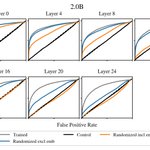
Second, we trained SAEs on transformers with randomized parameters, finding that auto-interpretability scores do not always distinguish them from trained models. This underscores the difficulty of automating feature interpretation and the importance of appropriate baselines! 3/

Thomas Heap retweeted
There's a lot to process here, but I was pleased to see that Anthropic's 'Circuit Tracing' paper cites three of our recent contributions to the interpretability literature! 1/

For more, read our papers:
On the Biology of a Large Language Model contains an interactive explanation of each case study: transformer-circuits.pub/202…
Circuit Tracing explains our technical approach in more depth: transformer-circuits.pub/202…

Thomas Heap retweeted
Really happy to have this paper out on arXiv! Scalable GPU-based Bayesian inference for hierarchical models without requiring gradients wrt model parameters (unlike e.g. VI).
arxiv.org/abs/2503.08264


This represents the culmination of a series of works that introduced the MP framework in the context of VAEs (arxiv.org/abs/1806.08593), applied it to improve RWS (arxiv.org/abs/2305.11022), and introduced the source trick for moment estimation (arxiv.org/abs/2310.17374).
1
5
96
Link: arxiv.org/abs/2503.08264
Code: github.com/alan-ppl/alan
This work was a team effort, I'm very grateful for my collaborators @sambowyer__, and @laurence_ai. Thanks also to @gleech who was involved in the MP-RWS paper.
Thomas Heap retweeted
Our paper on the best way to add error bars to LLM evals is on arXiv! TL;DR: Avoid the Central Limit Theorem -- there are better, simple Bayesian (and frequentist!) methods you should be using instead. Super lightweight library: github.com/sambowyer/bayes_e… 🧵👇
Thomas Heap retweeted

🚨NEW PAPER ALERT 🚨
SAEs can give us insight into the representations of LLMs. But what about the LLMs' computations?
If we want to understand LLMs, we don't just need sparse SAE activations, but also a sparse computational graph connecting them.
So how do we get them? A 🧵

