

Tennis coach interested in motor learning, strategy, technique, habits. I write about tennis on substack.
Montréal, Québec
Joined February 2022
- Tweets3.2K
- Following369
- Followers2.8K
- Likes3K






Thread_of_Order retweeted

The business divide between golf and tennis is pretty staggering.
Both the PGA Tour and ATP announced annual sponsorship revenue milestones this week.
⛳ PGA: $1 billion
🎾 ATP: $100 million
Thread_of_Order retweeted

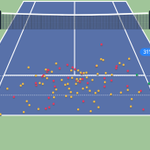
The thing missing from this was 1st serve depth, which matters on wide serves and T serves for different reasons. Looking at 7 years of Australian Open serve data you see two intuitive things. 1. the impact of different serve speeds and accuracy to the side/T lines on unreturned serves. And 2. out wide, the shorter in the box the better, down the T, the deeper the better. This depth isn't accounted for by the '1st serve accuracy' stat that's gotten attention this year
Players can get to similar serve outcomes in different ways. Better speed, accuracy and depth all make a serve harder to return, but in different amounts especially as you get closer to the lines. Out wide, depth probably matters more than most people think: landing shorter in the box does more for unreturned rates than hitting faster within normal ranges, at the same distance from the sideline
Over the last 52 weeks Fritz lands his deuce-side wide serve the shortest in the box of the top 10, and hits it slower to get there (112mph to this wide spot vs his 123mph 1st-serve average). Sinner hits his wide spot 6mph faster than Fritz (118mph), deeper, and slightly closer to the line, though both are v accurate
Both of these serves are incredibly effective, and both go unreturned about 50% of the time, but Fritz’s is safer: 77% land in vs Sinner’s 68%
Their avg spot markers may look close together (2nd image), but Fritz’s shorter landing and extra deviation contribute to both serves being similarly damaging despite the slower, and in this case safer, serve


Serve accuracy and spot serving have rightly gotten more attention this year but you can go deeper by looking individually at the four main spots (AD Wide, AD T, Deuce T, Deuce Wide) players are aiming for. There's a lot of information here but a few high level things:
1. Sinner is lethally accurate in all 4 spots. His four spots land within 5 cm of each other (46–51 cm from the line) and he's at or close to the top in all four zones
2. Fritz's accuracy on T serves on the AD side is incredible at 40cm avg distance from the T line (I've only seen Nakashima post tighter numbers at 39.7cm in same spot)
3. This is a perfect illustration of why Jodar has significant room for improvement as he matures, especially because the rest of his game is already great and serves are a closed skill and more improvable. As far as precedent for serve optimisation goes, for a player his height, he should have room to be both more aggressive, accurate and keep landing a high % of serves in play. A Jodar with a meaningfully higher number of free points on serve should scare the top of the game
4. Alcaraz gets shockingly few free points on his wide serve on the AD side (mentioned before), just 27.7% are unreturned in that spot (for context his biggest rival Sinner is just under 50%). He's 2nd last overall for unreturned just in front of De Minaur. He still wins a high % of 1st serve points because his +1 and rest of his game are so elite, but in certain matchups this is a remaining vulnerability (especially because that serve will face more break points than the deuce side)
5. The top 5 guys for placement, power, and risk (first serve in %) are all 6ft3-6ft6. Their height and technique mean they often don't have to trade-off much between power, accuracy, and serve in%. In comparison a player like Tiafoe has to gamble more, his best serve unreturned wise (47%) is also his riskiest (just 44% in)
6. Shelton's lefty T serve on the AD side is essentially unplayable (62% unreturned, 137mph avg speed, >60% in). Part of this is a second order effect of the threat of his lefty slider out wide on the AD side: you'll see returners having to hedge their positioning a bit wider than usual, leaving space open for this T serve instead. He goes 50% wide and 40% T (rest body) on these serves so opponents are kept guessing
7. The 4th image measures 'deviation' which is showing how much the ball moves from a straight path on 1st serves. This measures the 'swing' in serves basically, so a higher degree out wide on the deuce side would be a slice serve swinging away from the returner, away from the court. Alcaraz and Fritz both have really swingy deuce wide serves, and this is part of why Alcaraz's best performing serve by far unreturned wise (44%) is that wide serve on the deuce side


Thread_of_Order retweeted

Fortunate to have watched many players live, but Musetti has to be right at the top of my list. First time seeing him in person today.
Such a joy to watch. The variety, movement, touch, and of course those defensive lobs that are simply the best in the business.
Thread_of_Order retweeted
Serve accuracy and spot serving have rightly gotten more attention this year but you can go deeper by looking individually at the four main spots (AD Wide, AD T, Deuce T, Deuce Wide) players are aiming for. There's a lot of information here but a few high level things:
1. Sinner is lethally accurate in all 4 spots. His four spots land within 5 cm of each other (46–51 cm from the line) and he's at or close to the top in all four zones
2. Fritz's accuracy on T serves on the AD side is incredible at 40cm avg distance from the T line (I've only seen Nakashima post tighter numbers at 39.7cm in same spot)
3. This is a perfect illustration of why Jodar has significant room for improvement as he matures, especially because the rest of his game is already great and serves are a closed skill and more improvable. As far as precedent for serve optimisation goes, for a player his height, he should have room to be both more aggressive, accurate and keep landing a high % of serves in play. A Jodar with a meaningfully higher number of free points on serve should scare the top of the game
4. Alcaraz gets shockingly few free points on his wide serve on the AD side (mentioned before), just 27.7% are unreturned in that spot (for context his biggest rival Sinner is just under 50%). He's 2nd last overall for unreturned just in front of De Minaur. He still wins a high % of 1st serve points because his +1 and rest of his game are so elite, but in certain matchups this is a remaining vulnerability (especially because that serve will face more break points than the deuce side)
5. The top 5 guys for placement, power, and risk (first serve in %) are all 6ft3-6ft6. Their height and technique mean they often don't have to trade-off much between power, accuracy, and serve in%. In comparison a player like Tiafoe has to gamble more, his best serve unreturned wise (47%) is also his riskiest (just 44% in)
6. Shelton's lefty T serve on the AD side is essentially unplayable (62% unreturned, 137mph avg speed, >60% in). Part of this is a second order effect of the threat of his lefty slider out wide on the AD side: you'll see returners having to hedge their positioning a bit wider than usual, leaving space open for this T serve instead. He goes 50% wide and 40% T (rest body) on these serves so opponents are kept guessing
7. The 4th image measures 'deviation' which is showing how much the ball moves from a straight path on 1st serves. This measures the 'swing' in serves basically, so a higher degree out wide on the deuce side would be a slice serve swinging away from the returner, away from the court. Alcaraz and Fritz both have really swingy deuce wide serves, and this is part of why Alcaraz's best performing serve by far unreturned wise (44%) is that wide serve on the deuce side
Thread_of_Order retweeted

EXCLUSIVE: Ben Shelton is hiring Juan Carlos Ferrero
The Spaniard, who guided Carlos Alcaraz to six grand-slam titles, will work alongside Shelton’s father and lifelong coach Bryan next season.
thetimes.com/sport/tennis/ar…


Thread_of_Order retweeted

This is it. It's this inner drive, it stops feeling like work, and you just want to do it.
When I was a teen phenom, my parents would beg me to take a day off. It's the same with the greats I've worked with, they just want to be out there.
There's no one "pushing" them.

Thread_of_Order retweeted

Roger Federer takes on the ‘
impossible shot…
👀 @SH_RolexMasters
Thread_of_Order retweeted
Special episode this week. I promised more content on the direction of tennis – is the game getting better? But I don’t want to have the conversation in a bubble.
That’s why I enlisted some v smart friends @jamescolgan26, @AnthonyDabbundo, @Jack_McMullen11, @Drewdle25 to chat.


Thread_of_Order retweeted
This was arguably the most influential point of the match, a break point De Minaur created and dominated until the last shot in set 1. And it shows an interesting example of technique informing strategy at the top of the men's tour. De Minaur's quite uncommon eastern-leaning forehand grip and technique means it is much easier for him to hit inside-out rather than inside-in forehands from both central positions and his backhand corner. This means that he often ends up being predictable when he has these opportunities, which he has twice in this break point. Watch Djokovic really carefully when De Minaur has those forehands lined up (I've slowed down the 2nd one below to make this more clear). You'll see Novak split step and start moving to his backhand corner well before De Minaur makes contact. Now Novak also happens to be one of the best predictors of opponent shot direction of all time, but De Minaur also happens to be the most predictable elite player in this scenario (70% of these forehands go inside-out). Djokovic still had to make an extraordinary backhand pass to finish it off but getting in position to play the shot in the first place is probably the most interesting part of the point


Thread_of_Order retweeted
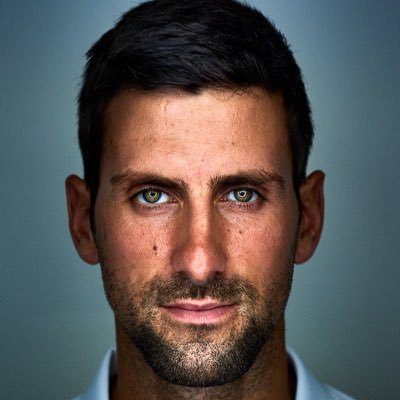
Alcaraz debuted some serve technique tweaks at Laver Cup. I tried to unpack them below.
Short version is that he managed to lower the toss and speed up the motion without sacrificing the length of his swingpath. Also revamped preparation for reasons less clear.
(VIDEO⬇️)

Thread_of_Order retweeted
Things like spin rates and groundstroke speed often get shown on broadcast but they're pretty incomplete in isolation. But if you capture each stage of a groundstroke you start to get a much fuller picture of the shot and the differences. For e.g it'll probably surprise people that Medvedev, one of the flatter forehand hitters, has the highest avg forehand net clearance of the Top 10. But he makes contact from further back, hits the ball more slowly than his peers, and yet still lands his shots pretty deep (reduced magnus effect forcing ball down compared to higher-spin peers). It's a pretty distinct shot shape to most of the rest of the top 10 and it's also a good example of how different contact inputs (contact point, speed, spin) can affect the outputs (net clearance and depth)

Thread_of_Order retweeted

Incredible stat: In the history of the ATP rankings, no man has won multiple Grand Slams in a season without recording at least EIGHT top 10 wins during that year
Alexander Zverev currently has TWO top 10 wins in 2026

Thread_of_Order retweeted

The camera panning from the clock at 0:07 to Pierce Brosnan.
Absolute cinema.
Thread_of_Order retweeted

Massive tennis ball rant incoming.
After playing Washington, Cincinnati, and the US Open, plus a full week of training in New York beforehand, I got a VERY good feel for the Wilson US Open balls we were using and know EXACTLY what they should feel like off my racket. They were good balls, and I have no complaints about what we played with at those tournaments this summer.
But since coming home, my last two days of practice with Wilson US Open balls have been miserable. They are sold, marketed, and labeled as the same balls, but the way they come off my racket and feel couldn’t be more different.
After that many weeks using the tournament balls, I know exactly how they respond. The balls I’m practicing with feel like literal green-dot kids’ balls: incredibly soft, dead, and going nowhere. I’m playing on a court with a similar speed to the courts at the Open as well just to be clear. I’ve tried balls from multiple cases to rule out a bad batch, and unfortunately, it’s been the same across the board. Other players I’ve spoken to since the Open have described the same thing.
The amount of effort I have to use to just produce a regular rally ball with these balls is insane. I’m having to throw my whole body into shots and swing out of my shoes just to produce a solid rally ball. Beyond being frustrating, it feels like it’s creating bad habits (I would never swing this aggressively normally or else I’d sent balls to the back fence or mistime every other shot) I’m having to adjust the way I hit just to compensate for a ball that behaves nothing like the one we use in competition.
That leads to the obvious the bigger issue and the reason for the rant: we need to be able to train with the same balls we compete with, and in the past I feel like this wasn’t usually an issue.
It didn’t used to feel this way. There was consistency, and any small differences could usually be explained by the court or conditions. Over the last year and a half, though, I’ve noticed such a significant difference between retail balls from both Wilson and Dunlop and their tournament equivalents, which are supposed to be identical, that it completely changes how you want to construct points and take risks on shots and just play points in general. I’m not exaggerating it really is making that big of a difference at the pro level.
The only positive I can take out of playing with these balls the last couple days is that it takes such more extra effort in every shot i hit at least it has been good cardio consistently having to swing so hard all the time 😂
It’s disappointing that this has started to feel normal. Training is a lot less enjoyable, and a lot less productive, when you’re spending it practicing with balls that are so different from what you’ll use when it matters.
Okay, rant over. Everyone go enjoy watching the rest of the Open :)
Thread_of_Order retweeted
At 7-5, 6-3, 5-3... Michelsen was 4 points away from winning the match and Tiafoe was a minimum 64 points away
Tiafoe won the match
There is no sport like tennis



Thread_of_Order retweeted

He visto el último set del Alcaraz-Shelton y lo que más me impresiona no es que un tío que se ha pegado 4 meses sin jugar un partido llegue en su primer torneo a cuartos del US Open, se vaya al supertiebreak tras ir 2-1 abajo en sets y llegue a estar minibreak arriba.
Lo que más me impresiona es que después de todo eso acaba perdiendo y el tío sale con una sonrisa de oreja a oreja. Es que ves la imagen sin contexto y piensas que ha ganado. Hay que tener una cabeza privilegiada para eso.
Y haber echado mucho de menos el tenis, claro. Aunque menos de lo que el tenis le ha echado de menos a él 🥚🥚

