
Salafi, Sunni, Muslim Shaykh Nasir Al-Fahd, Shaykh Ali Al-Khudair, Shaykh Ahmad Al-Khalidi, Shaykh Sultan Al-Utaybi, Shaykh Ahmad Jibril
0
Joined October 2026
- Tweets25
- Following1
- Followers204
- Likes6
Seeking Judgement from Taghut is Kufr and Shirk - Qadi Iyyad
Al-Qāḍī said:
“Seeking judgment from the Ṭāghūt must be considered Kufr, and not being pleased with the judgment of Muhammad ﷺ is Kufr, for several reasons”
First reason:
His statement:
“They wish to seek judgment from the Ṭāghūt, while they have been commanded to disbelieve in it.
He thus made seeking judgment from the Ṭāghūt the opposite of Kufr in it. This necessitates that seeking judgment from the Ṭāghūt is Kufr in Allah, just as Kufr in the Ṭāghūt is Imān
in Allah.”
Second:
His statement, the Most High:
“But no, by your Lord, they will not believe until they make you (O Muhammad) judge concerning that over which they dispute among themselves, and then find within themselves no discomfort concerning what you have judged, and submit with full submission.”
[Sūrah al-Nisāʾ, 4:65]
This is an explicit text concerning the Tākfir of the one who is not pleased with the judgment of the Messenger ﷺ.
Third:
His statement, the Most High:
“So let those who oppose his command beware, lest a trial strike them or a painful punishment befall them.”
[Sūrah al-Nūr, 24:63]
These verses indicate that whoever opposes anything from the commands of Allah and His Messenger has departed from Islam, whether his opposition stems from dount or from defiance and rebellion.
This establishes the correctness of the position adopted by the Companions (may Allah be pleased with them) concerning their judgment that those who withheld zakāh were Murt@ddeen.

Refutation of Lajnāh Ad-Daimah on beliefs of Apostate Madakhilah
A Thread 1🧵
Article put forwarded by Lājnah in refutation of Ali Al-Halabi one of the heads of Ridda of this Era:
“And whoever does not judge by
what Allah has revealed — it is they who are the disb€lievers.” (1)
This category is also encompassed by that distinction, as indicated by his statement (may Allah be pleased with him) concerning the verse: ‘Disb€lief lesser than disb€lief (Kufr dūna Kufr).’ He also said: ‘It is not the disb€lief that you are referring to.’
This is when a person's desires and personal inclinations lead him to judge a particular case by other than what Allah has revealed, while he nevertheless believes that the judgment of Allah and His Messenger is the truth, and acknowledges that he himself is in error and has deviated from guidance.
Even if this disb€lief does not expel him from the religion, his disobedience is nevertheless a tremendous sin, greater than the major sins such as fornication, drinking alcohol, th€ft, a false oath (al-yamīn al-ghamūs), and other similar sins. This is because an act of disobedience that Allah has designated as disb€lief in His Book is greater than an act of disobedience that He has not designated as disb€lief.
As for Shaykh Muhammad ibn Ibrahim (may Allah have mercy upon him), based on the previously quoted passages, he considers judging by French, American, British, and other man-made laws to be among the greatest and most comprehensive forms of major disbelief in belief (Kufr I‘tiqādī), which expels a person from the religion. It is also among the clearest forms of opposition and defiance towards Allah and His Messenger.
(1) Surah al-Mā'idah, 5:44.
(2) What Shaykh Muhammad ibn Ibrahim means by Kufr I‘tiqādī is broader than what al-Halabi assumes when he restricts disbelief to rejection and denial. This is because the term I‘tiqād (belief) encompasses what is in the heart, both its statements and its actions.
The statement of the heart is affirmation and conviction, while the action of the heart is submission, compliance, and acceptance.
Therefore, making man-made laws the source of judgment and placing them in the position of Allah's Shariah contradicts submission and acceptance of the heart, regardless of whether the person making judgments according to these laws believes that they are superior to the Shariah or whether he believes that the Shariah is superior to them.
The following points demonstrate that this is what Shaykh Muhammad ibn Ibrahim intended:
A. In the preceding four categories, he explained matters relating to a judge who rules by other than what Allah has revealed, including:
— Denying the superiority and legitimacy of the judgment of Allah and His Messenger.
— Preferring the judgment of other than Allah over Allah's judgment.
— Considering the judgment of Allah equal to other judgments.
— Permitting judgment by other than what Allah has revealed.
However, when he came to the fifth category, he did not mention any of these qualifications.
B. Shaykh Ibn Ibrahim (may Allah have mercy upon him) stated in Al-Fatāwā (12/280 and 6/189):
“As for the one who establishes laws, arranging and systematizing them, this is disb€lief, even if they say:
‘We have made a mistake, and the judgment of the Shariah is more just.’”
He also stated in Al-Fatāwā (6/189):
“If someone who judges by man-made law says, ‘I believe that it is false,’ this has no effect. Rather, this amounts to setting aside the Shariah, just as if someone were to say, ‘I worship idols, but I believe that they are false.’”
The practical disb€lief (Kufr ‘Amalī) that does not expel a person from the religion, according to this distinction, is when someone judges a particular case — without establishing a system of codified laws (1) — while believing that the judgment of Allah and His Messenger is the truth and acknowledging his own error and deviation from guidance.


It should be noted that the Jews considered this act atleast to be zinā, an unlawful act regardless of whether the offender was a person of high or low social standing. However, under the laws of our time, it is only classified as zinā when the aforementioned conditions and restrictions are fulfilled.
As for the statement of al-Bara' (may Allah be pleased with him), concerning the disbelievers as a whole, the principle is that consideration is given to the generality of the wording, not the particularity of the occasion. Although the occasion of revelation concerned the disb€lievers, the intended meaning encompasses all people, Muslims and disbelievers alike.
Furthermore, he was opposed in this interpretation by another Companion, namely Hudhayfah ibn al-Yaman (may Allah be pleased with them both), who said concerning the statement of Allah:
“And whoever does not judge by what Allah has revealed — it is they who are the disb£lievers.”
He said:
“How excellent are the brothers Banu Isra'il for you! You have all the sweetness while they have all the bitterness. By Allah, you will certainly follow their path, even to the extent of a sandal strap.”
Reference: Tafsir al-Tabari, narration no. 12033.
Note: Apply this same reasoning to the remaining rulings that have been altered and distorted.
Furthermore, in those countries that govern through man-made laws, even the rulings of Islamic Shariah that are implemented there do not possess binding legislative authority until they are presented before the National Assembly, Parliament, or another legislative body and approved by it.
So tell me, by your Lord: Who holds the authority of judgment here? Allah, or these people?!
One of the foundations of their constitution is that legislative authority belongs to the ruler or president, rather than Allah. Exalted is Allah far above what the wrongdoers say!
---
Written by: Muhammad ibn Salim al-Dawsari
Forwarded by:
- Murt@dd Salih al-Fawzan
- Murt@dd Sa'd al-Humayd
- Abdullah ibn Jibrin
- Abdul Aziz al-Rajihi
- Shaykh Abdullah al-Sa'd
So where does this stand in comparison to what al-Halabi has claimed? Is this anything other than a distortion of the intended meaning of Shaykh Muhammad ibn Ibrahim (may Allah have abundant mercy upon him)?
It is also important to point out that al-Halabi — may Allah guide him — turned away from the clear and decisive statements of Shaykh Muhammad ibn Ibrahim and instead resorted to isolated phrases taken from here and there.
This is truly astonishing. How can someone abandon a treatise specifically written on this subject, containing its foundational principles, systematic explanations, and detailed classifications, and instead turn to scattered statements that appeared incidentally in another treatise or a response written under particular circumstances? And then make those scattered statements override the clear and explicit ruling?!
Why should we go so far when the students of Shaykh Muhammad ibn Ibrahim are still among us today, conveying the position of their teacher that I have explained to you?
Among them is one of his foremost students, His Eminence Abdullah ibn Abd al-Rahman al-Jibrin. He issued a handwritten fatwa in response to one of al-Halabi's associates, who had attributed to the Shaykh something he had never said.
Here is the text:
(1) This is because, had it been a matter of codification, it would have been included under the fifth category of the first section. Shaykh Muhammad ibn Ibrahim (may Allah have mercy upon him) clarified this in Al-Fatāwā (12/280 and 6/189), where he stated:
“As for the case concerning which it was said, ‘Disb€lief lesser than disb€lief,’ this is when someone brings judgment from other than Allah while believing that he is disobedient and that the judgment of Allah is the truth. This is what occurs from him once or something similar.But as for the one who establishes laws, arranging and systematizing them, this is disb€lief, even if they say:
‘We have made a mistake, and the judgment of the Shariah is more just.’”
They have neglected the fact that this issue concerns Tawheed of Allah Allah, the Almighty, in judgment and legislation. What, then, is their position regarding this matter? What is the extent of their belief in it? And what is the ruling concerning someone who contests Allah, the Almighty, in this right?
Is it permissible or acceptable for any of Allah's creation to share in His authority of judgment?
If they say, ‘Yes,’ then they have cast off the bond of Islam from their necks.
But if they say, ‘No,’ we say to them: Then what is this that some of the rulers of our time are doing? What should it be called?
Allah, the Almighty, declares fornication unlawful, while those rulers enact and codify a law that contradicts — indeed, directly opposes — this ruling. According to their law, if fornication takes place with the consent of both parties, provided they have reached the legally recognised age of adulthood, there is no offence and no Hadd for those involved.
Furthermore, unl@wful sexual intercourse is not even classified as zinā under their law from the outset unless it occurs under the specific conditions and restrictions mentioned earlier.
Their law holds that prosecution in such cases is a right belonging exclusively to the husband, and permits him to intervene to stop the proceedings at any stage of the trial. He may even intervene to halt the Hadd (1) after the final judgment has been issued (2).
So, who holds the authority of judgment here? Allah, or these rulers?!
What greater act of challenging Allah's authority could there be than this?!
And what difference is there between their conduct and that of the Yahud concerning whom Allah revealed:
“And whoever does not judge by what Allah has revealed — it is they who are the disb€lievers.” (Surah al-Mā'idah, 5:44)

Imam Taqiuddin al-Hilali wrote in his Tafsir:
Imam Ibn Kathir said:
“The verse condemns those who turn away from the Book and Sunnah and seek judgment from other than them in falsehood intended by T@ghut in this verse.”
Allah says:
﴿وَقَدْ أُمِرُوا أَن يَكْفُرُوا بِهِ﴾
“Although they were commanded to disbelieve in it.”
Meaning: In the T@ghut. This is evidence that seeking judgment from the T@ghut is contrary to and opposed to faith. Faith is not valid except through disbelief in it and abandoning recourse to it. Whoever does not Kufr in the T@ghut has not believed in Allah.
Allah says:
﴿وَيُرِيدُ الشَّيْطَانُ أَنْ يُضِلَّهُمْ ضَلَالًا بَعِيدًا﴾
“And Satan wishes to lead them far astray.”
This is because the desire to seek judgment from other than the Book of Allah and the Sunnah of His Messenger is an act of obedience to Sh@ytan. He only calls his followers so that they may become inhabitants of the bl@ze.
The verse contains evidence that abandoning Tahakkūm the T@ghut—which is everything other than the Book and Sunnah—is an obligation, and that the one who seeks judgment from it is neither a believer nor even a Muslim.
Allah says:
﴿وَإِذَا قِيلَ لَهُمْ تَعَالَوْا إِلَىٰ مَا أَنْزَلَ اللَّهُ وَإِلَى الرَّسُولِ رَأَيْتَ الْمُنَافِقِينَ يَصُدُّونَ عَنْكَ صُدُودًا﴾
“And when it is said to them: ‘Come to what Allah has revealed and to the Messenger,’ you see the hypocrites turning away from you with aversion.” [An-Nisa 4:61]
Meaning: When they are called to seek judgment according to what Allah has revealed and to the Messenger, they turn away arrogantly.
Allah also says:
﴿وَإِذَا دُعُوا إِلَى اللَّهِ وَرَسُولِهِ لِيَحْكُمَ بَيْنَهُمْ إِذَا فَرِيقٌ مِنْهُمْ مُعْرِضُونَ﴾
“And when they are called to Allah and His Messenger so that he may judge between them, a group of them immediately turns away.” [An-Nur 24:48]
Imam Ibn al-Qayyim said:
“This is evidence that whoever is called to have the Book and Sunnah judge between them, but refuses to comply, is among the hypocrites.”
The word *يَصُدُّونَ* here means turning away; it does not mean preventing others. This is why its verbal noun is *صُدُودًا*, whereas the verbal noun of the transitive form is *صَدًّا*.
So, if Allah, Glorified is He, has judged those who turn away from this to be hypocrites, then what about the one who goes further than merely turning away, by preventing people from having the Book and Sunnah judge between them and from seeking judgment according to them, through his words, actions, and writings?
Then, despite all this, he claims that he only intended goodness and reconciliation. Was there goodness in his doing this? Or was he supposedly seeking reconciliation between the T@ghut whose judgment he upheld and the Book and Sunnah?

Ridda of one who joins army of Mushrikeen
Abu ʿUbayd said: Ibn Bukayr narrated to us, from Ibn Lahīʿah, from Yazīd ibn Abī Ḥabīb, that Abū ʿAlī al-Hamdānī narrated to him:
“They were accompanying Faḍālah ibn ʿUbayd (رضي الله عنه) at sea when a Muslim man who had fled to the enemy was brought before him. He was offered Islam, so he accepted Islam. Then he fled a second time, and was brought before him, and Islam was offered to him, so he accepted Islam again. Then he fled a third time, and was brought before him, whereupon he رضي الله عنه recited
Surah al-Nisāʾ (4:137):
“Indeed, those who believed, then disb£lieved, then believed, then disb£lieved, and then increased in disb£lief — Allah would never forgive them, nor guide them to a way.””

Judging by Man-Made Laws is Shirk
Shaykh Abd Al-Rahman Hassan said:
"It is well known that people differ in how fully they fulfil Tawḥīd. Its true meaning is to sincerely devote the entire religion to Allah alone.
Negation in this Tawḥīd is accompanied by affirmation. This means that you establish in your heart that Allah alone is worthy of worship and reject the worship of everything besides Him.
Thus, you combine negation and affirmation, saying:
Lā ilāha illā Allāh — There is no deity worthy of worship except Allah.
Negation: Rejecting the divinity of everything besides Allah.
Affirmation: Affirming that Allah alone is worthy of worship....
Its true reality also entails Tahakumm (seeking Judgement) from Allah alone, rejecting turning to anything besides Him for Tahakkūm, and bringing disputes before Him rather than before anything besides Him.....
(3) Judging by Man-Made Laws, in whatever form, is a type of shirk that nullifies the meanings of the word of Tawḥīd. It is a blatant violation of Allah’s exclusive authority to legislate, and a grave transgression against the attributes exclusive to divinity. This is in addition to the severe injustice they entail and their deficiencies, which are characteristic of every human undertaking."

Taking Laws from other than Prophets is greatest form of Shirk
Imām Ibn Ḥazm (رحمه الله) said:
“Thus, if they (Christians) deny the existence of prophethood after him (Jesus, peace be upon him), while Laws can only be received from the Prophets (peace be upon them)—for otherwise, whoever legislates them independently of the Prophets (peace be upon them) would be setting himself up as a judge over Allah Most High, and this is among the gravest forms of associating partners with Allah (shirk), falsehood and absurdity—then their laws, which is their Deen are not derived from any Prophet whatsoever.”
📕 Al-Fiṣal fī al-Milal wa-l-Ahwāʾ wa-l-Niḥal 1/130

Shaykh ʿAbd al-Laṭīf Āl al-Shaykh’s Position on Ḥākimiyyah
I have seen Madkhali Nusayri Murtaddeen attributing their Pagan religion to this noble Imam.
As Allah, ʿAzza wa-Jall, says:
“Indeed, the worst of living creatures in the sight of Allah are the deaf and dumb who do not use reason.” (Qur’an 8:22)
“Had Allah known any good in them, He would have made them hear. And even if He had made them hear, they would still have turned away, refusing.” (Qur’an 8:23)
1. Tākfir of one who does Istibdal of Shari‘ah
Shaykh Abdūl-Latif Al-Shaykh said:
“So examine the reports of those who came before them.
They abandoned the Book and replaced it (Istabdalū).
And they replaced their ways because of their deviation (Istabdalū).
And likewise, they replaced the glorification of our Lord, Glorified be He, with insults (Istabdalū).
What did they see in the leaders of disbelief?
They replaced the divine law with that tyrannical law (Istabdalū).
They replaced the teachings with legislation from Satan (Istabdalū).
They replaced the worship of the Most Merciful with ignorance and the setting up of rivals to Him (Istabdalū).
They replaced His rulings in people's minds (Istabdalū).
And they replaced faith with disbelief (Istabdalū).
They accepted the rule of a state that opposed them.
And they replaced His revelation with laws that contradicted it (Istabdalū).”
2. Takfir of one who seeks Judgement (Tahakkūm) from other than Shari‘ah
Shaykh ʿAbd al-Laṭīf ibn ʿAbd al-Raḥmān was also asked:
“What is the ruling regarding the people of the sawālif (traditional customs) among the Bedouins and others, who judge according to the customs of their fathers and forefathers? Are they declared disbelievers on that basis after the clarification has been made, and so on?”
He replied:
“Whoever seeks Judgement from other than the Book of Allah and the Sunnah of His Messenger, after the clarification has been given (that his customs oppose Shari‘ah), is a Kafir.
Allah, the Most High, said:
‘And whoever does not judge by what Allah has revealed, then it is those who are the disbelievers.’ (Al-Mā’idah 5:44)
And Allah, the Most High, said:
‘So is it other than the religion of Allah that they seek?’ (Āl ʿImrān 3:83)
And Allah, the Most High, said:
‘Have you not seen those who claim that they have believed in what was revealed to you and what was revealed before you? They wish to seek judgment of Ṭāghūt, while they were commanded to reject it…’ (An-Nisāʾ 4:60)
And Allah, the Most High, said:
‘And We certainly sent into every nation a messenger saying, “Worship Allah and avoid Ṭāghūt.”’ (An-Naḥl 16:36)
And there are many verses conveying this meaning.”
3. Takfir of one who attends Parliement and Legislative Councils
“Among the greatest of sins and misguidance that nullify the asl of Islam is supporting the enemies of Allāh...
Included in the first category are also attending gatherings in which the rulings of Allah and the rulings of His Messenger are opposed, judgment is made according to the laws of the Franks, the Christians, and those who abolish or reject the truth, and one witnesses mockery of the rulings of Islam and its people.”
4. Takfir of Judges of Constitution and Man-Made Laws
Shaykh ʿAbd al-Laṭīf Āl ash-Shaykh writes in response to Muḥammad ibn ʿAjlān:
❝As for you permitting seeking aid from them [the mushrikīn] — the dispute is not [only] regarding this particular issue, but rather in appointing them, bringing them, and establishing them in an Islamic land wherein they destroy the symbols of Islām, the foundations of the religion, and the principles (ʾuṣūl) and branches (furūʿ) of the religion.
Among their leaders [of the mushrikīn who are brought in] there exists a law and a ṭāġhūt that they have established to judge between the people concerning blood, wealth, and other matters — opposing and contradicting the revealed texts (nuṣūṣ).


Truthwillremain retweeted

Imām ibn Al-Qayyim said:
231 — So if they call you to anything other than the arbitration of the two arbiters ( Quran and Sunnāh) , then do not listen to the caller to Kufr and disobedience.

Seeking Judgment (Taḥākum) from Other Than the Sharīʿah Is Seeking Judgment from Ṭāghūt
Allah سبحانه وتعالى says:
﴿ يُرِيدُونَ أَن يَتَحَاكَمُوا إِلَى الطَّاغُوتِ وَقَدْ أُمِرُوا أَن يَكْفُرُوا بِهِ ﴾
“They wish to seek judgment of Ṭāghūt, while they have been ordered to Disbelieve in them.”
[Sūrah An-Nisāʾ 4:60]
Imām Ibn al-Qayyim al-Jawziyyah رحمه الله stated:
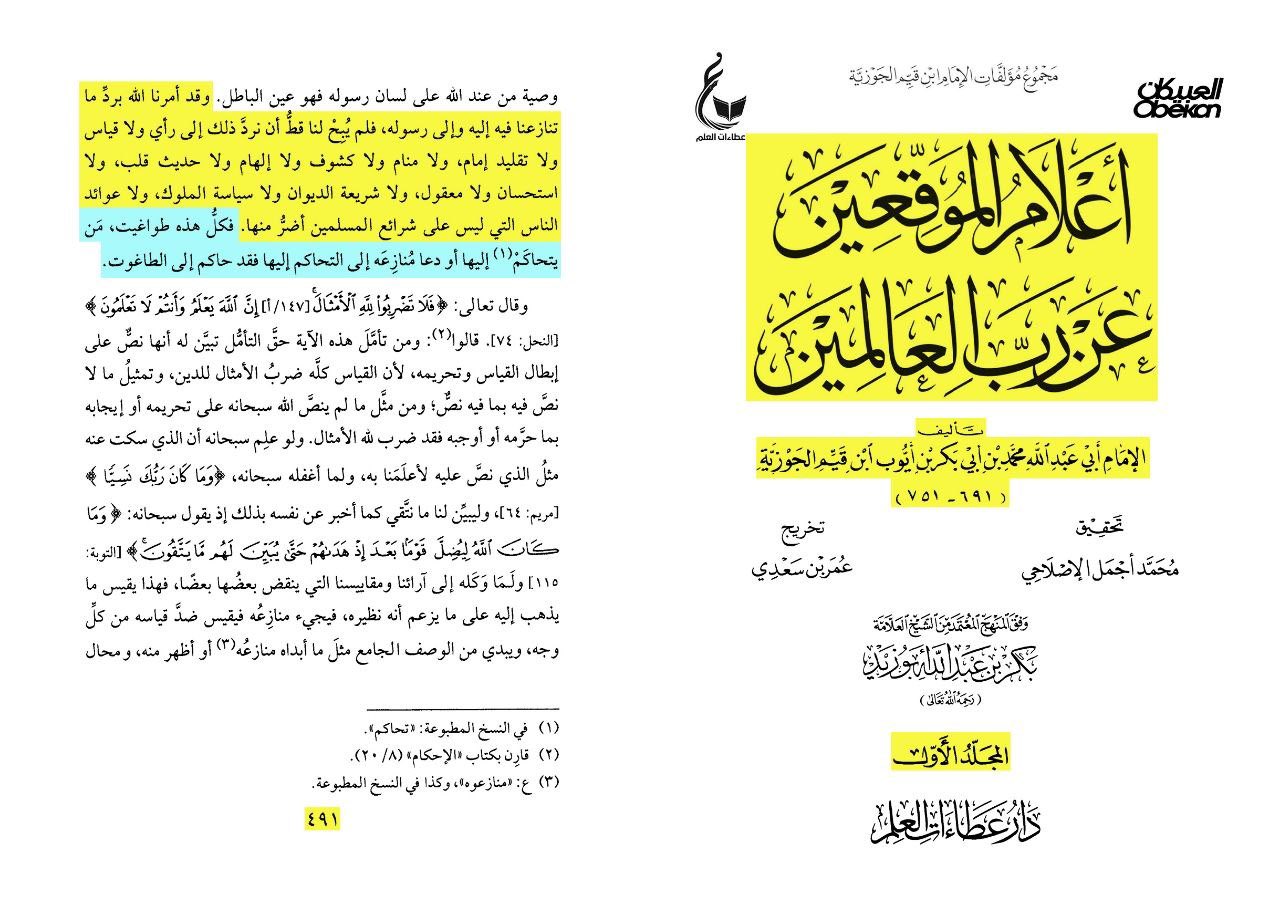
“Allah has commanded us to refer whatever we dispute over back to Him and to His Messenger. He has never permitted us to refer such matters to personal opinion, analogy, or the blind following of an imam; nor to dreams, mystical unveilings, inspiration, what one’s heart tells them, juristic preference, rational judgment, the laws of the state, the policies of kings, or the customs of people—among which there is nothing more harmful to the laws of the Muslims than these customs.
All of these are Ṭawāghīt (false authorities to whom judgment is referred). Whoever submits to their judgment, or calls upon his disputant to seek their judgment, has indeed sought judgment from Ṭāghūt.”
• So one who legislated Lāws in opposition to Shari‘ah is Taghut
• One who set up Man-Made Courts in opposition to Shari‘ah is a Taghut
• Judge who puts these Laws forward for disputing parties to seek Judgement from is a Taghut
• One who enforces the authority of these Courts binding people to refer Judgement to them from police and soldiers are soldiers of Taghūt and Shirk
Once you understand this, you would will know that Kufr Duna Kufr is restricted to individual court Judgement, that does not become a reference for people to seek Judgment from
And Madkhalis and their likes are Murtaddeen who defend and cement the thrones of Tawaghīt, and these Murtaddeen have came into obedience to Taghut whose rule they consider Islamically valid
Truthwillremain retweeted
Ruling by Man-Made Law is Shirk
Imam Al-Hajjawi in book of Huood:
"The copies of this Tawrah are altered and it is not permissible to act according to anything in them.
Whoever acts today according to its altered and abrogated sharāʿiʿ, he is a k@fir."

Abd Al-Aziz Ar-Rayyis refutes Saleh Al-Shaykh on Hakimiyyāh
"Saleh Al-Shaykh was mistaken to make Takfir on all the governments because they do not rule by Shari‘ah"
Ruling by other than Shari‘ah is Major Kufr
Shaykh ʿAbdullāh ibn Muḥammad ibn ʿAbd al-Wahhāb رحمه الله said:
“The action of this man who assaulted the man he found in the house is forbidden. It is an act of transgression and injustice. He must be disciplined and punished with a discretionary punishment (taʿzīr) sufficient to deter him and others like him from committing such an act.
He is also liable to legal retribution (qiṣāṣ) where retribution is applicable, and blood money (diyah) where retribution is not possible—unless the injured party agrees to accept blood money in place of retribution in all cases.
As for the accused man, the most that the ruler may do is discipline him through a discretionary punishment, such as beating or imprisonment, according to his judgment. Anything beyond that is injustice, transgression, and a violation of the limits set by Allah.
If the assailant denies causing some of the injuries while admitting to others, the burden of proof rests upon him regarding his claim that someone else participated in causing those injuries. If he cannot produce evidence, then the statement of the injured party, supported by an oath, is accepted regarding the attribution of those injuries to that particular individual, in view of the circumstantial evidence indicating that all of them were caused by this assailant.
Every believer must be pleased with the judgment of Allah and His Messenger ﷺ, and must find no resistance within himself toward what Allah and His Messenger have decreed, whether it agrees with his desires or opposes them.
Whoever has sickness or hypocrisy in his heart submits to the Sharīʿah when it agrees with his desires, but opposes it when it conflicts with his desires and customs. This is among the hallmark of the hypocrites, concerning whom Allah said:
‘Have you not seen those who claim that they believe in what has been revealed to you and what was revealed before you? They wish to refer judgment to Taghut, even though they were commanded to reject them. Satan wishes to lead them far astray.’
— Qur’an 4:60
Whoever seeks a judgment other than that of Allah and His Messenger has sought the judgment of ṭāghūt.
And how astonishing it is that a person hears words of disbelief and hypocrisy in his gathering (ie Judge judging by other than Shari‘ah), yet does not condemn the one who speaks them. Rather, he remains silent, thereby becoming a partner in the wrongdoing.”

Imam Bukhari that one who seeks to change the Lāws of Islam is a Murtadd
Abu Bakr رضي الله عنه held the view that those who withheld Zakat should be fought. Umar رضي الله عنه said,
“How can you fight them when the Messenger of Allah ﷺ said:
‘I have been commanded to fight the people until they testify that there is no god worthy of worship except Allah. When they say,
“There is no god worthy of worship except Allah,” they have protected their lives and their wealth from me, except when there is a right due upon them.’
Abu Bakr then said,
‘By Allah, I will certainly fight anyone who separates (by adhering to one and withholding the other) what the Messenger of Allah ﷺ had joined together.’
Thereafter, Umar followed Abu Bakr’s position.
Abu Bakr did not give accepted consultation in this matter because he had the verdict of the Messenger of Allah ﷺ concerning those who separated prayer from Zakat and sought to change the Religion and its Lāws.
The Prophet ﷺ said:
‘Whoever changes his religion, k¡ll him.’”
Indeed, بديل (badīl) is general term, for leave something for another, so whoever leaves Islām for another Religion, or leaves off part of Islam for another Shari‘ah, or leaves off part of religion by withholding it comes under this hadith regarding Murtadd

Ruling by other than Shari‘ah is Major Kufr
Shaykh Abd Ar-Rahman bin Hassan Al-Shaykh said:
“Whoever calls to seeking judgment by other than Allah and His Messenger ﷺ:
He has made a partner with Allah in obedience and opposed what the Messenger ﷺ was commanded by Allah to do, in His saying:
“And judge between them by what Allah has revealed, and do not follow their desires, and beware of them lest they tempt you away from some of what Allah has revealed to you.” [Al-Ma’idah: 49]
And His saying, Exalted is He:
“But no, by your Lord, they will not truly believe until they make you judge concerning that over which they dispute among themselves, then find within themselves no discomfort concerning what you have judged, and submit in full submission.” [An-Nisa’: 65]
Whoever opposes what Allah and His Messenger have commanded by judging between people by other than what Allah has revealed, or by seeking such judgment in pursuit of what he desires and wants, has cast off the bond of Islam and faith from his neck, even if he claims to be a believer.
For Allah, Exalted is He, condemned those who wanted that and declared them false in their claim to faith, as implied by His saying, “They claim,” which negates their faith. For the word “claim” is generally used for someone whose assertion is false, due to his contradiction of what that assertion requires and his acting in a manner incompatible with it.
This is further confirmed by His saying: “Although they were commanded to reject it,” for rejecting false deities is a pillar of Tawhid, as stated in the verse in Surah Al-Baqarah. If this pillar is not fulfilled, a person is not a monotheist.
Tawhid is the foundation of faith, through which all deeds are sound and in whose absence they become corrupt.
This is also made clear in His saying, Exalted is He:
“So whoever rejects false deities and believes in Allah has grasped the firmest handhold…” [Al-Baqarah: 256]
That is because seeking judgment from the Taghut constitutes belief in it.
And His saying:
“And Satan wishes to lead them far astray.”
In this verse, Allah explains that seeking judgment from the Taghut is something Satan commands and makes attractive to those who obey him. He also explains that this is among the means by which Satan leads astray those whom he misguides. He emphasizes it with the verbal noun and describes it as far-reaching, indicating that this is among the greatest forms of misguidance and the furthest from guidance.
Thus, this verse contains four matters: first, that it is the will of Satan; second, that it is misguidance; third, that it is emphasized by the verbal noun; and fourth, that it is described as being far from the path of truth and guidance.
Glory be to Allah! How magnificent this Qur’an is, how eloquent it is, and how clearly it demonstrates that it is the speech of the Lord of all worlds, revealed to His noble Messenger and conveyed by His truthful and trustworthy servant. May Allah’s peace and blessings be upon them both.
His saying:
“And when it is said to them, ‘Come to what Allah has revealed and to the Messenger,’ you see the hypocrites turning away from you in aversion.”
Allah, Exalted is He, explains that this is a characteristic of the hypocrites, and that whoever does this or seeks it, even if he claims to be a believer, is extremely far removed from faith.
The eminent scholar Ibn al-Qayyim, may Allah have mercy on him, said:
“This is evidence that whoever is called to make the Book and the Sunnah the basis of judgment and refuses is among the hypocrites.”
