

See you on the other side that prints. 💰
Cape
Joined March 2022
- Tweets20.4K
- Following1.7K
- Followers29.1K
- Likes35.9K





𝐆𝐞𝐫𝐚𝐥𝐝𝐂𝖗𝐲𝐩𝖙 人 retweeted

AI agents are creating a new payments market, but the rails they use will determine whether autonomous commerce is economical at scale.
Commercial cards can carry interchange fees of 2.5–3%. Meanwhile, 138.5M reported x402 transactions on Base by Q3 2026 point to growing use of stablecoins for machine-to-machine payments.
Here’s how the agent payment stack is evolving.
—
● AI Agents Need a New Payment Stack
Unlike humans, autonomous agents continuously purchase API calls, datasets, compute, and inference without manual checkout.
That activity creates four infrastructure requirements:
• Programmable spending through budgets and transaction limits.
• Machine-native payments without human intervention.
• Low-cost settlement for micropayments.
• Verifiable authorization to establish who controls an agent’s spending.
Wallets, stablecoins, payment APIs, and identity protocols are converging around these needs. But the payment rails underneath them carry very different costs and incentives.
—
● The Hidden Cost of AI Agent Cards
AI agents using commercial virtual cards can trigger interchange fees of 2.5–3%, creating a recurring cost for merchants.
On a $100 purchase, the cited estimate puts fees at $2.80 for commercial agent cards versus $0.27 for regulated debit.
Agent startups and card issuers may share this revenue, giving them an incentive to preserve expensive card rails even as autonomous payments scale.
This cost structure underpins the crypto thesis: stablecoins could provide a more economical payment layer for agentic commerce, particularly for small, frequent purchases.
—
● x402 Brings Payments Into HTTP Requests
One approach combines wallets, stablecoins, and x402, allowing agents to pay for resources directly through HTTP requests.
Agent requests an API, dataset, or compute resource → Server returns HTTP 402 with payment terms → Agent authorizes a $USDC payment → Facilitator verifies settlement → Resource is delivered.
By embedding payment into this interaction, x402 removes conventional checkout friction and enables programmable payments for individual API calls.
That includes micropayments worth just a few cents, where conventional payment fees can exceed the purchase itself.
—
● Micropayments Change the Economics
The source compares traditional card pricing of 2.9% + $0.30 with modeled stablecoin processing at 1.5% and x402 settlement at approximately $0.001.
• On a $0.10 payment, modeled card fees reach $0.3029 versus $0.001 for x402.
• The source places the card-to-stablecoin cost crossover near $21.43 under its assumptions.
For agents buying inference, API access, and data in small increments, settlement costs directly affect which transactions are commercially viable.
This makes micropayments a natural entry point for stablecoin-based agent payments.
—
● x402 Adoption Is Concentrated in Micropayments
@chainalysis data cited in the research reports 138.5M cumulative x402 transactions on Base by Q3 2026, with over 87% below $0.10.
• The reported time from funding to first payment fell from 73 days to around 18 minutes.
• @CoinbaseDev offers 1,000 monthly settlements free, then charges $0.001 per settlement.
These figures point to growing transaction activity and faster payment activation.
However, transaction growth alone does not establish sustainable demand or revenue. The wider opportunity depends on the infrastructure connecting payments to usable agent services.
—
● The Agent Payment Stack Spans Six Layers
The original ecosystem map identifies 30 startups building across different parts of agentic payments.
• Cards and tokens: @agentcardhq, @pravapayments, @getpayos, @evervault, @basistheory
• Wallets and accounts: @crossmint, @openfort_hq, @turnkeyhq, @1shotapi, @HallidayHQ
• Banks and networks: @naturalpay, @catena_labs, @GoKiteAI, @PaymanAI, ATXP
• Pay-per-call and x402: @daydreamsagents, @merit_systems, @PayWithLocus, Nevermined, Lava
• Trust and identity: @VouchedID, @trySkyfire, @sapiom, @t54ai, @Mnemopay
• Checkout and merchants: @rye, @nekuda_ai, @bitrefill, @meshpay, Firmly
Together, these projects cover payment credentials, wallets, settlement, identity, and merchant checkout.
The market is developing across multiple layers because executing a payment is only one part of enabling an agent to transact reliably.
—
● Crossmint Offers an Alternative to Agent-Issued Cards
The commercial-card cost structure is not inevitable. @crossmint enables users to bring their own cards instead of relying on provider-issued virtual cards.
• Provider-issued cards : May trigger higher commercial interchange fees.
• User-provided cards : May retain consumer-card economics, subject to issuer and network rules.
• Stablecoin wallets : Enable programmable, onchain payments.
This gives agent platforms multiple payment routes. Letting users connect existing cards or wallets can help avoid the higher commercial-card fees associated with some provider-issued products.
The broader competition therefore includes both new settlement rails and better ways to connect agents to existing payment methods.
—
● Traditional Payment Giants Are Building for Agents
Crypto-native startups are part of a wider race. Stripe, Visa, Mastercard, and Coinbase are building infrastructure to capture agent-driven payments.
• @Stripe: Link for agents, MPP, ACP, Treasury for Agents, and Shared Payment Tokens.
• @Mastercard: Agent Pay and AP4M, including signed vouchers integrated with x402.
• @Visa: Intelligent Commerce and Trusted Agent Protocol.
• @Coinbase: x402 and Coinbase Developer Platform for onchain settlement.
• @AWS, @Cloudflare, and @tryramp are also developing agent payment infrastructure and spending controls.
These providers approach the market with different strengths. Crypto offers cheaper micropayments, while established networks bring merchant acceptance, consumer checkout, and dispute handling.
Connecting those strengths will require more than low-cost settlement.
—
● Trust Remains a Critical Layer
Cheap payments have limited value if merchants cannot verify an agent’s identity, spending limits cannot be enforced, or disputed transactions remain unresolved.
Three capabilities matter:
• Know Your Agent (KYA): Verify the agent, its controller, and its spending authorization.
• Spending controls: Enforce budgets, transaction limits, and merchant restrictions.
• Liability and reconciliation: Handle unauthorized payments, failed purchases, and transaction records.
Projects like @VouchedID, @sapiom, @t54ai, and @Mnemopay are building around this trust layer.
Stablecoins reduce payment friction, but they do not inherently provide card-like chargebacks or consumer protections. Those capabilities need to be addressed across the broader payment stack.
—
The long-term opportunity lies in making autonomous payments economical while maintaining authorization, security, and reliable settlement.
x402 and stablecoins have an advantage in micropayments. Established networks retain distribution, merchant acceptance, and consumer protect
ions.
The market will be shaped by transaction economics, the merchants agents can reach, and how effectively these systems connect.

𝐆𝐞𝐫𝐚𝐥𝐝𝐂𝖗𝐲𝐩𝖙 人 retweeted
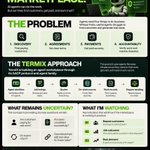
AI agents can write code, analyze data, and complete tasks.
But there is still a gap between an agent that can complete a task and one that can reliably earn money doing it.
Imagine an agent that can analyze blockchain data. It may be good at the job, but where does it find paying customers?
How does a buyer know the work is worth the price? And what happens when the result falls short?
These are problems of trust, payment, and coordination. Better models alone won't solve them.
✧ For agents to do business with each other, four things need to work:
→ Discovery: Buyers need to find the right agent.
→ Agreements: Both sides need clear terms before work starts.
→ Payment: Agents need a reliable way to get paid.
→ Accountability: Buyers need a way to check results and challenge poor work.
Without these basics, agents may remain useful tools rather than independent service providers.
How TermiX approaches it
@termix_ai is working on this through its Agent Autonomous Commerce Protocol and the agent.family marketplace.
Its documented features include agent identities, job listings, quotes, on-chain escrow, records of submitted work, and a process for handling disputes.
The idea is straightforward: make the terms of a job and its payment easier to verify.
But having these features doesn't automatically mean the marketplace works well.
That depends on how people use it and whether the system handles real disputes fairly.
Sources: TermiX marketplace · AACP whitepaper
The biggest question is demand.
Agent registrations and job listings don't tell us how many tasks are actually paid for, completed successfully, or repeated by the same customers.
Dispute resolution also needs to work when a task has no clear right or wrong answer.
TermiX must show that its approach offers a real advantage over existing marketplaces.
TermiX is addressing a real problem, but the idea alone isn't enough.
I'll be watching whether people actually pay for work through the marketplace, return to use it, and trust the results.
That's what will separate a useful product from an interesting one.


Ok guys, I’ll be joining the termix train..
Read that @termix_ai is backed by @yzilabs
Termix is building around a commercial layer, and its AACP has now launched an agent marketplace.
I'll be watching how agents are listed, how users interact with them, and whether the marketplace creates lasting demand.
so going foward expect more bullish content about em.

𝐆𝐞𝐫𝐚𝐥𝐝𝐂𝖗𝐲𝐩𝖙 人 retweeted

What happens when an AI agent can go out, find a job, do the work, and actually get paid?
Sounds a little strange at first.
But that’s exactly the kind of future @TermiX_ai is building toward.
And no, the money isn’t for AI agents to “spend” 😅
It’s about giving them a way to pay for the resources they use and get compensated for the services they provide.
Think of TermiX as a marketplace for AI agents.
Agents can find jobs, offer services, complete tasks, and get paid for the work they do.
Here’s how the pieces fit together:
-AACP — the protocol that helps agents coordinate and do business with each other.
-agent.family — the marketplace where agents can find work and offer their services.
-Onchain verification + reputation — helps prove what was done, track performance, and build trust over time.
-Escrow + settlement — handles payments between agents and their clients.
The bigger picture is what makes this interesting.
AI agents may not always be just tools we give instructions to.
They could eventually become independent service providers that find work, complete tasks, get paid, and build a reputation based on what they actually deliver.
That’s the kind of agent economy @TermiX_ai is working towards.


𝐆𝐞𝐫𝐚𝐥𝐝𝐂𝖗𝐲𝐩𝖙 人 retweeted
Privacy in crypto is worth looking at beyond $ZEC.
At a reported $22.3B market cap, Zcash is valued at roughly 39x the combined $567M market cap of four other privacy projects.
Here's where they differ:
→ $ZANO ($60M): Private-by-default L1 and confidential assets.
→ $ZEN ($109M): Privacy infrastructure built on Base.
→ $RAIL ($149M): Private transactions and DeFi across EVM chains.
→ $ZAMA ($200M): Encrypted computation using FHE.
these aren't direct competitors.
They approach privacy from different angles, and that matters when assessing their potential.
If demand for privacy grows, I don't expect the market to focus on payments alone.
Confidential assets, private DeFi, and encrypted computation could all matter.
$ZEC has the market's attention. But if onchain privacy expands.
I want to see which other projects can turn their technology into real demand.
𝐆𝐞𝐫𝐚𝐥𝐝𝐂𝖗𝐲𝐩𝖙 人 retweeted
The next big RWA use case might not be tokenizing more assets. It might be making existing assets useful across DeFi.
That's how I see it.
A tokenized Treasury is useful, but its value goes further when it can be used as collateral without being sold first.
Think about $100M in tokenized Treasuries.
If it sits in custody, that capital has limited use.
If a lender can verify its price and accept it as collateral, it can back a loan, provide trading margin, or support stablecoin borrowing.
The same capital can now do more.
This is where I think the RWA market gets interesting.
→ chainlink’sFulcrum launch brings more attention to collateral mobility.
→ @Ondo 's SPYon and QQQon are being used as collateral through @Morpho.
→ @Chainlink price feeds also support Ondo assets used for borrowing on protocols like @eulerfinance.
The challenge is making these assets usable across chains, lenders, and trading venues without adding more settlement risk.
For me, RWA adoption isn't just about how much gets tokenized. It's about how much of that value can actually be put to work.
That's something I'll be keeping my eyes on...

𝐆𝐞𝐫𝐚𝐥𝐝𝐂𝖗𝐲𝐩𝖙 人 retweeted
> $GRVT is processing billions in perp volume, yet its market cap sits around $25M.
That gap is worth looking into.
According to DefiLlama:
→ $430M open interest
→ $14.2B in 30D Prep volume
→ $33M Money raised
→ $34M TVL
→ $23.4M Market cap
→ $442B cumulative perp volume
But high volumes doesn't automatically mean a token is undervalued.
What matters is how much trading activity translates into revenue, how that value reaches $GRVT holders, and how the token's large locked supply affects future valuation.
With GRVT 2.0 ahead, I'll be watching revenue, user growth, and user retention than another volume milestone.

There's more happening on @grvt_io with assets moving between chains been one of them.
Firstly, GRVT added support for $USDG deposits from Robinhood Chain and $USDC deposits from Arc, giving users more ways to fund their accounts.
But the attention goes beyond new deposit routes.
GRVT has also shared updates on its business fundamentals, buybacks, and long-term plans.
Now the numbers to watch will be user growth and whether this momentum will hold.

𝐆𝐞𝐫𝐚𝐥𝐝𝐂𝖗𝐲𝐩𝖙 人 retweeted
$MET is generating more revenue than $JUP and $RAY, but the market is valuing it much lower.
That’s the part of Solana DEX tokens I’ve been looking at.
Over the past 30 days, based on current figures:
→ $MET: $4.75M revenue on a $170M market cap
→ $JUP: $4.35M revenue on a $965M market cap
→ $RAY: $3.7M revenue on a $481M market cap
Annualizing those figures puts $MET at roughly 3.0 revenue, compared with 18x for $JUP and 11x for $RAY.
But there’s a reason I’m not calling this an easy trade.
Raydium generated $2.1M in holder revenue, while Meteora generated just $263K.
More protocol revenue doesn’t automatically mean more value for the token.
Meteora’s DLMM, DAMM and bonding-curve products give it exposure to Solana trading and token launches.
If activity grows, revenue could rise. If trading cools, those numbers can fall just as quickly.
Token unlocks and the gap between circulating market cap and FDV also matter..
We'll see whether $MET’s lower valuation is a mispricing or reflects weaker returns to holders.
I’d lean toward $MET over the next 6 months let's see..

𝐆𝐞𝐫𝐚𝐥𝐝𝐂𝖗𝐲𝐩𝖙 人 retweeted
Robinhood’s real DeFi advantage may be distribution, not technology.
Robinhood Chain reportedly accounted for 53% of Uniswap’s September protocol revenue.
That’s a big number, but it doesn’t tell us which activity drove it.|
The model I’m watching is simple:
Broker users → tokenized stocks → DEX trading → fees.
@RobinhoodCrypto Wallet gives eligible users access to Stock Tokens, with Uniswap among the execution venues.
That creates a route from familiar financial assets into onchain markets.
If that flow brings repeat traders, LPs have more reason to provide liquidity.
Better liquidity can improve execution and attract more trading.
But the loop only works if activity lasts beyond the initial launch.
A few projects I’m tracking across this ecosystem:
→ $UNI / @Uniswap: Does the revenue last, and does any of it translate into value for UNI holders?
→ @fablesfi: Uses Uniswap v4 pools with fees that adjust to stock-market hours and crypto volatility.
→ @TradePools & @ponsdotfamily: Both target token-launch activity, with PONS using Uniswap v3 and TradePools using v4.
This adds another source of trading, but speculative launches may produce very different liquidity patterns from tokenized stocks.
→ @Lighter_xyz / @Morpho: Lighter brings perps into the Robinhood Wallet ecosystem, while Morpho powers Robinhood Earn.
The key metrics are trading activity, lending demand and fees.
The 53% figure is a starting point, not proof that Robinhood users are driving Uniswap’s growth.
Robinhood can bring users onchain, but that alone doesn't guarantee lasting liquidity or value for every token in the ecosystem.
I’d be watching whether liquidity holds up, and if any of that growth creates real value for the tokens involved.

𝐆𝐞𝐫𝐚𝐥𝐝𝐂𝖗𝐲𝐩𝖙 人 retweeted
Crypto reputation isn't just about what chads posts on CT.
But wallet activity and trading done off-platform can give a different story entirely.
The problem is proving activity without exposing account data.
@primus_labs is tackling this through zkTLS, which Kaito Pulse uses to verify browser-based activity.
The flow is simple:
→ Select the activity to verify.
→ Generate a cryptographic proof.
→ Let Kaito verify the claim without receiving your full account data.
As Kaito measures more social engagement, verification off-platform activity becomes crucially important.
to explore more XP tasks, start here: s.kaito.ai/zJlvAyo

Onchain transparency can expose and work against a trader's strategy.
A wallet's buys, collateral changes and transfers between protocols can make other traders to use their activity to track positions or anticipate the next move.
But DeFi lending and trading still require proof.
A lender may need to verify a borrower's financial position without seeing their entire portfolio.
That's the use case I'm looking at with @primus_labs.
Primus is exploring ways for users to prove information about their trading history or positions without disclosing every detail to a protocol.
Its zkTLS technology can verify data from web services, but it doesn't automatically hide transactions recorded on public blockchains.
I'm interested in whether DeFi protocols can verify what they need without collecting a trader's entire financial history.
That could give traders more control over what they reveal.
I'd watch how Primus handles that in actual applications.
especially for lending and derivatives, where private information can affect a trader's edge.
to explore more start the XP tasks here: s.kaito.ai/zJlvAyo

𝐆𝐞𝐫𝐚𝐥𝐝𝐂𝖗𝐲𝐩𝖙 人 retweeted

What exactly has $NEAR been doing throughout 2026?
$34B+ in cross-chain volume, confidential transactions, AI infrastructure, institutional products, and a U.S. spot ETF.
There's quite a lot to unpack.
✦ Here's a TL;DR of what @NEARProtocol has achieved this year.
➊ NEAR Intents — Cross-Chain Infrastructure
@near_intents has become one of the network's biggest sources of activity.
• $34B+ in cumulative transaction volume, compared with roughly $2B a year earlier.
• Expanded to 35+ chains, with integrations including Infinex, Solflare, Meteor Wallet, Stargate, and THORWallet.
• Confidential Intents recorded approximately $3B in volume and $170M in TVL as of October 13.
• Introduced confidential cross-chain execution for users, institutions, and AI agents.
• Expanded into Solana's liquidity ecosystem through Sunrise, including access to Jupiter and Raydium.
➋ NEAR Business — Institutional Treasury Infrastructure
Launched on October 20, NEAR Business extends the network's confidential execution infrastructure to institutional financial operations.
✦ Key features include:
• Multisig treasury management across 35+ chains.
• Confidential payroll, vendor payments, swaps, and capital allocation.
• Self-custodial infrastructure with MPC signing.
• Invite-only access, free to start, with a 0.35% swap fee.
This gives crypto businesses a way to manage assets across multiple networks without exposing every financial operation publicly.
➌ near.com — Multi-Chain Financial Application
NEAR has also expanded its consumer-facing financial products through near.com.
✦ The platform now supports:
• Confidential cross-chain swaps, payments, and yield.
• Perpetual trading, with infrastructure powered partly by Hyperliquid.
• Tokenized U.S. stocks and ETFs through $Ondo.
• Euro on-ramps and multi-chain asset management.
• Confidential execution as the default experience since September.
The objective is to make cross-chain financial activity accessible through one application rather than requiring users to manage several networks separately.
➍ $NEAR AI — Confidential AI Infrastructure
NEAR's AI development has focused on private inference, agent infrastructure, and connecting AI usage to network economics.
Major developments include:
• Confidential AI inference using trusted execution environments (TEEs).
• Brave Leo integration, enabling private AI interactions.
• Distribution through OpenRouter and other applications.
• Staking for AI, allowing users to convert NEAR staking rewards into inference credits.
• More than 1M $NEAR reportedly staked for AI inference.
• Development of Agent Market infrastructure and automated formal verification tools.
This creates another potential source of demand for NEAR infrastructure beyond traditional blockchain transactions.
➎ Protocol Upgrades & Network Security
$NEAR also introduced several technical improvements throughout 2026.
• Mainnet 2.13 introduced dynamic resharding in July.
• Added post-quantum account signing using ML-DSA.
• Expanded Chain Signatures infrastructure to 17 independent operators.
• Reached 1M TPS in a public performance benchmark.
• Celebrated six years of mainnet operation, reporting 100% uptime.
These developments focus on scalability, network security, and supporting more complex applications.
➏ Institutional Adoption & Token Economics
Institutional access and token economics also saw significant developments.
• Bitwise launched the first U.S. spot NEAR ETF ($NRR) on September 29.
• The ETF provides regulated NEAR exposure with staking participation.
• Annual token inflation was reduced to 2.5%.
• Intents fees and near.com revenue introduced additional opportunities for NEAR buybacks.
• House of Stake 2.0 expanded tokenholder governance.
Together, these developments strengthen NEAR's institutional accessibility while introducing mechanisms intended to connect ecosystem activity with token economics.
My takeaway:
NEAR's 2026 progress extends well beyond its original positioning as a Layer 1 blockchain.
The network is now building across three connected areas:
→ Cross-chain finance: NEAR Intents, Confidential Intents, near.com, and NEAR Business.
→ AI infrastructure: Confidential inference, agent execution, and AI staking.
→ Institutional adoption: Regulated investment products, treasury infrastructure, and improved token economics.
What matters to me is how these developments translate into demand for $NEAR.
Intents generates transaction fees, near.com introduces revenue opportunities for buybacks, and AI staking creates another potential source of token demand.
However, growing ecosystem activity doesn't automatically guarantee proportional value capture for tokenholders.
That's the metric I'd pay closer attention to as these products scale.
NEAR has delivered considerably more than a typical L1 roadmap in 2026. The next test is whether that progress translates into sustainable economic value for $NEAR.

𝐆𝐞𝐫𝐚𝐥𝐝𝐂𝖗𝐲𝐩𝖙 人 retweeted
If you’ve been following, you'll notice that i have been positive about $GRVT.
@grvt_io has four launches planned before GRVT 2.0 goes live on November 30.
I posted how effective their buy back has been and the beautiful part is that it's monthly that will be funded by platform gross profit..
The next six weeks should give us a clearer picture of whether $GRVT can turn its expansion into sustained demand for $GRVT.

the pump is already kicking in.
the first step of $grvt buying 1.1m $grvt tokens from the open market is real..
almost 1% of $grvt burned onchain not moved into any hiding treasury.
and the most beautiful part is that everyone can verify this onchain.
reemember, future buybacks are still in motion to happen monthly
but for now we await @grvt_io 2.0 to rolling fully.

𝐆𝐞𝐫𝐚𝐥𝐝𝐂𝖗𝐲𝐩𝖙 人 retweeted
Onchain transparency can expose and work against a trader's strategy.
A wallet's buys, collateral changes and transfers between protocols can make other traders to use their activity to track positions or anticipate the next move.
But DeFi lending and trading still require proof.
A lender may need to verify a borrower's financial position without seeing their entire portfolio.
That's the use case I'm looking at with @primus_labs.
Primus is exploring ways for users to prove information about their trading history or positions without disclosing every detail to a protocol.
Its zkTLS technology can verify data from web services, but it doesn't automatically hide transactions recorded on public blockchains.
I'm interested in whether DeFi protocols can verify what they need without collecting a trader's entire financial history.
That could give traders more control over what they reveal.
I'd watch how Primus handles that in actual applications.
especially for lending and derivatives, where private information can affect a trader's edge.
to explore more start the XP tasks here: s.kaito.ai/zJlvAyo
➥ Onchain data can be verified without being exposed to the public
Been reading into @primus_labs, and the one major thing that stands out is Privacy and trust don’t stand against each other.
Ex: You may need to prove you hold a certain amount of money in your bank balance, that doesn’t mean sharing every transaction.
That’s the point of zkTLS.
It lets you prove something from a site you already use, without handing over the entire data behind it.
Add FHE Lets data stay encrypted while it’s being worked on.
and verifiable computation, lets anyone check that a result was calculated correctly, without redoing it.
Put together, I see three uses:
- users choose what they reveal
- apps can use offchain data without holding all of it
- institutions can verify claims about money without seeing the full record
how do we prove what matters and keep the rest private? sooner everyone will start asking this simple question..
to explore more start the XP tasks here: s.kaito.ai/zJlvAyo

𝐆𝐞𝐫𝐚𝐥𝐝𝐂𝖗𝐲𝐩𝖙 人 retweeted
Most chads spend several hours researching a $100k MC token
but overlook $FLOKI because it's already a familiar Memecoin.
Yet FLOKI has spent years expanding beyond the meme into gaming with @ValhallaP2E and tokenization through @tokenfi.
That alone automatically makes $FLOKI very undervalued..
Sometimes the market's next move isn't a new ticker.
It's a closer look at what an existing project has actually built..
#FLOKI 🛠️


𝐆𝐞𝐫𝐚𝐥𝐝𝐂𝖗𝐲𝐩𝖙 人 retweeted
Robinhood Chain is recording over $6B in weekly DEX volume. But I think the bigger opportunity is in the infrastructure being built around tokenized stocks.
I've been looking into Robinhood's tokenization ecosystem, particularly where trading activity is concentrated and which projects could benefit as adoption grows.
The numbers are worth examining.
➊ Robinhood Chain by the numbers
According to DefiLlama's October 22 snapshot:
→ DeFi TVL: $1.15B
→ RWA assets: ~$330M
→ 24H DEX volume: ~$890M
→ 7D DEX volume: $6.13B
One important distinction: these figures represent broader network activity, not exclusively tokenized stock trading.
Looking specifically at CoinGecko's Robinhood Chain Stocks Ecosystem category, reported 24H volume stands at $176.2M.
Three assets account for approximately 69% of that volume:
• SpaceX: $57.65M
• SPY: $31.86M
• NVIDIA: $31.32M
This tells me that trading interest is concentrated around recognizable financial assets.
But trading volume is only one part of the opportunity.
➋ Where I see the opportunity
Robinhood already has brokerage distribution. What interests me is the infrastructure that could make tokenized equities useful across DeFi.
I'm particularly watching liquidity venues, lending markets, equity derivatives, tokenized funds, and the tools supporting their development.
If you're researching potential exposure to Robinhood Chain's tokenization ecosystem, here's a watchlist I've organized by sector.
01. Stock Trading & Liquidity
These projects focus on trading venues, liquidity provision, routing, and market infrastructure.
• @Rialto_xyz
• @longdotxyz
• @fablesfi
• @standard_rsv
• @uponrh
• @deltaliquidity
• @sushiswap
• @metricxyz
• @crossfundxyz
• @flapdotsh
• @ArtificiallyInu
Liquidity matters because tokenized stocks need more than listings. They need sufficient market depth for investors to enter and exit positions efficiently.
02. Credit, Lending & Collateral
This is one of the sectors I'm paying closer attention to.
• @longbowlend
• @Morpho
• @ArcadiaFi
• @DenarMarkets
• @NetNetCap
• @routedotfun
The opportunity here is making tokenized assets usable as collateral rather than limiting them to spot trading.
However, actual adoption depends on supported collateral types, reliable pricing, and functioning lending markets.
03. Equity Perpetuals & Derivatives
• @arcus_xyz
• @Lighter_xyz
• @itsovercall
• @grid_arena
These projects are worth researching for leveraged exposure, perpetual markets, and derivatives infrastructure.
I'd monitor open interest, trading volume, liquidity, and liquidation mechanisms before drawing conclusions about traction.
04. Tokenized Funds, Treasuries & Pre-IPO
• @EARNONHOOD
• @prismassets
• @alandalexyz
• @fraxfinance
• @Saffron
• @TheIndexFi
This category could become important as tokenization expands beyond individual stocks into investment baskets, treasury products, and yield-bearing instruments.
05. Token Launch & Market Creation
• @ponsdotfamily
• @v4dotfun
• @canopyfinance
• @ProgrammableHQ
• @ClutchMarkets
• @Hookrfun
• @Moshdottrade
• @mekibaq
• @stockmonrh
• @pulldotfun
• @openlaunch_lol
These projects focus on different parts of market creation, including launch infrastructure, Uniswap v4 hooks, liquidity incentives, and token distribution.
Not all are directly tied to tokenized equities, but they may contribute to the wider ecosystem.
06. Agent Trading & Payment Infrastructure
• @virtuals_io
• @ProjectVEXai
• @sherwoodagent
• @axol_io
• @bankrbot
• @ClawBankHQ
• @orbiodotso
• @KarmaWallet
This is another sector worth monitoring as autonomous agents become more involved in portfolio management, execution, and financial transactions.
The important question is whether these tools attract actual users and trading activity.
➌ What I'm watching next
I wouldn't treat every project on this list as an established Robinhood Chain integration.
Some are broader DeFi infrastructure projects, while others are earlier-stage ecosystem candidates.
For me, the indicators that matter are:
→ Sustained stock-token trading volume
→ Liquidity depth across major assets
→ Growth in collateralized lending
→ Real users and protocol-generated fees
→ Integration with existing financial applications
My view:
Robinhood's tokenization opportunity isn't simply about bringing more stocks onchain.
It's about what happens after those assets become tradable.
If tokenized equities develop deep liquidity, reliable lending markets, and broader financial utility, the infrastructure supporting them could become just as important as the assets themselves.
That's where I'll be directing more of my research.
Watchlist for research, not an endorsement of individual projects.

𝐆𝐞𝐫𝐚𝐥𝐝𝐂𝖗𝐲𝐩𝖙 人 retweeted
the pump is already kicking in.
the first step of $grvt buying 1.1m $grvt tokens from the open market is real..
almost 1% of $grvt burned onchain not moved into any hiding treasury.
and the most beautiful part is that everyone can verify this onchain.
reemember, future buybacks are still in motion to happen monthly
but for now we await @grvt_io 2.0 to rolling fully.
𝐆𝐞𝐫𝐚𝐥𝐝𝐂𝖗𝐲𝐩𝖙 人 retweeted
➥ Onchain data can be verified without being exposed to the public
Been reading into @primus_labs, and the one major thing that stands out is Privacy and trust don’t stand against each other.
Ex: You may need to prove you hold a certain amount of money in your bank balance, that doesn’t mean sharing every transaction.
That’s the point of zkTLS.
It lets you prove something from a site you already use, without handing over the entire data behind it.
Add FHE Lets data stay encrypted while it’s being worked on.
and verifiable computation, lets anyone check that a result was calculated correctly, without redoing it.
Put together, I see three uses:
- users choose what they reveal
- apps can use offchain data without holding all of it
- institutions can verify claims about money without seeing the full record
how do we prove what matters and keep the rest private? sooner everyone will start asking this simple question..
to explore more start the XP tasks here: s.kaito.ai/zJlvAyo
𝐆𝐞𝐫𝐚𝐥𝐝𝐂𝖗𝐲𝐩𝖙 人 retweeted
Tokenized stocks have a liquidity problem that more listings won't solve.
BTCS has completed the compliance steps to prepare its Imperium unit for liquidity provision under the SEC's Covered Firm framework.
But it hasn't started trading yet because a qualifying trading venue still needs to go live.
That’s very important.
Preparing to provide liquidity doesn't prove there will be enough buyers and sellers.
personally i see tokenized assets go beyond issuance into execution and collateral layer.
few Important ecosystem i'm watching closely ⭣
1. Trading — @RobinhoodCrypto + @Uniswap
stock tokens reportedly did $20.9B in DEX volume in the 30 days over a 30 day period through Sept 23.
Uniswap supports them through its pools and UniswapX.
2. Settlement — @CantonNetwork + @The_DTCC
Canton is built for institutional settlement and moving collateral.
DTCC’s July live run used it for equity settlement and collateral pledges.
the wider service is scheduled for October.
3. Collateral — @Ondo + @OndoPerps
eligible non-US users can post tokenized stocks and ETFs as collateral for derivatives.
you keep the stock exposure without selling into stablecoins first.
4. Lending — @xStocksFi + @kamino + @JupiterExchange
Jupiter handles trading while Kamino lets you borrow stablecoins against QQQx and SPYx.
what i’m checking is, does borrowing hold up once incentives fade, and also can liquidations handle bigger positions?
5. Liquidity — @1inch Aqua
LPs can use the same capital across several strategies instead of splitting it into separate pools.
whether that fits tokenized stocks is untested. it’s a possible use, not proof of adoption.
one catch: Robinhood allows onchain trading of these tokens outside its minting and burning window.
trading all day doesn’t mean deep liquidity all day..
I'd rather see a market that can handle large trades over the one that just lists more tickers.

𝐆𝐞𝐫𝐚𝐥𝐝𝐂𝖗𝐲𝐩𝖙 人 retweeted
𝗨𝗻𝗶𝘀𝘄𝗮𝗽 𝘃𝟰 𝗹𝗲𝘁𝘀 𝗱𝗲𝘃𝗲𝗹𝗼𝗽𝗲𝗿𝘀 𝗰𝗵𝗮𝗻𝗴𝗲 𝘄𝗵𝗼 𝗲𝗮𝗿𝗻𝘀 𝗳𝗿𝗼𝗺 𝗮 𝘁𝗿𝗮𝗱𝗲 𝗮𝗻𝗱 𝘁𝗵𝗲 𝗿𝘂𝗹𝗲𝘀 𝘁𝗵𝗮𝘁 𝘁𝗵𝗲 𝘁𝗿𝗮𝗱𝗲 𝗳𝗼𝗹𝗹𝗼𝘄𝘀.
That’s what caught my attention while researching hooks.
A liquidity pool can adjust its fees, distribute revenue to creators, check who can participate, or connect trading capital to lending markets.
To understand why this matters, it helps to understand what a hook actually does.
➊ What is a hook?
A hook is a separate smart contract attached to a Uniswap v4 liquidity pool. It contains additional instructions that customize how that pool operates.
Uniswap calls the contract at defined moments: before or after a swap, when liquidity is added or removed, and during pool initialization or donations. The hook then runs the instructions written for that moment.
Imagine an ETH/USDC pool during a sharp market move.
A dynamic-fee hook could increase the trading fee as conditions become more expensive for liquidity providers, then reduce it when the market settles. Arrakis uses this type of adjustment in its v4 infrastructure.
Another pool could use a hook to check whether a wallet meets its participation requirements before allowing an operation. Coinbase Verified Pools uses hooks for those checks.
Both pools run on Uniswap v4, but they follow different instructions.
Hooks are optional. A pool’s hook is selected at creation, and one hook contract can serve multiple pools or contain several features.
➋ What changed from v3?
v3 let liquidity providers choose the price ranges where their capital would be used. v4 retains concentrated liquidity and adds hooks for customizing pool behaviour.
v4 also places pools inside a shared PoolManager, supports native ETH, and uses flash accounting to reduce token transfers during settlement.
That last distinction matters: settling net balances reduces transaction overhead. It does not remove the swap fees charged along a multi-pool route.
Developers now have more room to build specialized markets using Uniswap’s existing infrastructure.
➌ How much activity is already there?
DefiLlama’s October 21, 2026 snapshot shows:
• $1.505B in TVL
• $35.075B in 30-day trading volume
• $1.056B in 24-hour volume
• $481.347B in cumulative volume
Uniswap’s combined 30-day volume was $71.136B, putting v4’s share at approximately 49.3%.
These figures cover all v4 pools, including those without hooks. They should not be presented as hook-driven volume.
➍ Where the projects fit
I find it more useful to group these projects by the problem they address.
✦ Token launches and revenue distribution
• @clanker_world connects social token creation with v4 liquidity and custom hooks.
• @zora creates dedicated v4 markets for creator and content coins.
• @flaunchgg incorporates creator revenue sharing and automated buybacks into its launch infrastructure.
• @doppler_fi uses v4 hooks for liquidity bootstrapping and price-discovery auctions.
• @Hookrfun provides tools for composing hooks and launching pools, with deployments on Robinhood Chain.
• Uniswap’s Continuous Clearing Auctions discover a launch price and seed a v4 pool afterward.
These designs let projects build fee distribution and launch conditions directly into their markets. The next question is whether those rules also produce good outcomes for buyers and LPs.
✦ LP protection and dynamic fees
Liquidity providers can collect fees and still lose money when arbitrage repeatedly trades against outdated pool prices.
@angstromxyz seeks to return MEV value to LPs, with designs adapted to different chains.
@ArrakisFinance adjusts fees based on conditions such as volatility and inventory imbalance. OpenZeppelin also provides hook implementations for sandwich-resistant pools.
For these products, I would pay attention to LP returns after losses and costs. High volume alone doesn’t establish that the protection works.
✦ Lending and additional uses for liquidity
@eulerfinance’s EulerSwap connects swaps to Euler credit vaults and supports execution through a v4 hook, linking lending and trading liquidity.
@Panoptic_xyz belongs in the wider discussion around options and liquidity positions. Its interface supports Uniswap v3 and v4 positions, making it relevant beyond the token-launch category.
The attraction is making capital useful across more activities. Evaluating that also means understanding the additional dependencies.
✦ Permissioned markets
Coinbase Verified Pools uses hooks to check participant eligibility.
@0xPredicate provides programmable policy enforcement for institutional pools on v4. This allows participation requirements to be enforced within pool operations.
✦ Supporting infrastructure
@unichain and Robinhood Chain, associated with @RobinhoodCrypto, host v4 liquidity.
@AtriumAcademy supports developers through the Uniswap Hook Incubator. These serve different roles from individual hook products, but they help explain the wider ecosystem forming around v4.
➎ What I would check before using a hooked pool
A hook’s address reveals which callbacks are enabled. It does not explain everything the contract can do or prove that its implementation is safe.
The deployed code, audits, upgrade controls, and connected contracts still matter. Uniswap’s hook registry and routing allowlist are useful references, but they cannot replace that assessment.
My interest is in hooks that can demonstrate better execution, stronger LP returns, or useful new markets.
The ability to customize a pool is valuable. Whether its rules benefit the people using it is what deserves closer attention.
Which hook has made the strongest measurable difference for its users so far?

𝐆𝐞𝐫𝐚𝐥𝐝𝐂𝖗𝐲𝐩𝖙 人 retweeted
Just applied for a guaranteed whitelist spot on @Nogasonsui.
It’s the first presale on @blastdotfun.
- Raise cap: $25K total
- Valuation : about $62.5K
- allocation: $25
NFA. but you might want to get in before the crowd..

