Tyler | Northwise (@TylerNorthwise) header
Tyler | Northwise (@TylerNorthwise) profile picture

Founder of Northwise. Trying to understand technology, incentives, and where the value goes.

Joined September 2026
Photo by Tyler | Northwise (@TylerNorthwise)Photo by Tyler | Northwise (@TylerNorthwise)Photo by Tyler | Northwise (@TylerNorthwise)Photo by Tyler | Northwise (@TylerNorthwise)Photo by Tyler | Northwise (@TylerNorthwise)Photo by Tyler | Northwise (@TylerNorthwise)Photo by Tyler | Northwise (@TylerNorthwise)Photo by Tyler | Northwise (@TylerNorthwise)Photo by Tyler | Northwise (@TylerNorthwise)Photo by Tyler | Northwise (@TylerNorthwise)
Our $NBIS 2027 model and forecast might be our least viewed model for Nebius yet, but I think it's the most well done by the team and the most significant and relevant timing wise. We are planning a massive build after Nebius earnings, where we are going to leverage this new data and model to fill in the gaps and model out 2028, 2029, and then a new 2030 model using this year by year approach in hand with our ground-up data center capacity data. It's never been more important to understand the fundamentals of this sector and Nebius' specific circumstances. If you follow our work and haven't yet pulled the trigger on a membership, we are running our first year anniversary sale until early Monday morning. I highly recommend seeing if its a fit for your individual research workflow. Members get our full price targets for 30+ names, both flagship and active growth portfolios, data center tracker, imbedded capacity built financial forecasting tools for $NBIS $IREN $CRWV $CIFR $KEEL and $WULF and support our goal of bringing a full time research team to Northwise. Regardless, cheers to an incredible full first year of Northwise memberships and a special thanks to those who continue to support our journey to fill the gap between institutional and retail research. northwiseproject.com/checkou…
Nebius $NBIS is nearly 50% below its all-time high, and the fear spreading through AI infrastructure is hard to ignore: what if demand keeps growing, but the companies building for it run out of money? The pressure on $CRWV and $IREN shows how widely that fear has spread. For businesses buying expensive GPUs and renting out computing capacity, access to financing can decide whether a full order book ever becomes a good outcome for shareholders. We think the market is underestimating how much revenue Nebius can bring online in 2027. Our base case forecasts $21.9B of revenue and $12.5B of EBITDA as new capacity enters service. But getting there requires $58.8B of cash capex. Even with $21.6B of operating cash flow, including customer prepayments, that leaves roughly $37.2B to fund. The timing of those advances, the availability of secured debt and the price of new equity all matter. That is where our conviction has to earn its keep. We follow the capacity through delivery, contracts and cash, then account for the debt and dilution needed to build it. Slower commissioning or worse financing terms change the outcome. We've made the full operating analysis and the bear, base and bull results free to read. The image below puts the capacity, earnings, cash requirements and share count together so you can see what our view depends on. The new Nebius 2027 report is in the first reply.
2
7
59
7,774
I put more weight on the source of NVIDIA $NVDA's earnings growth than on the size of a buyback announcement. In our central forecast, normalized diluted EPS rises from $8.82 in calendar 2026 to $33.77 in 2030. Revenue growth does most of that work. The margin changes are a small drag, while the lower net weighted-average share count adds to the result. That tells me where to spend my research time. The big questions are whether customers can fund the equipment, whether NVIDIA can deliver it and how much value the company retains as competition improves. Repurchases help the per-share outcome. They cannot carry this forecast if the operating expansion disappoints. These are forecasts, not reported results or stock-return estimates.
1
2
208
Be patient today with $NBIS and others. Don’t over-leverage. The fundamentals will eventually take charge of the sentiment and picture. Earnings continue to explode around the market, and demand remains n a consistent upwards trend. That does not mean the market has to rally back next week. I see this as a possible bottom, but it could be a 2018 like scenario. Yesterday definitely felt near capitulation, but that’s often where a last unexpected down move finishes.
2
33
2,673
The red is a bit blinding, but this is a phenomenal opportunity to pick up the highest names across tech. Some names we like most here: AI Infra: $NBIS $AMD $NVDA Fintech: $SOFI $NU $HOOD Hyperscalers: $AMZN $GOOG $META Emerging: $MELI $JMIA $GRAB Discretionary: $CELH $HNST $HIMS Bonus: $RKLB $NFLX $MU $SNDK With the market officially in correction territory, I believe it’s prudent to keep a long term horizon and to slowly move risk on in lots. NFA, but we are buyers across Northwise and personal allocations with some valuations hitting GFC levels.
3
1
21
1,764
I find the AST SpaceMobile $ASTS competitive debate more useful when I start with what the customer must do to use the service. Broadband through a separate terminal, emergency messaging on a supported device and a carrier service reaching an ordinary phone solve different problems. Their capabilities can overlap over time, but their adoption requirements and economics are different. The appeal of AST's approach is straightforward: keep the phone, number and carrier relationship, then extend coverage where the terrestrial network falls away. That could make adoption easier because the carrier already has the customer. The tradeoff is that the carrier is also a sophisticated wholesale buyer. Distribution reach does not tell me what AST will earn per line, how much capacity each line will consume or how bargaining power will be shared. I built those questions into the free operating model accompanying the report. They are more useful starting points than treating the entire satellite industry as one market. northwiseproject.com/researc…
334
We’re going to be deep diving heavily back into the AI infra buildout here soon. Core model updates coming to $NBIS $CRWV $IREN to start. Looking to build year by year through 2030 with an emphasis of separating fact from FUD regarding where these names stand today. We remain very constructive on the sector as a whole with special credit to those with a healthy balance sheet, plenty of financing flexibility for the buildout ahead, and those creating full AI native integrated stacks. Overall, we believe the current market dynamics are extremely sentiment driven and could flip “overnight” at any time. We aren’t predictors of short term technicals, but we believe the flip will come now or over the next several months. In the meantime, we see a multitude of opportunities across the sector and continue to average into the most high quality names. We view this is a generational buying opportunity for the next leaders in Cloud. The fundamental picture has not worsened and if anything valuations are more attractive across tech as a whole than they have been over many years. We are buyers and will continue to be at these prices, unless the thesis is fundamentally proven broken.
2
4
40
2,479
Congrats to those who picked up $NBIS under $150. Our smaller active internal fund is now 100% nebius for the time being. We might not be completely out of the woods yet, but I do see a lot of narratives dissipating/reframing after today. Don’t underestimate how much politics influences the markets at times. Really good opportunity to return to the fundamentals with earnings coming up. Highly recommend checking out our 2027 model to familiarise yourself at some differentiated perspectives. We expect a very large beat of street estimates for 2027, but management will likely raise guidance for exit ARR and capex a few times before it’s all said and done to keep some stability.
9
1
2
105
8,956
An older GPU can still work perfectly and be worth replacing. For a power-constrained operator such as Nebius $NBIS or IREN $IREN, the same power slot might support a newer NVIDIA $NVDA system that earns more after its costs. I compare those two uses of power. Book depreciation, the old machine's remaining cash contribution and the cost of installing its replacement can point to different dates. I see room for a replacement cycle, but its timing has to be earned by better economics.
2
5
1,194
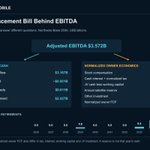
AST SpaceMobile $ASTS could build a high-margin service and still need substantial recurring investment to keep that service running. Satellites have to be replaced. That is why I look beyond the $3.57B of EBITDA in the report's Base 2030 forecast. The same forecast produces about $2.23B of cash after that year's investment, while the normalized owner-cash calculation comes to roughly $1.86B after allowing for recurring economic burdens, including satellite replacement. Those are different views of the business. I would not subtract the normalized replacement reserve again from cash flow that already includes actual investment. The seven-year satellite-life assumption implies roughly $890M of annual replacement spending once the modeled constellation matures. Shorter useful lives would raise that burden. I want a successful constellation to fund its own renewal and still leave meaningful cash for owners. High EBITDA margins are encouraging, but the replacement cycle helps determine how much of that success shareholders can ultimately keep.
3
3
12
2,335
Remember $NBIS is trading for less than one time our projected 2027 ARR. If we are too high by 50%, nebius is still trading less than two times next year’s exit. Not many opportunities to intersect that deep of value, elite management, and an insatiable demand environment.
2
8
2
113
17,867
I am bullish on NVIDIA $NVDA, but I do not treat better AI efficiency as automatic proof that equipment demand will rise. If the computing needed for a fixed-quality task falls to one-quarter, task volume has to quadruple just to keep aggregate computing unchanged. Double the tasks and computing falls by half. Eight times the tasks would double it. Those are hypothetical examples, but they put a real question in front of the thesis: how much useful new work becomes economical as the price falls? For Nebius $NBIS and IREN $IREN, utilization and the price customers will pay matter alongside task growth. I want to see new applications absorb the savings, and enough demand left over to justify more machines.
1
254
When I follow a launch for AST SpaceMobile $ASTS, I try to connect it to four separate business clocks: when cash leaves, when hardware is ready, when it enters service and when a carrier can be billed. Those dates can be far apart. Paying for a satellite does not put it in orbit. Reaching orbit still leaves deployment, testing and commissioning. Carrier integration and commercial readiness matter before the hardware can support recurring revenue. That timing is why a delay can hurt even if the eventual constellation works. Construction spending may continue while the associated receipts move further out. I also separate an insurance recovery from service restoration. Cash compensation can help fund a replacement, but it cannot instantly replace the missing coverage or recover every lost month of sales. The attached six-satellite loss case is a hypothetical stress test. I use it to examine how operational setbacks travel through the business, rather than treating a successful launch count as a complete financial forecast.
287
Nebius $NBIS could earn more per megawatt while customers pay less per unit of AI work. Better hardware can make that happen. If the amount of useful work a system delivers grows faster than the price of renting it, the customer gets better economics even as the provider earns more. The Rubin illustration in our 2027 Nebius Model shows the relationship. Using a selected NVIDIA benchmark and reference rack-power figures, we get about 59% more useful work per megawatt than GB300. Our assumed gross rental revenue per megawatt rises by about 22%. Under those assumptions, the customer's price per unit of work falls roughly 23%, while Nebius earns more from the same power budget. The figures are a workload-specific illustration. Actual customer workloads and negotiated prices will determine how much of the gain Nebius captures. For Nebius, Rubin could raise the revenue potential of each secured megawatt while making it more economical for customers to expand their AI usage. Its software platform can help turn that hardware capability into billable revenue by keeping the systems busy and delivering reliable performance.
3
4
53
2,763
Tyler | Northwise retweeted
$NBIS's Independence campus could become a foundation for years of US growth, giving Nebius more control over where and how it adds compute. The site is planned for up to 1.2 GW across four buildings. Owning that footprint lets Nebius plan power, cooling and later expansions together. The buildings and electrical infrastructure can support several generations of GPUs, giving it a place to expand customer capacity over many years. For shareholders, the opportunity is a larger business built on infrastructure Nebius controls. Ownership also puts more of the construction and financing burden on Nebius. The return depends on getting power, computing equipment and customers into place together. Delays leave capital tied up longer before it earns revenue. That makes the power arrangements central to the story. The utility supply, off-site Blue Valley generation and future on-site generation are separate parts of the plan. A power-station permit is progress, but it does not establish operating compute. The 1.2 GW is ultimate planned capacity. Our review did not verify current active IT MW. Nebius's May 2026 guidance pointed to Missouri operations in 2027, while its four-building plan spans five to seven years. Confirmed power delivery, commissioned capacity and customer activation will show when that long-term opportunity starts contributing to the business. Our refreshed Independence report explains the full site, its power arrangements and the path ahead, with new diagrams and direct tracker and model connections.
🤖 Made with AI
2
2
1
45
3,719
I think the Street is underestimating the size of the business Nebius $NBIS could be operating by the end of 2027. Our forecast is $21.9B of 2027 revenue, roughly 79% above the $12.2B consensus used in our report. We also see $42.6B of owned-cloud exit ARR, rising to a $44.2B platform run rate when net partner revenue is included. Here is what gives me conviction in numbers that far apart. In its Q2 shareholder letter, Nebius said: "We could sell our entire 2027 capacity on these terms today." It was deliberately retaining capacity for customers willing to pay more for immediate access. The same letter reported landmark deals at $20M-$25M of annual revenue per MW and a $40M-$50M opportunity for short-duration capacity, with the first such deal already signed. At GTC Berlin, Arkady Volozh said demand was not the constraint and that he wanted at least half of capacity serving those shorter-duration needs. That commercial mix matters enormously. The revenue potential of a megawatt changes with the hardware inside it and the contract attached to it. Then there is the physical expansion. Management plans to deploy more than 1 GW a year starting in 2027. The Berlin discussion specifically addressed 1 GW of Vera Rubin, with Volozh describing a ramp weighted toward Q3 and Q4. Pennsylvania provides a concrete site milestone: an initial 260 MW phase targeted for October 2027. We translate that evidence into 1 GW of new Rubin installations, another 250 MW of Blackwell, and an existing fleet that continues earning. Those are our assumptions. We allow time for commissioning, price each hardware generation separately, honor signed contracts and allocate roughly half of incremental accepted capacity to shorter-duration customers. That leaves about 1.61 GW accepted at year end, but only 938 MW billing on average during 2027. This timing is why the exit ARR looks so large relative to annual revenue. A cluster arriving late in the year contributes little to that year's sales while contributing fully to December's annualized pace. My reading is that consensus implies a smaller productive fleet, lower realized pricing, later delivery, or some combination of the three. I think the capacity plans and signed deal economics support a much larger outcome.
Nebius $NBIS is nearly 50% below its all-time high, and the fear spreading through AI infrastructure is hard to ignore: what if demand keeps growing, but the companies building for it run out of money? The pressure on $CRWV and $IREN shows how widely that fear has spread. For businesses buying expensive GPUs and renting out computing capacity, access to financing can decide whether a full order book ever becomes a good outcome for shareholders. We think the market is underestimating how much revenue Nebius can bring online in 2027. Our base case forecasts $21.9B of revenue and $12.5B of EBITDA as new capacity enters service. But getting there requires $58.8B of cash capex. Even with $21.6B of operating cash flow, including customer prepayments, that leaves roughly $37.2B to fund. The timing of those advances, the availability of secured debt and the price of new equity all matter. That is where our conviction has to earn its keep. We follow the capacity through delivery, contracts and cash, then account for the debt and dilution needed to build it. Slower commissioning or worse financing terms change the outcome. We've made the full operating analysis and the bear, base and bull results free to read. The image below puts the capacity, earnings, cash requirements and share count together so you can see what our view depends on. The new Nebius 2027 report is in the first reply.
2
5
40
3,317
I think it's very important to start distinguishing vocabulary between what's known as the neocloud sector. The mistake many are still making is mixing in together every company that buys, builds, or hosts GPUs and datacenters. There are significant differences between players like $NBIS that are pulling together full stack software and hardware cloud and managed inference services and companies that are simply providing bare metal, or even some that are just accumulating energy. There are a number of subcategories within this space that need to start being broken down; to be transparent the moats are completely different, as will be there access to financing through any squeeze in capital markets. Will be posting more on this soon. @SMASIMHO has done a great job of pushing more individual language when it comes to Nebius in particular. As we are seeing with the basket selling across the sector and even confusion surrounding posts by @elonmusk , it's never been more important to educate both retail and institutional investors (many of which are STILL just taking revenue and guessing on a multiplier to model out this buildout). We have always believed, at Northwise, that not all of these players will make it and that there will be a period of consolidation. This can be seen in every sector to have ever existed. There's nothing wrong or unusual about it. During every sectorial boom there is VC like period where investors bet on a quantity of horses rather than the pack leaders. Every time there is a shift, once investors begin to realize that there are clear quality leaders. This Short term period of anxiety surrounding the markets is a phenomenal time to reevaluate our approach as independent viewers of the sector. You'll see shortly how massive the capex is going to be in 2027-2028 in our eyes. It's our responsibility to better educate why companies like Nebius are not going to struggle to raise tens of billions, but also acknowledge this is the exception not the indefinite norm.
8
18
1,887
Tyler | Northwise retweeted
$NBIS has reached a major milestone at Vineland, reporting delivery of all capacity tranches under its Microsoft agreement. The focus now turns to how the wider campus develops around that customer commitment. The latest developments put power at the centre of that question. New Jersey's enforcement action and the subsequent notice of intent to sue bring permitting into sharper focus. DataOne, the facility's owner and operator, disputes the generator-permitting determination and says it plans to seek permits while transitioning to fuel cells. For us, the next meaningful signs of progress are resolution of the permitting issues, confirmation of permanent power and additional capacity entering service. Those milestones will help us assess the path toward Nebius's wider 2027 campus target. We've refreshed our Vineland report to explain what has changed and what comes next, with direct connections to the Data Center Tracker, Nebius hub and existing model.
8
12
1
112
8,549
A single price target hides much of what matters about $IREN. Our report's $108.78 probability-weighted December 2030 value combines different delivery, customer and financing outcomes. Some paths work well on one dimension and poorly on another. We also include funding failures that can leave shareholders with nothing. I find that range more useful than assuming every part of a bull case arrives together. It shows what the investment needs to go right and where a good operating story can still disappoint an owner. The probabilities are our judgments, not measured odds. The full report, including the scenarios, is free to read: northwiseproject.com/researc…
1
384
When I think about NVIDIA $NVDA's inference opportunity, I start with the work someone wants an AI system to finish. A single task can require the model to read context, generate a response, call a tool, inspect the result and try again. The tool's own execution is separate from the model calls around it. Caching can also reduce repeated work. That makes a count of user prompts a weak measure of the computing behind an AI product. A more capable service can use more inference per task while still saving the customer time or money. I find that a more useful way to think about demand for NVIDIA's systems and the capacity sold by Nebius $NBIS and IREN $IREN. The economic question is whether the completed task is valuable enough to pay for all the work needed to finish it.
1
1
332
Our initial results from our $NBIS 2027 modeling are pretty shocking. We really think the street is getting this wrong by one of the largest margins we've ever seen. Pulling in a lot of recently announced colocation and greenfield capacity. 2027 and 2028 demand environment is looking very certain with the larger owned sites beginning to come online in chunks. A lot of commentary from GTC Berlin is changing how we look at and model near term and long term capacity allocation. We think there are real cases where prepayments could pay almost 100% in GPU cost in exchange for lower end of the spectrum revenue per MW pricing (still very high in 6-12 month contracts). Don't underestimate the importance of this pricing power as capital needs are set to explode higher over the coming years. Additionally, in light of recent price action and to celebrate the first full year of Northwise Premium and memberships we are considering a sale for new signups. Members have full access to all of our price targets across the AI infra buildout, our full downloadable models, our full data center tracker features and integrated modeling, as well as both of our portfolios (flagship and newer active growth strategy) Let me know if there's an interest in this and we will make it happen. Expect an update and new report soon on Nebius in 2027 before Q3 earnings.
5
5
2
71
5,160