

The Stone Center for Research on Wealth Inequality and Mobility advances interdisciplinary research on the origins and nature of contemporary inequalities.
Harris School of Public Policy
Joined February 2023
- Tweets635
- Following549
- Followers2.2K
- Likes926






Pinned Tweet
Who gets rich under capitalism? The answer may lie in the law.
On Nov. 18, join the Stone Center and legal scholar Katharina Pistor to explore how capitalism's legal regime shapes wealth and inequality.
Free and open to the public; space is limited: uchicago.jotform.com/2628558…

Is India becoming more meritocratic?
Gupta, Munshi & Singh document narrowing caste gaps in education and occupations since the 1980s. Affirmative action and caste networks may both play a role, though substantial inequalities persist.
Read now: bit.ly/4A0cdck

UChicago | Stone Center on Inequality & Mobility retweeted

The Stone Centre at UCL is recruiting a Postdoctoral Research Fellow for a one to two year position starting on 1 September 2027. Applications close on 13 November. Learn more and apply here: econjobmarket.org/positions/…

ALT Job announcement graphic for a Postdoctoral Research Fellow at the Stone Centre at UCL. Apply by 13 November 2026. Shown over a blue-tinted photo of UCL’s main building, with the UCL and Stone Centre logos.
Can changing the way Medicaid is administered affect how much care people receive? This Friday, Naomi Zewde will present evidence of health gains and state savings, asking whether exiting managed care could offer a path toward reducing health inequalities.
forms.gle/odSMsaVKtAKTgQ9Y6

Critics of the SAT want to redefine merit around character and creativity.
Zwick argues that these alternatives are just as difficult to measure, just as easy to game, and equally tied to privilege. Ultimately, merit depends on an institution’s goals.
bit.ly/4zhQlZW

UChicago | Stone Center on Inequality & Mobility retweeted

📣Empieza #SobreMexico
Nuestra directora divisional Graciela Teruel da inicio al 12° Congreso de Economía y de Políticas Públicas #SobreMéxico
Empezamos con la conferencia magistral de Steven Durlauf (@sndurlauf ) sobre movilidad social
Siguelo online
💻sobremexico.ibero.mx/


An interest rate reduction on your student loans?
Stone Center Affiliate Lesley Turner encourages borrowers, especially those with large loan balances, to take advantage of lower rates by signing up for autopay.
Read what she shared with @NewsHour: pbs.org/newshour/education/s…

UChicago | Stone Center on Inequality & Mobility retweeted

🟠El CEEY e @ibero_economia te invitamos a las conferencias magistrales de @sndurlauf y Santiago Levy en el 12º Congreso de Economía y Políticas Públicas #SobreMéxico
Temas: movilidad social y desigualdades
📅 22 y 23 de octubre
📍 Auditorio San Ignacio de Loyola, @IBERO_mx

ALT Anuncio de conferencias magistrales con fotos de Steven Durlauf y Santiago Levy, fechas y horarios en octubre de 2026.
Every time you speak, you reveal something about the voices you heard as a child. But how does this shape how others judge us?
Psychologist @K_Kinzler discusses speech as an overlooked driver of inequality, from hiring to housing to court.
Listen→ bit.ly/47ptoIe
Congratulations are due to our affiliate and frequent collaborator, @guido_alfani!

I am deeply honoured to have been awarded the 2026 Serena Medal for Italian Studies by the @BritishAcademy_ !🙏
thebritishacademy.ac.uk/news…

Does teacher-facing artificial intelligence (AI) improve student learning at scale?
Tomorrow, our first Inequality Workshop kicks off with this big question. @cqcampos will present findings from his recent paper.
See you there!

UChicago | Stone Center on Inequality & Mobility retweeted

A new working paper from @JPAL_NA's Racial Equity Advisory Committee members Dania Francis, @robgillezeau, @nomadj1s, and @aviceisza explores how RCTs can (and can’t) help us understand systemic racial discrimination.

Can randomized evaluation help us understand systemic racial discrimination? Exploring how randomized controlled trials can help us understand systemic racial discrimination—and where they fall short, from Dania V. Francis, @robgillezeau, @nomadj1s, and @aviceisza nber.org/papers/w35882

Calls for merit-based college admissions assume that merit can be measured separately from privilege.
Brighouse & Collins argue that admissions cannot be meritocratic in a society that isn't, and claiming otherwise reproduces its greatest harms.
Read: bit.ly/4dAHJ8b

Their essay, Meritocracy and Higher Education in the United States, is part of the special volume Whither Meritocracy? Part Two: Meritocracy Across the Globe, published by @SageJournals.
UChicago | Stone Center on Inequality & Mobility retweeted

Explore meritocracy from a global perspective.
Dive into The ANNALs latest issue, Whither Meritocracy? Part Two: Meritocracy Across the Globe, now: ow.ly/aj2750ZQlQ1
@TheAAPSS @sndurlauf @UCStoneCenter @HarrisPolicy

UChicago | Stone Center on Inequality & Mobility retweeted
The Munich International Stone Center for Inequality Research (ISI) at @LMU_Muenchen is hiring a Junior Research Group Leader in Wealth #Inequality Research. Applications for the full-time, three-year role close on 15 November: job-portal.lmu.de/jobposting…

ALT Job announcement graphic for a Junior Research Group Leader in Wealth Inequality Research at ISI Munich. Apply by 15 November 2026. Shown over a blue-tinted aerial photo of central Munich, with the LMU and ISI logos.
UChicago | Stone Center on Inequality & Mobility retweeted

Applications are open for 2 postdoctoral positions. These full-time, 2-year positions start in August 2027 and are based at @GC_CUNY One is focused on wealth inequality, the other more broadly on economic inequality. Apply by November 2! stonecenter.gc.cuny.edu/appl…

Cleaner water, fewer deaths, less environmental inequality? What does federal water funding achieve?
Affiliate Bhash Mazumder w/ @DavidKeiserEcon, @davidmolitor & @josephshapiro analyze decades of U.S. drinking water pollution data to find out.
Watch: bit.ly/4hItyjP

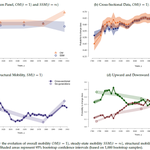
In the last 130 years of China’s Qing Dynasty, aggregate intergenerational mobility increased.
A working paper from our postdoc and job market candidate @Butaeva_K, with @sndurlauf & Alexander Shapoval, reveals a more complicated story.
Keep reading🧵⬇️
bit.ly/3VAXLsE

Before 1850, mobility was converging toward a steady state. Around 1850, that pattern broke, and instability set in until the dynasty fell, a timing that coincides with the Opium Wars and the Taiping Rebellion.
