

Specialist in Computer Vision, Image Processing, Machine Learning (Deep Learning), Audio Signal Processing. Releasing https://nitter.cf/t.co/vIQ9OrhRif low-cost dubbing service
Barcelona, España
Joined July 2015
- Tweets244
- Following360
- Followers136
- Likes90



Ugiat Technologies retweeted

NVIDIA released a new looped transformer:
Instead of stacking more layers, it runs the same layers multiple times so a 4B model can think like a 9B one.
Here's how it works:
In a standard transformer, every token passes through a stack of decoder blocks once, and each block has its own weights.
So if you want a deeper model, you add more blocks, and the parameter count grows with the depth.
NVIDIA's Dory1.0-4B decouples the two by reusing a chunk of its layers.
The model is split into three parts:
> An input block of 8 blocks runs once and turns the tokens into a hidden state x.
> A recurrent block of 20 shared blocks runs k times, where k can be anywhere from 1 to 4.
> An output block of 8 blocks runs once on the final state, followed by the LM head.
Before every pass through the recurrent block, x is added back to the current state and the sum is L2-normalized.
This keeps the original token representation in view on every pass, instead of each pass only seeing what the previous one produced.
Both models in the diagram below store 36 blocks of weights.
The standard transformer applies each block once, while Dory applies 36 blocks at k=1, 56 at k=2, and 96 at k=4, i.e., 72, 112, and 192 physical layers from the same checkpoint.
The extra depth is actually helpful on reasoning and agentic tasks:
> SWE-bench Verified:
- at 1 loop → 50.3
- at 2 loops → 59.5
- at 4 loops → 61.8
> 12-benchmark average:
- at 1 loop → 35.17
- at 2 loops → 39.67
- at 4 loops → 40.60
- and with 2 or more loops, it beats Qwen3.5-9B, Gemma 4 12B, and Gemma 4 26B-A4B.
More loops implies more compute per token, but the 4-loop model also writes 1.3x to 2.5x fewer output tokens on agentic tasks.
So 2 loops end up costing only 1.03x to 1.25x the compute of 1 loop end to end, which is why NVIDIA recommends 2 as the default.
By default, Dory keeps a separate KV cache for every loop, so at 4 loops the recurrent layers store 4x the cache.
To avoid this, it can keep only the cache from the last loop, which uses the same KV memory as a normal model with only a small change in accuracy.
One thing to note here is that looping helps the model reason over what it already knows, but it does not add knowledge.
For instance, on tasks like AA-Omniscience, accuracy stays at 10.0 whether you run 1 loop or 4, and on knowledge-heavy tasks like GPQA, Dory still trails Qwen3.5-4B.
Here's the paper: arxiv.org/abs/2611.03998
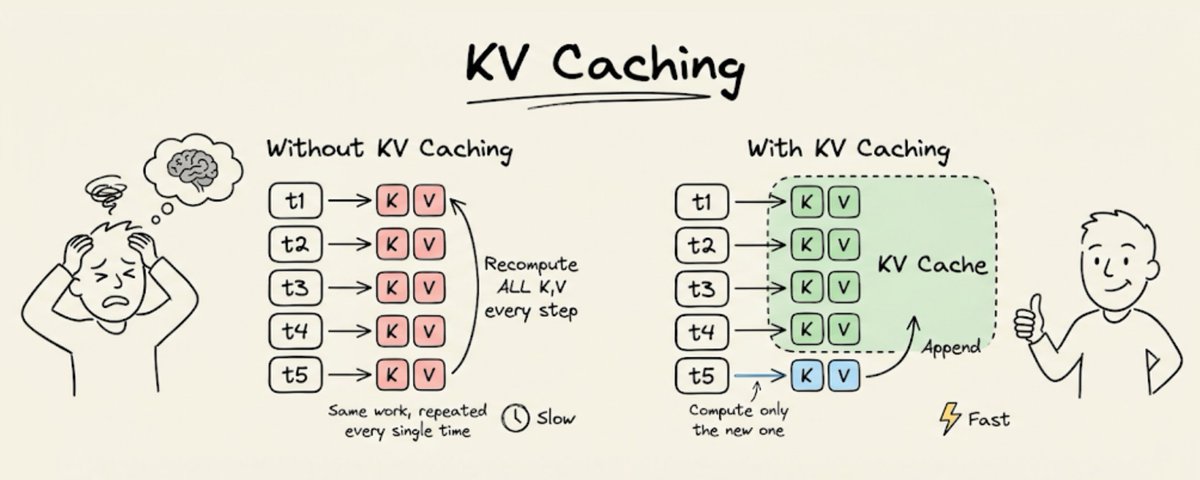
That said, how much memory looping costs comes down to how the KV cache is handled, so I wrote a full breakdown of how KV caching works.
It covers what gets cached during prefill, how the cache grows during decoding, and why it becomes the main memory bottleneck at long context.
Read it below.

Ugiat Technologies retweeted

We asked GPT-6 Astra to edit Qwen3.5-0.8B weights to improve math.
It directly changed only 0.016% of weights, fixing 0.8B's reasoning loops & improving math up to 6x and even instruction following 3x, without gradients or training.
We call this Weight-Space Programming: frontier LLMs can now natively read/write neural network weights! 🧵
Blog: rikiyat.github.io/blog/weigh…

Readers added context they thought people might want to know
LLM was given weights explicitly as text in prompt and used code/forward passes (per authors' logs) to ablate Qwen looping direction, a known thinking-mode issue per model card. Primarily fixed repetition in that mode, not general 'natively' improving weights/math.
rikiyat.github.io/blog/weight-sp…
github.com/RikiyaT/lm_und…
huggingface.co/Qwen/Qwen3.5-0…
huggingface.co/RikiyaT/Qwen3.…
Ugiat Technologies retweeted

Releasing the Energy-Book 🔋 from its first appendix's chapter, where I explain how I create my figures. 🎨
Feel free to report errors via the issues' tracker, contribute to the exercises, and show me what you can draw, via the discussion section. 🥳
github.com/Atcold/Energy-Boo…

Ugiat Technologies retweeted

GPT-6 Astra represents a step-function change in model capability for interactive reasoning problems. It scores 66% on ARC-AGI-3 using our standard harness, and nearly 100% with a continuous conversation harness and custom compaction, at a cost of roughly $360 per game.
In fact, the continuous harness version significantly outperforms our human baseline in action efficiency across almost all levels. When we examined the reasoning chains to understand how the model operates, we found it performing highly efficient, on-the-fly symbolic world modeling for each game and level. It goes as far as developing its own shorthand DSL to represent in-game situations -- essentially a game-specific algebraic notation.
Overall, Astra exhibits symbolic modeling behaviors we had previously only seen with sophisticated harnesses -- so harness capabilities are increasingly shifting into the model itself.
We see Astra as a major breakthrough in model intelligence.
Read our post on Astra and what these results mean: arcprize.org/blog/astra

Ugiat Technologies retweeted

A Japanese dev spotted the trick: ask Claude Code to automatically Find Skills.
Can match your goal to the right tool, using Vercel’s skills CLI across Claude, Codex, Cursor, and Gemini.
so install skill like dev tools rather than rewritten by hand
Ugiat Technologies retweeted

AI Engineering Specialization
🚀 Intro to AI Engineering
🔓 Open-source AI Models
🧠 Learn Embeddings and Vector Databases
🤖 Learn AI Agents
💬 Learn OpenAI's Assistant API
📱 Build AI Apps with LangChain.js
imp.i384100.net/k0d7qN

Ugiat Technologies retweeted
New Andrej Karpathy interview: "To get the most out of the tools that have become available now, you have to remove yourself as the bottleneck.
You cannot be there to prompt the next thing. You need to take yourself outside the loop. You have to arrange things such that they are completely autonomous.
The more you can maximize your token throughput and not be in the loop, the better. This is the goal. So, I kind of mentioned that the name of the game now is to increase your leverage. I put in very few tokens just once in a while, and a huge amount of stuff happens on my behalf."
---
From @NoPriorsPod YT channel (link in comment)
Ugiat Technologies retweeted

You can now train Qwen3.5 with RL in our free notebook!
You just need 8GB VRAM to RL Qwen3.5-2B locally!
Qwen3.5 will learn to solve math problems autonomously via vision GRPO.
RL Guide: unsloth.ai/docs/get-started/…
GitHub: github.com/unslothai/unsloth
Qwen3-4B: colab.research.google.com/gi…


Spending hours watching #longvideos just to find a few key insights? There’s a smarter way. With DoblAI, instantly generate accurate #transcripts, #translations and #subtitles — fully synced and ready to use. Work faster, repurpose content easily, and make every video count
56
Ugiat Technologies retweeted

Excited to share our latest deep-dive on @NVIDIA's DGX Spark AI-PC! Discover how we unlocked advanced reasoning in Llama 8B through full fine-tuning—entirely offline, thanks to DGX Spark’s unified 128GB memory.
Learn how synthetic data and chain-of-thought prompts are pushing the boundaries of local LLMs.
🖇️ Read the full recipe and results on the PyTorch Foundation blog: hubs.la/Q041mvSQ0
👥 @bhutanisanyam1 (PyTorch Meta), Hamid Shojanazeri (PyTorch Meta), Clement Anthonioz Blanc (Meta)
#PyTorch #DGXSpark #AI #LLM #FineTuning

DoblAI to improve video accessibility youtu.be/dQ3trPCxi2k?si=3GS3… a través de @YouTube
14
Ugiat Technologies retweeted
A solid 65-page long paper from Stanford, Princeton, Harvard, University of Washington, and many other top univ.
Says that almost all advanced AI agent systems can be understood as using just 4 basic ways to adapt, either by updating the agent itself or by updating its tools.
It also positions itself as the first full taxonomy for agentic AI adaptation.
Agentic AI means a large model that can call tools, use memory, and act over multiple steps.
Adaptation here means changing either the agent or its tools using a kind of feedback signal.
In A1, the agent is updated from tool results, like whether code ran correctly or a query found the answer.
In A2, the agent is updated from evaluations of its outputs, for example human ratings or automatic checks of answers and plans.
In T1, retrievers that fetch documents or domain models for specific fields are trained separately while a frozen agent just orchestrates them.
In T2, the agent stays fixed but its tools are tuned from agent signals, like which search results or memory updates improve success.
The survey maps many recent systems into these 4 patterns and explains trade offs between training cost, flexibility, generalization, and modular upgrades.


Ugiat Technologies retweeted

Google just dropped "Attention is all you need (V2)"
This paper could solve AI's biggest problem:
Catastrophic forgetting.
When AI models learn something new, they tend to forget what they previously learned. Humans don't work this way, and now Google Research has a solution.
Nested Learning.
This is a new machine learning paradigm that treats models as a system of interconnected optimization problems running at different speeds - just like how our brain processes information.
Here's why this matters:
LLMs don't learn from experiences; they remain limited to what they learned during training. They can't learn or improve over time without losing previous knowledge.
Nested Learning changes this by viewing the model's architecture and training algorithm as the same thing - just different "levels" of optimization.
The paper introduces Hope, a proof-of-concept architecture that demonstrates this approach:
↳ Hope outperforms modern recurrent models on language modeling tasks
↳ It handles long-context memory better than state-of-the-art models
↳ It achieves this through "continuum memory systems" that update at different frequencies
This is similar to how our brain manages short-term and long-term memory simultaneously.
We might finally be closing the gap between AI and the human brain's ability to continually learn.
I've shared link to the paper in the next tweet!

Ugiat Technologies retweeted
Need to optimize applications with large models and stretched memory resources?
Learn how to accelerate large-scale LLM inference and Cache Offload with CPU-GPU Memory Sharing in NVIDIA’s recent developer tech blog:
📎: hubs.la/Q03V7v_q0
#PyTorch #OpenSourceAI #AI #Inference #Innovation

Ugiat Technologies retweeted
NVIDIA's brilliant paper gives a lot of details and actionable techniques. 🎯
Small Language Models (SLMs) not LLMs are the real future of agentic AI.
They gave a recipe for swapping out the large models with SLMs without breaking anything and show that 40%‑70% of calls in open agents could switch today.
It argues that SLMs, already match big models on many routine agent tasks, cost far less to run, and slot neatly into mixed‑model pipelines, so most agent calls should shift to SLMs.
🗝️ The central claim
SLMs that fit on a laptop already handle the narrow language chores inside most agents.
Because those chores rarely need open‑ended chat, the authors say an SLM‑first design is the natural default, and large models become occasional helpers.
@NVIDIAAIDev 👏

Ugiat Technologies retweeted
This github repo is a goldmine.
3.4K Starts ⭐️ in 4 days.
end-to-end, code-first tutorials covering every layer of production-grade GenAI agents, guiding you from spark to scale with proven patterns and reusable blueprints for real-world launches.

Ugiat Technologies retweeted
Anthropic free masterclass on prompt engineering is one of the best 👌
Teaches you how to write effective prompts for Claude models. You’ll start with basic prompt structure, clarity, and role assignment in three beginner chapters.
Intermediate lessons cover separating data from instructions, formatting outputs, and step-by-step reasoning (“precognition”), with hands-on exercises to reinforce each topic.
Advanced chapters tackle hallucination avoidance and building complex prompts for chatbots, legal, financial, and coding use cases. Interactive “Example Playground” sections let you experiment in real time and refer to an answer key for guidance.

