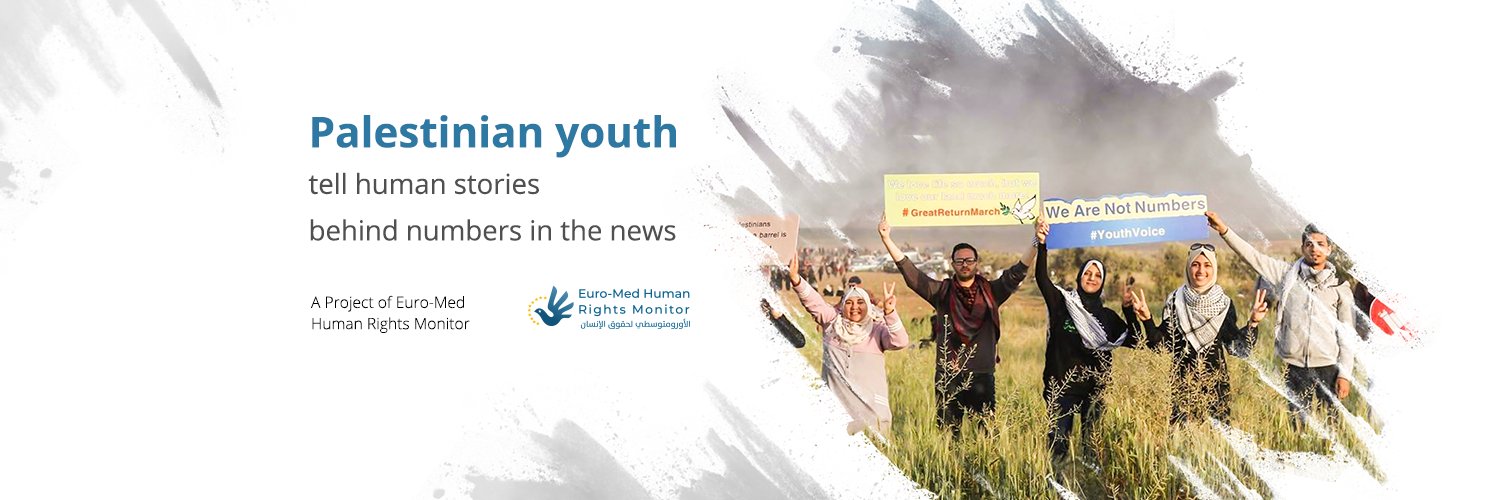

A project of @EuroMedHR that pairs Palestinian writers with int'l mentors to write the stories behind the numbers of victims. Content not censored by Euro-Med
Gaza Strip, Palestine
Joined January 2015
- Tweets13.7K
- Following482
- Followers28K
- Likes2.6K


🧵Halloween lets many people choose a little fear, knowing it will pass by morning. In Gaza, fear has no such ending.
We asked our We Are Not Numbers writers: “What was the scariest moment of your life?” For some, choosing just one was impossible.
Here are their answers, in their own words👇


🧵 October, November and December carry the weight of unbearable loss for We Are Not Numbers.
During these months, Israel killed people who helped shape our community, nurtured young voices and believed in the power of Palestinian storytelling.
They were more than names in our stories. They were the people who helped us tell them.
We remember them, their words, their dreams and the lives stolen from them. Their voices remain part of who we are, and their legacy lives on in every story we continue to tell.
⤵️


Israel killed our beloved writer, Huda Al-Sosi, on 23 October 2023, alongside members of her family.
Dear Huda, you had only just begun your journey with us. We wish we had more time to know you, celebrate your dreams, and share your stories. You will forever remain in our hearts.


Israel killed our writer, Mahmoud Alnaouq, alongside 20 members of his family.
Dear Mahmoud, you had a whole future waiting for you, filled with dreams you worked so hard to achieve. We wish you had been given the chance to live them. We miss you beyond words.


Israel killed our beloved, Refaat Alareer, on 6 December 2023.
Dear Refaat, we miss you deeply. You inspired a generation of young Palestinian writers to find their voices, and your legacy will forever remain in our hearts.


Our writer Shaimaa Hussein tells the story of her little sister, Touleen, who took her first steps while fleeing the sound of a bomb. At just six years old, Touleen has lost her father and much of her childhood. Now, all she dreams of is walking home with him again.
wearenotnumbers.org/her-firs…

"I asked Touleen what she wanted to do when the war ended. I expected her to ask for something that she had loved when she was little: a doll, a new dress, or perhaps a shawarma like my father used to reward her with. But she did not ask for any of those things. She said she only wanted to play again with her father. To hug him. To walk to school with him. To see him again when school was over. And to walk home together with him in the warm afternoon sun."
- Shaimaa Hussein, a WANN writer
"Every day now we ask ourselves, “When and where?” Even if we are allowed to return to Al-Shuja’iyya, where would we live when the entire area is filled with thousands of destroyed homes and rubble is strewn over every meter?”
Read the full story by WANN writer Nadera Mushtaha on our website


This week’s Story of the Week goes to Ahmad Sameh Sbaih’s “The room where the street couldn’t find us.”
For Ahmad and his friends, the streets of #Gaza were a playground, until a video game shop offered a room where they could escape the siege and feel, for a while, like children. Years later, they returned to the same room. The screens and noise were familiar, but they had changed. War had followed them even into the place where they once found refuge.
Ahmad is a WANN writer. Our writers take part in six months of writing, journalism and storytelling training, working with mentors to develop and refine their stories. Ahmad’s story was mentored by Corinne Segal.
Read the full story on our website: wearenotnumbers.org/the-room…

As part of the October 2025 ceasefire, the Yellow Line marked the position to which Israeli forces initially withdrew. It left Israel controlling 53% of Gaza. Since then, Israeli forces have repeatedly moved the yellow concrete markers westward. By October, the UN put the area under Israeli control at about 65% of the Strip.
Each shift pushes the boundary deeper into Palestinian neighbourhoods, leaving people with less space and forcing families to flee again. On 11 October, the markers moved west in Shujayea.
The warning says not to approach the line. But where can people go when the line keeps coming towards them?

"What have I to do with constellations
when entire neighborhoods
survive only in memory?
Do not ask, for what have I to do with beauty
when every road I imagine
carries the dead."
Read the full poem on our website: wearenotnumbers.org/a-geogra…

With most places for leisure destroyed during Israel’s genocide, children in Gaza have few places to go and little chance to simply play, watch a film or spend time together.
A community initiative has created a cinema for them, a space to gather, enjoy a film and reclaim a moment of childhood.
🧵👇🏼
Every October, women are urged to get checked for breast cancer. In Gaza, that message comes with questions no awareness campaign can answer: Where do you go? Who will treat you? Will Israel let you leave if the care you need is unavailable?
Breast cancer awareness must include the women being denied a chance to survive it.
#PinkOctober


The scale of the crisis facing women with breast cancer in Gaza amid the Israeli siege and ongoing genocide. ⬇️


For women battling breast cancer in Gaza, the struggle is not only against the disease, but also against a healthcare crisis that has left patients waiting for lifesaving treatment.
In her latest story for We Are Not Numbers, Shahed AbuAlShaikh sheds light on the uncertainty, fear, and suffering facing women who urgently need medical evacuation and treatment abroad amid Israel’s ongoing siege and genocide.
Read the full story in our website.

