

Journalism packages a story. Reporting shows what happened. Documenting the framing, omissions, and loaded language in between.
Joined October 2026
- Tweets385
- Following34
- Followers42
- Likes70




📌 Welcome to What They Left Out.
Most misleading news isn't an outright lie. It's a true number with no context, a quote clipped in half, or a headline the article doesn't back up. This account calls that out.
Every post takes one article, clip, or politician's post and breaks it down the same way. First, what they claimed or implied. Then what they left out or twisted, with real numbers and sources. Then the technique they used, so you can spot it yourself next time.
The 10 techniques I track:
1. Valuation or estimate treated as realized fact
2. Omission of the limiting or qualifying fact
3. Selective framing/choice of metric
4. Correlation or sequence presented as causation
5. Loaded language and implication
6. Headline–body mismatch
7. Source selection and hierarchy
8. False precision or false certainty
9. Decontextualized quotes or clips
10. Motte-and-bailey presentation (a bold claim that retreats to a safer one when challenged)
I watch every video before I write about it. If the facts are on their side, I'll say so. If I get something wrong, I'll correct it publicly.
Read the whole story. Then ask what they left out.
1
162
You're right about one thing. 15% a year for 60 years isn't happening. A $1.8T company compounding like that would be worth more than the entire planet. Grandma's math is a fantasy.
Everything else you wrote is wrong, though.
"Nobody's getting free SpaceX shares." SpaceX put out an investor release on Nov 25 committing one newly issued share to every active Trump Account. Musk said he'd match it personally, then pledged another share every year after that. The company share is set to transfer in December. You can argue about who counts as "active," but calling it fake is just wrong.
"Money losing." Q3 2026, from the actual 10-Q: $14.6B revenue, $2.8B operating income, $4.4B net income. Starlink alone did $5.2B in operating income through nine months. Even the xAI side posted a Q3 operating profit. The big losses you're thinking of are xAI's 2025 numbers from before the merger.
"Go bust sooner than later." They're sitting on $89.9B in cash and securities against $38.8B in debt. Yes, they're spending a fortune on AI data centers. Heavy capex isn't insolvency.
"Never achieve any of its stated goals." They landed an orbital booster in 2015, a thing the entire industry said was impossible. They've flown NASA astronauts to the ISS since 2020. Starlink has 13.6M subscribers. They put the large majority of all mass in orbit. Starship's Ship just got caught back from orbit on Nov 14.
You can be skeptical of the hype. Just pick a criticism that survives a glance at the 10-Q.
4

First, almost nobody actually makes the federal minimum wage. Per the Bureau of Labor Statistics, only 1% of hourly workers earn $7.25 or less, and fewer than 80,000 people make exactly $7.25 out of more than 81 million hourly workers. The market already pays more than that in most places.
A flat $20 federal floor would still hit the country very unevenly, because pay and living costs aren't the same everywhere.
**It's above the middle wage in whole states.**
The typical U.S. worker makes $24.51 an hour, and in California it's $28. In Mississippi, half of all workers make $19.29 or less. Arkansas ($20.98) and West Virginia ($21.78) aren't far ahead. What a big coastal city can shrug off with higher menu prices is a massive shock in small towns and lower-cost states.
**Small businesses get squeezed hardest.**
A November 2026 study of California's $20 fast-food law found the 20 biggest chains handled the hike fine, while smaller chains saw roughly 20% fewer workers, 10% fewer locations, and up to 21% more closures. Mom-and-pop shops, rural diners, and local daycares don't have McDonald's or Walmart's budget for kiosks and automation, so a $20 mandate pushes small shops out and hands business to giant chains.
**Fewer entry-level jobs and higher prices.**
Even for a smaller $17 federal minimum wage, the Congressional Budget Office estimated around 700,000 jobs lost. Gallego's bill jumps to $20 in three years, phases out the tipped wage, and automatically raises it every year after that. Businesses in tight-margin fields like groceries, restaurants, retail, and childcare don't just eat that cost. They raise prices, cut hours, or stop hiring teens and first-time workers, and workers already making $20 to $25 expect raises too, pushing payroll costs up across the board.

4
First, almost nobody actually makes the federal minimum wage. Per the Bureau of Labor Statistics, only 1% of hourly workers earn $7.25 or less, and fewer than 80,000 people make exactly $7.25 out of more than 81 million hourly workers. The market already pays more than that in most places.
A flat $20 federal floor would still hit the country very unevenly, because pay and living costs aren't the same everywhere.
**It's above the middle wage in whole states.**
The typical U.S. worker makes $24.51 an hour, and in California it's $28. In Mississippi, half of all workers make $19.29 or less. Arkansas ($20.98) and West Virginia ($21.78) aren't far ahead. What a big coastal city can shrug off with higher menu prices is a massive shock in small towns and lower-cost states.
**Small businesses get squeezed hardest.**
A November 2026 study of California's $20 fast-food law found the 20 biggest chains handled the hike fine, while smaller chains saw roughly 20% fewer workers, 10% fewer locations, and up to 21% more closures. Mom-and-pop shops, rural diners, and local daycares don't have McDonald's or Walmart's budget for kiosks and automation, so a $20 mandate pushes small shops out and hands business to giant chains.
**Fewer entry-level jobs and higher prices.**
Even for a smaller $17 federal minimum wage, the Congressional Budget Office estimated around 700,000 jobs lost. Gallego's bill jumps to $20 in three years, phases out the tipped wage, and automatically raises it every year after that. Businesses in tight-margin fields like groceries, restaurants, retail, and childcare don't just eat that cost. They raise prices, cut hours, or stop hiring teens and first-time workers, and workers already making $20 to $25 expect raises too, pushing payroll costs up across the board.
Critiquing banks, corporate cartels, and crooked deputies isn't socialism. The Joads' whole tragedy is losing their own private family farm and wanting land and self-reliance again, not state ownership. Calling every story about screwed-over workers "socialist" is pure cope.
5
**Why Emotional Border Clips Skip the Law and the Bill**
A viral 49-second video on X shows adults using cardboard to push a toddler under razor wire along a sandy embankment while others pull her through on the other side. Sharing the clip, X user @DavidLeftyMA wrote: "I just fundamentally do not understand seeing this & wanting to harm these people."
That framing is an outrageous appeal to emotion. Apply @DavidLeftyMA's worldview evenly across crime, and he'd be watching a burglar break into his neighbor's home and wondering why anyone would wish harm on the burglar. According to federal statutes, the nonpartisan Congressional Budget Office (CBO), and city budget offices across the country, it turns a serious legal and financial debate into a cartoon. You can care about a child's safety and still ask how a country enforces its laws and pays its bills.
**The Law Is Clear**
Crossing the U.S. border outside an official port of entry is a federal crime: a misdemeanor on a first offense (up to six months in prison) and a felony after that. Reentering after a prior deportation is a felony, carrying up to two years in prison, or up to 10 or 20 years for people with prior criminal convictions. Arresting and removing people who bypass legal entry points is simply how a nation of borders and laws operates, not an act of cruelty.
**Who Pays the Bill**
Where the emotional clip goes completely silent is on the fiscal cost, especially for states and cities that have to fund schools, shelters, and emergency services right away.
In its June 2025 report, the CBO estimated that recent immigration arrivals led to $19.3 billion in direct state and local spending in 2023 alone. More than half of that went to public schools ($5.7 billion), shelters and related aid ($3.3 billion), and border security ($2.7 billion).
**Emotion Is Not a Policy**
An emotional video of a child under razor wire is meant to shut down the argument before it starts. By implying that anyone who wants border laws enforced wants to "harm these people," @DavidLeftyMA sidesteps federal criminal statutes, billions in real city and state budget costs, and the basic question every country has to answer: how to balance compassion with enforceable borders and sustainable public finances. Throwing out the law over a 49-second clip isn't a serious answer to either problem.

7
**Why Emotional Border Clips Skip the Law and the Bill**
A viral 49-second video on X shows adults using cardboard to push a toddler under razor wire along a sandy embankment while others pull her through on the other side. Sharing the clip, X user @DavidLeftyMA wrote: "I just fundamentally do not understand seeing this & wanting to harm these people."
That framing is an outrageous appeal to emotion. Apply @DavidLeftyMA's worldview evenly across crime, and he'd be watching a burglar break into his neighbor's home and wondering why anyone would wish harm on the burglar. According to federal statutes, the nonpartisan Congressional Budget Office (CBO), and city budget offices across the country, it turns a serious legal and financial debate into a cartoon. You can care about a child's safety and still ask how a country enforces its laws and pays its bills.
**The Law Is Clear**
Crossing the U.S. border outside an official port of entry is a federal crime: a misdemeanor on a first offense (up to six months in prison) and a felony after that. Reentering after a prior deportation is a felony, carrying up to two years in prison, or up to 10 or 20 years for people with prior criminal convictions. Arresting and removing people who bypass legal entry points is simply how a nation of borders and laws operates, not an act of cruelty.
**Who Pays the Bill**
Where the emotional clip goes completely silent is on the fiscal cost, especially for states and cities that have to fund schools, shelters, and emergency services right away.
In its June 2025 report, the CBO estimated that recent immigration arrivals led to $19.3 billion in direct state and local spending in 2023 alone. More than half of that went to public schools ($5.7 billion), shelters and related aid ($3.3 billion), and border security ($2.7 billion).
**Emotion Is Not a Policy**
An emotional video of a child under razor wire is meant to shut down the argument before it starts. By implying that anyone who wants border laws enforced wants to "harm these people," @DavidLeftyMA sidesteps federal criminal statutes, billions in real city and state budget costs, and the basic question every country has to answer: how to balance compassion with enforceable borders and sustainable public finances. Throwing out the law over a 49-second clip isn't a serious answer to either problem.

Neither person arrested at Sea-Tac was a citizen or green-card holder; both overstayed 2015 tourist visas. ICE hasn't hired "tens of thousands" of agents (OPM shows under 10,000 net hires). And the Port confirmed it got advance TSA notice and stayed out under WA's sanctuary law.
12
You just defined capitalism with a welfare state and slapped a "socialism" sticker on it. Socialism is state or collective ownership of the means of production, not "anybody can be rich." In every country that actually tried it, only the ruling class got rich.
28
Federal law doesn't pause for Thanksgiving or a rainstorm. You can't even spell Hightstown, cite zero facts about who was arrested or any misconduct, and still call agents "dangerous." If you don't want ICE in the streets, repeal NJ's 2026 law limiting jail handoffs.
13
It's 3.2 years (2024), not 4, and drops to 1.45 by age 65. Birth life expectancy gets dragged down by 3x the homicide rate, 2.4x the traffic deaths, overdoses, and obesity, not doctors. Meanwhile Canada's median wait just hit a record 30.7 weeks and MAID is 5.1% of deaths.
1
10
Where'd 14% come from? Farm Bureau has dinner up 6% ($58.63, still under 2022's $64.05 peak), and even the Groundwork report your unsourced chart pulls from says 11%. Turkey jumped because bird flu and aMPV hit flocks, not tariffs. Over 99% of U.S. turkeys are domestic.
1
21
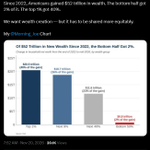
Elizabeth Warren put a pumpkin pie on a table to "explain" wealth inequality, and the whole prop is the trick.
She starts by saying, "Let's pretend that this pie represents all the wealth held by American households," then asks "how much is left over for everyone else." That's the fixed-pie fallacy in a pie tin. Wealth isn't a single pie sitting on a counter that billionaires took slices off. Federal Reserve data shows total U.S. household net worth grew from $20.4 trillion in Q3 1989 to $185.7 trillion in Q2 2026. The bottom 50% didn't get cleaned out either: their net worth went from $0.72 trillion to $4.28 trillion over that same stretch, while consumer prices rose 2.67x. Even after inflation, the bottom half's wealth more than doubled. When someone builds a company and its stock rises, nobody took a bite off your plate. The pie got bigger.
Then her co-speaker drops the sleight of hand: billionaires "often pay a lower percentage of their wealth in taxes than the average American does." Catch the word swap? WEALTH, not INCOME. America taxes income, not net worth. According to Tax Foundation's breakdown of IRS Tax Year 2023 data, the top 1% paid 38.4% of all federal income taxes, about as much as the bottom 95% combined. The top 10% paid 70.5%, and the top 25% paid 86.3%. The bottom 50% paid 3.3%. Comparing someone's income tax bill to their unrealized stock value isn't math, it's a misleading magic trick.
Her five plates leave out plenty, too. Those wealth shares count only marketable assets and strip out Social Security and traditional pensions, which are a massive piece of what working families actually rely on. And that dramatic empty plate labeled "BILL" for the bottom 20% doesn't just show people in poverty. Any young grad starting out with student loans shows up with negative net worth before their career even gets rolling.
Now look at her pitch: a "two-cent wealth tax" (2% above $50 million, 3% above $1 billion). Almost all billionaire wealth is unrealized stock and business equity, not cash sitting in a checking account. You don't owe federal income tax when your 401(k) goes up on paper until you sell. Taxing the estimated paper value of someone's assets every single year, whether they sell a share or not, isn't "pitching in two cents." It's annual asset SEIZURE.
Europe already tried this. Per the OECD and Tax Foundation, 12 OECD countries had net wealth taxes in 1990. Only 4 still do. Austria, Denmark, Germany, Sweden, and France all repealed theirs after capital flight, valuation headaches, and underwhelming revenue.
Warren promises universal child care, free community college, lower health care costs, "and that's just the beginning" off a tax most of Europe already abandoned. It's a three-minute prop comedy routine designed to make you mad at the wrong people.

33
You literally posted it under "most extreme leftist opinion" and then acted shocked anyone pushed back. Wanting everyone fed and housed isn't disagreeable. Pretending it happens by magic without someone else's labor or money is a kid's wish list, not a policy.
5
36 seconds and you can't name one bill. Your "$5,000" is JEC Democrat math. Same method, JEC Republicans found Colorado paid $9,481 more in Biden's first 20 months, vs $4,500 under Trump. You voted for his $1.9T spree. Extending ACA subsidies alone? $350B, per CBO. Who pays?

It costs way too much just to live these days.
We’re ready to push through solutions that will actually lower costs for Coloradans.
1
9
Patty Murray is LYING! You flashed the Farm Bureau headline at 0:02 and skipped the rest of it. Dinner for 10 is $58.63, still $5.42 below the $64.05 peak in 2022 when Democrats ran Washington. Even Farm Bureau's own release says "remains below 2022 record high." 33 years in, still no plan.
That's a modeled global estimate: about 47,000 a year out of 4.1B women and girls, or 1.1 per 100K. Africa and Asia account for 79% of it, and the UN admits data there is thin. Same report: men are 81% of all homicide victims. Every murder's awful. Give people the whole picture.
77
No dates on that graphic? It's a progressive group's one-year cherry-pick. Farm Bureau's national survey: dinner for 10 is $58.63, still below the $64.05 record in 2022, when you ran the Senate. Turkey's up 10%, not 26%. Pie crusts? Down. Spare us.
1
26