

Macro research for investors. Covering Asia, commodities, currencies, and asset allocation. Sign up for free daily Newsletter: https://nitter.cf/t.co/C4EG0o3TVg
Joined March 2024
- Tweets1.3K
- Following162
- Followers1.9K
- Likes108






🚨 THE U.S. GOVERNMENT JUST POSTED ITS WORST OCTOBER DEFICIT IN THE CHART'S HISTORY.
America recorded a staggering $404.1 billion federal deficit in October 2026, compared with $284.4 billion one year earlier.
That's a 42.1% deterioration in just 12 months.
The latest shortfall exceeds the approximately $285 billion deficits recorded in October 2020 and 2025, making it the largest October deficit across the 2010–2026 period.
The underlying fiscal dynamics are equally concerning.
Federal receipts declined 8.8% year over year, while spending surged 12.2%.
YCC Capital believes this deterioration strengthens the case for structurally higher Treasury term premiums.
With annual deficits already approaching $2 trillion, persistent borrowing requirements threaten to collide with restrictive Federal Reserve policy.
The critical implication: even if inflation eventually cools, America's fiscal imbalance could prevent long-term Treasury yields from falling as much as investors expect.

🚨 AMERICA'S FISCAL TRAJECTORY IS BECOMING INCREASINGLY DANGEROUS FOR BONDS.
U.S. federal spending reached approximately $7.396 trillion in fiscal 2026, while government revenue totaled just $5.4 trillion.
The result: a staggering $1.992 trillion fiscal deficit.
Spending increased 5.5% year over year, substantially outpacing revenue growth of 3.2%.
The deficit widened by approximately $217 billion, pushing the fiscal shortfall from 5.8% to 6.2% of GDP.
Meanwhile, net interest expenses have climbed toward $1.4 trillion, reflecting the increasingly expensive burden of financing federal debt.
YCC Capital sees a dangerous feedback loop.
Larger deficits require more Treasury issuance. Greater borrowing needs can push yields higher. Higher yields increase debt-service costs, worsening future deficits.
This creates structural pressure on long-duration bonds even if economic growth moderates.
America's fiscal deterioration is no longer just a Washington problem. It's a global bond-market risk.

🚨 $100 OIL COULD KEEP U.S. INFLATION ABOVE 3% THROUGH 2027.
YCC Capital's inflation scenarios expose a major vulnerability in current market expectations.
Under a zero-monthly-inflation scenario, U.S. headline CPI could fall below 1% by May 2027 and approach zero by September.
But that is an exceptionally favorable trajectory.
With oil around $90 per barrel, inflation could remain above 4% in late 2026 before declining toward 2% by May 2027.
At $100 oil, the picture changes dramatically.
Headline CPI could approach 4.8% around December 2026 and remain near 3% in May 2027, before rebounding above 4% later in the year.
Second-round energy effects could add another 0.3–0.6 percentage points to inflation.
Our conclusion: markets are pricing disinflation that depends heavily on cheap oil.
One sustained energy shock could force the Federal Reserve into significantly more aggressive tightening.

🚨 AMERICA'S INFLATION PROBLEM IS SPREADING AGAIN.
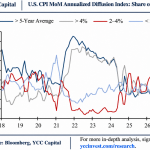
The U.S. CPI diffusion index reveals something more important than the headline inflation number: how many consumer-price categories are experiencing elevated inflation.
During the 2022 inflation shock, approximately 85% of CPI components exceeded their five-year average, while more than 70% experienced annualized monthly inflation above 4%.
Both measures subsequently collapsed as inflation pressures moderated.
But the latest data show renewed deterioration.
The share of CPI components rising at annualized rates above 4% has rebounded toward 40%, while roughly 35% are increasing between 2% and 4%.
YCC Capital believes this signals a broadening inflation threat rather than an isolated energy-price shock.
Inflation breadth has increased for three consecutive months.
That matters because widespread price increases are substantially harder to reverse through temporary declines in oil.
The Fed cannot sustainably defeat inflation while pricing pressure keeps spreading.

🚨 THE U.S. INFLATION COMEBACK IS ALREADY VISIBLE.
America's three-month annualized core CPI inflation rate has accelerated to 3.68%, challenging expectations of a smooth return toward the Federal Reserve's 2% target.
The underlying components reveal why this matters.
Housing-services inflation remains elevated, running around 3–4% annualized.
Non-housing services inflation has rebounded toward approximately 4–5%, while core goods inflation has also turned positive.
This is fundamentally different from an inflation spike driven exclusively by gasoline.
During 2021, core goods inflation briefly exceeded 20% annualized. Today's problem is less extreme but more broadly distributed across services and goods.
YCC Capital believes energy-related transportation, distribution, and operating costs are increasingly embedded throughout consumer prices.
Even falling oil prices may not reverse these second-round effects immediately.
The Fed faces an inflation problem that is becoming harder—not easier—to eliminate.

4
256
🚨 AMERICA'S INFLATION PROBLEM IS NOT FINISHED.
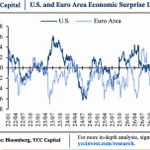
The composition of U.S. economic surprises reveals why the Federal Reserve cannot declare victory.
Inflation surprises surged above +3.0 in early 2022 before gradually declining toward zero by 2024.
But the latest readings show inflation surprises returning to positive territory, around +0.2 to +0.3.
Growth surprises have also recovered from approximately -0.6 in mid-2025 toward zero, following a brief positive rebound in 2026.
This combination matters enormously.
Inflation is proving more persistent than expected, while economic growth has avoided the sustained deterioration that might otherwise justify monetary easing.
YCC Capital believes this creates an uncomfortable environment for investors.
The Fed may confront renewed price pressures without a sufficiently weak economy to restrain them.
The risk is not simply sticky inflation. It's resilient growth forcing interest rates higher for longer.

5
228
🚨 THE U.S.–EUROPE ECONOMIC DIVERGENCE IS WIDENING AGAIN.
Economic surprise indicators reveal a striking shift in global growth momentum.
The U.S. Economic Surprise Index has recovered toward positive territory, recently hovering around +0.1 after reaching approximately +0.4 earlier in 2026.
Meanwhile, the Euro Area index has plunged toward -0.5, reversing its mid-2026 rebound near +0.4.
That represents an approximately 0.9-point deterioration in European economic surprises from its recent peak.
YCC Capital sees a clear divergence.
American growth remains relatively resilient despite elevated borrowing costs, supported by investment and underlying economic activity.
Europe faces greater vulnerability to energy prices, weak external demand, and uneven industrial performance.
The implications extend beyond growth.
Persistent U.S. resilience could justify tighter Federal Reserve policy, while European weakness complicates the ECB's outlook.
The dollar's structural support may prove stronger than markets anticipate.

🚨 U.S. TREASURY YIELDS ARE SENDING TWO DIFFERENT WARNINGS.
America's 10-year Treasury yield surged 28 basis points to 5.13%, while the 2-year jumped 33 basis points to 4.84% during the latest trading week.
The 2-year yield is now near its highest level since September 30.
But the real signal lies in the yield curve.
The 10Y–2Y spread has fluctuated dramatically, falling toward 20 basis points in October before recovering toward 30 basis points in November.
YCC Capital identifies two forces driving this volatility:
Short-term yields reflect expectations of further Federal Reserve tightening.
Long-term yields increasingly reflect America's deteriorating fiscal position, Treasury issuance requirements, and inflation risk.
With U.S. deficits approaching $2 trillion annually, even weaker economic growth may not guarantee falling long-term yields.
Our conviction: the front end remains vulnerable, and another yield-curve inversion is possible.

🚨 THE U.S. RATE-HIKE CYCLE IS FAR FROM OVER.
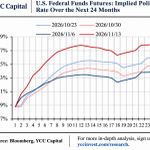
Federal funds futures are flashing a warning: Wall Street is rapidly repricing the Federal Reserve's tightening trajectory.
On November 13, the implied U.S. policy rate climbed from approximately 3.87% in the first month to nearly 4.78% by month 12—a staggering 91-basis-point increase.
Just one week earlier, the 12-month implied rate stood near 4.35%. That's roughly 43 basis points of additional tightening expectations in seven days.
Even 24 months out, futures now imply approximately 4.79%, versus 4.38% on November 6.
YCC Capital believes markets are still underestimating persistent American inflation.
Our analysis suggests additional Fed tightening could arrive as early as March or April 2027, particularly if oil prices rebound.
The biggest risk isn't delayed easing. It's a more aggressive Fed.

6
358
CHINA’S MASSIVE TRADE SURPLUS JUST SHRANK 21% IN ONE MONTH.
China recorded a $105.28 billion merchandise trade surplus in October 2026, down sharply from September’s $133.53 billion.
That represents a $28.25 billion monthly contraction, or approximately 21.2%.
Yet the surplus remained 19.6% above October 2025’s $88 billion.
The explanation matters.
Exports increased 35.2% YoY, but imports accelerated even faster at 41.6%, narrowing the gap despite strong overseas shipments.
YCC Capital sees two competing forces: global AI investment sustaining China’s manufacturing exports, while technology components, industrial inputs, and commodities drive import demand.
The structural risk remains substantial.
Persistent $100 billion-plus monthly surpluses invite trade retaliation, while reliance on external demand exposes China to geopolitical shocks.
China’s export machine remains formidable. Its dependence on foreign buyers remains its greatest vulnerability.

13
1,231
CHINA’S AI IMPORT BOOM REVEALS A CRITICAL WEAKNESS IN ITS TECHNOLOGY AMBITIONS.
October 2026 delivered extraordinary growth in selected Chinese technology imports.
Automatic data-processing equipment imports surged approximately 261% YoY, although growth slowed from nearly 297% in September.
Integrated circuit imports increased around 83%, while diodes advanced approximately 15%.
China’s copper imports climbed roughly 46%, coal imports nearly 58%, and crude oil imports approximately 41%.
But the broader economy tells a different story.
Automobile imports contracted approximately 45%, while soybeans and iron ore remained negative.
YCC Capital interprets this divergence as evidence of concentrated industrial and AI-related demand rather than broad domestic recovery.
China remains heavily exposed to international technology supply chains, especially in advanced computing.
The more China participates in the global AI investment boom, the more visible its dependence on imported technology becomes.

CHINA’S EXPORT ECONOMY IS SPLITTING INTO TWO VERY DIFFERENT WORLDS.
October 2026 reveals an extraordinary divergence between AI-related manufacturing and traditional export industries.
China’s exports of automatic data-processing equipment accelerated from approximately 94% to 116% YoY.
Integrated circuits surged nearly 138%, maintaining exceptional growth.
General machinery strengthened from roughly 15% to 35%.
Meanwhile, automobile export growth slowed from approximately 63% to 37%. Toys decelerated from 42% to 27%, and home appliances weakened from 31% to 20%.
Furniture growth nearly halved, falling from 22% to 12%.
YCC Capital sees a concentrated technology-driven export cycle rather than a broad manufacturing renaissance.
China participates heavily in global AI supply chains, but advanced semiconductor intellectual property and high-margin computing platforms remain dominated by international competitors.
China is capturing AI-related manufacturing volume—not necessarily the industry’s most valuable profits.

CHINA’S TRADE BOOM JUST REVEALED A MAJOR STRUCTURAL IMBALANCE.
October 2026 delivered explosive headline numbers:
China’s exports surged 35.2% YoY to $412.33 billion, while imports jumped 41.6% to $307.05 billion.
Total merchandise trade reached $719.38 billion, expanding 37.9%.
But the divergence is revealing.
Export growth moderated slightly from September, while import growth accelerated sharply, surpassing exports by 6.4 percentage points.
YCC Capital believes the import acceleration reflects concentrated demand for AI infrastructure, semiconductors, industrial machinery, and energy inputs—not necessarily a broad recovery in Chinese household consumption.
That distinction changes the investment narrative.
Global AI capital expenditure is supporting China’s industrial activity, but external technology cycles remain volatile.
China’s trade numbers are booming. Its domestic economic foundations remain dangerously dependent on forces beyond Beijing’s control.

CHINA’S EXPORT SURGE IS HIDING A DANGEROUS DEPENDENCY ON GLOBAL DEMAND.
China’s October 2026 export growth remained extraordinary, but momentum weakened across key destinations.
Exports to the United States grew approximately 32% YoY, down from nearly 39% in September. ASEAN growth moderated from roughly 52% to 45%, while the EU slowed to approximately 23%.
Japan remained near 14%, and Hong Kong eased toward 47% after previously exceeding 60%.
The message is clear: China’s export engine remains powerful, but its acceleration is increasingly fragile.
YCC Capital sees a structural vulnerability beneath these numbers.
China’s manufacturing sector is benefiting from overseas demand while domestic consumption, property markets, and private-sector confidence remain weak.
For global investors, this divergence matters enormously.
China is exporting its way around domestic weakness—not solving it.

Wall Street Is Pricing a December Fed Cut Despite Persistent Inflation
U.S. interest-rate markets have moved aggressively toward expecting monetary easing at the December Federal Reserve meeting.
As of November 10, the probability of a 25-basis-point cut had climbed above 90%, compared with approximately 70% in late October.
Meanwhile, the probability of no change collapsed from nearly 30% to effectively zero.
A 50-basis-point cut carries a much smaller probability, around 8%.
YCC Capital sees a potentially dangerous disconnect between market expectations and underlying inflation fundamentals.
October headline CPI accelerated to 4.0% annually, while core CPI increased to 2.8%.
Monthly core inflation also exceeded expectations at 0.30%.
With inflation pressures persisting across housing, transportation, and selected consumer goods, aggressive easing expectations may prove vulnerable.
The biggest risk for U.S. bonds is no longer simply inflation. It is the possibility that markets have priced a more dovish Federal Reserve than economic conditions justify.

America’s Core Inflation Is Reaccelerating Despite Cooling Energy Momentum
U.S. underlying inflation is proving considerably more persistent than headline disinflation narratives suggest.
Core CPI accelerated to approximately 2.8% annually in October, compared with 2.6% previously.
Meanwhile, the chart’s core PCE series remains near 2.1%–2.2%, highlighting the different signals coming from the Federal Reserve’s two major underlying inflation measures.
The historical contrast is striking.
Core CPI previously approached 9.5% during the 2021–2022 inflation shock before moderating sharply.
Yet the latest readings demonstrate that underlying price pressures have not disappeared.
Monthly core CPI increased 0.30%, exceeding the 0.20% consensus expectation.
YCC Capital believes this creates a difficult policy environment: energy disinflation may eventually lower headline CPI, but domestic services and goods inflation could remain stubborn.
For Treasury investors, persistent core inflation raises the risk that restrictive Federal Reserve policy lasts longer than markets anticipate.

2
205
America’s Rental Market Is Quietly Reaccelerating
The U.S. rental market is showing early signs of renewed momentum after several years of disinflation.
Zillow annual rental inflation has recovered toward 2.7%, compared with approximately 2.0% earlier in 2026.
Monthly rental growth has also strengthened toward 0.35%, following a period of substantially weaker readings.
The historical comparison is important.
During the 2021–2022 inflation cycle, Zillow annual rent growth surged above 15%, while monthly increases briefly exceeded 1.5%.
Current readings remain far below those extremes, but the direction has changed.
YCC Capital sees this as an emerging risk to the Federal Reserve’s inflation outlook.
Rental inflation feeds into official shelter CPI with a delay, meaning today’s private-market developments can influence future inflation readings.
The danger is not another 2022-style rental explosion. It is persistent housing inflation preventing the final stage of U.S. disinflation.

1
1
180
America’s Rental Inflation Is Rebuilding Its Momentum
U.S. housing inflation may be approaching another turning point, and private rental indicators are sending an important warning.
Official housing-rent CPI remains elevated near 3.4% annually, despite the dramatic normalization in private-market rents.
Zillow rental inflation previously surged above 15% in 2022, while Apartment List rent growth approached 18%.
Both subsequently cooled sharply.
However, Zillow annual rent inflation has now recovered to approximately 2.7%, compared with 2.49% previously.
Apartment List annual growth has also turned positive at 0.07%, its first positive reading since May 2023.
YCC Capital believes the key risk is the delayed transmission of private-market rents into official CPI.
Housing inflation typically adjusts slowly, making renewed rental strength particularly important for monetary policy.
Even if energy inflation retreats, sticky U.S. shelter costs could prevent core inflation from normalizing as quickly as markets expect.

5
391
China’s Consumer Goods Inflation Reveals a Deeply Uneven Recovery
China’s consumer-price landscape is becoming increasingly fragmented, with sharp differences across discretionary goods and services.
The latest figures show overall monthly growth of approximately 0.74%, compared with 0.16% previously.
Yet several categories remain under significant pressure.
Medical care prices declined 1.46% month over month and 3.31% annually. Cultural and entertainment prices fell 3.27% monthly and 2.85% annually.
Other goods and services, meanwhile, increased 3.57% monthly despite remaining down 4.65% annually.
Household goods rose 1.12% monthly but declined 1.31% year over year.
YCC Capital interprets these divergences as evidence of unstable pricing conditions rather than a synchronized Chinese consumption recovery.
Temporary category-specific rebounds cannot offset persistent weakness across major consumer segments.
For investors, China’s consumer economy remains a highly uneven market where selective price increases coexist with substantial deflationary pressure.

America’s Used-Car Inflation Is Reaccelerating Beneath the Surface
The U.S. used-vehicle market is showing renewed pricing pressure, and the leading indicators deserve attention.
The Manheim Used Vehicle Price Index has recovered from annual declines approaching 15% during 2023–2024 to modest positive growth in 2026.
That is a meaningful reversal.
During the previous inflation cycle, Manheim prices surged more than 50% annually before official used-vehicle CPI followed with increases exceeding 40%.
The relationship matters because wholesale vehicle prices often move ahead of consumer inflation.
Today, official used-vehicle CPI remains near or slightly below zero, even as wholesale pricing has returned to positive territory.
YCC Capital believes this divergence creates upside risk for future U.S. vehicle inflation.
Combined with potential automobile tariffs, stronger wholesale prices could complicate the Federal Reserve’s disinflation outlook.
The next inflation surprise may emerge from categories investors currently consider contained.
