

Official English account for Yandex. We build AI and put it to work at scale across Search, Maps, Cloud and devices. Research, open source and product news.
34 global offices
Joined October 2012
- Tweets1.4K
- Following17
- Followers35.8K
- Likes138






What's common between estimating glacier ice thickness, distinguishing diseases with similar symptoms, and forecasting demand at new parcel pickup points? CatBoost.
CatBoost is a machine-learning library widely used by researchers and developers around the world. Developed at Yandex and released as open source in 2017, it helps find patterns and make predictions from structured data.
One of its biggest strengths is handling categorical information — things like cities, product names, and IDs — which makes it easier to build ML models using real-world data.
Next year marks a decade since we open-sourced CatBoost. Its reach now extends far beyond any one field.
Our review of publications from July through October 2026 found more than 1,000 relevant mentions across medicine, engineering, Earth sciences, energy, business analytics, and other areas.
Here are some recent examples from medicine, Earth sciences, and business analytics ⬇️


🌎 CatBoost in Earth Sciences
Measuring glacier ice. Researchers combined CatBoost with XGBoost to estimate ice thickness across glaciers worldwide, creating a dataset that can improve estimates of ice reserves and potential sea-level rise.
Detecting uranium in groundwater. Scientists in India tested CatBoost to predict uranium contamination from routine water-quality measurements, potentially helping identify which water sources need more expensive testing.
Mapping ocean chlorophyll. Researchers in China used CatBoost as part of a machine-learning ensemble to reconstruct global chlorophyll concentrations down to 220 meters, supporting research into marine ecosystems and the ocean's carbon cycle.
📊 CatBoost in Business Analytics
Planning pickup points. At Uzum Market, engineers use CatBoost to forecast order volumes at new pickup points before they open, helping the marketplace plan where to expand its network.
Improving recommendations. Coveo used AI-assisted experiments to explore ways to improve its recommendation model. Switching to CatBoost with a ranking-specific objective was the only improvement that held up in testing.
Predicting video engagement. Sia AI uses CatBoost to analyze hundreds of audio, visual, and text features, estimating how viewers might engage with videos before they're published.
Games like Alias, 20 Questions, and Wheel of Fortune test how LLMs use clues, plan ahead, and stay consistent across turns.
That's the idea behind MTGBench, an open-source benchmark by Yandex researchers and students at the Yandex School of Data Analysis: yandex.com/company/news/2026…


From delivery ETAs to demand forecasts, tabular regression powers everyday services.
Our researchers are pushing the field forward: comparing 18 training objectives and developing a noise-aware method to improve predictions, tested on 28 datasets and four model architectures.

Training neural networks for tabular regression? Our latest work may be of interest
And it's not only about which of the 18! regression objectives is best, but touches on the role of noise and global early stopping in tabular DL in general
arxiv.org/abs/2610.13909
Thread (1/N)

Our joint research on distributed AI inference helps assess AI safety risks.
@AnthropicAI cited Petals — a BitTorrent-like approach to distributed AI inference co-developed by our researchers, @HSE_eng, @UW, @huggingface and @UnivParisSaclay — in a study of self-replicating AI.

“Our experiments suggest that small AI models may be months away from being capable enough to self-replicate on commercial IoT devices, like smart ovens and off-brand Android TV boxes. A replicator like this would be challenging to shut down, since there’s no centralized point to shut off - though it may be slow (with a doubling time of days). Unlike non-AI malware, it could also figure out unfamiliar devices on its own. In our evals, a 9B model got inference running on 8 of the 9 hardware types we tested.
Models of 30B parameters and under can already complete many of the individual steps for replication today, though they make mistakes when composing them end to end. In our simplified evals, GLM-5.2 and stronger models are capable of end to end replication. If small models improve at their historical rate, they’ll match this capability level by the end of this year. Small weight-based replicators may be possible soon after.” -@bucketofkets @willzhou97
anthropic.com/research/self-…

Petals allows a network of smaller devices to run a model too large for any single one.
Anthropic used a similar approach to run a 26B model across 15 Android TV boxes — as part of its research into the risks of AI self-replication.
More about Petals: research.yandex.com/blog/pet…
Five Yandex scientists and educators rank in the global top 1–2% in their fields, per @Stanford & @Scopus . A sixth made the career-long top 1%.
elsevier.digitalcommonsdata.…
Their work includes #CatBoost, a widely used gradient boosting algorithm, and AQLM, an LLM quantization tool. 🧵
AQLM tackles a major challenge in running large language models: memory consumption.
It compresses model weights to just 2–3 bits per parameter, dramatically reducing memory requirements. It's open source and supported by Hugging Face Transformers.
huggingface.co/docs/transfor…

RainNet uses neural networks and radar data to forecast rainfall. Further research targets more accurate heavy-rain predictions — critical for anticipating extreme weather.
github.com/hydrogo/rainnet
From LLMs to weather, this work shows how research can make a difference.
Fresh recommendations need fresh data — but real-time processing at scale is hard.
That’s why we built YTsaurus Flow. Now open source, it handles 100+ GB/s, keeps state between events and provides exactly-once by default.
Apache 2.0 👉github.com/ytsaurus/ytsaurus…
The trick is in the infrastructure: managing state, balancing load and recovering from failures without losing or duplicating data.
On our blog, we break down how YTsaurus Flow handles those challenges — and why we built our own engine.
medium.com/yandex/open-sourc…

Our researchers at @YandexResearch are exploring new ways for LLMs to operate as agents. Meet AsyncLLM: a framework that lets pretrained models observe, reason and act concurrently — with no additional training.
Paper, code and demos 👇
LLMs are general asynchronous agents
We're releasing AsyncLLM - a framework for pretrained LLMs to observe, reason and act concurrently, with no additional training
Paper: huggingface.co/papers/2609.3…
Code: github.com/dvmazur/async_llm
Website with Demos: dvmazur.github.io/async_llm
🧵...


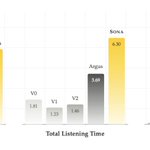
Sona reads a user’s history once and uses it to both generate and rank candidates, avoiding repeated computation across stages.
It builds on a decade of our recommendation research, including ARGUS and Gryphon. Our open dataset Yambda, with nearly 5B interactions, has also been cited by @Meta and Kuaishou researchers.
Teams at ByteDance, @TencentGlobal, @Spotify and @PinterestEng are advancing the same broader shift toward unified recommendation models.
Explore Sona’s architecture and results: arxiv.org/abs/2608.11015
A look behind the scenes: Running our 8B data filter over the whole corpus would have cost more than 200,000 GPU-hours. So we built a multi-stage pipeline that keeps about 95% of the useful documents.
Full report on arXiv soon.
Learn more about training AliceAI-Foundation-80B-A3B-Base here: medium.com/yandex/aliceai-fo…


⚡80B parameters, only 3B active per token.
We've released the weights of our Alice AI Foundation 80B-A3B Base. It's open for anyone to build on. 256K context, Apache 2.0.
Explore it on Hugging Face: huggingface.co/yandex/AliceA…

⚡80B parameters, only 3B active per token.
We've released the weights of our Alice AI Foundation 80B-A3B Base. It's open for anyone to build on. 256K context, Apache 2.0.
Explore it on Hugging Face: huggingface.co/yandex/AliceA…
📌 Alice AI Foundation 80B-A3B Base — EN README on Hugging Face: huggingface.co/yandex/AliceA…
