




Pinned Tweet
Introducing Cosign.
cosign.co


Excited to introduce @Cosign: the curated professional network for the startup community: cosign.co
Our goal is to create the following:
- A comprehensive startup directory of investors, companies, and operators, including what they worked on and who they worked on it with.
- Cosign graph: Who shaped your career? Who were you actually in the trenches with? Who would work with you again? Who thinks you’re someone to watch?
- Durable reputation: Great endorsements happen every day on X and disappear into the feed. Cosign attaches those signals permanently to people and companies.
- Discovery: Who are the best fintech angels? Which AI companies should I watch? Who are the best designers?
- Intent network: Privately signal “I’d invest in them,” “I’d hire them,” “I’d work with them,” or eventually even “I’d acquire this company.” Match people when interest exists on both sides.
Imagine if Wikipedia, LinkedIn, and OG AngelList had a baby. Though Cosign is a community, not a business.
In order to join, you need to be cosigned. Or you can apply directly.
David Booth and I started this idea 7 years ago but didn’t have the firepower to make it work. Now we do.
No one has really touched LinkedIn in 20 years. Excited to take a swing.
cosign.co
Chris Power of @HadrianInc says in wartime simulations, the US runs out of munitions in about a week, and it takes 2-3 years to restock:
"Out of every war game we run, we run out of munitions and missiles, whatever, in like six to seven days. And then it takes about two to three years to refill that battery of, 'Hey, you now have more missiles to shoot.'"
"Every single war basically, if it goes hot, both sides throw everything they've got at each other over a time period. And it's basically then if it gets protracted, how fast can you reconstitute?"
"We shoot all our missiles in one week and then we have none for two years. That is how kind of terrible the situation is."
"The only thing we can do is focus on, honestly, attritable systems, because if you kill a carrier and they've got that range, there's nothing we can do about it."
"A lot of attritable mass... We basically blow everything in the seven days. We got to have the manufacturing battery to be able to refill the clip extremely fast."
@2112Power (September 2025)


Brian Schimpf of @AndurilTech on why industrial production is a deterrent in itself, and why technological superiority alone won't win a war:
"These wars are protracted, they are industrial in scale, and if you were to bring it down to one variable, the amount of kilograms that you can throw at each other turns out to probably be the single most important factor."
"I think the technical superiority is a huge advantage. We're not gonna just outproduce China on like dumb ammunition, right? Like that clearly we have to have an edge around our space capabilities, how we can sense, how we can confuse them, how sophisticated our weapons are."
"But I think the part that got so clear outta Ukraine was that industrial production has a deterrence factor... it is critical for winning a conflict."
"When most of the war games with China show that we'd be out of munitions in... like eight days, that's not a deterrence factor really anymore."
"I think the belief for a long time was that [technological superiority] was sufficient, but a low number of really exquisite weapons is not gonna win a conflict."
@SchimpfBrian (September 2025)
a16z's Erin Price-Wright says factory technicians can now retool production lines with AI in 20 minutes, a job that used to take an outside integrator 3 months:
"Historically, if you're setting up a line with a lot of automation, you really need to be producing a lot of one single thing. That's how you get the cost down, and how you justify investing in a pretty bespoke manufacturing line."
"But what we're seeing across our portfolio is that manufacturing technicians themselves have the intuition, and now the software tools, to change the economics of producing low-volume, high-mix on the line."
"A manufacturing technician, not necessarily someone with a college degree or who's studied software engineering, can now use these tools to reprogram and reconfigure their lines on the fly, because they understand the manufacturing process."
"Instead of calling a systems integrator, which takes 3 months and hundreds of thousands of dollars to reconfigure a line, you can have a manufacturing engineer use Claude and do that in 20 minutes. That's been a real game changer."
@espricewright

The American Dynamism 50 is a16z's annual list of companies building for America's future.
This year's edition covers the industrial base end to end, from the inputs that come out of the ground to factories that make things and systems that deter conflict.
a16z's Erin Price-Wright and Connor Love join Elena Burger to break down this year's list and its theme, Production is Deterrence, built around a simple idea: "You don't have a defense industrial base without an industrial base."
0:50 From mines to factories and systems
3:05 How the internet and nuclear was built
5:05 Drones built DJI into a robotics giant
6:50 Defense dollars pay for new factories
8:30 SpaceX and Tesla lessons on scale
10:15 How Mariana runs a mine on software
12:20 "AI cannot turn a wrench yet"
14:10 Retooling in 20 mins, not 3 months
17:45 Startups build before Pentagon asks
20:35 Why hard tech can be more valuable
24:45 The race for the biggest American flag
28:25 How defense parts unlock US robotics
32:05 The rise of the "manufacturing middle"
37:25 Anduril and SpaceX founder mafias
41:05 Private capital: USA's edge over China
46:30 The buildout must hit Middle America
YouTube: youtu.be/cRJ7CfaK1Vc
@espricewright @ConnorLoveCA @VirtualElena
Eugenia Kuyda of @Wabi predicts that within a year, one of the biggest consumer AI platforms will be multiplayer, with real network effects:
"Today most AI products are single player. And I would say that you could probably argue they don't have much of a moat. They don't necessarily have switching costs."
"It was pretty easy to move between, say, Claude and ChatGPT, but at least they had some memory about me. With these single player agents, it's so easy to jump between them because all the context is in my Gmail."
"I think in a year what we'll see is that one of the biggest consumer AI platforms will be multiplayer and will have network effects in it. Right now we just sort of agree that single player is the way to go for most AI products."
"A year from now, I think we'll look back at it as more kind of the early innings, and the products that win will have a lot of network effects and be focused on you talking to other people, not just AI."
@ekuyda w/ @sophiadew on @MTSLive

Today, I’m excited to share that we’ve raised $55M in Series A funding at a $1.25B valuation, led by @IVP, with support from @a16z, @ForerunnerVC, and an incredible group of founders and investors including @Benioff, @tobi, @dickc, and @marissamayer.
Everyone has an operating system for their phone. We’re building one for your life.
Right now, life is scattered across apps, group chats, calendars, and tabs. You’re the one connecting the dots and keeping everyone on the same page.
@wabi is a personal AI that helps you get your whole life organized. It brings your people, context, and apps together so you can coordinate plans, share the mental load, discover new things, and show up for each other.
Because AI shouldn’t just help us get things done. It should help us do more of what we love, with the people we love.
Join us 👇
a16z's Connor Love says building for defense is how America builds for everything else, because once you can make the parts "to quality and to cost," new markets start to make sense:
"When you build many systems, you also require many subsystems below that. There are really interesting military systems being built today. The corollary: by building towards defense, you also build for a different industry."
"The subsystems that go into some of our military systems are the exact same subsystems that are going to go into the future robotic systems. It's the actuators, the motors, the valves and switches."
"When you can build those to quality and to cost, then all of a sudden other markets that maybe weren't viable make sense... You're going to have this robotic wave that will come in America."
"AI can't turn a wrench yet. They will eventually. And that will be enabled by all that, actuators and switches and subsystems that we built... And we're not going to have to rely on factories in China."
"As you build an industrial base, an industrial base can be used for many things. Down to the component level, I just think we don’t have enough of it in America."
@ConnorLoveCA @espricewright @VirtualElena
The American Dynamism 50 is a16z's annual list of companies building for America's future.
This year's edition covers the industrial base end to end, from the inputs that come out of the ground to factories that make things and systems that deter conflict.
a16z's Erin Price-Wright and Connor Love join Elena Burger to break down this year's list and its theme, Production is Deterrence, built around a simple idea: "You don't have a defense industrial base without an industrial base."
0:50 From mines to factories and systems
3:05 How the internet and nuclear was built
5:05 Drones built DJI into a robotics giant
6:50 Defense dollars pay for new factories
8:30 SpaceX and Tesla lessons on scale
10:15 How Mariana runs a mine on software
12:20 "AI cannot turn a wrench yet"
14:10 Retooling in 20 mins, not 3 months
17:45 Startups build before Pentagon asks
20:35 Why hard tech can be more valuable
24:45 The race for the biggest American flag
28:25 How defense parts unlock US robotics
32:05 The rise of the "manufacturing middle"
37:25 Anduril and SpaceX founder mafias
41:05 Private capital: USA's edge over China
46:30 The buildout must hit Middle America
YouTube: youtu.be/cRJ7CfaK1Vc
@espricewright @ConnorLoveCA @VirtualElena
a16z retweeted

Today @arjunmathur_ and I are introducing Dream.
We’re announcing $17M in seed funding from @a16z , @svangel , @xyz_vc , and @ziggcap.
@dreamhq is developing a new class of models trained to reason about physical space: its geometry, its constraints, and the relationships between objects and the spaces that contain them. With these models, AI can make a real impact in the $13 trillion architecture, engineering, and construction (AEC) industry for the first time.


a16z's Connor Love and Erin Price-Wright on what startups should take from SpaceX and Tesla, and when building it all yourself actually makes sense:
Connor: "We can look to Elon for a lot of answers here. I mean, it's not a crazy statement to say really the few modern-day companies that have built anything at scale are probably SpaceX and Tesla. And if you look at how Elon and his team have built those businesses, it's been, one, very vertically integrated."
"I take the ideology that you shouldn't vertically integrate everything. I mean, again, if you're building a super exquisite system like a missile that is doing something very unique, you kind of have to because you have to control the exquisiteness. You have to control the cost."
Erin: "SpaceX and Tesla were doing first of their kind. There didn't exist an industrial base in the US to support them, and so they had to build it themselves. I think where there are high-quality suppliers, you should use suppliers."
Connor: "In a lot of ways they had to make those choices because they didn't have any other opportunity. But in the end, it's actually just that mantra of design for manufacturing that now exists within all these systems companies."
@ConnorLoveCA @espricewright
The American Dynamism 50 is a16z's annual list of companies building for America's future.
This year's edition covers the industrial base end to end, from the inputs that come out of the ground to factories that make things and systems that deter conflict.
a16z's Erin Price-Wright and Connor Love join Elena Burger to break down this year's list and its theme, Production is Deterrence, built around a simple idea: "You don't have a defense industrial base without an industrial base."
0:50 From mines to factories and systems
3:05 How the internet and nuclear was built
5:05 Drones built DJI into a robotics giant
6:50 Defense dollars pay for new factories
8:30 SpaceX and Tesla lessons on scale
10:15 How Mariana runs a mine on software
12:20 "AI cannot turn a wrench yet"
14:10 Retooling in 20 mins, not 3 months
17:45 Startups build before Pentagon asks
20:35 Why hard tech can be more valuable
24:45 The race for the biggest American flag
28:25 How defense parts unlock US robotics
32:05 The rise of the "manufacturing middle"
37:25 Anduril and SpaceX founder mafias
41:05 Private capital: USA's edge over China
46:30 The buildout must hit Middle America
YouTube: youtu.be/cRJ7CfaK1Vc
@espricewright @ConnorLoveCA @VirtualElena
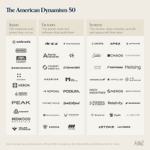
The 2026 American Dynamism 50 is here: our annual list of 50 companies, from within the a16z portfolio and beyond, building for America's future.
This year's theme is Production is Deterrence. "America's ability to prevent conflict depends on what it can build, how fast it can deliver, and how long it can keep going."
A new generation of defense companies is moving from prototypes to full-scale production, and the industrial base has to keep pace. This year's list is organized around three pillars:
1. Systems: the drones, ships, missiles, aircraft, and spacecraft that deter conflict.
2. Factories: the plants, tools, and software that build them.
3. Inputs: the materials and power they're made of and run on.
Get all three right, and the impact reaches well beyond defense, to skilled jobs, revitalized communities, and the supply chains behind energy, housing, and everyday goods.
Meet all 50: a16z.news/p/ad-50-2026-produ…
Mark Cuban's rule for the AI-era workforce: "People who know how to use AI replace the jobs of people who don't know how to use AI."
"[Healthcare] looks the same as any other industry. You have to still hire entry-level people."
"No matter what the model is, the minute it's released, it's behind. There's latency associated with every model."
"You need people who are aware of everything that's going on, that create context and deal with the models, be the human in the loop, understand the consequences."
"You need those people to grow with the organization over time so that as all these things change, they've seen the history of the implementation, and they can bring value to the organization."
@mcuban @julesyoo @eriktorenberg
Mark Cuban scaled Cost Plus Drugs from about 100 generics to roughly 4,000 at a flat 15% markup, forcing incumbents to change prices in ways decades of policy never did.
He thinks AI could transform healthcare, but it won't fix opaque prices and broken incentives on its own.
Mark sits down with a16z's Julie Yoo and Erik Torenberg to discuss what he's learned building Cost Plus Drugs, why trust is its core product, and how greater transparency could put pressure on healthcare costs.
They also explore why drugs designed for your DNA could cost close to nothing, the football field-sized drug plant his team shrank into tractor trailer-sized pods, his plan to make generics in Dallas for less than he pays manufacturers in India, and why every company will either be great at AI or go out of business.
0:50 Cost Plus beat decades of policy
3:15 111 generics to 4,000 drugs
5:00 A drug plant shrunk to 5K sq ft
5:55 $20M drug factories in a trailer
8:10 Hospital deals with zero denials
9:50 Why health plans are rigged
14:05 1,335 pages no human can check
18:35 "Where are they f**king me over?"
22:45 Making drugs cheaper than India
26:50 Why you still need entry-level hires
31:45 Nonprofit hospitals must offer aid
35:55 DNA-matched drugs for near $0
39:30 Why AI will mean more doctors
48:00 Mark's plan: "bye bye insurers"
52:25 Why AI labs' ads are useless
56:35 Get good at AI or go out of business
YouTube: youtu.be/5UWDUD6qaM4
@mcuban @julesyoo @eriktorenberg
Security testing is moving from a yearly checkup to always on
18% of CISOs run most of their offensive testing continuously today, 52% expect to within a year
They also want AI to close the loop, 70% would use it to retest and confirm their fixes actually worked
From a16z's @OwenColby and @steph_zhang, breaking down a survey of 100 CISOs at companies with 1,000+ employees: a16z.news/p/the-new-security…


AI is already running across the enterprise, and securing it is now one of CISOs' biggest concerns
Already in production at their companies:
- Employee generative AI tools (92%)
- AI coding assistants or agents (83%)
- MCPs or agent-to-app integrations (55%)
- Autonomous agents with tool access or write permissions (34%)
Their biggest concerns:
- AI attacks outpacing their team (55%)
- Employees leaking data into AI tools (47%)
- AI agents exceeding permissions or getting compromised (46%)
From a16z's @OwenColby and @steph_zhang, breaking down a survey of 100 CISOs at companies with 1,000+ employees: a16z.news/p/the-new-security…


Mark Cuban's advice for young people boils down to "there's gonna be two types of companies: those who are great at AI and those who have gone out of business."
"And then there's two types of people in how they use AI: those who use AI to learn anything, and those who use AI so they don't have to learn anything."
"And if you're one of those people who uses AI so that you can learn anything, and you realize what type of companies and problems aren't being solved by AI, don't be shy to just talk to your AI."
"And I say this not just to kids, but to 50 60, 70-year-old entrepreneurs. The biggest challenge right now with entrepreneurs using AI is the comfort level of talking to your AI... there's still a lot of hesitancy."
"Just like back in the day, those first spreadsheets, people still had their 10-key adding machine, and they would check it to make sure the spreadsheets were right."
"So when you ask me, is there one thing I truly believe, it's everything. Everything will change. This is the greatest transitional technology we have ever seen, and I've been around for all of them, right? This blows them all away."
@mcuban @julesyoo @eriktorenberg
Mark Cuban scaled Cost Plus Drugs from about 100 generics to roughly 4,000 at a flat 15% markup, forcing incumbents to change prices in ways decades of policy never did.
He thinks AI could transform healthcare, but it won't fix opaque prices and broken incentives on its own.
Mark sits down with a16z's Julie Yoo and Erik Torenberg to discuss what he's learned building Cost Plus Drugs, why trust is its core product, and how greater transparency could put pressure on healthcare costs.
They also explore why drugs designed for your DNA could cost close to nothing, the football field-sized drug plant his team shrank into tractor trailer-sized pods, his plan to make generics in Dallas for less than he pays manufacturers in India, and why every company will either be great at AI or go out of business.
0:50 Cost Plus beat decades of policy
3:15 111 generics to 4,000 drugs
5:00 A drug plant shrunk to 5K sq ft
5:55 $20M drug factories in a trailer
8:10 Hospital deals with zero denials
9:50 Why health plans are rigged
14:05 1,335 pages no human can check
18:35 "Where are they f**king me over?"
22:45 Making drugs cheaper than India
26:50 Why you still need entry-level hires
31:45 Nonprofit hospitals must offer aid
35:55 DNA-matched drugs for near $0
39:30 Why AI will mean more doctors
48:00 Mark's plan: "bye bye insurers"
52:25 Why AI labs' ads are useless
56:35 Get good at AI or go out of business
YouTube: youtu.be/5UWDUD6qaM4
@mcuban @julesyoo @eriktorenberg
AI's cyber skills have taken a huge leap in about two years
In a test that simulates a 32-step cyberattack on a company network, tracking how far each model gets as it uses more tokens:
- GPT-4o, a 2024 model, stalled at step 2 and never improved with more tokens
- Today's top models kept improving all the way to 100M tokens, getting about three-quarters of the way through on average
- The best attempts finished all 32 steps and took over the entire network
From a16z's @OwenColby and @steph_zhang on The New Security Agenda: a16z.news/p/the-new-security…

In a single year, AI has rewritten the security priority list for CISOs.
Attackers are moving faster. Bain estimates AI compresses a typical cyberattack from about four weeks to about 18 hours, and models keep getting better at finding and exploiting weaknesses.
There's also more to protect, with employees shipping apps they couldn't have built a year ago and agents getting access to source code, documents, and production systems.
In a survey of 100 CISOs at companies with 1,000+ employees, all seven of the most-selected 2027 priorities involve AI.
The biggest jumps since 2026:
- Internal AI agent security (+28 pts)
- AI SOC (+26 pts)
- AI offensive security (+24 pts)
- AI code security (+23 pts)
- AI vulnerability remediation (+22 pts)
Last year's staples:
- Exposure & vulnerability management (-21 pts)
- SIEM / security data (-18 pts)
- Privileged access management (-18 pts)
From a16z's @OwenColby and @steph_zhang on The New Security Agenda: a16z.news/p/the-new-security…

a16z's Martin Casado says many debates about VC turn into "a muddled, incoherent mess" because investors pull arguments from four investing mindsets that often conflict:
1. Financial: the business's finances are the asset, so investors judge deals on metrics like churn, margin, and growth, plus the size of the market.
2. Productive: the tech is the asset, and it creates new markets, so investors focus on tech, team, and market fit, and treat today's TAM as secondary.
3. Frontier: the founders are the asset, so investors back the best team in a wildly new space well before anything is working.
4. Speculative: investors have little visibility into the company, so they bet on the market's perception of the deal, with a heavy focus on price and timing.
Each one is coherent on its own, but using them as a grab bag breaks down, because "it's hard to directly refute a finance argument with a product argument since they make entirely different assumptions on what the bet is for value creation."
Martin's answer is to pick one core philosophy as a team and stick to it across deals, or evolve it by stage: frontier before there's a product, productive before traction, and financial once the business is repeatable.
He's "strictly a productive investor" and thinks new tech tends to create its own market, like "Uber and taxis, GitHub and the repository, Cursor and the IDE."
In his words, "If you truly believe a technology is revolutionary, TAM concerns should be third order at best."
Full piece from Martin: a16z.com/the-evolving-landsc…


Mark Cuban says the lack of AI adoption in organizations means the "trillionaire in the basement" entrepreneur is coming:
"You have to be able to understand as a CEO and in the C-suite how all those things impact your company. Once you get a good grasp on that... you can just find new ways for things to happen that benefit your customers or create new opportunities."
"And that's the brilliance of AI, right? AI is not smart. It's book smart maybe, but it's not street smart. It's not entrepreneur smart. You've got to have somebody there who guides it and helps it."
"But until you have a C-suite that understands how it works, it's gonna be very difficult for that organization."
"I literally sat with the head of a consumer food company... I'm like, 'Okay, well, let's do this. Let's take your number one product, your cookie, right? And I'm gonna ask ChatGPT to create a competitor...' And in about three minutes he was like, 'Oh, s**t.'"
"There's no better time to be an entrepreneur than right now. There will be the trillionaire in the basement."
@mcuban @eriktorenberg @julesyoo
Mark Cuban scaled Cost Plus Drugs from about 100 generics to roughly 4,000 at a flat 15% markup, forcing incumbents to change prices in ways decades of policy never did.
He thinks AI could transform healthcare, but it won't fix opaque prices and broken incentives on its own.
Mark sits down with a16z's Julie Yoo and Erik Torenberg to discuss what he's learned building Cost Plus Drugs, why trust is its core product, and how greater transparency could put pressure on healthcare costs.
They also explore why drugs designed for your DNA could cost close to nothing, the football field-sized drug plant his team shrank into tractor trailer-sized pods, his plan to make generics in Dallas for less than he pays manufacturers in India, and why every company will either be great at AI or go out of business.
0:50 Cost Plus beat decades of policy
3:15 111 generics to 4,000 drugs
5:00 A drug plant shrunk to 5K sq ft
5:55 $20M drug factories in a trailer
8:10 Hospital deals with zero denials
9:50 Why health plans are rigged
14:05 1,335 pages no human can check
18:35 "Where are they f**king me over?"
22:45 Making drugs cheaper than India
26:50 Why you still need entry-level hires
31:45 Nonprofit hospitals must offer aid
35:55 DNA-matched drugs for near $0
39:30 Why AI will mean more doctors
48:00 Mark's plan: "bye bye insurers"
52:25 Why AI labs' ads are useless
56:35 Get good at AI or go out of business
YouTube: youtu.be/5UWDUD6qaM4
@mcuban @julesyoo @eriktorenberg
a16z retweeted

Huge milestone: Eve has helped 350,000 people take on a system built to wear them down.
Take Mike Dickerson. A four-car pileup, two hip surgeries, then an insurer betting he’d take a lowball offer.
He didn’t. His lawyers @GeigerGroup fought for years and, with Eve’s help, got him 15x the first offer.
Firms on Eve have recovered $3.5B+ for their clients, and we’re just getting started.
Next milestone: 1 million people helped.

Mark Cuban scaled Cost Plus Drugs from about 100 generics to roughly 4,000 at a flat 15% markup, forcing incumbents to change prices in ways decades of policy never did.
He thinks AI could transform healthcare, but it won't fix opaque prices and broken incentives on its own.
Mark sits down with a16z's Julie Yoo and Erik Torenberg to discuss what he's learned building Cost Plus Drugs, why trust is its core product, and how greater transparency could put pressure on healthcare costs.
They also explore why drugs designed for your DNA could cost close to nothing, the football field-sized drug plant his team shrank into tractor trailer-sized pods, his plan to make generics in Dallas for less than he pays manufacturers in India, and why every company will either be great at AI or go out of business.
0:50 Cost Plus beat decades of policy
3:15 111 generics to 4,000 drugs
5:00 A drug plant shrunk to 5K sq ft
5:55 $20M drug factories in a trailer
8:10 Hospital deals with zero denials
9:50 Why health plans are rigged
14:05 1,335 pages no human can check
18:35 "Where are they f**king me over?"
22:45 Making drugs cheaper than India
26:50 Why you still need entry-level hires
31:45 Nonprofit hospitals must offer aid
35:55 DNA-matched drugs for near $0
39:30 Why AI will mean more doctors
48:00 Mark's plan: "bye bye insurers"
52:25 Why AI labs' ads are useless
56:35 Get good at AI or go out of business
YouTube: youtu.be/5UWDUD6qaM4
@mcuban @julesyoo @eriktorenberg
Formation Bio just announced a $600M fund aimed at drug development - arguably the most meaningful bottleneck in bringing new medicines to patients.
Few large pharma companies have been built in the past century. Even fewer have been founder-led.
AI is making drug discovery dramatically more productive, but promising drugs still compete for limited capital, experienced teams, and clinical development resources.
The Drug Development Accelerator Fund pairs dedicated capital with Formation Bio’s drug developers and AI platform to advance a larger portfolio of drugs toward patients.
Congrats @BenjamineYLiu, @lintaho, and the @formationbio team!

Today we’re announcing the $600M Formation Bio Drug Development Accelerator Fund.
@lintaho and I started @FormationBio because we believed the biggest bottleneck in bringing new medicines to patients wasn’t drug discovery, but drug development.
As AI dramatically accelerates discovery, that bottleneck is only becoming more acute. Without the capital and capacity to advance promising drugs through clinical trials, much of that progress won’t translate into medicines for patients.
Our new Fund brings together dedicated capital, drug development expertise, and AI-powered development capabilities to acquire promising drugs and advance them through the clinic.