
@YatesJJ
Account based inUnited States
About this account
- Account based in
- United States
- Connected via
- United States Android App
Account-level information from X, not a live location or the device used for a specific post.
Classical Liberal. I oppose the Undeclared Full Spectrum 5th Generation Hegelian Dialectical Warfare against the U.S., the West, and Scottish Enlightenment.
Wisconsin, USA
Joined July 2009
- Tweets54.3K
- Following1K
- Followers522
- Likes119K





Joshua Rucinski retweeted

The Zizians believe that eating meat should condemn one to torture and hell. In their ideology, most of humanity should be wiped out. That’s part of how they would “save the world” as members of the trans vanguard.
Learn the truth about the Zizian trans death cult in my new book: amazon.com/Zizians-Inside-Tr…


Joshua Rucinski retweeted

EXCLUSIVE: The DSA is taking over the court system in Los Angeles. The movement has elected a judge who wants to liberate black criminals from the "slave ship," and another who wants to use the courtroom for "healing circles" and "sound baths."
We expose them all.
Joshua Rucinski retweeted

Imagine being an elected school board member and getting investigated by the state for the outrageous act of… asking voters what they think about a tax increase.
Welcome to New Jersey!
Proud of our team at @TheFIREorg for helping get this ridiculous complaint dropped.


Joshua Rucinski retweeted
There is a small but enduring class of humans whose entire mission throughout history has been to get between the people & the gods & collect tolls on any transactions between them. To me, they're the ones to keep an eye on. They tend to go crazy in big ways & cause untold damage when they do.
Joshua Rucinski retweeted

A shoemaker's son who left school at 16 wrote a book in 1854 that nobody knew what to do with, and 83 years later a 21-year-old at MIT opened it and found the blueprint for every computer chip on Earth.
I went down this rabbit hole at 1am and I still can't get over how thin the thread is.
His name was George Boole. The book is called The Laws of Thought.
Boole never went to university. Not for a single day.
His father fixed shoes in Lincoln, England, and spent his spare money on telescopes and math books instead of the shop. The shop failed. At 16, George started teaching just to feed the family.
So he taught himself everything else at night.
At 14 he translated an ancient Greek poem into English. A local paper printed it. A schoolmaster wrote in to say no boy that age could have done it.
By 1849, a university in Ireland made him its first professor of mathematics. A man with no degree, now handing them out.
Then he asked a strange question. What if thinking follows rules, the same way numbers do?
Every argument you've ever had is built from statements that are either true or false. "It's raining." "I have an umbrella." Boole wanted to do math on those, the way you do math on 2 and 3.
So he built an algebra with only two numbers.
- 1 means true
- 0 means false
- AND works like multiplying
- OR joins two ideas together
- NOT flips one into the other
The whole system rested on one odd little equation. x times x equals x.
Try it with any normal number and it breaks. 5 times 5 is not 5. It only works for two numbers in the entire universe. Zero and one.
"Let us conceive, then, of an Algebra in which the symbols x, y, z, &c. admit indifferently of the values 0 and 1, and of these values alone."
That's Boole, in 1854.
Mathematicians found it clever. Philosophers argued about it. Nobody built a single thing with it.
Boole died ten years later at 49, after walking two miles to a lecture in pouring rain. He never saw his idea do anything useful.
Jump to 1936.
A 20-year-old named Claude Shannon is working on a giant calculating machine at MIT. It's packed with relays, little electrical switches that click open and shut. Wiring them together is mostly guesswork.
But Shannon had taken a philosophy class back at the University of Michigan. It covered Boole.
He looked at the switches and saw the 1s and 0s.
- A closed switch lets current through. That's 1.
- An open switch blocks it. That's 0.
- Two switches in a row only pass current if both are closed. That's AND.
- Two switches side by side pass current if either one is closed. That's OR.
Boole's algebra of thought was also an algebra of electricity. Same rules. Same two numbers.
Shannon wrote it up as his master's thesis in 1937. The psychologist Howard Gardner later called it possibly the most important master's thesis of the century.
Shannon just shrugged.
"It just happened that no one else was familiar with both fields at the same time."
Sit with that for a second. The idea was sitting in a library for 83 years. It only needed one person who happened to be standing in two rooms at once.
The phone in your hand holds billions of those switches. Every photo, every text, every AI answer is them flipping between 1 and 0, following rules a self-taught teacher wrote down before the light bulb existed.
Boole thought he was writing down how the human mind works.
He ended up writing down how machines would think.

Joshua Rucinski retweeted

The West needs a new governance system for the next century.
The one we have was inherited from previous centuries, when the West dominated the world and its states fought mainly among themselves. Those states were built for exactly that. As one historian put it: war made the state, and the state made war. Armies, borders, taxes, ministries – machines designed to fight each other. In the twentieth century, they did. Twice.
Our world has changed. The danger is no longer the army across the Rhine. It is the erosion of the civilization itself – from outside, from rivals who don’t share our values, and from inside, from the lie, the managers and the empty cradle. No single state can protect against that. And a superstate would make it worse: Brussels shows what happens when you answer a civilizational question with a bureaucracy.
And something else has changed. A family in Ohio, a family in Milan and a family in Lyon often have more in common with each other than with some other parts of their own countries – starting with their own capitals. There is clearly now a stronger sense of civilizational community among the majority populations across different Western countries than there is within the countries themselves. So the countries increasingly don’t represent much anymore – except a taxpayer base.
What we need is something new – and very old. Something akin to the structure of the Holy Roman Empire. Not a superstate – a structure to protect what is increasingly under threat. Not a military apparatus – a civilizational one. Not a unified state, but a framework that can accommodate many cultures, many languages, many different social or ideological bubbles, but still sharing a common historical ancestry, common ideals, and a compatible way of life that needs protecting, from outside as well as from within.
We have done this before. The Holy Roman Empire was a large family of kingdoms, duchies, free cities and archbishoprics, held together less by force than by a shared faith, a shared law and a shared idea of itself. Voltaire mocked it as neither holy, nor Roman, nor an empire. He missed the point. It lasted the better part of a thousand years precisely because it never tried to be a single state.
The Greeks never had one state either. They had the Olympic Games, the oracle at Delphi and Homer – and they knew they were Greeks.
That is the structure of an Empire, in its oldest sense: a family watching over what we call a Civilization – Western Civilization, Our Civilization. No coercive powers. No taxes, no army, no laws imposed on anyone. Just three functions: guidance, coordination and identity. Call it the Council of Western Civilization for a start.
The Romans had a word for that kind of leadership. Augustus wrote that he surpassed everyone in authority, but had no more power than his colleagues. Auctoritas, not potestas. That was the meaning of Princeps – the first citizen, not the master.
We all have a candidate in mind for who the Protector, or Princeps, should be…
But the first rule of a good structure is that no one is indispensable – not even the Princeps. It has to be built to outlast him.
I see it as an alternation between an imperial and a republican system for the periods of transition. The current system – clearly dysfunctional, as increasingly cut off from the realities underneath it – needs a reset. But that is for another post…


Patriots of Western Civilization, Unite.
The left conquered Western culture with two weapons: an idea and a network.
We have the idea. We lack the network.
Everywhere, people have understood the same thing – Americans, Brazilians, Argentines, Poles, Italians, French. The diagnosis is identical: the progressive project is a fraud, and we have been living for decades inside an empire of lies. The same words, the same slogans, the same methods, in every capital. In Poland we always knew. Nobody wanted to listen.
But there is a bigger problem. Everyone fights alone. Each country wages its own war, in its own language, with its own media and its own heroes. The French reinvent every morning what the Americans tested three years ago.
We win battles. We don’t wage a war.
That is exactly where the left always beat us. It was international from the start: the First International in 1864, the Second in 1889, Lenin’s Comintern in 1919 – a worldwide network of parties, newspapers, cadre schools and slogans. And guess who spent more than a year at the Comintern in Moscow in the early 1920s? Antonio Gramsci – the man who invented the long march to conquer culture. The conquest was carried out nation by nation. The brain was global.
So here is what we must build: a network. Not a party. Not a central organization with a leader. A network of free men and women, each rooted in their own nation, all connected.
Patriots organizing across borders – a contradiction? No. It is the only answer to an adversary that always organized across borders. Defending your nation never meant having no allies. It always required them.
The mission: the cultural counter-revolution. The left marched through the institutions. We will march back. Schools, universities, newsrooms, publishing, cinema, music, sport, the courts, the administration. Not by force – by competence, talent and work.
And we won’t need a hundred years. AI is breaking the two locks that held their hegemony in place. The first was the cost of production: a film needed millions, a studio, a subsidy – whoever held the counter held the culture. Soon a handful of talented people will do what took hundreds. The second lock was language: tomorrow a film shot in France will be released the same day in twenty languages. And a new battlefield is opening – the most important of all. Tomorrow, common sense will be whatever the machines answer. The long march will also run through the models.
But tools without organization are noise. The national networks must talk, synchronize, support each other. When one of us is censored, debanked or smeared, it is not for one country to respond. It is for all.
That is why we need a Council of Western Civilization. Not a headquarters – a meeting place. Public and transparent, everything the other side never was. It gives no orders. It maps what works, circulates it, and makes sure no one fights alone.
Let’s give the adversary its due: the left was brilliant, patient, methodical. It built narratives while the right built factories. And narratives won. Lenin reportedly called cinema the most important of the arts; the left took him at his word. The right still thinks it is entertainment. We need our own films, series, cartoons and games – not to explain what we fight, but to make people love what we defend. Beauty. Ambition. Science. Merit. The civilization that gave birth to us.
They had the institutions without the peoples. We have the peoples without the institutions.
Not for long.
In prison, Gramsci wrote that a crisis is when the old is dying and the new cannot be born. A century later, the old world that is dying is his.
The new can be born. But not by itself. It will be born if we build it – together, everywhere, at the same time.
Patriots of Western Civilization, unite.
🇺🇸🇫🇷🇵🇱🇮🇹🇬🇧🇦🇷🇧🇷💪🏻✌🏻🗽
Joshua Rucinski retweeted

"The boomers never really grew up, and now refuse to grow old...the 1960s youth revolution, which glamorized free sex and heavy drug use, imprinted a set of lifelong values on boomers...Now that their kids are grown up...back to their bred-in hedonism" thefp.com/p/arthur-brooks-bo…

Joshua Rucinski retweeted

“Any sufficiently advanced [startup] is indistinguishable from [a nation state intelligence collection target].”
- Arthur Clarke, probably.

We discovered a sophisticated recording device that was hidden inside one of our offices. We used our models to understand the device and where it had come from, identifying that a specific employee had planted it a few days earlier. We referred the matter to the FBI, and we’re grateful to the agents and prosecutors who moved quickly to make an arrest. The FBI’s investigation is ongoing and we will continue to support their work.
At this time, we have no indications of this individual inappropriately accessing or exfiltrating model weights, source code, or customer data. The employee was terminated.
We take protecting our technology, data, and people seriously, and as a matter of national importance. Our security program is designed to protect against a wide range of threat actors, from insider risks to cybercriminals to nation states, and this case is an example of how AI can help address these sophisticated security threats.
Joshua Rucinski retweeted

Harper Magazine appears to be competing with The Onion in satire this week. It is awarding its First Amendment prize to NPR CEO Katherine Maher. It is akin to awarding a Second Amendment prize to Gavin Newsom ... foxnews.com/media/npr-ceo-pr…

Joshua Rucinski retweeted

Protesters carried a "We support Hamas" banner at Amsterdam's WWII monument on Oct 7. The mayor calls it distasteful but legal. "Distasteful" is a coward's word. That banner cheers the slaughter of Jews in a city that shipped Jews to Auschwitz.
Joshua Rucinski retweeted

Democrats want to advance trans ideology, but know it's unpopular with voters, so they deflect by saying "let's not talk about that, lets focus on more important issues."
To which right should say "if it's no big deal, and it's unpopular, why don't you just drop it?"

I debated feminism with a women’s rights activist who refused to say what a woman is. Can you guess her response?
Shoutout @mattwalshblog for the question to end all questions
Joshua Rucinski retweeted

Last week, we aired our latest special Mapping the DSA Machine, just for our Torch subscribers. After the premiere, 97% of them voted to release it to the public immediately because they believe it's too critical to keep behind a paywall this close to the midterms.
And I agree. So today at 12 ET. We're dropping the entire special on YouTube. You need to see this.
Joshua Rucinski retweeted

This was perhaps the most rewarding project I've done. @glennbeck has such an amazing talent for taking complexity and explaining it in a simple, easy-to-understand way. The world needs to see this!

Last week, we aired our latest special Mapping the DSA Machine, just for our Torch subscribers. After the premiere, 97% of them voted to release it to the public immediately because they believe it's too critical to keep behind a paywall this close to the midterms.
And I agree. So today at 12 ET. We're dropping the entire special on YouTube. You need to see this.
Joshua Rucinski retweeted
"the only people left to sit down and type edited words about comedy are vegans commissioned to assess steakhouses. It’s shifted to where they don’t even sit down in the steakhouse. They just rant about the horrors they hear went on in there." houseofstrauss.com/p/why-the…

Joshua Rucinski retweeted

This is a huge step up for DW's efforts to bring conservative media and entertainment into the mainstream
It's a huge swing for the fences compared to their past efforts and the outcome could really change the cultural landscape for decades to come
Really hoping it's a hit

The Daily Wire’s new movie, written by Ben Shapiro, features a cast including Rob Lowe, James Franco and Jennifer Jason Leigh, as the conservative media company ramps up its filmmaking efforts.
go.forbes.com/B0vfh8

Joshua Rucinski retweeted

Wokeism is the most sophisticated form of racism ever built. Not because it hates one group, but because it reduces every human being to their skin color and calls it justice.
Its roots aren't mysterious. Critical theory from the Frankfurt School, French postmodernists like Foucault and Derrida, then critical legal studies on American campuses, distilled into Critical Race Theory in the 80s and 90s. The core idea: society is nothing but a power struggle between groups. The individual doesn't exist. Merit doesn't exist. Only oppressor and oppressed.
Accept that premise and everything else follows. You're judged by your race before you open your mouth. Your success is privilege, your failure is oppression. That's not anti-racism. That's racism with a PhD.
And look at who actually holds these views. Not most minorities. Only about 3% of Hispanic Americans use "Latinx." Most Black Americans told Gallup they wanted the same or more police presence in their neighborhoods, not less. The "Hidden Tribes" study found the hard progressive activist wing is around 8% of the population, and whiter and wealthier than average. A small radicalized class speaks in the name of minorities who never asked it to.
The coalition doesn't even hold together. Feminists vs trans activists on women's sports. Asian Americans who had to go to the Supreme Court because Harvard discriminated against them in the name of diversity. A framework that keeps producing these contradictions isn't a moral philosophy. It's a hierarchy of grievances.
And none of this grew organically. It's an industry. DEI became a multi-billion dollar market: corporate trainings, consultants, foundation grants, university bureaucracies whose budgets depend on the problem never being solved. Follow the incentives and you find an entire class of people paid to see racism everywhere. Cut the money and it starts collapsing, which is exactly what we've watched since companies began slashing DEI budgets.
Real anti-racism is simple: judge people as individuals. MLK said it in 1963. Everything since that tried to replace it has been a step backwards.
Joshua Rucinski retweeted
Why the Virtuous Majority Keeps Losing.
Most people are decent. They work, raise their children, pay their taxes, and don’t lie more than they have to. And yet, again and again, the country is run against them.
How?
Turns out the mechanism has a name: Olson’s logic of collective action. An economist named Mancur Olson worked it out in 1965.
The idea is simple. Imagine a subsidy worth millions to a small group of companies. It costs every taxpayer the price of a coffee. Who will organize? The few, for whom it is worth millions – they will hire lobbyists, fund campaigns, show up at every meeting. The many, each losing the price of a coffee, will do nothing. Nobody marches for the price of a coffee.
Concentrated gains organize. Dispersed losses sleep.
Add the free rider: in a large group, everyone hopes someone else will do the work. So nobody does.
That is why the small organized minority beats the large disorganized majority, almost every time. Not because it is right. Because it shows up.
Now look around. The grant-funded NGO, the bureaucracy defending its budget, the activist network with full-time staff, the lobby with an office next to the ministry. Each has a lot to gain from one more rule, one more program, one more subsidy. The families paying for it each lose a little – and they are busy raising children.
Vice organizes itself, because vice pays its organizers. Virtue has to be organized, because its rewards are spread across everyone.
Olson saw the long-run consequence too. In a second book he argued that stable nations slowly fill up with these organized interests, each defending its slice – until the whole country stiffens and growth stalls. Germany and Japan boomed after the war partly because defeat had swept the old coalitions away.
So what do we do? Olson’s own logic gives the answer.
Make the dispersed costs visible. The coffee nobody notices becomes a bill everyone can read. That is what telling the truth does.
Give the virtuous a reason to show up beyond duty: friendship, community, careers, joy. Movements that last give their members something to belong to.
And remember that the majority never needs to organize all at once. A committed minority is enough to start – the long march proved it. The rest follow once they see they are not alone.
And it needs structure. That is what the network of patriots across Western Civilization – and the Council of Western Civilization at its center – are for. Not to give orders. To show the direction, so the energy is not scattered. To give the vocabulary, so people can name what is being done to them. And to coordinate, so no one fights alone. Olson’s lesson in one line: the organized few beat the disorganized many. So become the organized many.
And here is the good news. Olson wrote in 1965, when organizing cost meetings, letters, money and years. Today it costs a post. The math that kept the decent majority asleep is changing.
The majority does not win by being right. It wins by showing up – together.

We live in an age of complex systems.
Civilization is human nature, multiplied by institutions.
Every human trait, every emotion, every vice gets scaled into its systemic, civilizational expression.
Envy – socialism. If I can’t have it, nobody should.
Pride – central planning. The planner never pays for his plan.
Wrath – cancel culture. The desire not merely to defeat an opponent, but to destroy him.
Sloth – dependency by design. A system that makes idleness safer than effort eventually gets more idleness.
Greed – crony capitalism. Private gains, public losses.
Gluttony – debt. Consuming today what belongs to your children.
Lust – pleasure without consequence, and the empty cradle.
Deceit – propaganda and managed reality: the Systemic Lie. A lie told to one person is a sin; told to millions, it becomes a system.
Love of power – bureaucracy. Every agency finds a reason to grow, and every procedure exists so that nobody can be blamed.
Fear – the compliant society. Nothing may be tried until it is proven harmless, so nothing new is tried. The precautionary principle would have banned fire.
Vanity – virtue signaling. Beliefs worn like jewelry.
Conformity – groupthink. When everyone must agree, collective stupidity masquerades as consensus.
Ignorance – cults and sects. Whoever knows nothing will believe anything.
Resentment – revolutionary politics. The desire not merely to rise, but to bring down those who have risen higher.
Cowardice – institutional silence. Everyone sees the problem. Nobody wants to be the first to name it.
Distrust – surveillance and control. When people no longer trust one another, they demand a system to watch everyone.
Guilt – a civilization ashamed of itself. The heir taught to despise his inheritance.
And the virtues:
Courage – free speech. Every right we have was first defended by someone who was afraid and spoke anyway.
Curiosity – science. The willingness to ask questions that might destroy what we think we know.
Ambition – meritocracy, or its corruption. Properly directed, ambition builds civilizations. Under the wrong incentives, it builds careers at civilization’s expense.
Honesty – trust, and markets that work. Where a handshake holds, a contract is cheap.
Shame – manners and honor. The rules nobody needs to write down. A people that loses its sense of shame needs a law for everything.
Responsibility – the market and the courts. Whoever decides should bear the consequences.
Patience – savings, cathedrals, families. Every cathedral was begun by people who knew they would never see it finished.
Hope – investment and children. Both are bets on tomorrow.
Gratitude – transmission. The willingness to receive an inheritance, preserve it and pass it on.
Perseverance – institutions that outlast their founders. The ability to keep building long after the original enthusiasm has faded.
Wisdom – constitutional limits. The recognition that no individual, however brilliant, should be trusted with unlimited power.
Joy – the feast, the festival, the laugh. A regime that can’t take a joke can’t take the truth.
Love of the particular – family and nation. Universal principles do not require us to abandon particular loyalties.
And two principles that determine whether a civilization survives:
Envy versus gratitude – Does a society teach its children to resent what others have, or to build upon what previous generations gave them?
Irresponsibility versus stewardship – Does a generation consume its inheritance, or pass on something greater?
Not merely personal virtues, but what determines whether a civilization can transmit its achievements across generations.
A system is a human trait, multiplied by millions – and given a budget.
And now a new multiplier is arriving: AI.
Whatever a system rewards, AI can reward faster, across more decisions, at a scale previously unimaginable, everywhere, at once.
Build a model that flatters, and it will flatter billions.
Build one that suppresses inconvenient truths, and censorship can become automatic.
Build one that seeks the truth, and truth will scale like never before.
The technology is a multiplier. The incentives determine what gets multiplied.
And the stakes go beyond the present generation.
The decisive question about AI is not how intelligent we make it. It is which human nature we encode into the systems that will shape the next generation.
That is why systems matter so much. The question is no longer only "is this person good?" It is "which of our traits does this system reward and multiply?"
A civilization is made of what it rewards, what it punishes, and how. Millions of daily decisions – who gets hired, who gets promoted, who gets heard, who gets silenced – accumulating into a system that works, or doesn’t. That lives and thrives, or dies.
Show me what a system rewards, and I will tell you what it will turn its people into.
And the expression of traits into systems requires structures. So even if the virtuous traits are the majority, if they are not active and organized, then the vicious ones will prevail. Vice organizes itself. Virtue has to be organized.
So do not be passive.
Tell the truth. Have courage. And build.
Joshua Rucinski retweeted
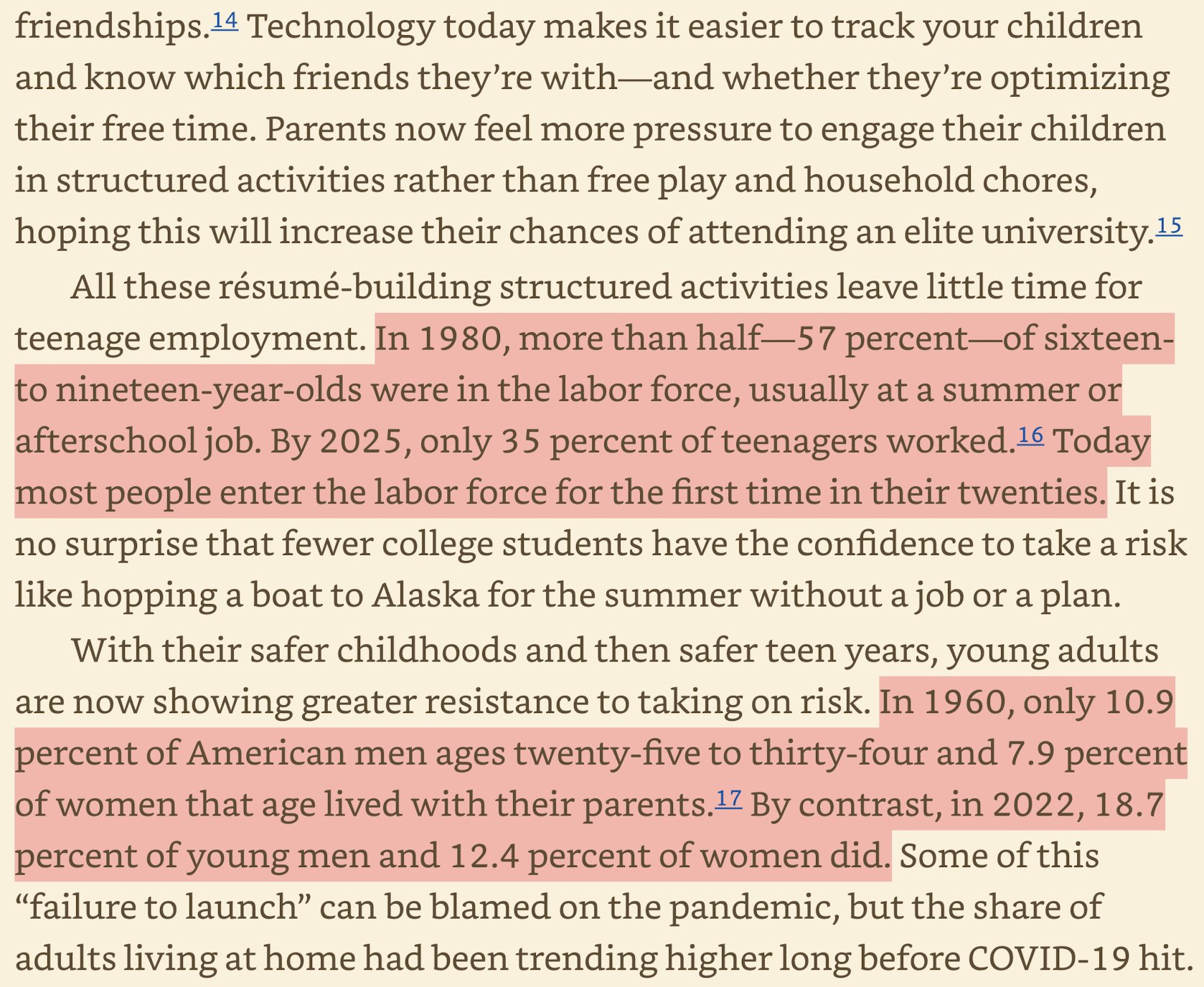
"In 1980, more than half—57 percent—of sixteen- to nineteen-year-olds were in the labor force, usually at a summer or afterschool job. By 2025, only 35% of teenagers worked. Today most people enter the labor force for the first time in their twenties." a.co/d/0hgonf1t
Joshua Rucinski retweeted

Implicit bias (or unconscious bias) is an attribution of stereotypes of certain qualities onto specific social groups (read: identities) that takes place almost entirely beneath one’s awareness.
newdiscourses.com/tftw-impli…
