

Click link to my Youtube channel to watch all my content https://nitter.cf/t.co/p65z6bKtzy My previous name was "Yoruba Cultural Heritage"
Joined October 2024
- Tweets11.9K
- Following1.5K
- Followers3.9K
- Likes765




Yoruba Mystic TV retweeted

The father of a teen killed in a shooting in the Bronx spoke through tears as he remembered his son.
Read more: pix11.com/news/crime/teen-ki…
Yoruba Mystic TV retweeted

Genius engineer is going viral after creating a robot that automates hair braiding up to 5 times faster than human hands, with over 7,000 salons across the U.S. already lining up to get it 🙏
Yoruba Mystic TV retweeted

Fox: Why are you here this morning?
Trump rally attendee: Well, in the late 70s, I was a little too young to go to South America for the Jonestown Massacre. But this is as close as I'll ever get, so that's why I'm here. There's nothing like seeing a cult right up front.
Little Simz (born Simbiatu Abisola Abiola Ajikawo) is of British-Nigerian heritage.
Her parents are from Nigeria, and she grew up in a household deeply connected to Nigerian culture, food, language (Yoruba), and Nollywood movies.
She has worked closely with and received mentorship from Gorillaz co-creator Damon Albarn.

Meet the Yoruba woman making waves in the UK.
Known by his stage name, Little Simz, Simbiatu is described by fans as Best UK Rapper Of All Times. She was born February 23, 1994, in Islington, London, and grew up becoming a British-Nigerian rapper, singer, songwriter, and actress.
As a Yoruba woman She has become one of the most acclaimed figures in contemporary UK hip-hop, blending introspective lyricism, jazz, soul, and electronic elements in her music with her work often exploring themes of identity, mental health, ambition, and Black womanhood.
She was said to have been influenced as a teenager by artists like Busta Rhymes, Nas, Biggie Smalls, and especially Lauryn Hill and started releasing music independently around 2010, gaining traction through mixtapes and live performances at venues like Hackney Empire and the Royal Albert Hall.
Ajikawo expanded into film and TV, featuring in:
- Top Boy (Netflix, 2019–2023) where she played roles as Shelley, a resilient club owner navigating London's underworld.
- Malcolm & Marie (2021): Supporting role in the Zendaya-John David Washington drama.
- Venom: Let There Be Carnage (2021) where she was a musician in the Marvel film; also contributed to the soundtrack.
- Upcoming: Steve (2025), a film with Cillian Murphy, where she starred alongside Tracey Ullman and Emily Watson.
Yoruba people are the giants of Africa.
THE GREAT YORUBA RACE: A LEGACY OF COURAGE, INTELLIGENCE, RESISTANCE, AND CIVILIZATION
In this slide show, you will learn the history of the great Yoruba people of Nigeria and West Africa.
Yoruba History is one of remarkable courage, intelligence, cultural sophistication, and resistance against oppression.
From the kingdoms of Yorubaland to the plantations of Cuba, the revolutionary struggles of Haiti, and the liberated African communities of Sierra Leone, the Yoruba left an enduring mark on world history.
British and European observers, including A. B. Ellis, documented the intelligence, independence, social organization, and determination of the Yoruba people. Even colonial authorities who sought to dominate them acknowledged qualities they found difficult to suppress.
In Cuba, the Lucumí (Yoruba) became renowned for their resistance. An 1843 British consular report described them as hardy Africans who were warlike in their homeland, while later historical accounts documented their courage and willingness to fight against enslavement.
In Haiti, the Nagô (Yoruba) contributed to revolutionary resistance and the development of religious traditions that helped sustain enslaved communities. Leaders such as Alaou demonstrate the importance of Nagô participation in the struggle against colonial oppression.
The story also extends to Panama, where Bayano led a major rebellion against Spanish colonial rule during the sixteenth century. Although his precise African origins remain uncertain, his resistance belongs to the broader history of African struggles for freedom.
In Sierra Leone, Yoruba-speaking Aku became an important part of the liberated African population, contributing to the intellectual, commercial, religious, and cultural development of the colony.
The Yoruba legacy was never confined to Nigeria or Africa. It crossed oceans, survived enslavement, influenced spiritual traditions, and helped shape societies throughout the Atlantic world.
The great Yoruba civilization is remembered not simply for its kings, kingdoms, artistic achievements, and sacred traditions, but also for the resilience of its people.
Our ancestors were not merely witnesses to history. They were among those who shaped it.
Proudly Yoruba. Proudly Nigerian. Proudly African.
Yoruba Mystic TV retweeted

“Asake will not go far if he continues to sing in Yoruba.” “Asake is an illiterate. Gunna features him and he starts singing in Yoruba.” “UK is second Lagos, that’s why he can sell out these arenas.” “Asake can’t speak English.” “All these artists are enjoying Yoruba tax.”
Now y’all are barking when a Yoruba person praises Asake for his achievements using that same language. What’s your problem?
If FOLA had an insane run like Asake, they’d start the “Yoruba tax” and “he speaks Yoruba” on him too.
Should we be hiding on this app for you because we want to satisfy you and let you badmouth all our artists for your satisfaction?
Ko ni ragba fun gbogbo yin Aye gbogbo yin ma baje ni e ni sorire.

Come, Nigerians! I'll pay $1,000 to anyone who can accurately translate what is being said in this Old English video. 🤣🤣🤣
Every day, you see just how ignorant some Nigerians are when it comes to basic history, linguistics, and the evolution of languages.
Imagine living in the 21st century and not understanding linguistic drift, one of the most fundamental processes in historical linguistics.
Languages change over time. As populations migrate, expand, and become geographically separated, their speech develops differences in pronunciation, vocabulary, grammar, and even sentence structure. Over generations, these changes produce regional dialects, some of which may eventually develop into distinct languages.
This is basic linguistics!
Yet you have Nigerians arguing that Yoruba dialects must be completely different languages simply because they sound different or because their speakers use Standard Yoruba, largely based on oyo varieties, as a common written and educational language.
By that logic, the English spoken centuries ago must belong to an entirely unrelated people because modern English speakers struggle to understand it. 🤣
These people conveniently ignore the historical and cultural connections among Yoruba-speaking populations, including their shared traditions, religious systems, ancestral relationships, and the importance of Ile Ife as a major ancestral and cultural center in Yoruba historical traditions.
They also fail to understand that standardization does not erase linguistic diversity. Standard Yoruba is a common literary and educational form; it does not mean every Yoruba community historically spoke exactly the same variety.
The existence of different Yoruba dialects is evidence of linguistic development, migration, regional interaction, and centuries of historical change. It does not establish that their speakers belong to unrelated civilizations.
If your argument is that two populations cannot share a broader linguistic and historical identity because their speech has changed over centuries, then you fundamentally misunderstand how languages evolve.
So, Nigerians, before embarrassing yourselves with arguments about Yoruba dialects, try translating the Old English in this video.
$1,000 is waiting! 🤣🤣🤣
THE GREAT YORUBA RACE: A LEGACY OF COURAGE, INTELLIGENCE, RESISTANCE, AND CIVILIZATION
In this slide show, you will learn the history of the great Yoruba people of Nigeria and West Africa.
Yoruba History is one of remarkable courage, intelligence, cultural sophistication, and resistance against oppression.
From the kingdoms of Yorubaland to the plantations of Cuba, the revolutionary struggles of Haiti, and the liberated African communities of Sierra Leone, the Yoruba left an enduring mark on world history.
British and European observers, including A. B. Ellis, documented the intelligence, independence, social organization, and determination of the Yoruba people. Even colonial authorities who sought to dominate them acknowledged qualities they found difficult to suppress.
In Cuba, the Lucumí (Yoruba) became renowned for their resistance. An 1843 British consular report described them as hardy Africans who were warlike in their homeland, while later historical accounts documented their courage and willingness to fight against enslavement.
In Haiti, the Nagô (Yoruba) contributed to revolutionary resistance and the development of religious traditions that helped sustain enslaved communities. Leaders such as Alaou demonstrate the importance of Nagô participation in the struggle against colonial oppression.
The story also extends to Panama, where Bayano led a major rebellion against Spanish colonial rule during the sixteenth century. Although his precise African origins remain uncertain, his resistance belongs to the broader history of African struggles for freedom.
In Sierra Leone, Yoruba-speaking Aku became an important part of the liberated African population, contributing to the intellectual, commercial, religious, and cultural development of the colony.
The Yoruba legacy was never confined to Nigeria or Africa. It crossed oceans, survived enslavement, influenced spiritual traditions, and helped shape societies throughout the Atlantic world.
The great Yoruba civilization is remembered not simply for its kings, kingdoms, artistic achievements, and sacred traditions, but also for the resilience of its people.
Our ancestors were not merely witnesses to history. They were among those who shaped it.
Proudly Yoruba. Proudly Nigerian. Proudly African.
Yoruba Mystic TV retweeted

Growing up with albinism, Nigerian artist Dapo Richard Oni never saw a comic book character who looked like him.
Now he is turning his childhood experiences into a story of resilience, hoping to inspire a new generation of readers.
Yoruba Mystic TV retweeted

Nigerian-American founder Yinka Ogunbiyi unveils the world’s first air-braiding robot. 🇳🇬🔥👏🏽
This robot makes hair up to five times faster than stylists.
Yoruba Mystic TV retweeted

Yesterday, I met someone whose last name is Akande.
He has an English 1st name, so it never occurred to me that he wasn't Yoruba. Until I saw his ID card with his middle name. Then he told me he was Bini. How many Bini people get Yoruba last name sef ? 🤔
BEWARE OF PAN AFRICANISM AND PAN AFRICANIST.
One of the greatest ironies of modern Pan-Africanism is that some of its supporters condemn European colonialism while embracing political identities and ideas that were themselves shaped by European colonial institutions and racial classifications.
Many have never seriously examined the intellectual history of the movement they promote.
Let's begin with the Harlem Renaissance.
During the 1920s and 1930s, prominent Black intellectuals and artists received financial support from wealthy white patrons, including Charlotte Osgood Mason, who sponsored figures such as Langston Hughes, Zora Neale Hurston, and Alain Locke.
But this money sometimes came with conditions. Mason promoted romanticized ideas about African spirituality and supposedly primitive Black culture, creating tensions with artists who wanted intellectual independence.
The irony is that a movement celebrating Black cultural expression was influenced by the expectations of wealthy white benefactors.
Now consider early Pan-African thought.
Some influential Black intellectuals, including Alexander Crummell, believed Africans needed to be transformed through Christianity, Western education, and European-derived institutions.
They challenged white racial domination while still accepting European assumptions about what constituted civilization.
And this brings us to the political contradiction.
European colonialism disrupted existing African kingdoms, nations, and political institutions, imposing territorial boundaries that frequently divided related peoples while incorporating historically distinct populations into common administrative states.
Yet some modern Pan-Africanists dismiss older African ethnolinguistic identities as primitive tribal divisions while treating the modern states and identities inherited from colonialism as natural political units.
How can you condemn colonialism while demanding that Africans weaken their historical identities to preserve political arrangements and identities established through colonial rule?
Take the Yoruba.
The Yoruba are a historical ethnolinguistic people and cultural nation whose languages, religious traditions, ancestral relationships, and political institutions existed long before Nigeria was created.
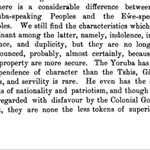
In 1894, British officer A. B. Ellis documented Yoruba-speaking communities and explicitly described sentiments of nationality and patriotism.
On page 32 of The Yoruba-Speaking Peoples of the Slave Coast of West Africa, Ellis wrote that these sentiments were:
"regarded with disfavour by the Colonial Government."
Think about that.
A British officer was documenting African nationality and patriotism while acknowledging colonial governmental hostility toward those sentiments.
This directly challenges the idea that strong indigenous ethnic consciousness invariably served European colonial interests or that so-called "tribalism" was inherently detrimental to Africa.
In some circumstances, such identities provided the political solidarity necessary to resist outside domination.
Now consider Nigerian nationalism.
Nnamdi Azikiwe promoted Pan-Africanism and Nigerian unity, yet the nationalist political environment in which he operated became increasingly divided along ethnic and regional lines.
His NCNC developed a particularly strong political base in the Eastern Region, while the Action Group and Northern People's Congress established their own regional power bases.
This demonstrates that nationalist rhetoric did not automatically eliminate ethnic political competition.
A politician could advocate a common Nigerian identity while participating in a system where regional populations competed for political power.
The language of unity does not guarantee equality among the peoples being united.
That remains an important question for modern Nigerian Pan-Africanists. Does their vision of unity protect the histories, languages, political rights, and autonomy of Africa's constituent peoples? Or does it expect those peoples to surrender their identities to a centralized political system?
And here is another irony.
Some people proudly embrace the racial identity of being "Black" while dismissing Yoruba, Akan, and other older African identities as socially constructed.
Yet the modern political meaning of Black identity was profoundly shaped by European racial classification, colonialism, and the transatlantic slave trade.
Black identity has also been reclaimed and transformed into a powerful source of solidarity. But why should a broad racial identity be considered more legitimate than historical African identities rooted in particular languages, cultures, and ancestral communities?
African unity should not require Africans to see themselves primarily through racial categories that developed under European domination.
Nor should it require the suppression of indigenous institutions that helped preserve African cultures through centuries of foreign interference.
The real issue is not whether Africans should cooperate. It is whether that cooperation strengthens African peoples or demands the erosion of their distinct identities.
The Yoruba did not become a people because the British created Nigeria.
Their historical relationships predated the colonial state.
And African political cooperation does not require the Yoruba, Hausa, Akan, or any other people to abandon their cultural nationhood.
You cannot claim to be liberating Africa from colonial influence while automatically treating older African identities as obstacles to civilization.
True African self-determination must include the right of African peoples to preserve their languages, cultures, institutions, and historical identities.
Unity should strengthen African peoples, not erase them.
🤖 Made with AI

Pan Africanism is poison.
You Condemn Colonialism in Africa While Praising the Same Methods Used to Suppress European Nations. 🤣
The contradiction in your argument is remarkable.
On one hand, you condemn European colonialism for imposing political identities on African peoples. On the other hand, you praise European governments for forcibly suppressing regional languages, traditional institutions, and established national identities in the name of unity.
So colonial domination is evil when Europeans impose it on Africans, but suddenly becomes enlightened nation-building when European states impose it on other European peoples? 🤣
You even celebrate the English Crown's dismantling of the Scottish clan system and France's suppression of regional languages as examples Africans should learn from.
Do you understand the irony?
Those policies involved coercion, cultural suppression, and forced assimilation, the very practices you supposedly oppose when discussing colonialism in Africa.
Now let's address your repeated misuse of the word "tribe."
The Yoruba are not simply a tribe. They constitute a major ethnolinguistic group and a historical cultural nation.
A nation does not necessarily require its own sovereign state.
The Yoruba existed as a network of related peoples, kingdoms, city-states, and communities long before the British established colonial Nigeria.
Their shared languages, religious institutions, traditions, and ancestral connections were not invented by British administrators.
And their different political institutions did not make them unrelated peoples.
Now, you claim Europe solved its divisions through the creation of modern national identities.
Really? 🤣
Then explain the United Kingdom today.
After centuries of political union and attempts at national integration, Scotland still has a major independence movement demanding the right to determine its constitutional future.
In October 2026, YouGov found that 47% of decided Scottish respondents supported independence, compared with 53% who opposed it.
So much for the idea that centuries of state-building permanently eliminated competing national identities.
Now explain Spain.
Spain has existed as a unified state for centuries, yet Catalonia continues to have a significant independence movement.
An October 2026 Catalan government opinion survey found approximately 43% supporting independence and 50% opposing it.
And Catalonia is not the only region with a distinct national identity. The Basques also maintain a longstanding national tradition.
So what exactly happened to your theory that modern European nation-building eliminated internal national divisions?
And then we have Yugoslavia.
Yugoslavia attempted to unite several South Slavic peoples under a common state and a broader Yugoslav political identity.
How did that end?
The federation disintegrated during the 1990s amid nationalist conflict, wars, ethnic cleansing, and mass displacement.
Croatia, Slovenia, Bosnia and Herzegovina, and other republics pursued separate political futures.
Yugoslavia is a particularly important example because it demonstrates that a common state identity does not automatically eliminate older national loyalties or political grievances.
And here is the fundamental problem with your entire argument.
You keep treating ethnic identity as inherently divisive while treating state nationalism as the solution.
But nationalism can also become exclusionary, coercive, and violent.
The difference is that one operates around an ethnic or cultural community, while the other may operate through a larger political state.
Making the political unit bigger does not automatically eliminate conflict.
Furthermore, your argument assumes that African progress requires the weakening of existing African identities.
Why?
Why must Yoruba people abandon their Yoruba identity to cooperate with other African peoples?
Why must the Igbo, Edo, Hausa, Akan, or other African populations weaken their cultural heritage to demonstrate national loyalty?
Political cooperation does not require cultural erasure.
The Yoruba can remain Yoruba while participating in a broader Nigerian or African political framework.
Just as the Scots can remain Scottish while participating in the United Kingdom, and Catalans can remain Catalan while living within Spain.
Whether those political unions should continue is a separate question from whether those identities deserve recognition.
And that is the distinction you continually overlook.
You also claim that eya, meaning a branch or division, somehow demonstrates that Yoruba philosophy recognized ethnic identity as an inherently destructive political weapon.
But a branch is not automatically an enemy of another branch.
Several branches can belong to the same tree. 🤣
Finally, you invoke Pan-African unity while dismissing older African ethnolinguistic identities as obstacles to progress.
Yet modern Pan-Africanism emerged under historical conditions profoundly shaped by European imperialism, slavery, and racial categorization.
Meanwhile, Yoruba civilization and its historical cultural relationships predate colonial Nigeria by centuries.
You cannot condemn identities imposed through colonialism while celebrating forced assimilation as the foundation of European civilization.
Nor can you insist that ethnic identity is inherently destructive while ignoring the nationalist conflicts that have repeatedly occurred within modern European states.
The lesson of European history is not that civilization requires the destruction of older identities. It is that building a common state does not automatically resolve competing national loyalties.
The Yoruba are a people with their own historical identity, not an administrative inconvenience that must disappear for Africa to progress.
African cooperation and Yoruba identity are not mutually exclusive.
You do not have to destroy the branches to strengthen the tree. 🤣
nitter.cf/CryptoMuse01/status/21…

The Yoruba language intuitively captured the purpose of tribalizing Africa. When I say "tribe," I am not referring to genetic or ancestral lineage; I am talking about a political weapon.
Tribal identity is intrinsically, structurally divisive when it exists inside a larger group.
The Yoruba call it ẹ̀yà — the fraction, the branch, the part.
Today in Africa, some of our bloodiest conflicts are fought along these exact fault lines.
I'm grateful for Rwanda. After their painful genocide, they learnt, they adjusted, and aggressively de-emphasized the tribe. (Again, tribe is not ancestry).
But in my own country, over three million deaths in a bloody civil war later, we have only regressed deeper into barbaric, tribal obsessions.
Wọ́n pé wa l’ólè, a n gbé ọmọ ẹran jó.
They called us barbarians and uncivilized, and we turn up every single day to prove them right.
When was the last time you went abroad and heard people obsessing over their tribe? In fact, as an immigrant overseas, the biggest threat to your safety comes from those harbouring tribal or racial sentiments.
But do you think Oyinbo didn't have tribes? Did they fall from heaven, or spring from the earth like grass?
No. Europe was once arguably the most violently tribal place on earth. The Anglo-Saxons, Franks, Goths, Celts, and Vandals hacked each other to pieces for centuries. In their Thirty Years' War alone, they slaughtered up to 60% of their people.
So, how did they escape it?
Through deliberate sociopolitical 'engineering'.
To survive, pre-European states systematically crushed local tribal allegiances. The French central state outright banned regional languages like Basque to force a single French identity.
The English crown violently dismantled the Scottish clan system — their tribal structure — banning traditional dress and weapons to force a unified British identity.
They built schools, wrote national anthems, and designed flags to turn tribesmen into citizens.
They engineered nationalism like it was a religion. They understood a fundamental truth: a modern, powerful civilization cannot coexist with powerful internal fractions (ẹ̀yà).
However, Europe's methods were born from a history of violent, hyper-destructive warfare. The only way they knew to de-emphasize differences was through violent subjugation.
We, as Africans, are not traditionally given to the practice of such widespread internal annihilation.
But the goal, however, remains the same:
We must unify to advance. But we can achieve this through dialogue and radical redefinition of our goal and purpose, rather than the sword.
nitter.cf/CryptoMuse01/status/21…
The Nigerian school system is failing our people.
Because these are kindergarten arguments. 🤣🤣
You are confusing linguistic variation, mutual intelligibility, political identity, ethnic identity, and language standardization as though they all mean the same thing.
First, your personal experience in Ara-Ekiti is not a linguistic study. Where exactly did you get that 60% mutual intelligibility figure? Did you conduct a controlled study, or did you simply encounter a dialect you struggled to understand and invent a percentage? 🤣
Yoruba is recognized by linguists as a dialect continuum. This means regional varieties can differ considerably, with mutual intelligibility generally decreasing as geographical and linguistic distance increases.
Nobody disputes that Ekiti, Owo, Ijebu, Ikale, Ilaje, and Oyo possess distinctive speech varieties.
But linguistic diversity does not establish separate ethnic origins.
And your European comparison actually undermines your argument.
Scandinavian languages demonstrate that closely related speech varieties can be classified as separate languages because of political, historical, and national circumstances. Conversely, varieties classified under one language can have substantial differences.
The distinction between a language and a dialect is not determined by one universal percentage of mutual intelligibility.
Now, let's address your claim about Standard Yoruba.
Yes, Standard Yoruba developed primarily from Oyo speech, with influences from other regional varieties. Nobody is disputing that.
But do you understand the difference between standardizing a written language and inventing the populations who speak its regional varieties?
English was standardized. German was standardized. Italian was standardized.
Did standardization suddenly create the ancestral populations who spoke those languages?
Of course not.
And here is where your argument becomes particularly interesting.
In their book The Yoruba from Prehistory to the Present, Aribidesi Usman and Toyin Falola discuss evidence that the name Yoruba was already circulating in the West African interior, probably before the sixteenth century.
They also discuss the historical interpretation that Yariba and Yarabawa were not originally restricted to Oyo.
So your claim that the broader name was simply manufactured by British colonial administration overlooks evidence of its earlier circulation.
Furthermore, in 1894, A. B. Ellis documented Yoruba-speaking communities and explicitly discussed sentiments of nationality and patriotism that the colonial government regarded with disfavor.
Think about that. A British officer was documenting sentiments of nationality and patriotism while acknowledging colonial disapproval of them.
That does not prove every Yoruba subgroup had an identical national consciousness. But it certainly complicates your claim that British authorities simply invented a convenient, unified identity.
And now you're saying you never discussed ancestry or genetics.
Fine. But then you turn around and declare, "It is incontestable that everyone is related."
Doesn't the word "related," particularly when discussing ethnic populations, refer to shared ancestry and genetic relationships? 🤣
So how can you claim ancestry and genetics were never part of your argument while simultaneously invoking the ancestral relationships between these populations?
The fact that the name Yoruba became more widely adopted during that period does not mean the underlying linguistic, cultural, and ancestral relationships were created during that period.
You are confusing the expansion of a collective identity with the invention of the people associated with it.
Finally, your argument about forming new alliances is an entirely separate political proposition.
You can advocate broader African cooperation without pretending that older African identities were manufactured by Europeans.
In fact, modern Pan-Africanism itself developed under historical conditions profoundly shaped by slavery, European racial classifications, imperialism, and colonialism.
Yet you are willing to embrace that modern collective identity while dismissing older ethnolinguistic identities as artificial.
The existence of distinct Yoruba kingdoms does not disprove shared identity. Differences between Yoruba speech varieties do not disprove shared ancestry. And standardizing written Yoruba did not create Yoruba civilization.
These are elementary distinctions.
You began by claiming that the British artificially engineered Yoruba peoplehood. Now you've retreated to arguing that some Ekiti speakers struggle to understand Standard Yoruba.
Bro, how did we go from colonial ethnogenesis to your personal difficulties understanding someone in Ara-Ekiti? 🤣🤣
That is not a historical rebuttal. That is a travel anecdote.
nitter.cf/CryptoMuse01/status/21…
Let me ask you this:
Have you heard someone say in Ado or any Ekiti language that they can only speak Ekiti, but they don't understand Yoruba. Or vice versa?
I have.
I was in Ara-Ekiti, deep inside Ijero and that's when I knew that Yoruba and some thick Ekiti variants were not up to 60% mutually intelligible ie being able to understand the other language without prior learning.
Have you heard Ogho (popularly spelt as Owo?). For the most part, it sounds nothing like Yoruba.
But Owo and Ilaje, Ikale, Oyo, Ijebu are called dialects of Yoruba. Not distinct languages o. Subcategories of Yoruba.
Do you know that there are many oyinbo languages that up to 90% mutually intelligible, but are not dialects?
Do you know where the popular Yoruba language we speak today comes from?
According to extensive documentation, itt was created from a type of Oyo. It was tweaked here and there to form Yoruba Ajumolo.
In my post, I didn't make any mention of ancestry or genetics, only the 'tribal' umbrella that was crafted.
It is incontestable that the everyone is related. The Oyo, the Igbomina, Ekiti, etc.
What I spoke about is the fact that the name under which we all congregate today was not formed by us. Neither was the umbrella formed for our benefit.
I then argued that if we could bond understand the name and identity called Yoruba, then we can form even better alliances for our upliftment.
Thank you.
You restricted comments because you wanted to exist in an echo chamber.
I wish you pan africanist would spend more time reading.
People like AB Ellis, Falola, Akintoye.
Because no excuse to go around making videos and post on an ethnic groups identity before you have a firm understanding of their history.


Yoruba Mystic TV retweeted
A European Writer Described the Yoruba as Independent, Urbanized and Difficult to Dominate
In 1894, British colonial writer A. B. Ellis published The Yoruba-Speaking Peoples of the Slave Coast of West Africa. In this book, he compared the Yoruba with several neighboring West African peoples and explained what he believed made Yoruba society stand out.
Ellis wrote that the Yoruba had a stronger sense of independence. In plain English, he was saying that the Yoruba were not naturally submissive and did not easily accept being controlled by others. He also observed that feelings of nationality and patriotism were already present among them. In other words, the Yoruba understood that they belonged to a wider cultural nation, and they took pride in protecting their people, political institutions and way of life.
According to Ellis, the British colonial government did not approve of this strong national consciousness. That is not difficult to understand: a proud and politically conscious population would be harder for a foreign government to dominate. People who value their independence, recognize their shared identity and remain loyal to their institutions are less likely to accept colonial rule without resistance.
Ellis nevertheless considered Yoruba patriotism and independence signs of social advancement. He described the Yoruba as active traders, sociable people and members of a highly developed society. He believed their commercial skill, independence and political awareness placed them ahead of the other groups he was comparing them with.
He also connected Yoruba development with the physical environment of Yorubaland. Much of the region was connected by open country, roads and rivers, making travel, trade and communication between communities easier. Instead of living mainly in small, isolated settlements hidden deep inside forests, large numbers of Yoruba people lived in organized towns.
These towns were not cut off from one another. People could travel, exchange goods, communicate and build political relationships across the region. This helped create a network of connected Yoruba urban centers. Trade brought different communities together, while town life encouraged cooperation, political organization and the exchange of knowledge.
Ellis argued that the Yoruba already possessed strong social instincts, which encouraged them to gather in towns in the first place. After many generations of urban life, those qualities became even stronger. Living in organized communities helped develop social discipline, loyalty, commercial knowledge and intellectual culture.
He was not claiming that the Yoruba were naturally born more intelligent than every other population. His argument was that Yoruba intelligence had become more “cultivated” through generations of town life, trade and regular interaction with other people. In modern language, he was saying that Yoruba society created conditions that encouraged education, social development, political organization and intellectual growth.
This observation is important because it challenges the false colonial image of precolonial Africans as people living without cities, organized governments or developed social institutions. Ellis encountered a Yoruba world of established towns, active markets, skilled traders, political consciousness and strong cultural identity.
He also noticed loyalty among the Yoruba. This loyalty was not simply obedience to an individual ruler. It included attachment to the community, homeland and wider Yoruba society. Their shared language, customs, institutions and historical identity helped create a sense of belonging that Europeans could recognize as nationality and patriotism.
Ellis ultimately concluded that the Yoruba were “certainly the leading people in West Africa” during his time. That was the personal judgment of a nineteenth-century British writer, not a modern scientific ranking of African peoples. His insulting descriptions of other African groups also reflect the prejudice and racial hierarchy common in colonial writing, so those parts should not be repeated as objective truth.
However, his direct observations of Yoruba urbanization, trade, independence and national consciousness remain historically significant. Even a European colonial observer acknowledged that the Yoruba possessed large connected towns, active commercial networks, cultivated social institutions, political awareness and a strong desire for independence.
In simple terms, Ellis was saying that the Yoruba were not an isolated or politically undeveloped population waiting for Europeans to organize them. They already possessed their own towns, governments, markets, social systems and national identity. Their society had developed through many generations of urban living and communication between communities.
Most importantly, he recognized that the Yoruba were proud, patriotic and difficult to reduce to silent colonial subjects. The colonial government may have disliked that independent spirit, but Ellis understood that it was evidence of an already established and sophisticated society.
Source: A. B. Ellis, The Yoruba-Speaking Peoples of the Slave Coast of West Africa (1894), printed pages 32–33; PDF pages 48–49.
Yoruba people are the giants of Nigeria and Africa.


Yoruba Mystic TV retweeted

📊 TOP 12 STATES BY REVENUE PERFORMANCE — H1 2026
State — Actual Revenue (% of Budgeted Revenue)
1 🟣 Oyo — N564.06bn (66.4%)
2 🟣 Ondo — N215.61bn (59.0%)
3 🟤 Bayelsa — N409.26bn (40.8%)
4 ⚫ Bauchi — N340.78bn (39.4%)
5 🟣 Lagos — N1.684tn (38.0%)
6 🟣 Ekiti — N141.89bn (37.1%)
7 ⚫ Taraba — N217.22bn (33.3%)
8 🟤 Delta — N555.87bn (32.7%)
9 🟠 Kogi — N258.94bn (31.6%)
10 ⚫ Yobe — N155.36bn (30.7%)
11 🟠 Kwara — N175.02bn (30.0%)
12 🟠 Nasarawa — N140.44bn (29.2%)
🟠 NC ⚫ NE 🟤 SS 🟣 SW
Oyo recorded 66.4% of its N849.78bn budgeted revenue in H1 2026, compared with 12.9% in Cross River.
NB: Rivers and Osun were excluded because their Q2 reports were unavailable.
#StatiSense
(BudgIT)