



It's lovely to understand something intuitively. Most technical books bury that behind jargon. With LLMs we can extract the intuition more easily.
I have just been learning about how robot joint movements are calculated:
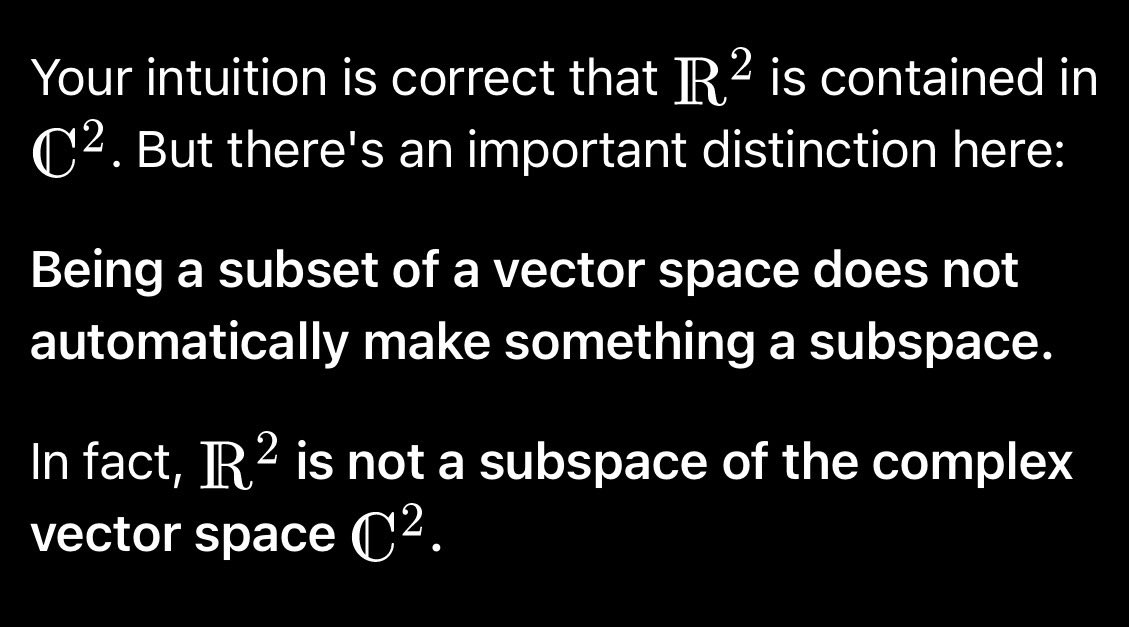
When calculating a rotation of a rigid body across an axis not at the origin of the reference frame coordinate, you first have to calculate where the object would end up if the rotation was around the origin then apply an offset to where the actual axis of rotation is. Makes sense, right?

Going through classical robotics basics. I use the book modern robotics by Lynch.
This is how I read it. I ask chat to condense, extract what is useful for a practitioner and explain more clearly. I find the derivation of the formulas (which will anyways be used in software libraries) pointless.


I bought my first robot arm: a @LeRobotHF So-101.
It is not easy to get hold of equipment when not a student. You can print it yourself, of course. But I got this second hand one which cost the same as doing it yourself. So it saves me a few days and lets me focus on the robotics side.
I'm launching something soon to solve the equipment access issue for fellow self-learners ;)
(especially if you are in Berlin!)

This is pretty cool!

Jensen closed his GTC Berlin 2026 keynote with this Hermes Agent demo as the finale.
He introduced it by saying the way to build an agent is to ask an agent to build it for you, so he installed and set up a customized Hermes in one prompt.
Then he used Hermes, running on @nvidia RTX Spark, to create a simulated training environment for the @huggingface Microduck. Hermes planned an obstacle course with Nemotron and had GPT-6 Astra build it using FreeCAD, Omniverse libraries, Blender, Newton, and Isaac Lab. Hermes trained thousands of simulated ducks on that course until the validated policy was ready to run on the real robot in the physical world.
At Nous, we believe open source is a practical tool as much as a philosophical ideal. It gives users the ability to build powerful, complex workflows chaining numerous local+cloud models, devices, and tools themselves instead of waiting for a company to enable them.
The fastest way to learn math is a great text book (Axler’s Linear Algebra Done Right here), gpt6/6.1 as a “for dummies” translator and doing exercises.


opus 5.5 sucks at writing proof based math lessons - no matter the prompting. gpt 5.6/6 (the one in the web chat) seems better at this.


Eeskander retweeted

Should Europe leave frontier AI to the Americans and the Chinese?
The idea has gained ground in Europe. It is a fundamental mistake.
Build or surrender: for now, the choice is still ours.
Full article below.
I have made the lessons shorter and clearly articulate the learning points in advance so the learner knows where they are going.
It's easy to drift of overcomplicate even when building with AI. The only cure is to use the product extensively yourself and give lots of feedback to claude.


We’ll look at this in a few years and wonder, did we really try to collect training data on all possible actions in the physical world? Nuts.

Embodied AI data collection in China has entered the era of mass crowdsourcing.
Just look at these screenshots. Ordinary people can now get paid to record everyday physical tasks: sorting packages, scanning barcodes, packing boxes, and more.
The price has dropped to just RMB 14 (~$2) per hour of valid video footage.
And here's the catch: "valid" means footage accepted by the buyer, not the total time spent recording.
Typically, only around 70% of recorded footage counts.
That brings the effective pay down to roughly RMB 9.8 (~$1.40) per hour of recording, even before accounting for setup and other work.
That's approaching the income level of China's lowest-paid workers.
The race to scale embodied AI data is no longer just about robots and GPUs.
It's also about how cheaply human physical labor can be turned into training data.
The platform is operated by Mifeng Technology (Maniformer), backed by AgiBot (Zhiyuan Robotics).
By the way, how much are they paying for data collection where your country ?