

Z Squared inc. is a digital infrastructure company.
Fort Lauderdale FL
Joined April 2025
- Tweets218
- Following148
- Followers207
- Likes138




Z Squared Advances Debt‑Free Arkansas AI Campus as Build‑Out Bottlenecks Constrain Major Markets
nasdaq.com/press-release/z-s…


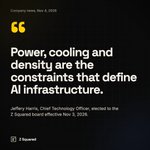
Our CTO, Jeffery Harris, has been elected to the Z Squared board of directors, effective Nov 3.
He'll keep serving as CTO. His work centers on the engineering side of AI infrastructure: power, cooling, and density.
Full release: nasdaq.com/press-release/z-s… $ZSQR

Z Squared Inc. Appoints Chief Technology Officer Jeffery Harris to Board of Directors
Read the full article here:
nasdaq.com/press-release/z-s…

A typical enterprise server rack averages under 8 kW (Uptime Institute 2024).
That's 100+ racks per MW. A liquid-cooled NVIDIA GB200 NVL72 rack draws around 120 to 130 kW. That's about 8 racks per MW.
Same megawatt. Very different math.

What's actually inside an AI-ready site? This week we're going one layer at a time.
Day 1 is power. Before a single GPU turns on, a site needs a grid connection, a substation, transformers, switchgear and backup systems.
Everything else is built on top of that

That concludes our educational series on edge computing, AI, and power.
Over the past few weeks we've covered what edge computing is, who uses it, how AI training and inference differ, and why power has become the real bottleneck.
Here's how it ties together. AI is no longer confined to a handful of large campuses. Models are trained in big facilities, then put to work everywhere: on phones, in factories, in stores, across cities. Every one of those layers depends on the same input first, and that's energized power.
That's the bottleneck Z Squared is built around. We acquire sites where power is already flowing and convert them into AI-ready capacity, starting with our Union County Campus in Arkansas.
As AI grows, so does the need for power. That's the layer we build.
Thank you for following along.

That concludes our educational series on edge computing, AI and power.
Here's how it all ties together.
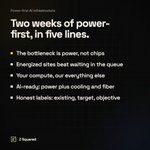
Two weeks of power-first AI infrastructure, in five ideas:
1. The scarcest input in AI is power, not chips.
2. Energized sites can be converted faster than new campuses can clear utility queues.
3. Our model: your compute, our everything else.
4. AI-ready means power plus the cooling, density, and fiber to use it.
5. We label status plainly: what's existing, what's a development target, and what's an objective.
The full picture, including where our Union County Campus stands today, is in our pinned post.


Site planning and preliminary engineering is beginning at our Union County Campus in El Dorado, Arkansas, where approximately 8 MW of utility power is available today. We’ve engaged A2 Advisors to lead site development and leasing strategy for the campus.
Full release: nasdaq.com/press-release/z-s…
$ZSQR

The AI conversation used to be about chips. Increasingly, it's about power.
Chips can be ordered. Grid capacity has to be planned, permitted, built, and connected, and in many markets that process takes years. New data center campuses can sit in utility queues while demand for AI capacity keeps growing.
That gap is the reason Z Squared exists. Instead of waiting in line for new power, we start with sites where power is already flowing and convert them to AI-ready capacity.
Lead with power. Build with speed. Scale with discipline.

AI demand comes in two shapes, and both run on power.
Training is how a model learns. It means large, concentrated jobs running on thousands of chips for weeks.
Inference is the model doing its job: answering questions, recognizing images, running agents. Each request is small, but the volume grows with every user and every new application.
Both need the same foundation: energized power, cooling, density, and connectivity. That's the capacity Z Squared is built to deliver, with AI and high-performance computing as our target workloads.

"Energized" and "AI-ready" aren't the same thing.
An energized site has power flowing. An AI-ready site adds everything modern AI workloads need on top of it:
• Cooling, with a path from air to liquid as rack densities climb
• Density: racks that draw far more power than typical enterprise servers
• Fiber: fast, redundant connectivity
• Physical security and monitoring
• Operations staff and remote hands on site
At Z Squared, power comes first. Everything else is engineered to the workload.
#AIInfrastructure #DataCenters #LiquidCooling
