

Covering the biggest moves in the stock market, the headlines making waves, and the trends shaping tomorrow. Not Financial Advice!
Join Trading Discord 👉
Joined July 2022
- Tweets24.6K
- Following705
- Followers87.4K
- Likes2.9K





StockMarket.News retweeted

Billionaire Ken Griffin is sitting on a MASSIVE $174 BILLION stock portfolio, and these are some of his biggest bets.
Here are some of its largest reported positions:
- $IVV: 7.60%
- $AMZN: 1.49%
- $NVDA: 1.36%
- $AAPL: 1.21%
- $MSFT: 0.81%
- $AVGO: 0.63%
- $GOOGL: 0.61%
What's interesting is that Citadel's largest disclosed position is actually $IVV, an ETF tracking the S&P 500, rather than an individual company. Beyond that, Amazon, NVIDIA, Apple, and Microsoft are among its biggest reported individual stock holdings, giving the portfolio significant exposure to AI, cloud computing, and the broader technology sector.
Want to see exactly what billionaire investors like Ken Griffin, Warren Buffett, and Bill Ackman are buying and selling?
Create a FREE Milk Road account to track their portfolios, see their latest disclosed holdings, and monitor changes every quarter.
milkroad.com/?utm_medium=soc…

Roblox CEO David Baszucki pushes back live on Bloomberg as the stock craters
Asked if one game, Steal an Egg, is half the platform's concurrent users, "Yeah, that's not correct"
"The distribution of games on our platform has never been healthier"
"For the first time ever, we're seeing primarily AI created experiences hit our top 20"
$RBLX is down about 20%, its biggest drop since July, after daily active users fell 9% to 138M and bookings dropped 12% year over year
He's betting AI made games will refill the top of the charts
via @technology, featuring @DavidBaszucki
StockMarket.News retweeted

Kalshi just raised $1 BILLION at a $40 BILLION valuation.
This company is growing at an absolutely ridiculous pace. Kalshi has now surpassed a $6 BILLION annualized trading fee revenue run rate, up from $4.6B in September, and is processing trading volume at an annualized pace exceeding $1 TRILLION. For context, its commodities business alone has grown to over $100 MILLION in annualized trading fees in just THREE MONTHS.
And this is no longer just a sports prediction market. Kalshi is rapidly expanding into crypto, commodities, and new financial products, including perpetual futures, equity binaries, and event-based indices. They are also building out their institutional business to attract hedge funds, proprietary trading firms, and other major financial institutions.
The company is even looking to expand internationally into Canada, Mexico, Brazil, and other markets. And here's something even crazier. Kalshi is currently on track for Q4 revenue to surpass Robinhood's, according to the company.
I genuinely believe prediction markets are going to become one of the biggest developments in financial markets over the next decade. We are watching an entirely new category of financial infrastructure being built, and Kalshi wants to be at the center of it.


Kalshi just raised an additional $1B, valuing the company at $40B. This will help us expand into stocks, compute, indices, and institutional.
Tomorrow marks 8 years since we got accepted into YC and the journey began.
The odds of a kid from Lebanon getting here were pretty low.
Growing up there was great, but very challenging. We went through war. We had bombs explode in front of my house. I watched brilliant people’s lives destroyed for reasons beyond their control.
Lebanon is an unpredictable country. That unpredictability made it hard to plan for success. And yet despite it all, my mom sacrificed everything to give me and my brother the chance to go back to the US.
I found my refuge in two things: anime and math. Especially math.
I loved math because it calmed me. It was the opposite of unpredictable: clear, deterministic, orderly, and consistent. The proof is either right or wrong. I find that elegant and beautiful.
I was lucky.
I made it to my dream school, MIT (largely thanks to my mom), and my love for math quickly translated to a love for statistics, probability, and markets.
I love markets for a lot of the same reasons. Their incentives are clear: you get rewarded for being right and for pursuing knowledge. They are effective weighting machines for people’s opinions. They provide an incentive to be truthful, because they separate good information from bad information. They let people challenge the consensus and be rewarded for being right.
IMO, Hayek, Surowiecki, Hanson, Tetlock were the founding fathers of prediction markets. The more I read them, the more obsessed I got with the idea of applying market-based pricing to more things.
Markets bring rigor and critical thinking to more questions. And in an increasingly polarized and information-positioned word, I believe we need that more than ever.
Markets would also let people predict and manage more things outside of their control. And the world was becoming increasingly more unpredictable, and more like Lebanon, not less.
That love for markets got Luana and me to build Kalshi.
At first, it was mostly an idea we couldn’t stop talking about. We didn’t have much money. Luana’s sister bought the Kalshi domain name for us (for ~$1.7k). We moved to SF to get started, and embarked on a long, uncertain journey to build a regulated exchange.
The paranoia and anxiety from my childhood never left me. Even when things are going well, I think about what could go wrong. When people trust you with their money, that instinct serves a purpose.
I wanted us to build something that would hold up under pressure.
The first principle we defined at the company: regulatory-first. We worked with regulators for years before we listed a single market. We took every step to do things the right way and always asked for approval before proceeding. It was very hard at times, especially when we were being overtaken by competitors, but we believe doing things the right way matters.
Luana and I aren’t the only ones.
Our team put years of their lives into something far from certain. That’s especially true of Lior, Brandon, Rainer, Luis, Xavier, and Josef, who stuck with us for years. They believed when there was little to point to. And they stuck with us no matter how long it took. Kalshi is the result of an arduous journey through a long desert where, at times, most people didn’t understand why we were making the walk.
Many people still don’t understand what we’re doing and some disagree with us. Markets have historically taken time to be understood and accepted by some. But while not always obvious, their benefits are vast: capital markets help allocate capital and derivative markets help predict and manage uncertainty.
I firmly believe in these benefits, and that’s why I am dedicating my life to building this market.
Markets have caused issues many times in the past, and they certainly can present harms (manipulation, insiders, and addictive behaviors). These harms are more acute for certain types of markets (sports, short-term options, etc.) than others. It’s why I believe that guardrails need to exist and why we have taken the approach we have taken. We have consistently prioritized thinking critically about the risks and building the appropriate safeguards, sometimes beyond what the regulators require us to do. Many believe more needs to be done, and that’s a conversation I welcome.
Over time, I believe more people will see what we see: markets can help us get smarter and manage the future with more rigor, more precision, and more certainty than we have today.
To our tens of millions of users: you have made Kalshi bigger than anything Luana and I could have possibly imagined. Thank you for trusting us and thank you for coming along on the journey. I feel a strong responsibility to build a company worthy of that trust.
I am so lucky to spend my life building something I love. I hope everyone finds something they care about that much. Something that keeps you curious. Something that pushes you to your limits. Something that may put you at odds with the status quo. Something worth the hard days.
For me, it’s still markets. The more I learn, the more I want to understand.


Jim Cramer says Microsoft is going to be number one while Alphabet won't rally
"I think the stock of Microsoft with all of its discipline is now set to soar while the stock of Alphabet won't rally"
"Too much baggage for Alphabet, no discipline, no sense of what it's supposed to be doing"
"They run it like a business, not a science project"
$GOOGL just had the worst day in its history, down 12.6%, as cash flow went negative for a second straight quarter, while $AMZN posted the highest operating margin in its history at 13.9%
Big Tech's AI spending race now has clear winners and losers in Cramer's eyes
via @MadMoneyOnCNBC, featuring @jimcramer
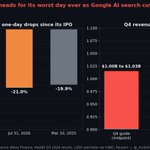
Reddit $RDDT is heading for its worst day ever, down as much as 29% to about $91
The selloff is wiping out more than $7 billion in market value and puts the stock at its lowest close since April 2025
The quarter itself was strong. Revenue jumped 53% to $895M and EPS came in at $1.40, both ahead of estimates
The problem is what comes next. Q4 revenue guidance of $1.00B to $1.03B came in below the $1.05B Wall Street wanted
Reddit says Google's AI search is sending it far fewer clicks, and warned daily active uniques could fall by a low double digit percentage in Q4 if referral traffic keeps sliding
It now plans to test making the site logged in only, a huge shift for "the front page of the internet"
This is the AI search fear in real time. $GOOGL just had its worst day ever on the same worry, and now the sites that live on Google traffic are getting repriced too. The real test for $RDDT is whether it can turn search visitors into logged in daily users before the traffic dries up

Shell CEO Wael Sawan says fuel demand at Shell stations is down about 5% globally, and almost 10% in Asia
"We're seeing globally a drop of around 5%"
"The Straits of Hormuz... is close to 80 to 85 percent of pre-war levels"
"We have drawn down significantly as a world on that inventory stock"
Brent is near $114, up more than 56% since the Iran war began in February
Even if the strait fully reopens, the world still has to refill its tanks first
via @CNBC, featuring @Shell
Benchmark's Cody Acree says Intel's after hours drop is "unprecedented"
"This is unprecedented, down 22% here, pretty far out after market so far"
"We've seen estimates for the market down now between 20 and 25% for the overall PC market for this year"
"It just shows that Intel is still largely a PC levered company with AI tangentially and foundry still on the come"
$INTC guided Q4 EPS to $0.25 vs $0.43 expected as memory costs crush PC volumes, even with data center beating
The AI boom is starving the PC market, and Intel is still living on PCs
via @CNBC
StockMarket.News retweeted
The Nasdaq 100 has now lost roughly $5 TRILLION in market value since October 6th.
The market is selling off because Wall Street is starting to seriously question how much money companies are spending on AI and whether those investments will actually generate meaningful returns. And no, It's not necessarily that AI demand is slowing down. The problem is that companies are spending hundreds of billions of dollars building AI infrastructure, and investors are becoming increasingly concerned about how long it will take to make that money back.
Amazon and Google have added to those concerns following their earnings reports. Amazon is spending aggressively on data centers, chips, and AI infrastructure, putting enormous pressure on free cash flow. Investors are realizing that even strong cloud growth doesn't necessarily translate into stronger profitability when capital expenditures are growing this quickly. And with Google also disappointing Wall Street, investors are becoming much less willing to overlook the costs associated with the AI boom. Intel made things even worse. Despite reporting a relatively strong third quarter, the company's fourth quarter guidance was extremely disappointing. Revenue, earnings, and gross margin expectations all came in well below what investors wanted to see. The company has enormous opportunities from AI related demand, yet it's still struggling to translate those opportunities into sustained growth and profitability.
Interest rates are also making things worse. Higher borrowing costs make it more expensive to finance massive data center projects, while inflation concerns are making investors less confident about how quickly the Federal Reserve can ease monetary policy. That's especially painful for technology stocks trading at high valuations based on future earnings. What's interesting is that this isn't necessarily a broad market collapse. The Nasdaq is getting hit much harder than the Dow, suggesting that investors are rotating out of technology and AI related stocks and into more defensive sectors.

Gold just fell to its lowest level in a year
Spot gold dropped about 3% this morning to roughly $3,910 an ounce, the lowest since October 2025
Gold futures are now down about 26% from January's record close of $5,318
And it's happening on a day the Nasdaq 100 is down more than 2% and $INTC is having its worst day since 1974
Usually the safe haven catches a bid in a selloff like this
Instead traders are pricing in more Fed hikes after a hot 0.5% September PCE print, and Richmond Fed's Tom Barkin just said a "gradual approach is a good way to go" on hikes
When even $GLD gets sold during a tech rout, it tells you investors are raising cash wherever they can, and rates are the thing the whole market is scared of right now

Sen. Rick Scott says the US should go in and "demolish" Iran's regime
"I think you have to prepare for war to get peace"
"I think we ought to go in and demolish the regime so we can end this"
"Nobody can fight the American military. If they put their mind to it, we're going to demolish the regime"
Brent crude sits above $115 as the US Navy escorts tankers through the Strait of Hormuz
A senior Armed Services Republican is now openly calling for regime change, and oil traders are listening
via @BloombergTV, featuring @SenRickScott
Evercore's Mark Mahaney says Amazon could burn about $50 billion in free cash flow next year
"It came in at a record amount that was closer to 30 billion"
"The market wanted 40% plus, low 40s AWS growth, and it only got 39%"
"I think it's going to be about 50 billion in negative free cash flow next year"
$AMZN is sliding after Q3 as it sticks with $220B of capex this year. The street expected about $10B of negative free cash flow, and ad growth came in at 12% vs the 18% to 19% the market wanted
Mahaney calls it an expectations correction, not a fundamentals one, but the AI bill is getting very real
via @CNBC, featuring @markmahaney
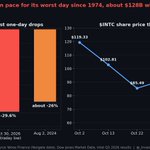
BREAKING. Intel $INTC just crashed as much as 29% today, putting it on pace for its worst day since 1974
That's about $128 billion in market value wiped out in a single session, the biggest one-day market cap loss in the company's history per Dow Jones Market Data
Only one day in Intel's history was worse, a nearly 30% drop on July 5, 1974. The stock has now blown past the 26% crash from August 2024
The trigger was a Q4 revenue guide of $15B to $16B vs $17.1B expected, with PC demand getting squeezed as the AI boom drains memory supply and pushes PC costs higher
$INTC nearly quadrupled into its June 22 record and is still up more than 80% this year, but it has now given back about half of that peak
The AI trade is starting to create real losers inside chips, and the market just made it clear that a strong data center story isn't enough when the core PC business is shrinking

Early Anthropic investor Matt Murphy of Menlo Ventures says the world has never seen a company grow like this at this scale
"The year over year growth rates through Q2 at like over 10x, a really healthy gross margin"
"They raised $140 billion and have $132 left on the balance sheet"
"How do you look at a company that's grown 10x, 3 years in a row and all of a sudden say, well, what if it stops growing?"
Anthropic filed its S-1 on Monday and is expected to go public next month as the first pure play generative AI IPO
The biggest AI listing ever is about to put real numbers on the table
via @YahooFinance, featuring @MenloVentures
Nasdaq 100 futures are down 2.6% after a brutal night of earnings
$INTC is down 25% premarket, on pace for its worst day since August 2024 when it fell 26%
Intel guided Q4 revenue to $15 to $16 billion vs $17.1 billion expected, blaming a weaker PC market and memory shortages
$RDDT is down 22%, $TWLO 21% and $RBLX 16% after soft Q4 outlooks
$AMZN is down almost 8% as AWS growth came in below what Wall Street hoped for
On the green side, $REGN is up 7%, $RIVN 6% and $CL 5% after beats
Right after $GOOGL's worst day ever and $NOW's 27% drop, the message from this earnings season is clear. The market is punishing any soft guide, no matter how good the quarter looked

Sam Altman says the world has far more serious software vulnerabilities than anyone expects
"These models are getting good at finding vulnerabilities in the wild"
"They continue to get better fairly rapidly"
"I think we're going to find that we are in a world of many more serious vulnerabilities than we expect"
He says startups are already rebuilding the internet's architecture for a world where AI keeps getting smarter $CRWD $PANW $NET $FTNT
AI is turning cybersecurity into an arms race
via Cheeky Pint, featuring @sama and @collision
Binance was just hit by the largest crypto theft in history
About $6.36 billion was pulled out of Binance wallets across 10 blockchains, most of it in roughly 20 minutes, per TRM Labs
That's about 4x the previous record, the $1.5 billion Bybit hack in February 2025
Binance says a compromised DevOps engineer's laptop let the attacker submit unauthorized withdrawals, and TRM and Chainalysis both tie the attack to North Korea's TraderTraitor (Lazarus) unit
Tether, Circle, Ripple and World Liberty froze roughly $2.7 billion, but the attacker still holds about 420,000 $ETH and 18,270 $BTC, around $2.4 billion beyond any freeze
Binance has paused withdrawals and says it has set aside more than $6.3 billion to cover user losses, with $5 billion already held in the exact tokens that were hit
The real test comes when withdrawals reopen. If outflows stay orderly, this is a record headline without a solvency problem, and the Nov 1 proof of reserves will show whether the hole is actually filled

Sam Altman says OpenAI is better than rival labs at not gaming AI benchmarks
"We endeavor not to bench max"
"I keep thinking that bench maxing is like over as a phenomenon and people keep doing it"
"I believe we are better than them right now"
He says the two things that matter are scientific discovery and being enjoyable to work with, and neither has a good benchmark $GOOGL $MSFT $META
Leaderboards are losing their grip on how AI models are judged
via Cheeky Pint, featuring @sama and @collision
Sam Altman says he would pay more to buy from Amazon inside ChatGPT
"I have such an extreme preference to buy something from Amazon versus some random e-commerce vendor"
"Like 10 out of 10 times I click Amazon, pay a higher price"
"Amazon in particular has this amazing defensibility by the fulfillment network"
He says brands, not websites, will win agentic commerce, and admits OpenAI hasn't built a good enough platform for partners yet $AMZN $SHOP $GOOGL
The moat in AI shopping is delivery and trust, not the storefront
via Cheeky Pint, featuring @sama and @collision
StockMarket.News retweeted
I'm dumping the majority of my Intel shares. This was genuinely one of the saddest earnings calls.
I had SO much hope for this company. I genuinely believed Intel was finally turning things around under Lip-Bu Tan and to be fair, they've made some real progress. But after listening to the entire earnings call, I honestly think Intel messed up BAD. And what makes this even more frustrating is that Intel has one of the biggest opportunities in the semiconductor industry sitting right in front of it, yet it cannot fully take advantage of it.
First, the guidance was absolutely terrible. Intel reported $16.5 billion in Q3 revenue and adjusted EPS of $0.52, which were actually pretty solid results. But then management guided for just $15 billion to $16 billion in Q4 revenue, compared to Wall Street's expectations of around $17.1 billion. They also expect adjusted EPS to fall to $0.25, compared to expectations of roughly $0.43. Even worse, gross margins are expected to fall from 44.1% to just 38% in a single quarter. That's a massive decline, especially for a company that's supposed to be improving its profitability.
But the biggest problem is what management said about 2027. Intel's PC business is getting destroyed by the ongoing memory shortage. Companies like Samsung, SK Hynix, and Micron are benefiting from enormous AI demand, but that same demand is making memory more expensive and harder to find for traditional computers.
And when memory becomes more expensive, the entire computer becomes more expensive. That means fewer people and businesses are willing to upgrade their PCs, which directly hurts Intel. Management now expects the overall PC market to shrink by around 12% in 2026 and another 10% in 2027. Intel also expects its own client revenue to fall more than 20% in Q4 alone. What really caught my attention was when management basically admitted that they don't expect the memory situation to improve in 2027. So this isn't just a temporary problem that disappears next quarter. It could continue hurting Intel for another year or longer.
Now, here's what frustrates me the MOST. Intel's data center business is absolutely booming, but they cannot manufacture enough chips to meet demand. Data Center and AI revenue grew nearly 80% year over year to $7.3 billion. Management expects industry server CPU shipments to grow more than 30% in both 2026 and 2027, and Lip-Bu Tan even believes the server CPU market could grow from around $40 billion today to more than $200 billion over the next five years because of AI agents. That's an unbelievable opportunity. But Intel is dealing with manufacturing capacity limitations, production bottlenecks, and shortages of the materials needed to package its chips. In other words, customers WANT to buy more Intel server CPUs, but Intel cannot produce enough of them.
And management made it pretty clear that these supply problems will continue into the first half of 2027, with meaningful improvements not expected until the second half. This is what bothers me more than anything. We're experiencing one of the strongest periods of CPU demand in years, and Intel is leaving billions of dollars in potential sales on the table while competitors fight for market share. Then there's the tragic accident at Intel's factory in Israel, which forced production to shut down for approximately two weeks. Management expects this to reduce Q4 revenue by around $300 million, with a similar impact potentially extending into Q1. It also accounts for about two percentage points of the expected Q4 gross margin decline. Obviously, this was an unfortunate situation, but it creates even more problems for a company that was already struggling to produce enough chips.
And don't even get me started on the foundry business. This was supposed to be one of the biggest reasons to invest in Intel. The idea was that Intel could become a serious competitor to TSMC by manufacturing chips for other companies. And yes, Intel is making progress. Its 18A manufacturing process is improving, production costs are coming down, and management sounds more confident about 14A but here's the reality. Intel's foundry business still lost $1.9 BILLION in Q3. External foundry revenue was only $411 million, and part of that came from a one time customer program. Management keeps talking about potential customers, improving yields, and future opportunities. But where are the major external customer commitments that will actually make this business profitable? I'm not saying they won't come. I'm saying investors have already been waiting years for this turnaround, and we're still talking about what MIGHT happen in 2027 and 2028.
And then came another comment that really disappointed me. Intel doesn't expect to generate positive free cash flow in 2027. The company already expects to spend around $20 billion on capital expenditures in 2026, and management said spending will increase significantly next year. So we're looking at another year of massive investments, continued foundry losses, a declining PC market, and potentially negative free cash flow. And remember, Intel raised $23 billion by issuing additional shares in August, meaning existing shareholders also have to deal with dilution. At some point, investors need to ask when all this spending is actually going to translate into sustainable profits.
Now, I want to be fair because there ARE positives here. Intel's server CPU demand is incredibly strong. Its manufacturing technology is improving. Granite Rapids is becoming more profitable, its custom silicon business is growing rapidly, and its upcoming products like Diamond Rapids and Nova Lake could help it regain market share. I also think the long term opportunity in AI infrastructure, advanced packaging, and foundry services is enormous. But here's the issue. Almost every major positive Intel talks about is something that could happen in the FUTURE. More manufacturing capacity in the second half of 2027. Potential foundry customers. A stronger product roadmap. Better profitability. Eventually positive free cash flow.
Meanwhile, all the problems are happening RIGHT NOW. The PC business is declining right now. Manufacturing constraints are hurting sales right now. Foundry is losing billions right now. And margins are expected to fall significantly next quarter. The worst part is that Intel doesn't even have a demand problem in its server business. It has an execution problem. And that's arguably even more frustrating because the opportunity is already there.
I understand that rebuilding a company like Intel takes years, and I still respect what Lip-Bu Tan is trying to accomplish. But after the massive rally in this stock, investors were expecting Intel to finally start delivering meaningful results, not another year of excuses and promises. I was willing to be patient with Intel because I believed the turnaround was gaining momentum. But this earnings call genuinely changed my perspective.
I'm not selling because I suddenly believe Intel is a terrible company or that its technology has no future. I'm selling because I no longer think the risk and reward are nearly as attractive as they were before. I'm dumping the majority of my position, but I'll likely keep a smaller stake because I still believe there's long-term potential here. I really wanted Intel to succeed. I still do. But wanting a company to succeed and believing its stock is a good investment at the current valuation are two completely different things.
And after listening to management today, I just cannot justify maintaining the same level of exposure. Intel had the opportunity to prove that its turnaround was finally working. Instead, management gave investors even more reasons to question it. This was genuinely disappointing.

Sam Altman says personal AI agents have not had their Macintosh moment yet
"This is not something that people are like, I cannot imagine my life without this thing"
"I think this is like a small number of ideas away from a super mainstream thing"
"It will just work, it will be reliable, you'll just give it more complex tasks"
He compares it to coding agents, which people already can't live without $AAPL $GOOGL $MSFT
The race for the default AI assistant is still wide open
via Cheeky Pint, featuring @sama and @collision