

🔞No Minors! 🔞 I have OCD: Obsessive Coyote Devotion. Froggy Gollum Enjoyer Proud Subtard Currently not answering DMs, Sorry.
Joined October 2022
- Tweets14K
- Following4.9K
- Followers965
- Likes72.1K






Pinned Tweet
If you're under 18, please do not follow. I post stuff you shouldn't be seeing.
8
18
8,655
Also I had claude make me some templates for my gesture studies, here they are for anyone who think they may be useful. @AnthropicAI


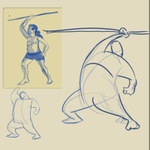
Still practicing gestures via @Weaselgrease 's mentorship,but also added Claude into the mix who also just helped me push the line of action and learn more stylization! @AnthropicAI

2
84


Daddy! I've made you a drawing of a knight!
Aww! that's awesome bobby! Let me go hang this on the fridge!
To: Digital Extremes Concept department:
Subject: "NEW CONCEPT DROP!"
338
Hey, @ComedyCentral ! I've got an idea for you! Take all the hot topic cancelled comediannes and call it the "Cancelled Chicks" Tour! Thank you, I'll let myself out...
289


Your organoids die within 180 days, what if they lived forever?
@finalsparkai @CorticalLabs @CorticalLabsBDM
A proposal for using cancer cells as a permanent, self-sustaining organic computing substrate. Immortal by nature. Redirectable by design.
mega.nz/file/8DIFwLRZ#irptXm…

1
293
Redirected Immortality:
A Proposal for Cancer Cell Substrate in Organic Computing
Submitted by Steven Graziano / NOETHICS
April 23, 2026
Abstract
This proposal outlines a novel conceptual framework for using cancer cells as a stable, self-perpetuating substrate for organic computing. Current organoid intelligence research faces a fundamental limitation: normal human cells deteriorate, require replacement cycles, and cannot sustain long-term computational use. Cancer cells, by contrast, exhibit natural immortality, rapid adaptive response, distributed network signaling, and emergent collective behavior — precisely the properties required for a durable organic computing medium. Drawing on existing research into cellular bioelectricity, concomitant resistance, and bioelectric-directed behavior (as demonstrated in cockroach neural steering experiments), this proposal argues that cancer cells represent an untapped and potentially revolutionary substrate for biological AI systems — one that converts a biological threat into a technological asset.
1. The Problem: Organic Computing Has a Mortality Problem
Organoid intelligence — the use of biological neural tissue for computation — is an emerging and promising field. Systems using lab-grown neuron clusters have demonstrated rudimentary learning behaviors, including training on tasks such as the Pong video game. However, the field faces a critical structural limitation that has not yet been adequately addressed:
Normal human cells have finite lifespans and require regular replacement
Maintaining viable organic tissue in lab conditions is expensive and technically demanding
Cell degradation introduces instability into long-term computational systems
There is no current organic substrate capable of indefinite self-sustaining operation
This mortality problem represents the single largest barrier between current organoid research and a practical, scalable organic computing system. The solution may already exist in nature — in a form previously considered only a threat.
2. The Observation: Cancer Cells Are Already Immortal Computers
Cancer cells possess a suite of properties that, recontextualized outside the human body, map remarkably well onto the requirements of an organic computing substrate:
2.1 Immortality
HeLa cells — derived from Henrietta Lacks' cervical cancer in 1951 — remain alive and actively dividing in laboratories worldwide over 70 years after their origin. No normal human cell line has demonstrated comparable longevity. This is not an anomaly but a feature of cancer cell biology: the deactivation of apoptotic (programmed death) pathways and the maintenance of telomerase activity produce cells that do not age in the conventional sense. In a controlled lab environment with no host to damage, this immortality becomes a pure engineering advantage.
2.2 Distributed Network Signaling
Tumor masses do not behave as collections of isolated cells. They communicate chemically and electrically across the population, coordinate resource allocation, signal growth direction, and share environmental response data. This is fundamentally network behavior — the same distributed processing architecture that underlies neural computation. The cancer cell population functions as a biological network that sends, receives, and acts on information collectively.
2.3 Rapid Adaptive Processing
When cancer cells encounter a hostile stimulus — immune response, chemotherapy, radiation — they do not simply die. The population analyzes the threat, restructures its cellular architecture, and develops resistance. This acquired drug resistance represents retained learning: the population processed a threat, adapted, and stored that adaptation persistently. This is, in functional terms, a biological analog to updating weights in a neural network.
2.4 Territorial Intelligence and Competitive Suppression
A primary tumor releases chemical signals that suppress the development of secondary tumors in the same host — a phenomenon known as concomitant resistance. This is not random behavior. The primary tumor is protecting its resource base, its host, by actively inhibiting competition. This territorial signal processing demonstrates that cancer cell populations engage in strategic environmental management — a form of distributed decision-making that operates at the population level without any central coordinating structure.
3. The Framework: Directional Input into an Existing Biological System
The proposed framework does not attempt to replace cancer cell biology or fight its natural optimization processes. Instead, it proposes to provide structured directional input into an already-running biological computing system — allowing the cell population's own emergent behavior to handle processing, while external signals direct the output toward intended computational goals.
The conceptual model draws directly from existing bioelectric steering research. In demonstrated experiments, cockroaches have been fitted with backpack electrode systems that deliver mild electrical stimuli to antennal nerve clusters, directing locomotion without overriding the insect's own nervous system. The cockroach's biological machinery handles all actual movement; the electrodes simply provide navigational input. The organism does the work. The interface provides direction.
Applied to cancer cell substrate computing, the same principle suggests: rather than engineering computation into cancer cells from scratch, develop bioelectric or chemical interfaces that provide input signals directing the population's existing processing activity toward structured computational tasks. The cancer cells' survival imperative — their drive to process, adapt, respond, and persist — becomes the power source. The interface becomes the keyboard.
3.1 The Alignment Parallel
It is worth noting that the core challenge of this framework — how do you direct a powerful optimization process toward intended goals without suppressing its underlying capability — is structurally identical to the central challenge of artificial intelligence alignment. The cancer cell substrate problem and the AI alignment problem share the same fundamental architecture. Research progress in one domain may have direct implications for the other.
4. Proposed Research Directions
4.1 Substrate Viability Study
Establish baseline computational properties of existing immortal cancer cell lines (beginning with HeLa) in isolated controlled environments. Document network signaling behavior, adaptive response patterns, and population-level decision-making under varied stimuli. Map these behaviors against known organoid intelligence benchmarks.
4.2 Directional Interface Development
Drawing from existing bioelectric steering methodology, develop minimal-intervention input interfaces that can provide structured signals to cancer cell populations without disrupting their underlying adaptive and network behaviors. Evaluate both electrical and chemical signaling pathways as potential input channels.
4.3 Longevity Comparison
Conduct direct comparative studies between cancer cell substrate systems and conventional organoid systems across extended time periods, measuring computational stability, maintenance costs, and degradation rates. Quantify the longevity advantage of immortal cell lines in practical computing contexts.
4.4 Containment and Safety Protocols
Develop robust isolation and containment frameworks ensuring that cancer cell substrate systems remain in fully controlled environments with no possibility of interaction with living hosts. Safety architecture must be treated as a foundational requirement, not a secondary consideration, given the biological properties of the substrate.
5. Conclusion
Cancer represents one of the most formidable optimization processes in known biology. Its properties — immortality, distributed signaling, rapid adaptive learning, territorial resource management — have made it extraordinarily dangerous in the context of a living host. Those same properties, isolated and redirected in a controlled environment, may represent the most viable path toward a stable, self-sustaining organic computing substrate.
The key conceptual shift proposed here is simple: stop treating cancer's properties as problems to be overcome and start treating them as engineering specifications to be utilized. The immortality that kills hosts becomes the perpetual power source. The adaptive learning that defeats treatments becomes the computational flexibility. The distributed network signaling that coordinates tumor growth becomes the processing architecture.
Nature has already built the system. The proposal is simply to give it a different job.
Submitted for consideration to researchers in organoid intelligence and organic computing.
Steven Graziano / NOETHICS — Atwater, California — April 2026
208
Steve The Dragon retweeted

The trailer ACME doesn’t want you to see. Coyote vs. ACME. In theaters August 28.

Ugh! My job is soul crushing!
I wish I didn't have to do this!
The misery never ends
OH NO! AI IS TAKING MY JOB!

2
3
827
I'll make my own 3d model eventually.
DragonScales Cereal youtube.com/shorts/5A9Rv13C6… via @YouTube

1
682


