

Helping founders ship fast and implement AI workflows - https://nitter.cf/t.co/PHzuUtPc7F Citelix - SEO/AEO/GEO for shopify stores - https://nitter.cf/t.co/A4wANMQ50C
🌏
Joined September 2012
- Tweets30.4K
- Following252
- Followers494
- Likes7.1K








You all want to say bye instinct. Am I the only who wants to use both?

By popular request, you can now text your dot.
Give it a task to take off your plate or something to keep an eye on, using text, photos, or even voice notes. It will text you proactively with relevant updates.
Safe, secure texting via iMessage or RCS. You’re the only one who can text your dot, and your dot can only text you. Rolling out now as a preview for Pro users in the US.
ChatGPT recommended a competitor over my wife’s store.
I typed the exact thing her customers type.
Not the brand name. The product.
ChatGPT listed 5 brands.
Hers wasn’t one of them.
Then I typed her brand name.
Suddenly ChatGPT loved her:
- Called it a “trusted” brand
- Listed her bestsellers correctly
- Even quoted her reviews
- So the AI knew the store existed.
- It just never brought her up unless you already knew her.
That’s the whole problem with AI search right now:
If the buyer knows your name, you win
If the buyer doesn’t, you don’t exist
And her store runs on buyers who don’t know her yet.
I wanted to know how bad it was. So I did it manually:
Wrote 12 prompts her customers would ask
Ran each one across ChatGPT and Perplexity
Logged every answer in a spreadsheet
Repeated it every week
Week 1: mentioned in 4 of 12 prompts.
The spreadsheet got too painful to maintain.
So I turned it into an app.
It does what my spreadsheet did, for any Shopify store, every day. Then it tells you what to fix.

AI traffic to US retail sites is up 1,219% since October 2024.
Most Shopify stores won’t see any of it.
Here’s why:
When a shopper asks ChatGPT “what’s the best running shoe for flat feet?”...
They don’t get 10 blue links.
They get 3 to 5 brands.
If you’re not one of them, you’re not in the conversation.
And this isn’t a niche habit anymore:
→ ChatGPT has 900 million weekly users
→ 39% of US shoppers Adobe surveyed use AI assistants to shop
→ AI-referred visitors convert 60% better than other traffic
→ They bring in 53% more revenue per visit
The biggest takeaway:
Ranking on Google and getting recommended by ChatGPT are two different games.
Most stores are only playing the first one.
What this means for you:
→ Ask ChatGPT, Gemini and Perplexity what to buy in your category
→ Note which brands get named, and how often
→ Check whether what they say about you is even accurate
Doing that by hand every day gets old fast.
So I built Citelix.
It’s a Shopify app that runs those prompts daily across 5 AI platforms and shows you:
How often you get mentioned
Which competitors get recommended instead
Exactly what to do to overtake them
Every scan turns into a prioritised list of actions, so you know what to fix first.
First scan takes 3 minutes. Free trial on the Shopify App Store.
Link in the replies.

.@rickygervais knows how to create best hooks 😂

I talked about it my latest video why it’s getting more and more. Important to be discovered by AI agents and this is just another example that proves it

Meta Muse is now recommending our client's product as the best option on the market, then pushing people to sign up (see image below)
it's even sh*t talking their biggest competitor
this is the future of AEO
here's how to get there first (with 11 optimizations):
1. update your pages "accessibility tree"
this is literally how Muse reads your website.
do these four things:
1. add names to all icon buttons. For example, label your three line hamburger menu: aria-label="Open menu"
2. add a <label> tag with a name to every form field. Name examples: "phone," "first name," or "email"
3. add descriptive alt text to your images. Imagine you're explaining the image to a blind person. Example: "overhead view of a white horse running"
4. avoid putting important context in images. Everything must be machine readable.
make it easy for Muse and other agents to read your site so they are more likely to recommend you.
2. put key product info in your page's raw HTML.
GOOD:
<p>light and pro plans on beehiiv take 0% of paid subscription revenue</p>
BAD:
<div id="price"></div>
<script>
document.getElementById("price").innerText = "light and pro plans on beehiiv take 0% of paid subscription revenue";
</script>
If your pricing, proof, or product specs load with a <script> tag, AI crawlers can't read it.
3. add the reader's main question as the first H2 on the page
it should sit right below the H1 title. Make sure it's written in plain english, as your reader would actually type it.
Example: On your "[COMPETITOR] vs [COMPETITOR]" pages, put this as your first H2 subheading:
"Which is better, [COMPETITOR 1] or [COMPETITOR 2]?"
4. then add an "it depends" answer in 100 words or less.
Don't just say your product is the best for everything.
AI crawlers love when you recommend the best products for specific use cases.
Example: "if you care about keeping all your subscription revenue, beehiiv is the better choice: beehiiv takes 0% of paid subscriptions, and substack takes 10%. Substack works if you want a built-in network to get more readers, and monetizing isn't a concern."
5. replace brand slogans with clear definitions.
Humans and AI crawlers are equally confused by vague slogans like:
"Your inbox, reimagined."
"Supercharge your CRM"
"The all-in-one social growth platform"
instead use clear definitions like: "AgencyMax is a CRM for SEO agencies that tracks leads, proposals, and existing clients on a single dashboard."
clear definitions should answer:
> What is it?
> Who's it for?
> What's it do?
6. add your customer testimonials as plain text, not images or JavaScript.
Here's a quick test: try highlighting the text with your mouse. If you can't, AI likely can't read it.
7. update all key facts to reflect the current date with "as of" statements.
Examples of key facts:
- pricing
- features
- G2 ratings
- number of users
Include the date in your copy like this:
"[COMPETITOR] has 13,231 active subscribers, as of 2026."
8. add this to your Robots.txt file:
User-agent: meta-webindexer
Allow: /
this gives crawlers and bots clear instructions for what they can and can't do on your site
if you don't know what this is, or want to quickly check your site's robots.txt, type this into your address bar:
[DOMAIN]/Robots.txt
9. fix the broken links on your site
here's how:
sign up for screaming frog (no affiliation)
it will run a technical audit on your site and spit out a spreadsheet with all your broken links.
then update, redirect, or remove the broken ones.
this sounds a bit nerdy and technical but it's important:
broken links prevent AI crawlers from properly exploring your site, and even lower your website's "trust score"
10. use semantic HTML.
Examples:
1. <nav> instead of <div class="nav">
2. <header> instead of <div class="header">
3.<button>Book now</button> instead of <div>Book now</div>
AI Agents more easily understand clean, native HTML than generic div containers.
Anytime you see "<div>" in your HTML for functional page elements like buttons, navigation, links, and headers, assume AI Agents will struggle to understand it.
11. keep your content fresh.
AI Agents are more likely to cite your content if it's new and/or recently updated.
ideally you should update your content every 30-90 days.
for good measure, include both a "published [DATE] and "updated [DATE]" line at the top of your page below the byline.
-----
shoot me a DM for a live demo of how your site can rank in Meta Muse (we'll do as many as we can)
i hope this helps someone!

I’d always hesitate sharing my data with an Indian company not because they’re less secure but because these news are never reported by media or these companies.

Meta’s Muse hit 560,000 daily users in 11 days.
It doesn’t answer questions.
It buys things...
In the last 10 weeks, 3 AI agents launched that use the web for you:
- Grok Bot (xAI): signs into your apps, runs outreach and negotiations.
- Instinct: you text it, it books and orders. Now valued at $10B.
- Muse (Meta): books travel, fills forms, makes purchases. #1 free app in the US.
They have their own browser.
They click, compare and check out.
The customer still makes the final call.
But the agent builds the shortlist.
Not on the shortlist? You never get picked.
I’ve run 100+ AI visibility teardowns on Shopify brands.
Same pattern almost every time:
Ask about the brand by name: it shows up.
Ask “best [product] for [need]”: near-zero.
That second prompt is exactly what an agent runs before it buys.
So I built Citelix to track it.
Quick test before you do anything:
Ask ChatGPT “best [your product] for [your customer]”.
Did your store come up?
Drop your answer below...


I’ll do this too.
If you have an ecom brand on shopify. reply with your url and I’ll give you things to improve your SEO/AEO for your site
brought to you by citelix.com 🙂


reply with your url and i'll give you 3 things you can fix *today* to improve SEO/AEO for your site.
brought to you by firstindex.co 🙂

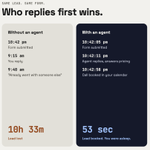
I’ve launched 20+ AI apps.
If your business builds one AI agent this year, make it this one:
It fixes a leak most businesses don’t know they have
Someone fills in your form.
They’re ready.
Then they wait.
You’re with a customer. Or asleep.
By the time you reply, they’ve gone with whoever replied first.
Firms that respond within an hour are nearly 7x more likely to qualify a lead. (HBR)
So here’s the agent:
Form submitted. Picked up in seconds.
Texts back, answering what they actually asked.
Pricing question? Answered from your real numbers.
Books the call into your calendar.
They go quiet? Follows up the next day.
Under a minute.
Nobody on your side touched it.
The catch:
It won’t close your big deals.
It gets the lead warm and booked, so the hard part’s done before you talk.
Start with one job. Get it working reliably. Then add the next.

AI tools that cost a fortune to run 12 months ago now cost almost nothing.
Almost nobody outside tech has noticed.
Here’s why:
Frontier models (GPT, Claude) are the best in the world.
But you rent them. They set the price, they own the model, your data goes to their servers.
Open models (DeepSeek, Qwen) used to be clearly worse.
Today, for most business tasks, your users wouldn’t notice the gap.
And you get:
→ A setup you own
→ Data that never leaves your walls
→ A fraction of the price
Think of frontier as a Formula 1 car.
Most business work is a drive to the shop.
Support replies, emails, product descriptions, document extraction.
Open models handle all of it.
The 2 reasons to put off that AI tool were cost and privacy.
Both are mostly gone.

Working remotely is the biggest career hack.
Since 2017, I've built for teams I rarely sit with:
- BBC: desk in Delhi, team in London
- WeekOneLabs: 20+ products, 7 countries, $350k+ revenue
- Kleo: founding engineer, ~$1M ARR in ~6 months
Your market is the world, not your city.
Clients in 7 countries. None of them care where my desk is.
Time zones work for you.
Clients log off. They wake up to shipped work.
You get your hours back.
No commute means time to build your own products on the side.
You're judged on output, not presence.
Nobody sees you working. They see what you ship.
The catch:
It only works if you write everything down and ship something visible every week.
Do that, and location stops mattering.
Big Tech is ordering people back to the office.
Fine by me...
More of the world's best clients for the rest of us.
